Page 250 of 280

•Theindicator may come on. For more information on the “check
engine” or the “service engine soon” indicator, refer toWarning lights
and chimesin theInstrument Clusterchapter.
ESSENTIALS OF GOOD FUEL ECONOMY
Measuring techniques
Your best source of information about actual fuel economy is you, the
driver. You must gather information as accurately and consistently as
possible. Fuel expense, frequency of fill-ups or fuel gauge readings are
NOT accurate as a measure of fuel economy. We do not recommend
taking fuel economy measurements during the first 1,000 miles (1,600
km) of driving (engine break-in period). You will get a more accurate
measurement after 2,000 miles-3,000 miles (3,000 km–5,000 km).
Filling the tank
The advertised fuel capacity of the fuel tank on your vehicle is equal to
the rated refill capacity of the fuel tank as listed in theRefill capacities
section of this chapter.
The advertised capacity is the amount of the indicated capacity and the
empty reserve combined. Indicated capacity is the difference in the
amount of fuel in a full tank and a tank when the fuel gauge indicates
empty. Empty reserve is the small amount of fuel remaining in the fuel
tank after the fuel gauge indicates empty.
The amount of usable fuel in the empty reserve varies and should
not be relied upon to increase driving range. When refueling your
vehicle after the fuel gauge indicates empty, you might not be
able to refuel the full amount of the advertised capacity of the
fuel tank due to the empty reserve still present in the tank.
For consistent results when filling the fuel tank:
•Turn the engine/ignition switch to the off position prior to refueling,
an error in the reading will result if the engine is left running.
•Use the same filling rate setting (low — medium — high) each time
the tank is filled.
•Allow no more than two automatic click-offs when filling.
•Always use fuel with the recommended octane rating.
•Use a known quality gasoline, preferably a national brand.
•Use the same side of the same pump and have the vehicle facing the
same direction each time you fill up.
2006 Five Hundred(500)
Owners Guide (post-2002-fmt)
USA(fus)
Maintenance and Specifications
250
Page 255 of 280

Readiness for Inspection/Maintenance (I/M) testing
In some localities, it may be a legal requirement to pass an I/M test of
the on-board diagnostics system. If the
indicator is on, refer to the
description in theWarning lights and chimessection of the
Instrument Clusterchapter. Your vehicle may not pass the I/M test with
the
indicator on.
If the vehicle’s powertrain system or its battery has just been serviced,
the on-board diagnostics system is reset to a “not ready for I/M test”
condition. To ready the on-board diagnostics system for I/M testing, a
minimum of 30 minutes of city and highway driving is necessary as
described below:
•First, at least 10 minutes of driving on an expressway or highway.
•Next, at least 20 minutes driving in stop-and-go, city-type traffic with
at least four idle periods.
Allow the vehicle to sit for at least eight hours without starting the
engine. Then, start the engine and complete the above driving cycle. The
engine must warm up to its normal operating temperature. Once started,
do not turn off the engine until the above driving cycle is complete.
POWER STEERING FLUID
Refer to thescheduled maintenance informationfor the service
interval schedules. If adding fluid is necessary, use only MERCON�AT F.
1. Start the engine and let it run
until it reaches normal operating
temperature (the engine coolant
temperature gauge indicator will be
near the center of the normal area
between H and C).
2. While the engine idles, turn the
steering wheel left and right several
times.
3. Turn the engine off.
4. Check the fluid level in the reservoir. It should be between the MIN
and MAX lines. Do not add fluid if the level is in this range.
5. If the fluid is low, add fluid in small amounts, continuously checking
the level until it reaches the range between the MIN and MAX lines. Be
sure to put the cap back on the reservoir.
2006 Five Hundred(500)
Owners Guide (post-2002-fmt)
USA(fus)
Maintenance and Specifications
255
Page 274 of 280
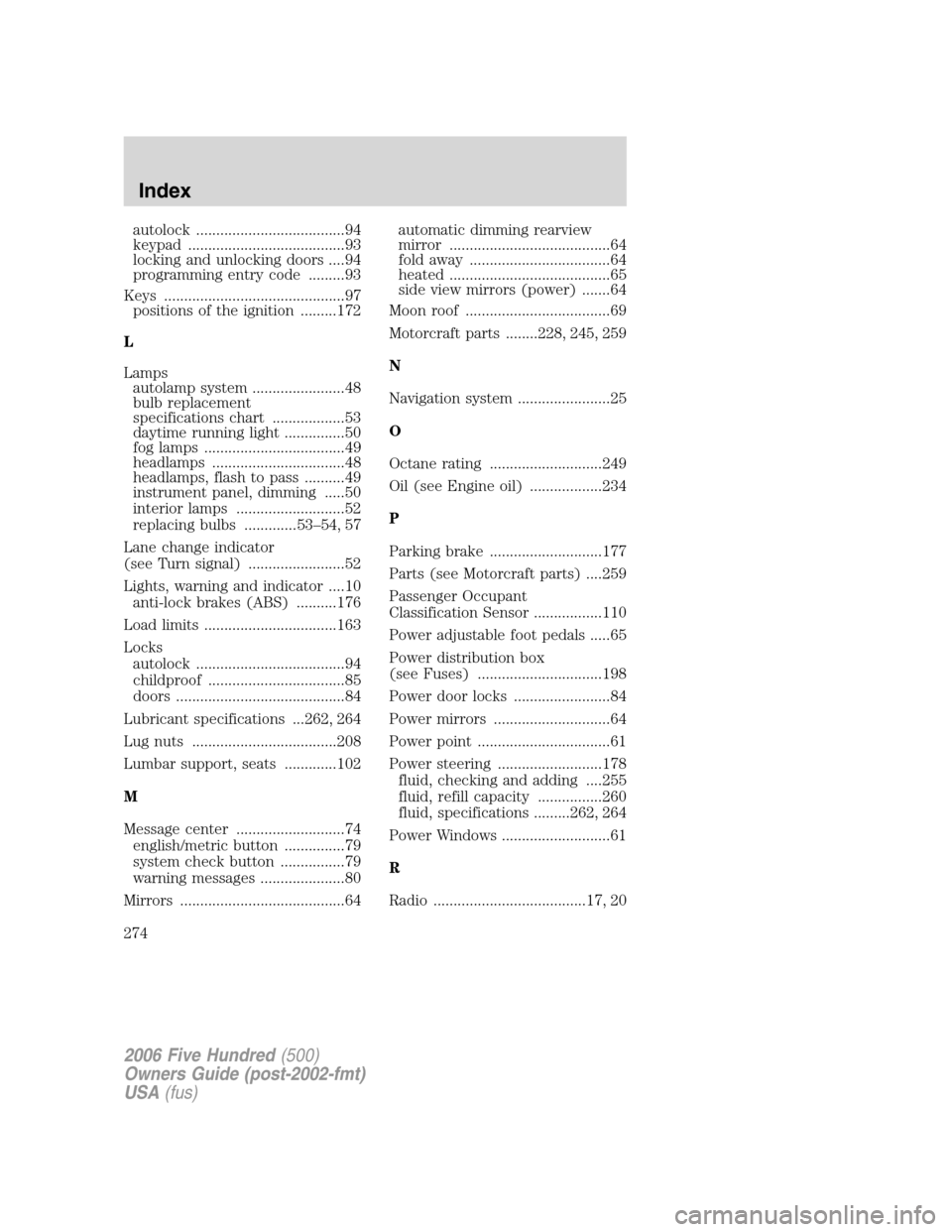
autolock .....................................94
keypad .......................................93
locking and unlocking doors ....94
programming entry code .........93
Keys .............................................97
positions of the ignition .........172
L
Lamps
autolamp system .......................48
bulb replacement
specifications chart ..................53
daytime running light ...............50
fog lamps ...................................49
headlamps .................................48
headlamps, flash to pass ..........49
instrument panel, dimming .....50
interior lamps ...........................52
replacing bulbs .............53–54, 57
Lane change indicator
(see Turn signal) ........................52
Lights, warning and indicator ....10
anti-lock brakes (ABS) ..........176
Load limits .................................163
Locks
autolock .....................................94
childproof ..................................85
doors ..........................................84
Lubricant specifications ...262, 264
Lug nuts ....................................208
Lumbar support, seats .............102
M
Message center ...........................74
english/metric button ...............79
system check button ................79
warning messages .....................80
Mirrors .........................................64automatic dimming rearview
mirror ........................................64
fold away ...................................64
heated ........................................65
side view mirrors (power) .......64
Moon roof ....................................69
Motorcraft parts ........228, 245, 259
N
Navigation system .......................25
O
Octane rating ............................249
Oil (see Engine oil) ..................234
P
Parking brake ............................177
Parts (see Motorcraft parts) ....259
Passenger Occupant
Classification Sensor .................110
Power adjustable foot pedals .....65
Power distribution box
(see Fuses) ...............................198
Power door locks ........................84
Power mirrors .............................64
Power point .................................61
Power steering ..........................178
fluid, checking and adding ....255
fluid, refill capacity ................260
fluid, specifications .........262, 264
Power Windows ...........................61
R
Radio ......................................17, 20
2006 Five Hundred(500)
Owners Guide (post-2002-fmt)
USA(fus)
Index
274
Page 276 of 280

recreational towing .................171
trailer towing ..........................169
wrecker ....................................214
Traction control ........................178
Transaxle
fluid, checking and adding
(automatic) .....................256–257
fluid, refill capacities ..............260
lubricant specifications ..........264
Transmission .............................179
brake-shift interlock (BSI) ....179
lubricant specifications ..........262
Trunk ...........................................85
remote release ....................83, 88
Turn signal ..................................52
V
Vehicle dimensions ...................264Vehicle Identification Number
(VIN) ..........................................266
Vehicle loading ..........................163
Ventilating your vehicle ...........175
W
Warning lights (see Lights) .......10
Washer fluid ..............................233
Water, Driving through .............191
Windows
power .........................................61
Windshield washer fluid and
wipers
checking and adding fluid .....233
operation ...................................58
replacing wiper blades ...........233
Wrecker towing .........................214
2006 Five Hundred(500)
Owners Guide (post-2002-fmt)
USA(fus)
Index
276