2006 FORD FIVE HUNDRED fan
[x] Cancel search: fanPage 138 of 280

must put them in safety seats made especially for children. Many states
require that children use approved booster seats until they are eight
years old. Check your local and state or provincial laws for specific
requirements regarding the safety of children in your vehicle. When
possible, always place children under age 12 in the rear seat of your
vehicle. Accident statistics suggest that children are safer when properly
restrained in the rear seating positions than in the front seating position.
Never let a passenger hold a child on his or her lap while the
vehicle is moving. The passenger cannot protect the child from
injury in a collision.
Always follow the instructions and warnings that come with any infant or
child restraint you might use.
Children and safety belts
If the child is the proper size, restrain the child in a safety seat. Children
who are too large for child safety seats (as specified by your child safety
seat manufacturer) should always wear safety belts.
Follow all the important safety restraint and airbag precautions that
apply to adult passengers in your vehicle.
If the shoulder belt portion of a combination lap and shoulder belt can
be positioned so it does not cross or rest in front of the child’s face or
neck, the child should wear the lap and shoulder belt. Moving the child
closer to the center of the vehicle may help provide a good shoulder belt
fit.
Do not leave children, unreliable adults, or pets unattended in
your vehicle.
Child booster seats
Children outgrow a typical convertible or toddler seat when they weigh
40 lb. (18 kg) and are around 4 years of age. Although the lap/shoulder
belt will provide some protection, these children are still too small for
lap/shoulder belts to fit properly, which could increase the risk of serious
injury in a crash.
To improve the fit of both the lap and shoulder belt on children who
have outgrown child safety seats, Ford Motor Company recommends use
of a belt-positioning booster.
Booster seats position a child so that safety belts fit better. They lift the
child up so that the lap belt rests low across the hips and the knees
2006 Five Hundred(500)
Owners Guide (post-2002-fmt)
USA(fus)
Seating and Safety Restraints
138
Page 141 of 280

Move a child to a different seating location if the shoulder belt
does not stay positioned on the shoulder during use.
Follow all instructions provided by the manufacturer of the
booster seat.
Never put the shoulder belt under a child’s arm or behind the
back because it eliminates the protection for the upper part of
the body and may increase the risk of injury or death in a collision.
Never use pillows, books, or towels to boost a child. They can
slide around and increase the likelihood of injury or death in a
collision.
SAFETY SEATS FOR CHILDREN
Child and infant or child safety seats
Use a safety seat that is recommended for the size and weight of the
child. Carefully follow all of the manufacturer’s instructions with the
safety seat you put in your vehicle. If you do not install and use the
safety seat properly, the child may be injured in a sudden stop or
collision.
When installing a child safety seat:
•Review and follow the information
presented in theAirbag
Supplemental Restraint System
section in this chapter.
•Use the correct safety belt buckle
for that seating position.
•Insert the belt tongue into the
proper buckle until you hear a
snap and feel it latch. Make sure
the tongue is securely fastened in
the buckle.
•Keep the buckle release button pointing up and away from the safety
seat, with the tongue between the child seat and the release button,
to prevent accidental unbuckling.
2006 Five Hundred(500)
Owners Guide (post-2002-fmt)
USA(fus)
Seating and Safety Restraints
141
Page 142 of 280

•Place seat back in upright position.
•Put the safety belt in the automatic locking mode. Refer toAutomatic
locking mode.
•LATCH lower anchors are recommended for use by children up to 48
lb (22 kg) in a child restraint. Top tether anchors can be used for
children up to 60 lb (27 kg) in a child restraint, and to provide upper
torso restraint for children up to 80 lb (36 kg) using an upper torso
harness and a belt-positioning booster.
Ford Motor Company recommends the use of a child safety seat having a
top tether strap. Install the child safety seat in a seating position with
LATCH and tether anchors. For more information on top tether straps
and anchors, refer toAttaching safety seats with tether strapsin this
chapter. For more information of LATCH anchors refer toAttaching
safety seats with LATCH (Lower Anchors and Tethers for Children)
attachmentsin this chapter.
Carefully follow all of the manufacturer’s instructions included
with the safety seat you put in your vehicle. If you do not install
and use the safety seat properly, the child may be injured in a sudden
stop or collision.
Rear-facing child seats or infant carriers should never be placed
in front of an active passenger airbag.
Installing child safety seats with combination lap and shoulder
belts
Airbags can kill or injure a child in a child seat.NEVERplace a
rear-facing child seat in front of an active airbag. If you must use
a forward-facing child seat in the front seat, move the seat all the way
back.
Children 12 and under should be properly restrained in the rear
seat whenever possible.
2006 Five Hundred(500)
Owners Guide (post-2002-fmt)
USA(fus)
Seating and Safety Restraints
142
Page 199 of 280
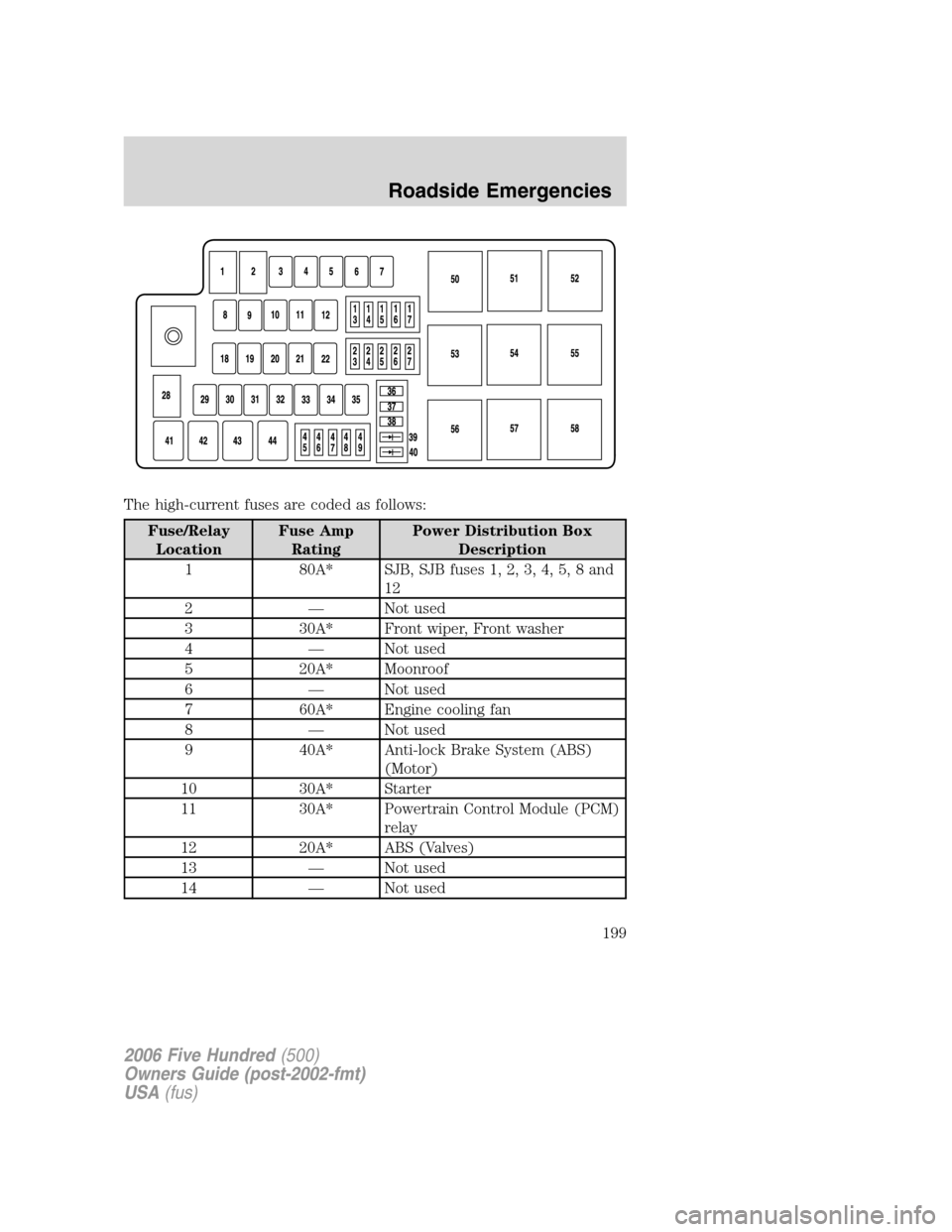
The high-current fuses are coded as follows:
Fuse/Relay
LocationFuse Amp
RatingPower Distribution Box
Description
1 80A* SJB, SJB fuses 1, 2, 3, 4, 5, 8 and
12
2 — Not used
3 30A* Front wiper, Front washer
4 — Not used
5 20A* Moonroof
6 — Not used
7 60A* Engine cooling fan
8 — Not used
9 40A* Anti-lock Brake System (ABS)
(Motor)
10 30A* Starter
11 30A* Powertrain Control Module (PCM)
relay
12 20A* ABS (Valves)
13 — Not used
14 — Not used
2006 Five Hundred(500)
Owners Guide (post-2002-fmt)
USA(fus)
Roadside Emergencies
199
Page 209 of 280

Do not attempt to push-start your vehicle. Automatic
transmissions do not have push-start capability; doing so may
damage the catalytic converter.
Preparing your vehicle
When the battery is disconnected or a new battery is installed, the
transmission must relearn its shift strategy. As a result, the transmission
may have firm and/or soft shifts. This operation is considered normal and
will not affect function or durability of the transmission. Over time, the
adaptive learning process will fully update transmission operation.
1.Use only a 12–volt supply to start your vehicle.
2. Do not disconnect the battery of the disabled vehicle as this could
damage the vehicle’s electrical system.
3. Park the booster vehicle close to the hood of the disabled vehicle
making sure the two vehiclesdo nottouch. Set the parking brake on
both vehicles and stay clear of the engine cooling fan and other moving
parts.
4. Check all battery terminals and remove any excessive corrosion before
you attach the battery cables. Ensure that vent caps are tight and level.
5. Turn the heater fan on in both vehicles to protect any electrical
surges. Turn all other accessories off.
Connecting the jumper cables
1. Connect the positive (+) jumper cable to the positive (+) terminal of
the discharged battery.
Note:In the illustrations,lightning boltsare used to designate the
assisting (boosting) battery.
+–+–
2006 Five Hundred(500)
Owners Guide (post-2002-fmt)
USA(fus)
Roadside Emergencies
209
Page 211 of 280

4. Make the final connection of the negative (-) cable to an exposed
metal part of the stalled vehicle’s engine, away from the battery and the
carburetor/fuel injection system.Do notuse fuel lines, engine rocker
covers or the intake manifold asgroundingpoints.
Do not connect the end of the second cable to the negative (-)
terminal of the battery to be jumped. A spark may cause an
explosion of the gases that surround the battery.
5. Ensure that the cables are clear of fan blades, belts, moving parts of
both engines, or any fuel delivery system parts.
Jump starting
1. Start the engine of the booster vehicle and run the engine at
moderately increased speed.
2. Start the engine of the disabled vehicle.
3. Once the disabled vehicle has been started, run both engines for an
additional three minutes before disconnecting the jumper cables.
+–+–
2006 Five Hundred(500)
Owners Guide (post-2002-fmt)
USA(fus)
Roadside Emergencies
211
Page 273 of 280

specifications ..................262, 264
Exhaust fumes ..........................175
F
Fluid capacities .........................260
Foglamps .....................................49
Four-Wheel Drive vehicles
driving off road .......................185
Fuel ............................................245
calculating fuel
economy ............................75, 250
cap ...........................................247
capacity ...................................260
choosing the right fuel ...........248
comparisons with EPA fuel
economy estimates .................253
detergent in fuel .....................249
filling your vehicle with
fuel ...........................245, 247, 250
filter, specifications ........245, 259
fuel pump shut-off switch .....194
improving fuel economy ........250
octane rating ...................249, 264
quality ......................................249
running out of fuel .................249
safety information relating to
automotive fuels .....................245
Fuel pump shut-off switch .......194
Fuses ..........................................195
G
Gas cap (see Fuel cap) ............247
Gas mileage
(see Fuel economy) .................250
Gauges .........................................14
H
Hazard flashers .........................194Head restraints .................101, 107
Headlamps ...................................48
aiming ........................................50
autolamp system .......................48
bulb specifications ....................53
daytime running lights .............50
flash to pass ..............................49
high beam .................................49
replacing bulbs ...................53–54
turning on and off ....................48
Heating
heating and air conditioning
system ...........................40, 42, 44
Homelink wireless control
system ..........................................70
Hood ..........................................231
I
Ignition ...............................172, 264
Illuminated visor mirror .............59
Infant seats
(see Safety seats) .....................141
Inspection/maintenance (I/M)
testing ........................................255
Instrument panel ........................60
cleaning ...................................226
cluster ........................................10
lighting up panel and
interior .......................................50
J
Jack ............................................201
positioning ...............................201
storage .....................................201
Jump-starting your vehicle ......208
K
Keyless entry system .................93
2006 Five Hundred(500)
Owners Guide (post-2002-fmt)
USA(fus)
Index
273