Page 28 of 272
Headlamps on warning chime:Sounds when the headlamps or parking
lamps are on, the ignition is off (and the key is not in the ignition) and
the driver’s door is opened.
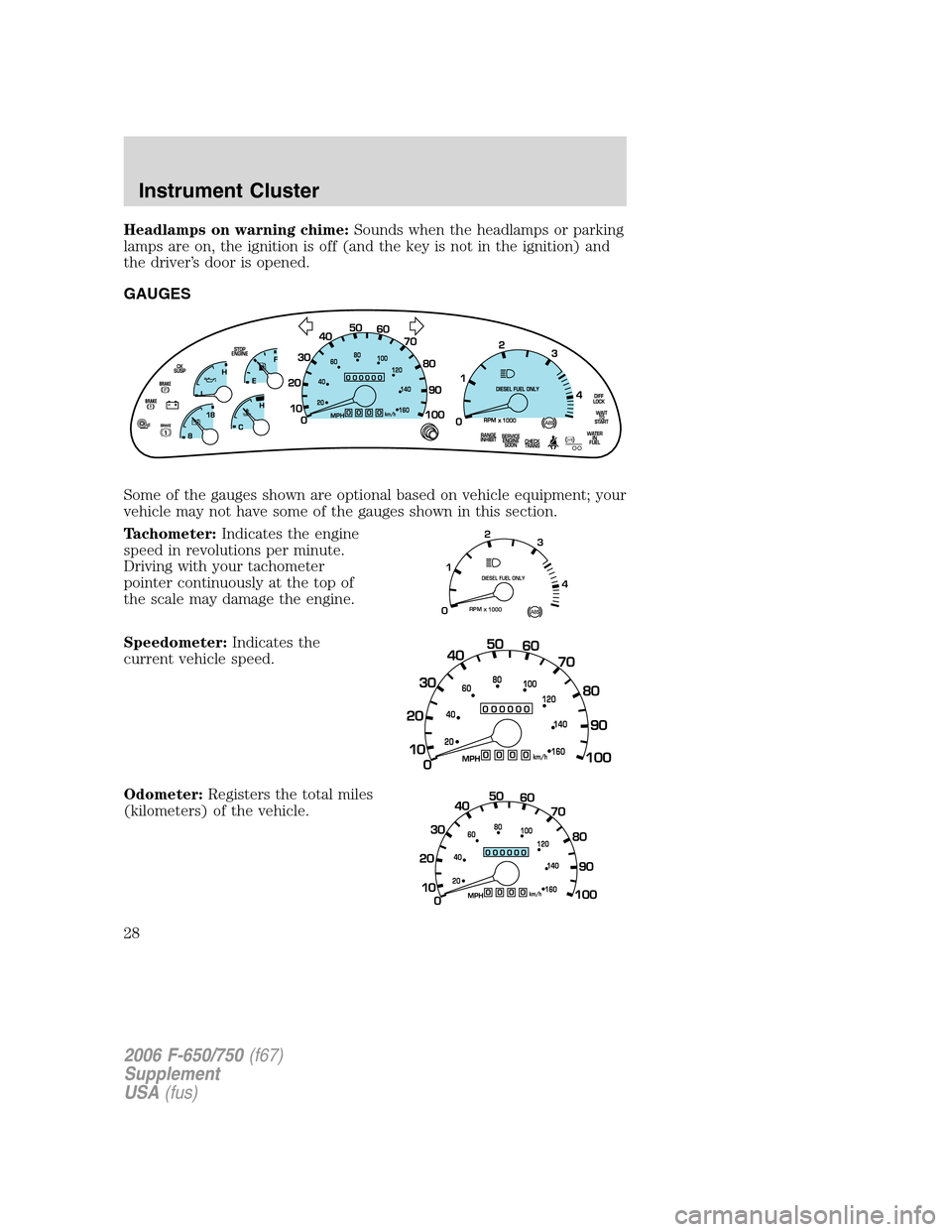
GAUGES
Some of the gauges shown are optional based on vehicle equipment; your
vehicle may not have some of the gauges shown in this section.
Tachometer:Indicates the engine
speed in revolutions per minute.
Driving with your tachometer
pointer continuously at the top of
the scale may damage the engine.
Speedometer:Indicates the
current vehicle speed.
Odometer:Registers the total miles
(kilometers) of the vehicle.
RPM1000
DIESEL FUEL ONLY
X012
3
4
2006 F-650/750(f67)
Supplement
USA(fus)
Instrument Cluster
28
Page 29 of 272
Trip odometer:Registers the miles
(kilometers) of individual journeys.
To reset, depress the control.
Engine coolant temperature
gauge:Indicates engine coolant
temperature. At normal operating
temperature, the needle will be in
the normal range (between “H” and
“C”).If it enters the red section,
the engine is overheating. Stop
the vehicle as soon as safely
possible, switch off the engine
and let the engine cool.
Never remove the coolant reservoir cap while the engine is
running or hot.
Transmission temperature gauge
(if equipped, automatic
transmission only):
Indicates the temperature of the
transmission fluid. The normal
temperature range is 150°–230°F
(65°–110°C). Readings of
230°–250°F (110°–121°C) are
satisfactory for intermittent
operation and are not cause for
alarm. Operation above 250°F
(121°C) can cause the fluid to break down and will result in component
damage.
H
C
2006 F-650/750(f67)
Supplement
USA(fus)
Instrument Cluster
29
Page 30 of 272
Hourmeter (if equipped):
Registers the hours the engine has
been operating.
Battery voltage gauge:Indicates
the battery voltage when the
ignition is in the ON position. If the
pointer moves and stays outside the
normal operating range (as
indicated by arrows), have the
vehicle’s electrical system checked
as soon as possible.
Engine oil pressure gauge:
Indicates engine oil pressure. The
needle should stay in the normal
operating range (as indicated by the
arrows). If the needle falls below
the normal range, stop the vehicle,
turn off the engine and check the
engine oil level. Add oil if needed. If
the oil level is correct, have your
vehicle checked at your dealership
or by a qualified technician.
818
L
H
2006 F-650/750(f67)
Supplement
USA(fus)
Instrument Cluster
30
Page 31 of 272

Fuel gauge:Indicates
approximately how much fuel is left
in the fuel tank (when the ignition
is in the on position). If your vehicle
is equipped with dual fuel tanks, the
engine will draw fuel from the
passenger-side fuel tank only. With
dual fuel tanks, the vehicle will be
equipped with a fuel transfer pump system that will draw fuel from the
driver-side fuel tank and send fuel to the passenger-side fuel tank. The
passenger-side fuel tank must have fuel in it at all times otherwise the
vehicle may stall and may be difficult to re-start. The fuel gauge reads
the fuel level only from the passenger-side fuel tank.
Air filter restriction gauge:
Measures the vacuum inside the air
cleaner. The more the air cleaner is
restricted (dirty, clogged), the
higher the vacuum reading. Change
the air filter when the gauge reads
25 inches. After installation of the
new filter element, reset the gauge
to 0.
Air pressure gauge:All vehicles
equipped with air brakes have a
dual-pointer air gauge to indicate
the pressure in each brake circuit.
The green pointer indicates the air
pressure in the primary system and
the red pointer indicates the air
pressure in the secondary system.
When the pressure is too low for
normal brake operation (less than
60 psi [414 kPa]) and the ignition is
on:
•a warning buzzer will sound and
•a warning light will illuminate in the instrument cluster
0 30120 90 60
150AIR
PRESSURE
PSI
2006 F-650/750(f67)
Supplement
USA(fus)
Instrument Cluster
31
Page 63 of 272
Fold-away mirrors
The mirrors can be manually folded forward or backwards for narrow
spaces like driving through an automatic car wash or backing out of a
garage with the trailer tow mirror.
The telescoping feature (if equipped) allows the mirror to extend
approximately three inches (76 mm). This feature is especially useful to
the driver when towing a trailer.
SPEED CONTROL (IF EQUIPPED)
To turn speed control on
Press CRUISE RPM. If the vehicle is
moving, speed control will be
enabled; if the vehicle is stationary,
engine RPM can be controlled.
Do not use the speed control in heavy traffic or on roads that
are winding, slippery, or unpaved.
Do not shift the gearshift lever into N (Neutral) with the speed
control on.
CRUISE
RPM
OFF
2006 F-650/750(f67)
Supplement
USA(fus)
Driver Controls
63
Page 64 of 272

To turn speed control off
Press OFF or turn off the ignition.
Once speed control is switched off,
the previously programmed engine
RPM will be erased.
Do not use the speed control in heavy traffic or on roads that
are winding, slippery, or unpaved.
To set a speed
Press SET +. If the vehicle is
moving, this will set the vehicle
speed. If the vehicle is stationary,
this will set the vehicle idle RPM.
If you drive up or down a steep hill, your vehicle speed may vary
momentarily slower or faster than the set speed; this is normal.
Speed control cannot reduce the vehicle speed if it increases above the
set speed on a downhill. If your vehicle speed is faster than the set
speed while driving on a downhill, you may want to shift to the next
lower gear or apply the brakes to reduce your vehicle speed.
If the vehicle speed falls below 30 mph (48 km/h) or engine RPM falls
below 1,000 RPM, your speed control will disengage; this is normal.
Pressing RESUME - will re-engage it.
Do not use the speed control in heavy traffic or on roads that
are winding, slippery, or unpaved.
CRUISE
RPM
OFF
2006 F-650/750(f67)
Supplement
USA(fus)
Driver Controls
64
Page 65 of 272
To set a higher set speed
Press and hold SET +. If the vehicle
is moving, this will increase vehicle
speed; if the vehicle is stationary,
this will increase engine RPM.
Release the control when the
desired vehicle speed/engine RPM is
reached.
Press and release SET + to operate
the tap-up function. Each press will increase the set speed by 1 mph
(1.6 km/h) or engine RPM in idle mode.
To set a lower set speed
Press and hold RESUME -. If the
vehicle is moving, this will decrease
vehicle speed; if the vehicle is
stationary, this will decrease engine
RPM. Release the control when the
desired vehicle speed/engine RPM is
reached.
Press and release RESUME - to
operate the tap-down function. Each press will decrease the set speed in
increments of 1 mph (1.6 km/h) or engine RPM in idle mode.
SET RESUME
2006 F-650/750(f67)
Supplement
USA(fus)
Driver Controls
65
Page 66 of 272
To disengage speed control
•Depress the brake pedal or
•Depress the clutch pedal (if
equipped).
Disengaging the speed control will
not erase the previously
programmed set speed or engine
RPM.
Pressing OFF will erase the
previously programmed engine RPM.
To return to a previously set speed
Press RESUME -. For RESUME - to
operate, the vehicle speed must be
above 30 mph (48 km/h) or engine
speed must be above 1,000 RPM.
CRUISE
RPM
OFF
SET RESUME
2006 F-650/750(f67)
Supplement
USA(fus)
Driver Controls
66