2006 FORD EXPEDITION instrument panel
[x] Cancel search: instrument panelPage 274 of 360
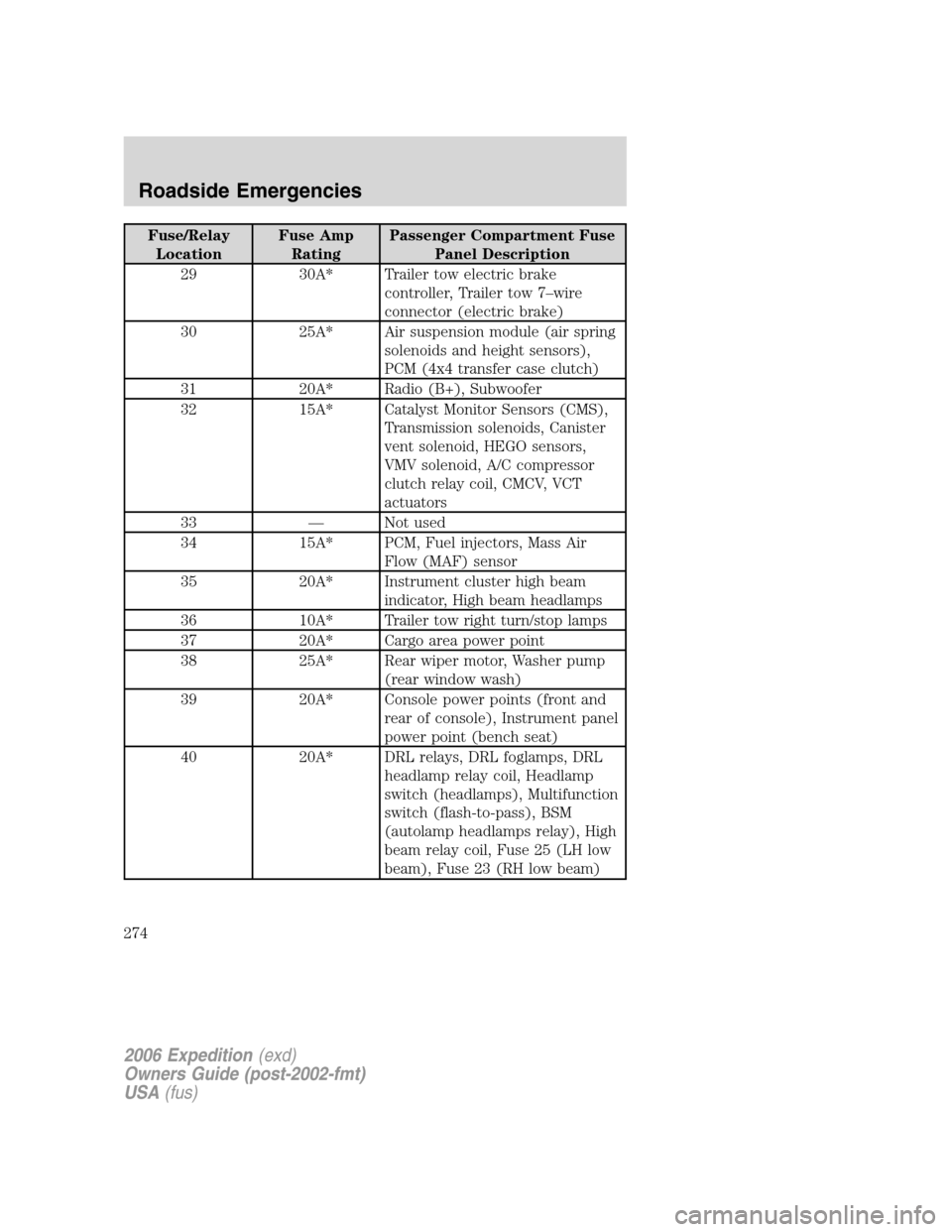
Fuse/Relay
LocationFuse Amp
RatingPassenger Compartment Fuse
Panel Description
29 30A* Trailer tow electric brake
controller, Trailer tow 7–wire
connector (electric brake)
30 25A* Air suspension module (air spring
solenoids and height sensors),
PCM (4x4 transfer case clutch)
31 20A* Radio (B+), Subwoofer
32 15A* Catalyst Monitor Sensors (CMS),
Transmission solenoids, Canister
vent solenoid, HEGO sensors,
VMV solenoid, A/C compressor
clutch relay coil, CMCV, VCT
actuators
33 — Not used
34 15A* PCM, Fuel injectors, Mass Air
Flow (MAF) sensor
35 20A* Instrument cluster high beam
indicator, High beam headlamps
36 10A* Trailer tow right turn/stop lamps
37 20A* Cargo area power point
38 25A* Rear wiper motor, Washer pump
(rear window wash)
39 20A* Console power points (front and
rear of console), Instrument panel
power point (bench seat)
40 20A* DRL relays, DRL foglamps, DRL
headlamp relay coil, Headlamp
switch (headlamps), Multifunction
switch (flash-to-pass), BSM
(autolamp headlamps relay), High
beam relay coil, Fuse 25 (LH low
beam), Fuse 23 (RH low beam)
2006 Expedition(exd)
Owners Guide (post-2002-fmt)
USA(fus)
Roadside Emergencies
274
Page 277 of 360
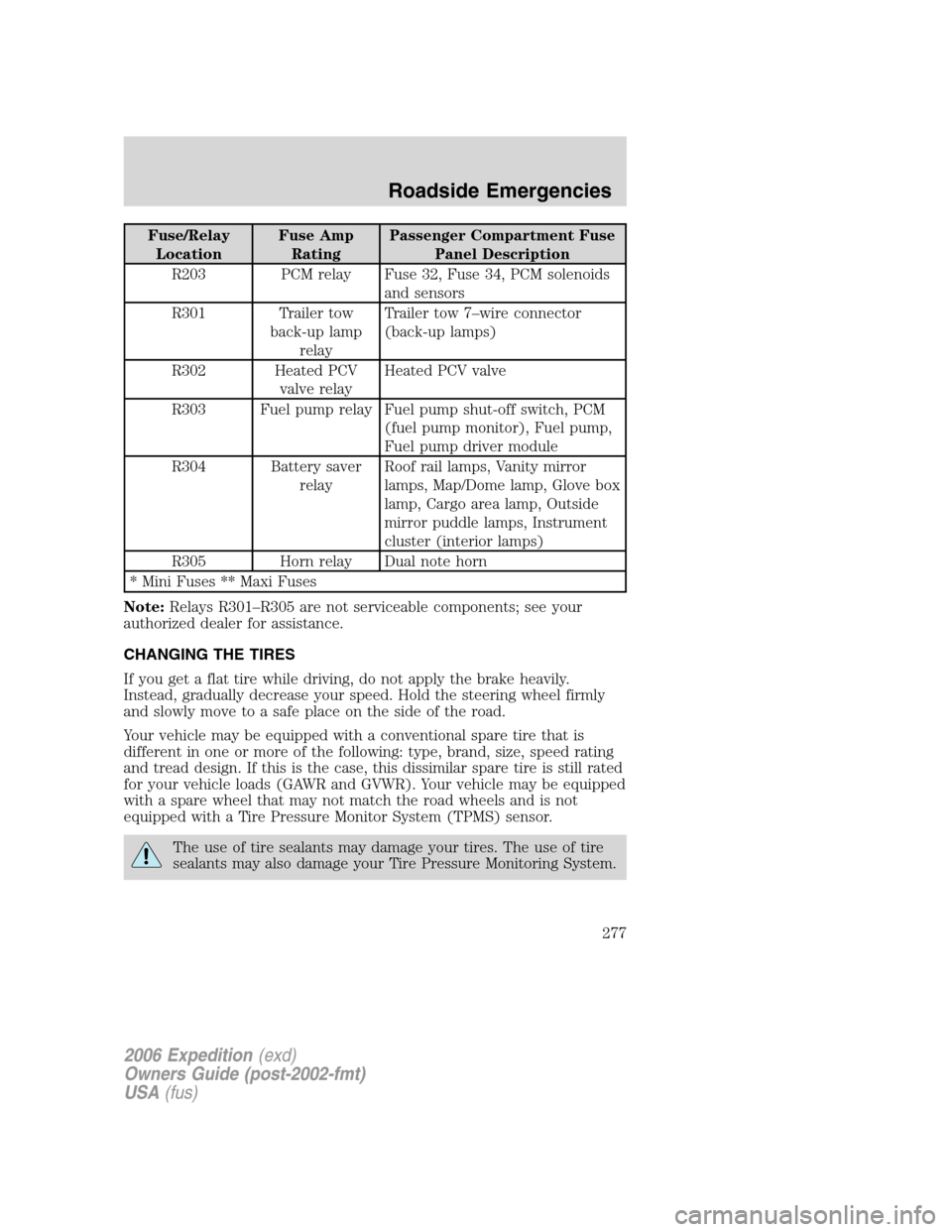
Fuse/Relay
LocationFuse Amp
RatingPassenger Compartment Fuse
Panel Description
R203 PCM relay Fuse 32, Fuse 34, PCM solenoids
and sensors
R301 Trailer tow
back-up lamp
relayTrailer tow 7–wire connector
(back-up lamps)
R302 Heated PCV
valve relayHeated PCV valve
R303 Fuel pump relay Fuel pump shut-off switch, PCM
(fuel pump monitor), Fuel pump,
Fuel pump driver module
R304 Battery saver
relayRoof rail lamps, Vanity mirror
lamps, Map/Dome lamp, Glove box
lamp, Cargo area lamp, Outside
mirror puddle lamps, Instrument
cluster (interior lamps)
R305 Horn relay Dual note horn
* Mini Fuses ** Maxi Fuses
Note:Relays R301–R305 are not serviceable components; see your
authorized dealer for assistance.
CHANGING THE TIRES
If you get a flat tire while driving, do not apply the brake heavily.
Instead, gradually decrease your speed. Hold the steering wheel firmly
and slowly move to a safe place on the side of the road.
Your vehicle may be equipped with a conventional spare tire that is
different in one or more of the following: type, brand, size, speed rating
and tread design. If this is the case, this dissimilar spare tire is still rated
for your vehicle loads (GAWR and GVWR). Your vehicle may be equipped
with a spare wheel that may not match the road wheels and is not
equipped with a Tire Pressure Monitor System (TPMS) sensor.
The use of tire sealants may damage your tires. The use of tire
sealants may also damage your Tire Pressure Monitoring System.
2006 Expedition(exd)
Owners Guide (post-2002-fmt)
USA(fus)
Roadside Emergencies
277
Page 304 of 360
helps to remove the hot wax deposited on the wiper blade and
windshield from automated car wash facilities.
•Do not use abrasives, as they may cause scratches.
•Do not use fuel, kerosene, or paint thinner to clean any parts.
•Wiper blades can be cleaned with isopropyl (rubbing) alcohol or
windshield washer solution. Be sure to replace wiper blades when they
appear worn or do not function properly.
Do not use sharp objects, such as a razor blade, to clean the
inside of the rear window or to remove decals, as it may cause
damage to the rear window defroster’s heated grid lines.
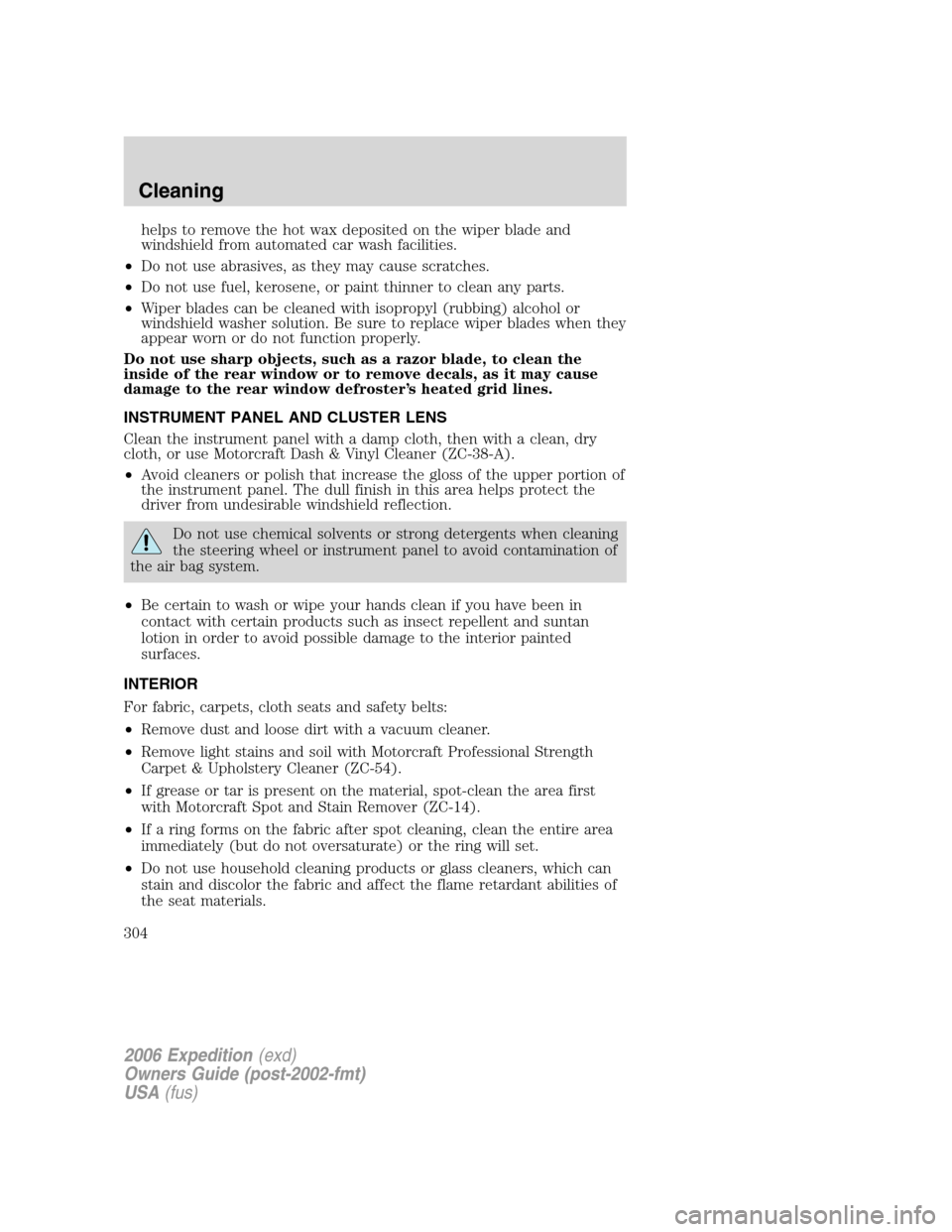
INSTRUMENT PANEL AND CLUSTER LENS
Clean the instrument panel with a damp cloth, then with a clean, dry
cloth, or use Motorcraft Dash & Vinyl Cleaner (ZC-38-A).
•Avoid cleaners or polish that increase the gloss of the upper portion of
the instrument panel. The dull finish in this area helps protect the
driver from undesirable windshield reflection.
Do not use chemical solvents or strong detergents when cleaning
the steering wheel or instrument panel to avoid contamination of
the air bag system.
•Be certain to wash or wipe your hands clean if you have been in
contact with certain products such as insect repellent and suntan
lotion in order to avoid possible damage to the interior painted
surfaces.
INTERIOR
For fabric, carpets, cloth seats and safety belts:
•Remove dust and loose dirt with a vacuum cleaner.
•Remove light stains and soil with Motorcraft Professional Strength
Carpet & Upholstery Cleaner (ZC-54).
•If grease or tar is present on the material, spot-clean the area first
with Motorcraft Spot and Stain Remover (ZC-14).
•If a ring forms on the fabric after spot cleaning, clean the entire area
immediately (but do not oversaturate) or the ring will set.
•Do not use household cleaning products or glass cleaners, which can
stain and discolor the fabric and affect the flame retardant abilities of
the seat materials.
2006 Expedition(exd)
Owners Guide (post-2002-fmt)
USA(fus)
Cleaning
304
Page 309 of 360
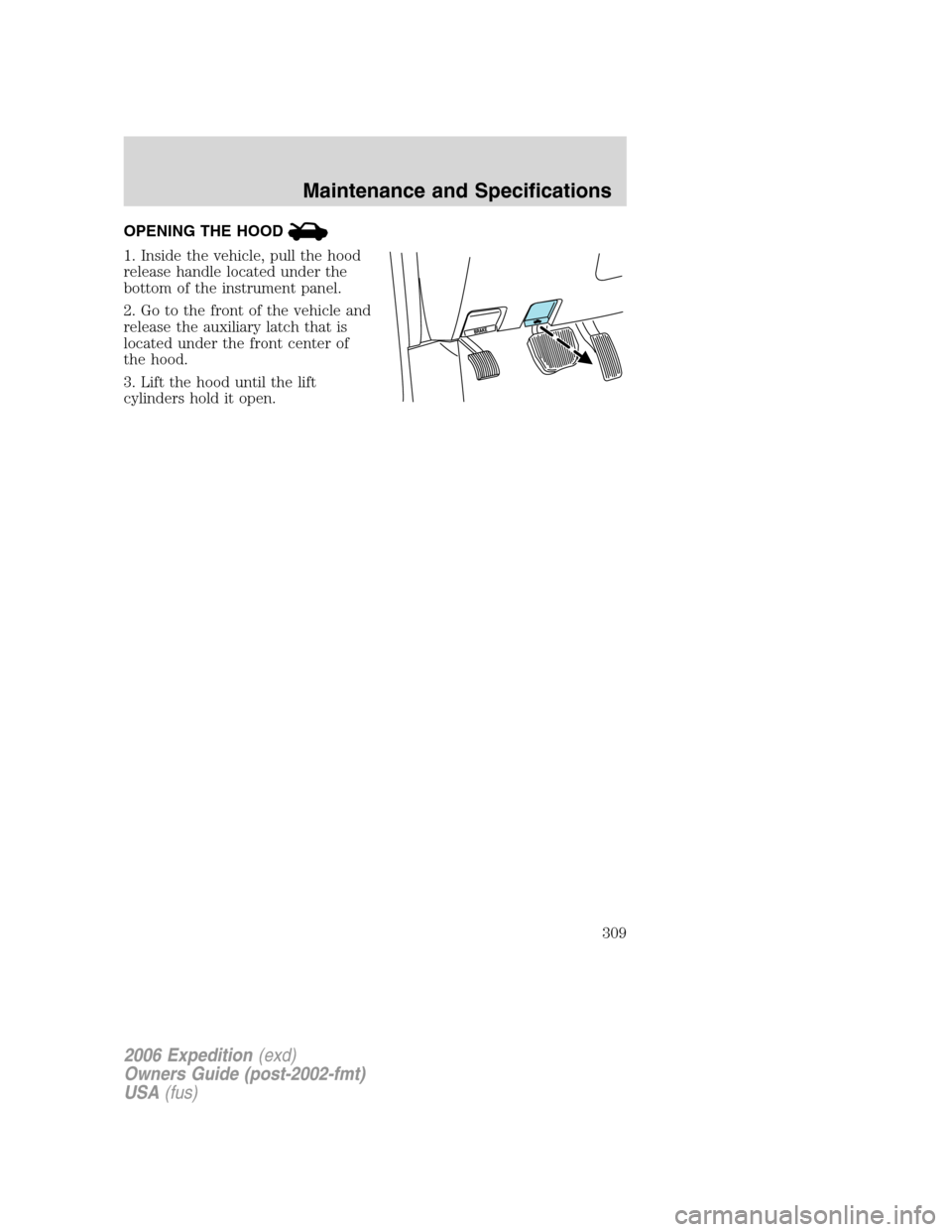
OPENING THE HOOD
1. Inside the vehicle, pull the hood
release handle located under the
bottom of the instrument panel.
2. Go to the front of the vehicle and
release the auxiliary latch that is
located under the front center of
the hood.
3. Lift the hood until the lift
cylinders hold it open.
2006 Expedition(exd)
Owners Guide (post-2002-fmt)
USA(fus)
Maintenance and Specifications
309
Page 323 of 360

•NEVER decrease the coolant concentration below 40%.
•Decreased engine coolant concentrations below 40% will
decrease the corrosion protection characteristics of the engine
coolant and may cause engine damage.
•Decreased engine coolant concentrations below 40% will
decrease the freeze protection characteristics of the engine
coolant and may cause engine damage.
•Refer to the chart on the coolant container to ensure the
coolant concentration in your vehicle will provide adequate
protection at the temperatures in which you drive.
Vehicles driven year-round in non-extreme climates should use a 50/50
mixture of engine coolant and distilled water for optimum cooling system
and engine protection.
What you should know about fail-safe cooling
If the engine coolant supply is depleted, this feature allows the vehicle to
be driven temporarily before incremental component damage is incurred.
The “fail-safe” distance depends on ambient temperatures, vehicle load
and terrain.
How fail-safe cooling works
If the engine begins to overheat:
•The engine coolant temperature
gauge will move to the red (hot)
area.
•CHECK ENGINE TEMPERATURE
will illuminate in the message
center (if equipped).
•The
indicator light will illuminate.
•CHECK GAGE will appear on the instrument panel cluster.
If the engine reaches a preset over-temperature condition, the engine
will automatically switch to alternating cylinder operation. Each disabled
cylinder acts as an air pump and cools the engine.
When this occurs the vehicle will still operate. However:
•The engine power will be limited.
•The air conditioning system will be disabled.
•Warning messages will appear in the message center (if equipped).
CH
2006 Expedition(exd)
Owners Guide (post-2002-fmt)
USA(fus)
Maintenance and Specifications
323
Page 348 of 360
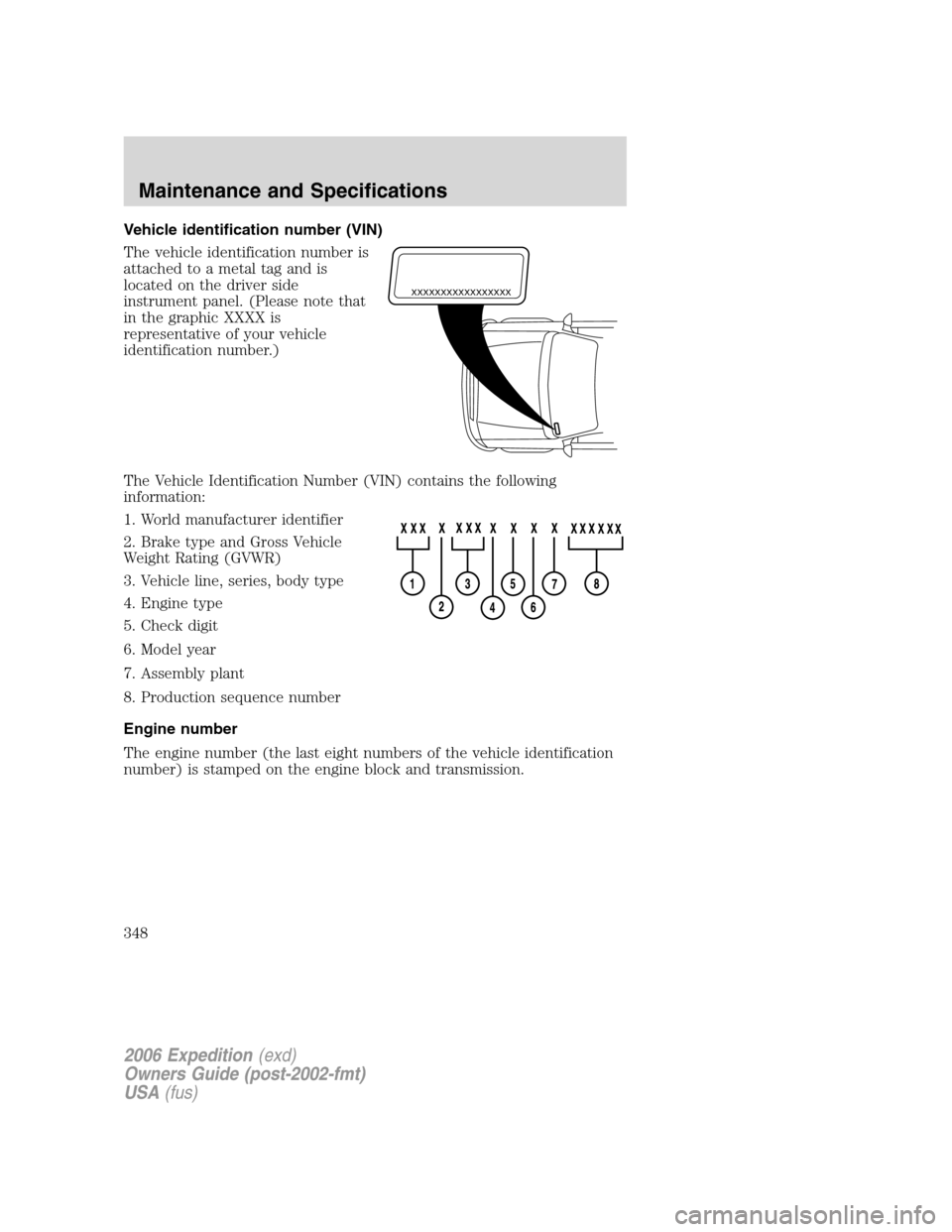
Vehicle identification number (VIN)
The vehicle identification number is
attached to a metal tag and is
located on the driver side
instrument panel. (Please note that
in the graphic XXXX is
representative of your vehicle
identification number.)
The Vehicle Identification Number (VIN) contains the following
information:
1. World manufacturer identifier
2. Brake type and Gross Vehicle
Weight Rating (GVWR)
3. Vehicle line, series, body type
4. Engine type
5. Check digit
6. Model year
7. Assembly plant
8. Production sequence number
Engine number
The engine number (the last eight numbers of the vehicle identification
number) is stamped on the engine block and transmission.
XXXXXXXXXXXXXXXXX
2006 Expedition(exd)
Owners Guide (post-2002-fmt)
USA(fus)
Maintenance and Specifications
348
Page 353 of 360
A
ABS (see Brakes) .....................239
Accessory delay ........................111
Air cleaner filter ...............338–339
Air conditioning ..........................87
auxiliary heater and air
conditioner ................................91
Air suspension ...........................245
description ..............................245
Airbag supplemental
restraint system ................180, 184
and child safety seats ............182
description ......................180, 184
disposal ....................................187
driver airbag ....................182, 185
indicator light .................184, 187
operation .........................182, 185
passenger airbag .............182, 185
Antifreeze
(see Engine coolant) ................318
Anti-lock brake system
(see Brakes) ......................239–240
Armrests ....................................153
Audio system (see Radio) ...19, 24
Automatic transmission
driving an automatic
overdrive .................................249
fluid, adding ............................336
fluid, checking ........................336
fluid, refill capacities ..............340
fluid, specification ..................345
Auxiliary power point ...............108
Axle
lubricant
specifications ..................343, 345
refill capacities ........................340B
Battery .......................................316
acid, treating emergencies .....316
jumping a disabled battery ....285
maintenance-free ....................316
replacement, specifications ...339
servicing ..................................316
BeltMinder .................................176
Brakes ........................................238
anti-lock ...........................239–240
anti-lock brake system
(ABS) warning light ...............240
fluid, checking and adding ....335
fluid, refill capacities ..............340
fluid, specifications .........343, 345
lubricant specifications ..343, 345
parking ....................................240
shift interlock ..........................248
Bulbs ............................................98
C
Capacities for refilling fluids ....340
CD-single premium .....................19
Cell phone use ..............................9
Changing a tire .........................277
Child safety restraints ..............188
child safety belts ....................188
Child safety seats ......................191
in front seat ............................192
in rear seat ......................192, 194
Cleaning your vehicle
engine compartment ..............302
instrument panel ....................304
interior .............................304–305
plastic parts ............................303
safety belts ..............................304
washing ....................................301
2006 Expedition(exd)
Owners Guide (post-2002-fmt)
USA(fus)
Index
353
Page 355 of 360
recommendations ...................315
refill capacities ........................340
specifications ..................343, 345
Exhaust fumes ..........................237
F
Fail safe cooling ........................323
Floor mats .................................136
Fluid capacities .........................340
Foglamps .....................................94
Four-Wheel Drive vehicles .......253
control trac .............................254
description ..............................254
driving off road .......................257
indicator light .........................254
preparing to drive your
vehicle .....................................247
Fuel ............................................325
calculating fuel
economy ..........................128, 329
cap ...........................................327
capacity ...................................340
choosing the right fuel ...........328
comparisons with EPA fuel
economy estimates .................332
detergent in fuel .....................329
filling your vehicle
with fuel ..................325, 327, 329
filter, specifications ........324, 339
fuel pump shut-off switch .....266
improving fuel economy ........329
octane rating ...........328, 345–346
quality ......................................328
running out of fuel .................329
safety information relating
to automotive fuels ................325
Fuses ..................................268–269G
Garage Door Opener
(see Homelink wireless
control system) .........................119
Gas cap (see Fuel cap) ............327
Gas mileage
(see Fuel economy) .................329
Gauges .........................................16
H
Hazard flashers .........................266
Headlamps ...................................93
aiming ........................................95
autolamp system .......................93
bulb specifications ....................98
daytime running lights .............94
flash to pass ..............................94
high beam .................................93
replacing bulbs .........................99
turning on and off ....................93
Heating
heating and air
conditioning system ...........83, 87
Homelink wireless control
system ........................................119
Hood ..........................................309
I
Ignition .......................235, 345–346
Infant seats
(see Safety seats) .....................191
Inspection/maintenance
(I/M) testing ..............................334
Instrument panel
cleaning ...................................304
cluster ........................................12
2006 Expedition(exd)
Owners Guide (post-2002-fmt)
USA(fus)
Index
355