Page 191 of 288

Driving on hilly or sloping terrain
Although natural obstacles may make it necessary to travel diagonally up
or down a hill or steep incline, you should always try to drive straight up
or straight down.Avoid driving crosswise or turning on steep
slopes or hills.A danger lies in losing traction, slipping sideways and
possibly rolling over. Whenever driving on a hill, determine beforehand
the route you will use. Do not drive over the crest of a hill without
seeing what conditions are on the other side. Do not drive in reverse
over a hill without the aid of an observer.
When climbing a steep slope or hill,
start in a lower gear rather than
downshifting to a lower gear from a
higher gear once the ascent has
started. This reduces strain on the
engine and the possibility of stalling.
If you do stall out, Do not try to
turnaround because you might roll
over. It is better to back down to a
safe location.
Apply just enough power to the wheels to climb the hill. Too much
power will cause the tires to slip, spin or lose traction, resulting in loss of
vehicle control.
Descend a hill in the same gear you
would use to climb up the hill to
avoid excessive brake application
and brake overheating. Do not
descend in neutral; instead,
disengage overdrive or manually
shift to a lower gear. When
descending a steep hill, avoid
sudden hard braking as you could
lose control. When you brake hard,
the front wheels can’t turn and if
they aren’t turning, you won’t be
able to steer. The front wheels have to be turning in order to steer the
vehicle. Rapid pumping of the brake pedal will help you slow the vehicle
and still maintain steering control.
If your vehicle has anti-lock brakes, apply the brakes steadily. Do not
“pump” the brakes.
2006 Escape(204)
Owners Guide (post-2002-fmt)
USA(fus)
Driving
191
Page 192 of 288

Driving on snow and ice
4WD vehicles have advantages over 2WD vehicles in snow and ice but
can skid like any other vehicle.
Should you start to slide while driving on snowy or icy roads, turn the
steering wheel in the direction of the slide until you regain control.
Avoid sudden applications of power and quick changes of direction on
snow and ice. Apply the accelerator slowly and steadily when starting
from a full stop.
Avoid sudden braking as well. Although a 4WD vehicle may accelerate
better than a two-wheel drive vehicle in snow and ice, it won’t stop any
faster, because as in other vehicles, braking occurs at all four wheels. Do
not become overconfident as to road conditions.
Make sure you allow sufficient distance between you and other vehicles
for stopping. Drive slower than usual and consider using one of the lower
gears. In emergency stopping situations, avoid locking of the wheels. Use
a “squeeze” technique, push on the brake pedal with a steadily increasing
force which allows the wheels to brake yet continue to roll so that you
may steer in the direction you want to travel. If you lock the wheels,
release the brake pedal and repeat the squeeze technique. Since your
vehicle is equipped with a Four Wheel Anti-Lock Brake System (ABS),
apply the brake steadily. Do not “pump” the brakes. Refer to theBrakes
section of this chapter for additional information on the operation of the
anti-lock brake system.
4WD vehicles should be driven with traction devices as referred to in
Using snow tires and traction devicesin theTires, Wheels and
Loadingchapter.
Maintenance and Modifications
The suspension and steering systems on your vehicle have been designed
and tested to provide predictable performance whether loaded or empty
and durable load carrying capability. For this reason, Ford Motor
Company strongly recommends that you do not make modifications such
as adding or removing parts (such as lift kits or stabilizer bars) or by
using replacement parts not equivalent to the original factory equipment.
Any modifications to a vehicle that raise the center of gravity can make
it more likely the vehicle will roll over as a result of a loss of control.
Ford Motor Company recommends that caution be used with any vehicle
equipped with a high load or device (such as ladder racks or pickup box
cover).
2006 Escape(204)
Owners Guide (post-2002-fmt)
USA(fus)
Driving
192
Page 203 of 288
Fuse/Relay
LocationFuse Amp
RatingPower Distribution Box
Description
18 40A** Blower motor
19 40A** Accessory delay relay - Subwoofer
and 4WD, Low beam
20 60A** ABS
21 40A** Horn, CHMSL, Cluster, Power
locks and power seats
22 40A** (I4) Cooling fan
50A** (V6)
23 40A** Rear defroster, Park lamps relay
24 40A** (I4) High/Low speed fan
50A** (V6)
25 — Shunt
R2 — PCM relay
R3 — Fuel pump relay
R4 — Cooling fan relay
R5 — High/Low speed fan relay 1
R6 — Blower motor relay
R7 — Starter relay
R8 — High/Low speed fan relay 2
R9 — Fog lamps relay
R10 — A/C relay
D1 — Not used
D2 — A/C diode
* Mini fuse ** Cartridge fuse
CHANGING A FLAT TIRE
If you get a flat tire while driving:
•do not brake heavily.
•gradually decrease the vehicle’s speed.
•hold the steering wheel firmly.
•slowly move to a safe place on the side of the road.
The use of tire sealants may damage your tires.
2006 Escape(204)
Owners Guide (post-2002-fmt)
USA(fus)
Roadside Emergencies
203
Page 239 of 288
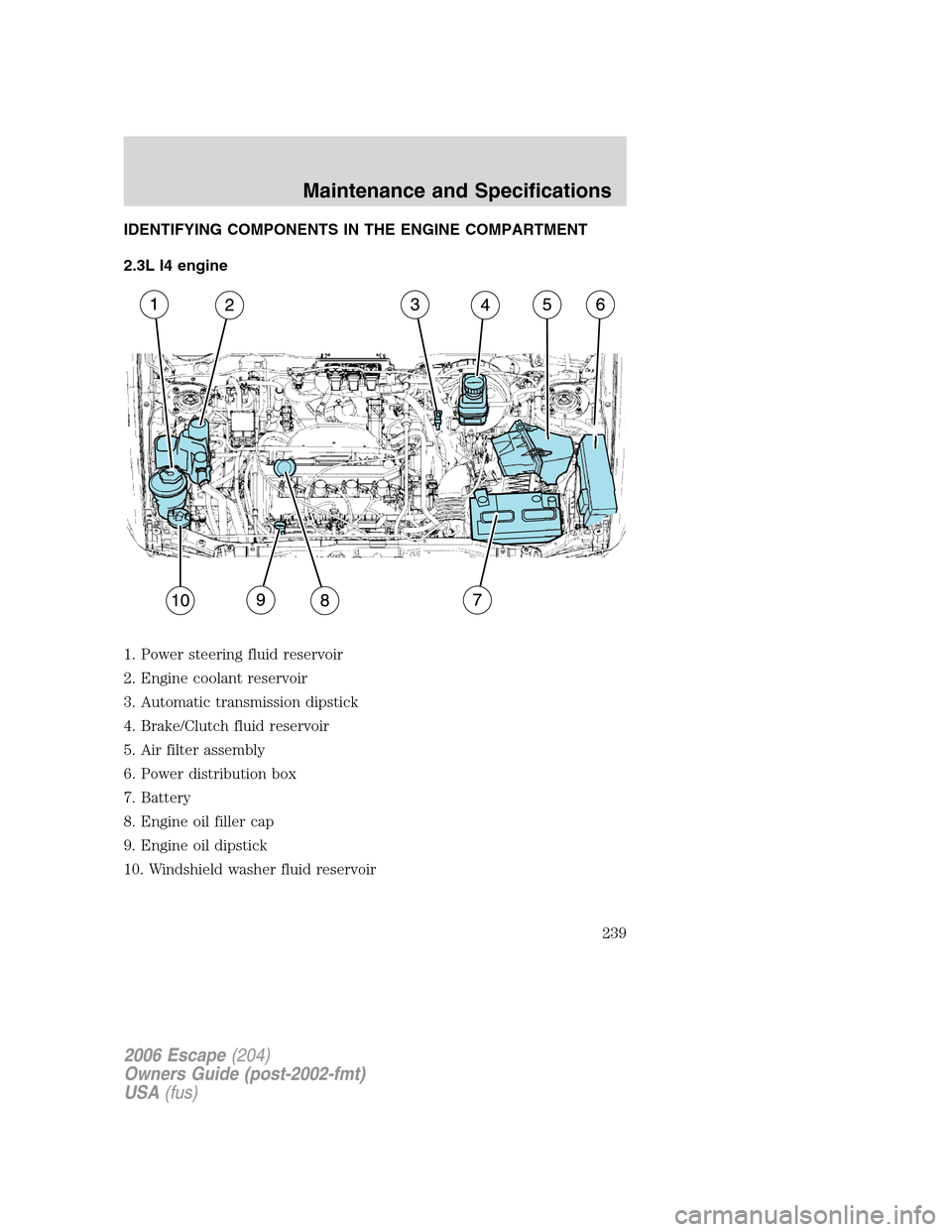
IDENTIFYING COMPONENTS IN THE ENGINE COMPARTMENT
2.3L I4 engine
1. Power steering fluid reservoir
2. Engine coolant reservoir
3. Automatic transmission dipstick
4. Brake/Clutch fluid reservoir
5. Air filter assembly
6. Power distribution box
7. Battery
8. Engine oil filler cap
9. Engine oil dipstick
10. Windshield washer fluid reservoir
2006 Escape(204)
Owners Guide (post-2002-fmt)
USA(fus)
Maintenance and Specifications
239
Page 240 of 288
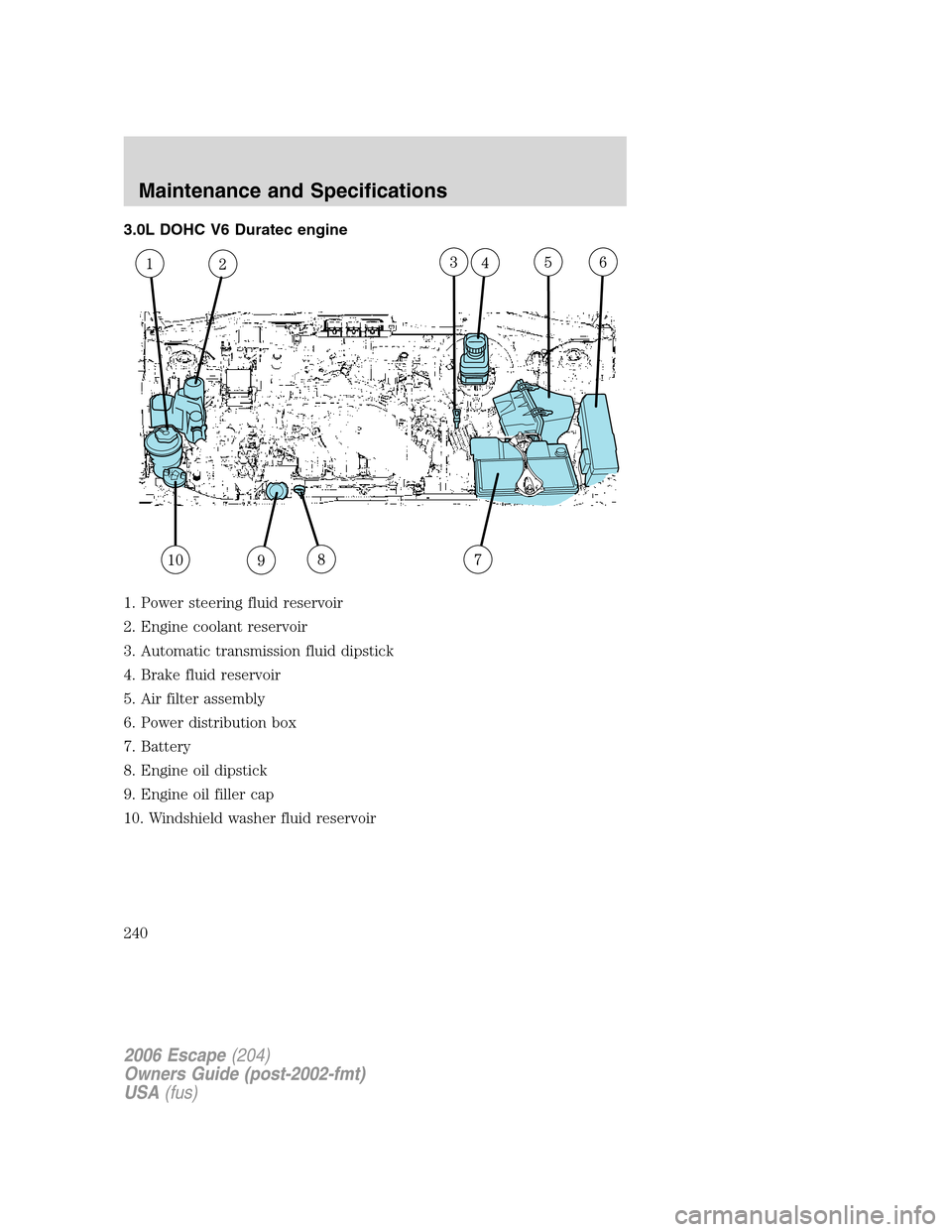
3.0L DOHC V6 Duratec engine
1. Power steering fluid reservoir
2. Engine coolant reservoir
3. Automatic transmission fluid dipstick
4. Brake fluid reservoir
5. Air filter assembly
6. Power distribution box
7. Battery
8. Engine oil dipstick
9. Engine oil filler cap
10. Windshield washer fluid reservoir
2006 Escape(204)
Owners Guide (post-2002-fmt)
USA(fus)
Maintenance and Specifications
240
Page 253 of 288

How fail-safe cooling works
If the engine begins to overheat:
•The engine coolant temperature
gauge will move to the red (hot)
area.
•The
indicator light will
illuminate.
If the engine reaches a preset
over-temperature condition, the engine will automatically switch to
alternating cylinder operation. Each disabled cylinder acts as an air
pump and cools the engine.
When this occurs the vehicle will still operate. However:
•The engine power will be limited.
•The air conditioning system will be disabled.
Continued operation will increase the engine temperature and the engine
will completely shut down, causing steering and braking effort to
increase.
Once the engine temperature cools, the engine can be re-started. Take
your vehicle to a service facility as soon as possible to minimize engine
damage.
When fail-safe mode is activated
You have limited engine power when in the fail-safe mode, so drive the
vehicle with caution. The vehicle will not be able to maintain high-speed
operation and the engine will run rough. Remember that the engine is
capable of completely shutting down automatically to prevent engine
damage, therefore:
1. Pull off the road as soon as safely possible and turn off the engine.
2. Arrange for the vehicle to be taken to a service facility.
3. If this is not possible, wait a short period for the engine to cool.
4. Check the coolant level and replenish if low.
Never remove the coolant reservoir cap while the engine is
running or hot.
5. Re-start the engine and take your vehicle to a service facility.
Driving the vehicle without repairing the engine problem
increases the chance of engine damage. Take your vehicle to a
service facility as soon as possible.
2006 Escape(204)
Owners Guide (post-2002-fmt)
USA(fus)
Maintenance and Specifications
253
Page 264 of 288

•Next, at least 20 minutes driving in stop-and-go, city-type traffic with
at least four idle periods.
Allow the vehicle to sit for at least eight hours without starting the
engine. Then, start the engine and complete the above driving cycle. The
engine must warm up to its normal operating temperature. Once started,
do not turn off the engine until the above driving cycle is complete.
POWER STEERING FLUID
Check the power steering fluid.
Refer to thescheduled
maintenance informationfor the
service interval schedules.If adding
fluid is necessary, use only
MERCON�AT F.
1. Start the engine and let it run until it reaches normal operating
temperature (the engine coolant temperature gauge indicator will be
near the center of the normal area between H and C).
2. While the engine idles, turn the steering wheel left and right several
times.
3. Turn the engine off.
4. Check the fluid level in the
reservoir. It should be between the
MIN and MAX lines. Do not add
fluid if the level is in this range.
5. If the fluid is low, add fluid in small amounts, continuously checking
the level until it reaches the range between the MIN and MAX lines. Be
sure to put the cap back on the reservoir.
MAXMIN
2006 Escape(204)
Owners Guide (post-2002-fmt)
USA(fus)
Maintenance and Specifications
264
Page 270 of 288
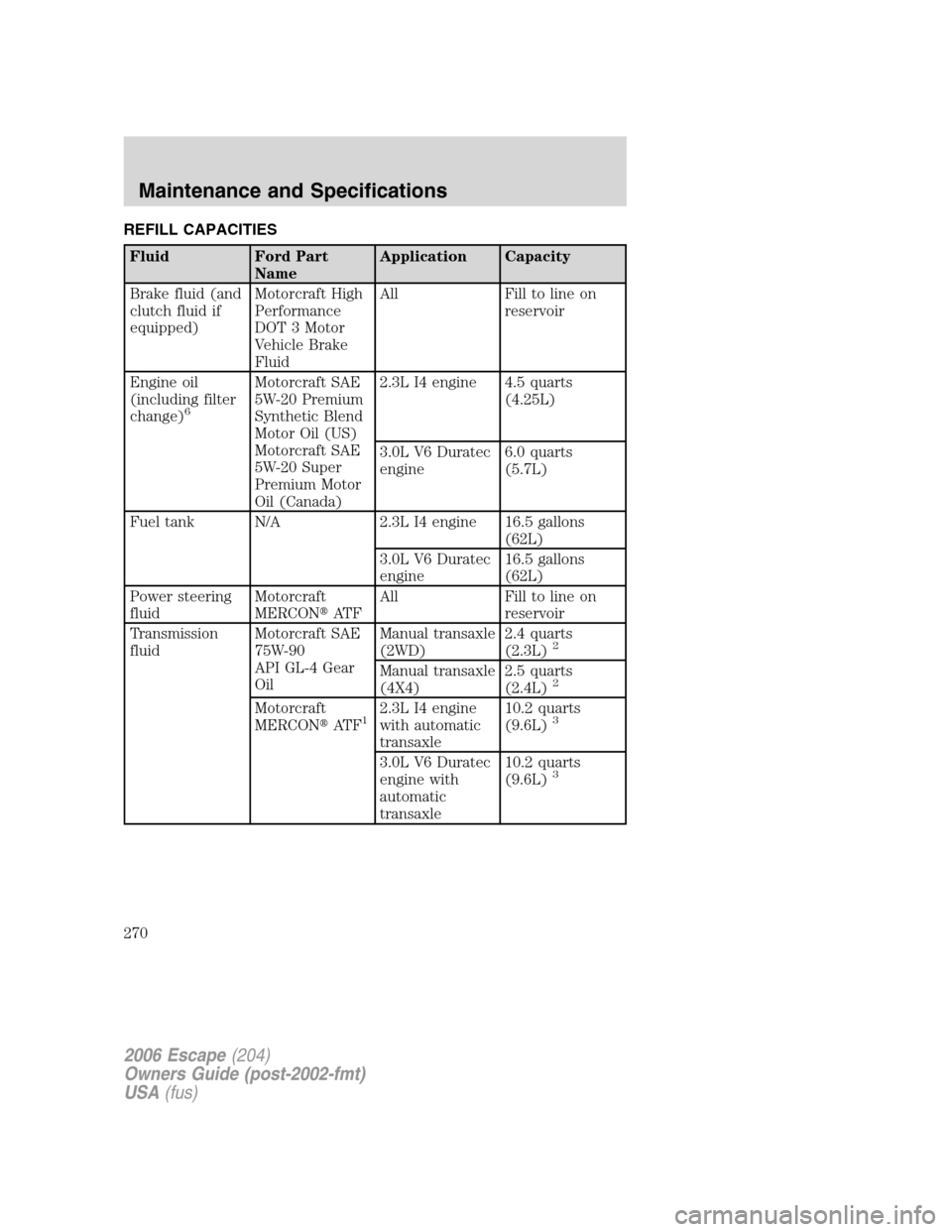
REFILL CAPACITIES
Fluid Ford Part
NameApplication Capacity
Brake fluid (and
clutch fluid if
equipped)Motorcraft High
Performance
DOT 3 Motor
Vehicle Brake
FluidAll Fill to line on
reservoir
Engine oil
(including filter
change)
6
Motorcraft SAE
5W-20 Premium
Synthetic Blend
Motor Oil (US)
Motorcraft SAE
5W-20 Super
Premium Motor
Oil (Canada)2.3L I4 engine 4.5 quarts
(4.25L)
3.0L V6 Duratec
engine6.0 quarts
(5.7L)
Fuel tank N/A 2.3L I4 engine 16.5 gallons
(62L)
3.0L V6 Duratec
engine16.5 gallons
(62L)
Power steering
fluidMotorcraft
MERCON�AT FAll Fill to line on
reservoir
Transmission
fluidMotorcraft SAE
75W-90
API GL-4 Gear
OilManual transaxle
(2WD)2.4 quarts
(2.3L)
2
Manual transaxle
(4X4)2.5 quarts
(2.4L)2
Motorcraft
MERCON�AT F12.3L I4 engine
with automatic
transaxle10.2 quarts
(9.6L)3
3.0L V6 Duratec
engine with
automatic
transaxle10.2 quarts
(9.6L)3
2006 Escape(204)
Owners Guide (post-2002-fmt)
USA(fus)
Maintenance and Specifications
270