2006 FORD ESCAPE lock
[x] Cancel search: lockPage 245 of 288
Adding engine oil
1. Check the engine oil. For instructions, refer toChecking the engine
oilin this chapter.
2. If the engine oil level is not within the normal range, add only certified
engine oil of the recommended viscosity. Remove the engine oil filler cap
and use a funnel to pour the engine oil into the opening.
3. Recheck the engine oil level. Make sure the oil level is not above the
MAX or FULL mark on the engine oil level indicator (dipstick).
4. Install the indicator and ensure it is fully seated.
5. Fully install the engine oil filler cap by turning the filler cap clockwise
1/4 of a turn until it is seated.
To avoid possible oil loss, DO NOT operate the vehicle with the
engine oil level indicator and/or the engine oil filler cap removed.
Engine oil and filter recommendations
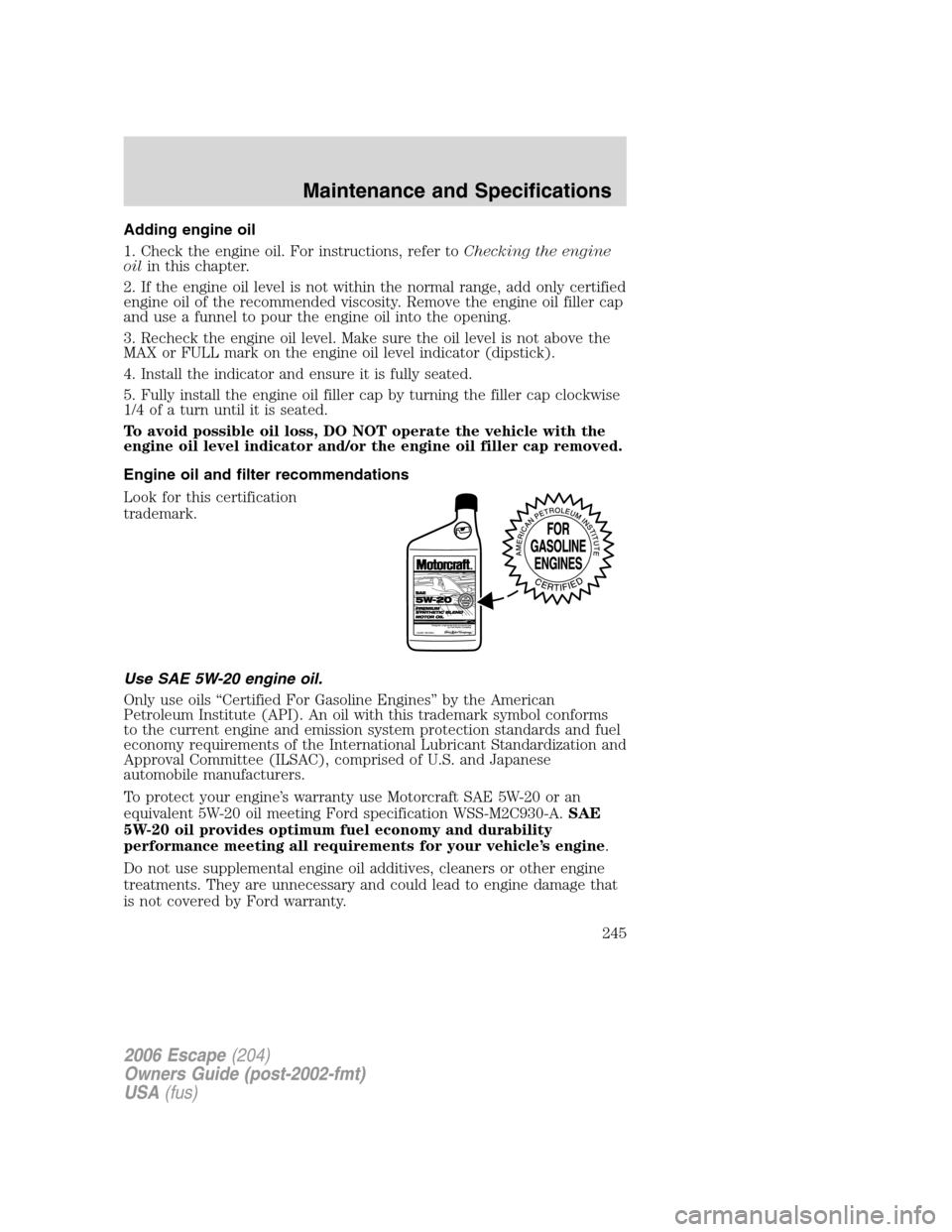
Look for this certification
trademark.
Use SAE 5W-20 engine oil.
Only use oils “Certified For Gasoline Engines” by the American
Petroleum Institute (API). An oil with this trademark symbol conforms
to the current engine and emission system protection standards and fuel
economy requirements of the International Lubricant Standardization and
Approval Committee (ILSAC), comprised of U.S. and Japanese
automobile manufacturers.
To protect your engine’s warranty use Motorcraft SAE 5W-20 or an
equivalent 5W-20 oil meeting Ford specification WSS-M2C930-A.SAE
5W-20 oil provides optimum fuel economy and durability
performance meeting all requirements for your vehicle’s engine.
Do not use supplemental engine oil additives, cleaners or other engine
treatments. They are unnecessary and could lead to engine damage that
is not covered by Ford warranty.
2006 Escape(204)
Owners Guide (post-2002-fmt)
USA(fus)
Maintenance and Specifications
245
Page 248 of 288

When the battery is disconnected or a new battery installed, the
transmission must relearn its adaptive strategy. As a result of this, the
transmission may shift firmly. This operation is considered normal and
will not affect function or durability of the transmission. Over time the
adaptive learning process will fully update transmission operation to its
optimum shift feel.
If the battery has been disconnected or a new battery has been installed,
the clock and the preset radio stations must be reset once the battery is
reconnected.
•Always dispose of automotive
batteries in a responsible manner.
Follow your local authorized
standards for disposal. Call your
local authorized recycling center
to find out more about recycling
automotive batteries.
ENGINE COOLANT
Checking engine coolant
The concentration and level of engine coolant should be checked at the
mileage intervals listed inscheduled maintenance information.The
coolant concentration should be maintained at 50/50 coolant and distilled
water, which equates to a freeze point of -34°F (-36°C). Coolant
concentration testing is possible with a hydrometer or antifreeze tester
(such as the Rotunda Battery and Antifreeze Tester, 014–R1060). The level
of coolant should be maintained at the “FULL COLD” level or within the
“COLD FILL RANGE” in the coolant reservoir. If the level falls below, add
coolant per the instructions in theAdding engine coolantsection.
Your vehicle was factory-filled with a 50/50 engine coolant and water
concentration. If the concentration of coolant falls below 40% or above
60%, the engine parts could become damaged or not work properly.A
50–50 mixture of coolant and water provides the following:
•Freeze protection down to -34°F (-36°C).
•Boiling protection up to 265°F (129°C).
•Protection against rust and other forms of corrosion.
•Enables calibrated gauges to work properly.
L
E
A
D
RETURN
RECYCLE
2006 Escape(204)
Owners Guide (post-2002-fmt)
USA(fus)
Maintenance and Specifications
248
Page 251 of 288
2. When the engine is cool, wrap a thick cloth around the coolant
pressure relief cap on the coolant reservoir (a translucent plastic bottle).
Slowly turn cap counterclockwise (left) until pressure begins to release.
3. Step back while the pressure releases.
4. When you are sure that all the pressure has been released, use the
cloth to turn it counterclockwise and remove the cap.
5. Fill the coolant reservoir slowly with the proper coolant mixture (see
above), to within the “COLD FILL RANGE” or the “FULL COLD” level on
the reservoir. If you removed the radiator cap in an overflow system, fill
the radiator until the coolant is visible and radiator is almost full.
6. Replace the cap. Turn until tightly installed. (Cap must be tightly
installed to prevent coolant loss.)
After any coolant has been added, check the coolant concentration (refer
toChecking engine coolant). If the concentration is not 50/50
(protection to –34° F/–36° C), drain some coolant and adjust the
concentration. It may take several drains and additions to obtain a 50/50
coolant concentration.
Whenever coolant has been added, the coolant level in the coolant
reservoir should be checked the next few times you drive the vehicle. If
necessary, add enough 50/50 concentration of engine coolant and
distilled water to bring the liquid level to the proper level.
If you have to add more than 1.0 quart (1.0 liter) of engine coolant per
month, have your dealer check the engine cooling system. Your cooling
system may have a leak. Operating an engine with a low level of coolant
can result in engine overheating and possible engine damage.
Recycled engine coolant
Ford Motor Company does NOT recommend the use of recycled engine
coolant in vehicles originally equipped with Motorcraft Premium Gold
Engine Coolant since a Ford-approved recycling process is not yet
available.
Used engine coolant should be disposed of in an appropriate
manner. Follow your community’s regulations and standards for recycling
and disposing of automotive fluids.
Coolant refill capacity
To find out how much fluid your vehicle’s cooling system can hold, refer
toRefill capacitiesin this section.
2006 Escape(204)
Owners Guide (post-2002-fmt)
USA(fus)
Maintenance and Specifications
251
Page 256 of 288
Refueling
Fuel vapor burns violently and a fuel fire can cause severe
injuries. To help avoid injuries to you and others:
•Read and follow all the instructions on the pump island;
•Turn off your engine when you are refueling;
•Do not smoke if you are near fuel or refueling your vehicle;
•Keep sparks, flames and smoking materials away from fuel;
•Stay outside your vehicle and do not leave the fuel pump unattended
when refueling your vehicle — this is against the law in some places;
•Keep children away from the fuel pump; never let children pump fuel
Use the following guidelines to avoid static build-up when filling an
ungrounded fuel container:
•Place approved fuel container on the ground.
•DO NOT fill a fuel container while it is in the vehicle (including the
cargo area).
•
Keep the fuel pump nozzle in contact with the fuel container while filling.
•DO NOT use a device that would hold the fuel pump handle in the fill
position.
Fuel Filler Cap
Your fuel tank filler cap has an indexed design with a 1/4 turn on/off feature.
When fueling your vehicle:
1. Turn the engine off.
2. Carefully turn the filler cap counterclockwise 1/4 of a turn to unscrew
the cap.
3. Pull to remove the cap from the fuel filler pipe.
4. Reinstall the cap on the filler pipe and turn it clockwise until at least
one click is heard.
After refueling, if the “CHECK FUEL CAP” indicator comes on and stays
on when you start the engine, the fuel filler cap may not be properly
installed. Turn off the engine, remove the fuel filler cap, align the cap
properly and reinstall it securely. The “CHECK FUEL CAP” indicator
should turn off after three driving cycles with the fuel filler cap properly
installed. A driving cycle consists of a cold engine start-up followed by
mixed city/highway driving.
2006 Escape(204)
Owners Guide (post-2002-fmt)
USA(fus)
Maintenance and Specifications
256
Page 277 of 288
Vehicle identification number (VIN)
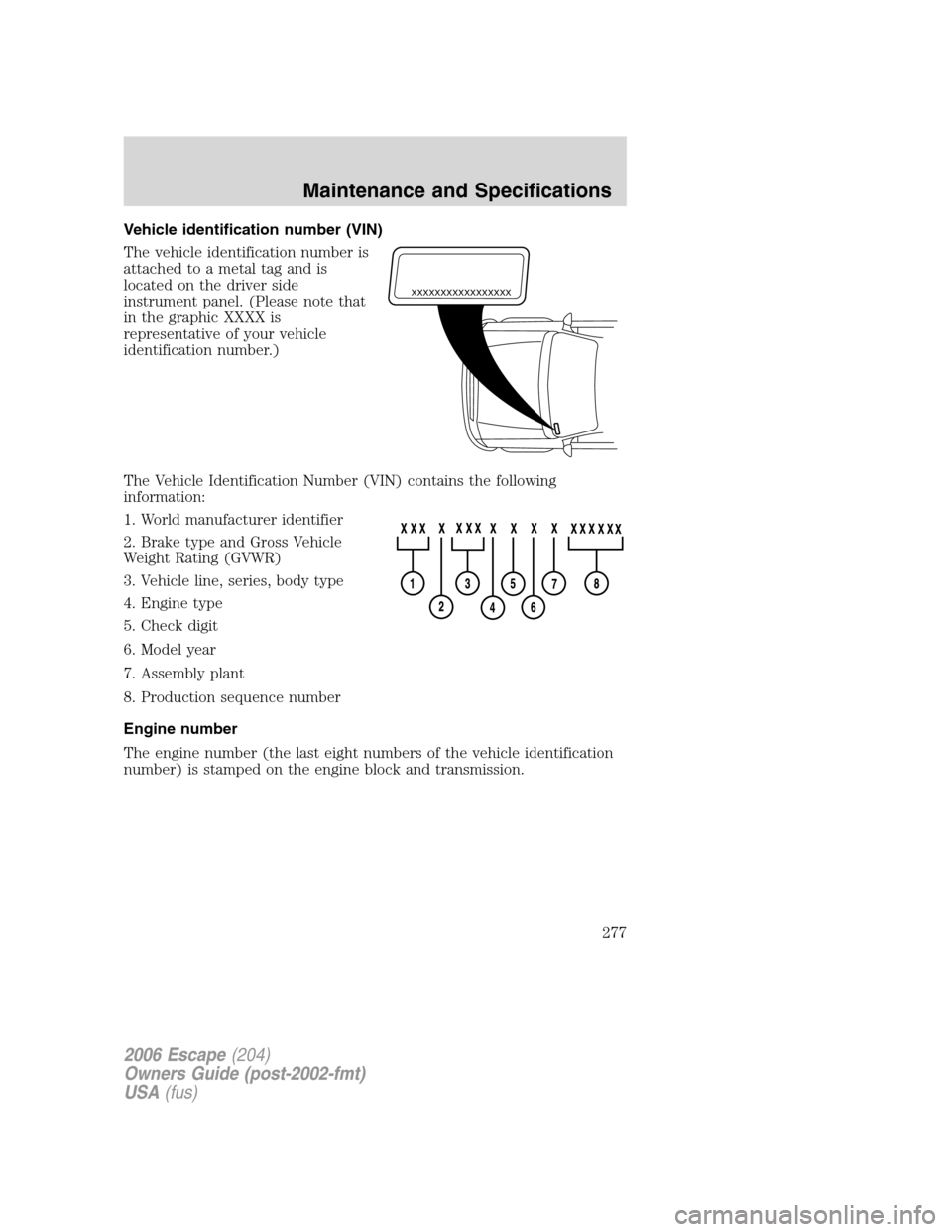
The vehicle identification number is
attached to a metal tag and is
located on the driver side
instrument panel. (Please note that
in the graphic XXXX is
representative of your vehicle
identification number.)
The Vehicle Identification Number (VIN) contains the following
information:
1. World manufacturer identifier
2. Brake type and Gross Vehicle
Weight Rating (GVWR)
3. Vehicle line, series, body type
4. Engine type
5. Check digit
6. Model year
7. Assembly plant
8. Production sequence number
Engine number
The engine number (the last eight numbers of the vehicle identification
number) is stamped on the engine block and transmission.
XXXXXXXXXXXXXXXXX
2006 Escape(204)
Owners Guide (post-2002-fmt)
USA(fus)
Maintenance and Specifications
277
Page 280 of 288

Interior style
Electrochromatic compass/temperature interior mirrors
Floor mats
Scuff plates
Lifestyle
Bike racks
Cargo organization and management
Mobile-ease hands-free communication system
Rear seat entertainment systems
Trailer hitches, wiring harnesses and accessories
Peace of mind
First aid and highway safety kits
Full vehicle covers
Keyless entry keypad
Locking gas cap
Navigation systems
Remote start
Vehicle security systems
For maximum vehicle performance, keep the following information in
mind when adding accessories or equipment to your vehicle:
•When adding accessories, equipment, passengers and luggage to your
vehicle, do not exceed the total weight capacity of the vehicle or of
the front or rear axle (GVWR or GAWR as indicated on the Safety
Compliance Certification label). Consult your dealer for specific weight
information.
•The Federal Communications Commission (FCC) and Canadian Radio
Telecommunications Commission (CRTC) regulate the use of mobile
communications systems — such as two-way radios, telephones and
theft alarms - that are equipped with radio transmitters. Any such
equipment installed in your vehicle should comply with FCC or CRTC
regulations and should be installed only by a qualified service
technician.
•Mobile communications systems may harm the operation of your
vehicle, particularly if they are not properly designed for automotive
use.
2006 Escape(204)
Owners Guide (post-2002-fmt)
USA(fus)
Accessories
280
Page 281 of 288
•To avoid interference with other vehicle functions, such as anti-lock
braking systems, amateur radio users who install radios and antennas
onto their vehicle should not locate the Amateur Radio Antennas in
the area of the driver’s side hood.
•Electrical or electronic accessories or components that are added to
the vehicle by the dealer or the owner may adversely affect battery
performance and durability.
2006 Escape(204)
Owners Guide (post-2002-fmt)
USA(fus)
Accessories
281
Page 282 of 288

A
Accessory delay ..........................58
Air cleaner filter ...............267, 269
Airbag supplemental restraint
system ........................114, 121, 124
and child safety seats ............116
description ..............114, 121, 124
disposal ....................................127
driver airbag ............116, 122, 125
indicator light .........120, 123, 126
operation .................116, 122, 125
passenger airbag .....116, 122, 125
side airbag ...............................121
All Wheel Drive (AWD),
driving off road .........................186
Ambulance packages ....................8
Antifreeze
(see Engine coolant) ................248
Anti-lock brake system
(see Brakes) ..............................173
Anti-theft system ........................90
arming the system ....................90
disarming a triggered system ..91
Audio system
(see Radio) ......................19, 27, 31
Automatic transaxle
fluid, adding ............................265
fluid, checking ........................265
Automatic transmission ............176
driving an automatic
overdrive .................................178
fluid, refill capacities ..............270
fluid, specification ..................274
Auxiliary power point .................55
Axle
lubricant specifications ..272, 274
refill capacities ........................270B
Battery .......................................246
acid, treating emergencies .....246
jumping a disabled battery ....214
maintenance-free ....................246
replacement, specifications ...269
servicing ..................................246
BeltMinder .................................109
Brakes ................................172–173
anti-lock ...................................173
anti-lock brake system (ABS)
warning light ...........................173
fluid, checking and adding ....265
fluid, refill capacities ..............270
fluid, specifications .........272, 274
lubricant specifications ..272, 274
parking ....................................174
shift interlock ..........................176
Bulbs ............................................47
C
Calculating load ........................163
Capacities for refilling fluids ....270
Cargo area shade ........................70
Cargo cover .................................71
Cassette tape player ...................19
Cell phone use ..............................8
Child safety restraints ..............128
child safety belts ....................128
Child safety seats ......................130
attaching with tether straps ..134
in front seat ............................132
in rear seat ..............................132
Cleaning your vehicle
engine compartment ..............232
instrument panel ....................234
2006 Escape(204)
Owners Guide (post-2002-fmt)
USA(fus)
Index
282