2006 FIAT CROMA climate control
[x] Cancel search: climate controlPage 130 of 240

Roof rack/ski rack
Remove the roof rack or the ski rack from
the roof as soon as they are no longer
used. These accessories lower air pene-
tration and adversely affect consumption
levels. When needing to carry particular-
ly voluminous objects, preferably use a
trailer.
Electric devices
Use electric devices only for the amount
of time needed. Rear heated window, ad-
ditional headlights, windscreen wipers and
heater fan need a considerable amount of
energy, therefore increasing the require-
ment of current increases fuel consump-
tion (up to +25% in the urban cycle).
Climate control
The air conditioner is an additional load
which greatly affects the engine leading to
higher consumption (on average up to
+20%). When the temperature outside
the car permits it, use the air vents where
possible.
Spoilers
The use of non-certified aerodynamic
items may adversely affect air drag and
consumption levels.DRIVING STYLE
Starting
Do not warm the engine with the car at
a standstill or at idle or high speed: under
these conditions the engine warms up
much more slowly, increasing electrical
consumption and emissions. It is therefore
advisable to move off immediately, slow-
ly, avoiding high speeds. This way the en-
gine will warm faster.
Unnecessary actions
Avoid accelerating when waiting at traffic
lights or before switching off the engine.
This and also double declutching is ab-
solutely pointless on modern cars and al-
so increase consumption and pollution.
Gear selection
As soon as the conditions of the traffic and
road allow, use a higher gear. Using a low
gear to obtain brilliant performance in-
creases consumption.
In the same way improper use of a high
gear increases consumption, emissions an
engine wear.CONTAINING
RUNNING COSTS
Here are some suggestions which may
help you to keep the running costs of your
car down and lower the amount of toxic
emissions released into the atmosphere.
GENERAL CONSIDERATIONS
Car maintenance
Have checks and adjustments carried out
in accordance with the “Service schedule”.
Tyres
Check the pressure of the tyres routine-
ly at an interval of no more than 4 weeks:
if the pressure is too low, consumption
levels increase as resistance to rolling is
higher.
Unnecessary loads
Do not travel with too much luggage
stowed in the boot. The weight of the car
(especially when driving in town) and its
trim greatly affects consumption and sta-
bility.
130
WARNING
LIGHTS AND
MESSAGES
IN AN
EMERGENCY
CAR
MAINTENANCE
TECHNICAL
SPECIFICATIONS
INDEX
DASHBOARD
AND CONTROLS
SAFETY
DEVICES
CORRECT USE
OF THE CAR
Page 175 of 240

175
WARNING
LIGHTS AND
MESSAGES
CAR
MAINTENANCE
TECHNICAL
SPECIFICATIONS
INDEX
DASHBOARD
AND CONTROLS
SAFETY
DEVICES
CORRECT USE
OF THE CAR
IN AN
EMERGENCY
F 47
F 48
F 49
F 50
F 51
F 52
F 5320
20
7,5
7,5
7,5
15
7,5
USERSFUSE AMPERE
Power for control unit on driver side
Power for control unit on passenger side
+15 Branch point for steering wheel, Connect, rain sensor control unit,
climate control system, diesel fuel heater, volumetric protection control unit,
control unit for moving and warming left front and right front seat,
Hands-free kit control unit, phone presetting, cruise control,
instrument panel dimmer, sunroof curtain
Air bag system
+15 Branch point for electric steering, tyre pressure control unit
Rear window wiper, boot control unit relay coils, cigar lighter
+30 instrument panel
Page 176 of 240

176
WARNING
LIGHTS AND
MESSAGES
CAR
MAINTENANCE
TECHNICAL
SPECIFICATIONS
INDEX
DASHBOARD
AND CONTROLS
SAFETY
DEVICES
CORRECT USE
OF THE CAR
IN AN
EMERGENCY
F 1
F 2
F 3
F 4
F 5
F 6
F 6
F 7
F 7
F 8
F 9
F 10
F 11
F 14
F 15
F 16
F 17
F 18
F 19
F 2060
40
20
40
40
40
50
40
50
40
20
15
15
10
10
7.5
10
7.5
7.5
30 Fuse box in engine compartment
USERSFUSE AMPERE
+30 Dashboard control unit 2
+30 Climate control system fan
+ 30 Electric steering lock branch point
+ 30 Brake branch point (pump)
+ 30 Brake branch point (solenoid valve)
+30 Engine cooling fan low speed (2.2 - Multijet)
+ 30 Engine cooling fan low speed (Multijet a.t.)
+30 Engine cooling fan high speed (2.2 - Multijet)
+ 30 Engine cooling fan high speed (Multijet a.t.)
+30 Manual climate control system fan (excluding Multijet a.t.)
Headlight washer
Horns
Sundry secondary services
Right main beam headlight
Left main beam headlight
E.i. system
E.i. primary services
+30 Engine control unit, automatic transmission control unit and gear lever
Compressor
Diesel fuel filter
Page 186 of 240

186
WARNING
LIGHTS AND
MESSAGES
TECHNICAL
SPECIFICATIONS
INDEX
DASHBOARD
AND CONTROLS
SAFETY
DEVICES
CORRECT USE
OF THE CAR
IN AN
EMERGENCY
CAR
MAINTENANCE
30 60 90 120 150 180
●●●●●●
●●●●●●
●●
●●●●●●
●●●●●●
●
●
●
●
●
●●●
●●●
●●●
●●●●●●
●●●●●●
(●)(●)(●)(●)(●)(●)
●●●●●●
●●●
●●●●●●
Thousands of km
Check exhaust emissions (petrol versions)
Check exhaust emissions/smoke (Multijet versions)
Check antievaporation system (petrol versions)
Check engine control system operation (through diagnostic socket)
Check and top up, if required, automatic transmission oil level
Replace accessory drive belt/s (Multijet versions / petrol exclude 1.8)
Replace accessory drive belt/s (1.8 petrol versions)
Replace timing belt (Multijet versions)O
Replace timing belt (1.8 petrol versions)O
Change spark plugs (petrol versions exclude 1.8)
Change spark plugs (1.8 petrol versions)
Replace diesel fuel filter (Multijet versions)
Change air cleaner cartridge (petrol versions)
Change air cleaner cartridge (Multijet versions)
Change engine oil and oil filter (petrol versions)
Change engine oil and oil filter (Multijet versions - DPF)*
Change engine oil and oil filter (Multijet versions without DPF)
Change brake fluid (or every 2 years)
Change pollen filter (or every year)
Oregardless of the km covered, the timing belt shall be replaced every 4 years for particularly demanding use
(cold climates, driving in the city, idling for a long time) or in any case every 5 years
* Engine oil and oil filter shall actually be changed according to the conditions of use of the car and it is indicated by the relevant warning light
or message (where provided) on the instrument panel (see section “Warning lights and messages”).
183-206 Croma TRW GB 20-11-2006 15:03 Pagina 186
Page 203 of 240

203
WARNING
LIGHTS AND
MESSAGES
TECHNICAL
SPECIFICATIONS
INDEX
DASHBOARD
AND CONTROLS
SAFETY
DEVICES
CORRECT USE
OF THE CAR
IN AN
EMERGENCY
CAR
MAINTENANCE
Rear window wiper fig. 21
Rear window washer jets can be adjust-
ed in the same way.
The nozzle holder is on the rear window.
HEADLIGHT WASHERS
Regularly check that the spray jets are in-
tact and clean.
The headlight washers are automatically
switched on when the windscreen wash-
er is operated and the headlights are on.
BODYWORK
PROTECTION FROM
ATMOSPHERIC AGENTS
The main causes of corrosion are the fol-
lowing:
❒atmospheric pollution;
❒salty air and humidity (coastal areas,
or hot humid climates);
❒seasonal environment conditions.
Not to be underestimated is also the abra-
sive action of wind-borne atmospheric
dust and sand and mud and gravel raised
by other cars.
On your Fiat Croma, Fiat implemented
the best manufacturing technologies to ef-
fectively protect the bodywork against
corrosion.
These include:
❒Painting products and systems which
give the car particular resistance to
corrosion and abrasion;
❒Use of galvanised (or pretreated) steel
sheets, with high resistance to corro-
sion; SPRAY NOZZLES
Windscreen wiper fig. 20
If the jet of fluid is inadequate, firstly check
that there is fluid in the reservoir: see
“Checking fluid levels” in this section).
Then check that the nozzle holes are not
clogged, if necessary use a needle.
Fluid jets shall be directed at about 1/3
height from the window upper edge.
fig. 20F0L0152mfig. 21F0L0151m
183-206 Croma TRW GB 20-11-2006 15:03 Pagina 203
Page 224 of 240

224
WARNING
LIGHTS AND
MESSAGES
INDEX
DASHBOARD
AND CONTROLS
SAFETY
DEVICES
CORRECT USE
OF THE CAR
IN AN
EMERGENCY
CAR
MAINTENANCE
TECHNICAL
SPECIFICATIONS
2.2
litres kg
62 –
7 - 9 –
7.4 –
5–
– 0.750
3 (5) –2.2 a.t.
litres kg
62 –
7 - 9 –
7.4 –
5–
– 0.750
3 (5) –Recommended products and
genuine lubricants
Unleaded petrol
with no less than 95 R.O.N
(EN228 Specification)
Mixture of 50% demineralised wa-
ter and 50% PARAFLU UP
SELENIA PERFORMER
MULTIPOWER
TUTELA TOP 4
TUTELA PROFESSIONAL
SC 35
CAPACITIES
Fuel tank:
including a reserve of:
Engine cooling system– with climate control:
Engine sump and filter:
Hydraulic brake circuitwith ABS:
Windscreen/rear window
/headlight washer fluid reservoir: (*)
(*) The values in brackets refer to versions with headlight washers.1.8
litres kg
62 –
7 - 9 –
7.4 –
4.5 –
– 0.750
3 (5) –
207-231 Croma TRW GB 20-11-2006 15:04 Pagina 224
Page 225 of 240
225
WARNING
LIGHTS AND
MESSAGES
INDEX
DASHBOARD
AND CONTROLS
SAFETY
DEVICES
CORRECT USE
OF THE CAR
IN AN
EMERGENCY
CAR
MAINTENANCE
TECHNICAL
SPECIFICATIONS
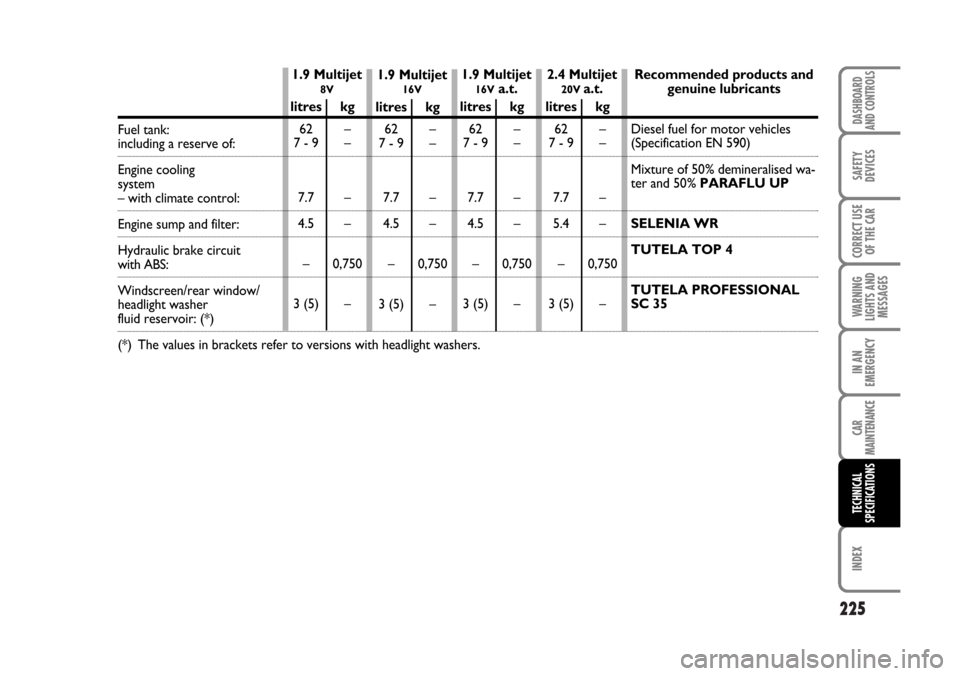
1.9 Multijet8V
litres kg
62 –
7 - 9 –
7.7 –
4.5 –
– 0,750
3 (5) –
1.9 Multijet 16V
litres kg
62 –
7 - 9 –
7.7 –
4.5 –
– 0,750
3 (5) –
2.4 Multijet20V a.t.
litres kg
62 –
7 - 9 –
7.7 –
5.4 –
– 0,750
3 (5) –1.9 Multijet 16Va.t.
litres kg
62 –
7 - 9 –
7.7 –
4.5 –
– 0,750
3 (5) –Recommended products and
genuine lubricants
Diesel fuel for motor vehicles
(Specification EN 590)
Mixture of 50% demineralised wa-
ter and 50% PARAFLU UP
SELENIA WR
TUTELA TOP 4
TUTELA PROFESSIONAL
SC 35
Fuel tank:including a reserve of:
Engine cooling
system
– with climate control:
Engine sump and filter:
Hydraulic brake circuit
with ABS:
Windscreen/rear window/
headlight washer
fluid reservoir: (*)
(*) The values in brackets refer to versions with headlight washers.
207-231 Croma TRW GB 20-11-2006 15:04 Pagina 225
Page 228 of 240

❒extra-urban cycle: frequent accel-
erating in all gears, simulating extrau-
rban use of the car; the speed varies
between 0 and 120 km/h;
❒combined consumption: is calcu-
lated weighing about 37% of urban cy-
cle consumption and about 63% of
extraurban consumption.
FUEL CONSUMPTION
The fuel consumption figures given in the
table below are determined on the basis
of the homologation tests set down by
specific European Directives.
The procedures below are followed for
measuring consumption:
❒urban cycle: cold starting followed
by driving that simulates urban use of
the car;
228
WARNING
LIGHTS AND
MESSAGES
INDEX
DASHBOARD
AND CONTROLS
SAFETY
DEVICES
CORRECT USE
OF THE CAR
IN AN
EMERGENCY
CAR
MAINTENANCE
TECHNICAL
SPECIFICATIONS
IMPORTANT The type of route, traffic
situations, weather conditions, driving
style, general conditions of the car, trim
level/equipment/accessories, load, climate
control system, roof rack, other situations
that affect air drag may lead to different
fuel consumption levels than those mea-
sured.
Fuel consumption according to Directive 1999/100/EC (litres x 100 km)
Petrol versions
1.8 2.2 2.2 a.t.
Urban 9.8 11.4 12.5
Extra-urban 6.0 6.7 7.6
Combined 7.4 8.4 9.4
Multijet versions
1.9 Multijet 8V1.9 Multijet 16V1.9 Multijet 16Va.t. 2.4 Multijet 20Va.t.
Urban 7.9 8.1 9.3 11.5
Extra-urban 5.0 4.9 5.8 6.0
Combined 6.1 6.1 7.1 8.0
207-231 Croma TRW GB 20-11-2006 15:04 Pagina 228