2006 DODGE SPRINTER wheel
[x] Cancel search: wheelPage 208 of 330

208 STARTING AND OPERATING
NOTE: Chains must be the proper size for the vehicle,
as recommended by the chain manufacturer.
Snow chains should only be driven on snow-covered
roads at speeds not to exceed 30 mph (50 km/h).
Remove chains as soon as possible when driving on
roads without snow.
NOTE: When driving with snow chains, you may wish
to deactivate the ASR before setting the vehicle in
motion. This will improve the vehicle’s traction.Please observe the following guidelines when using
snow chains:
Snow chains should only be used on rear wheels. In
vehicles with dual rear wheels, they should be
mounted on the exterior wheels. Follow the
manufacturer’s mounting instructions.
Only use snow chains that are approved by the
vehicle manufacturer. For approved snow chains,
please contact your authorized Sprinter Dealer.
Use of snow chains may be prohibited depending
on location. Always check local and state laws
before installing snow chains.
WARNING!
Use snow chains on rear wheels only.
Some tire sizes do not leave adequate clearance for
snowchains. To help avoid serious damage to
your vehicle or tires, use of snow chains is not
permissible with the spare wheel.
Page 209 of 330

STARTING AND OPERATING 209
5
To avoid damage to your vehicle, tires or chains,
observe the following precautions:
Because of limited chain clearance between tires and
other suspension components, it is important that
only chains in good condition are used. Broken
chains can cause serious vehicle damage. Stop the
vehicle immediately if noise occurs that could
suggest chain breakage. Remove the damaged parts
of the chain before further use.
Install chains as tightly as possible and then
retighten after driving about 1/2 mile (0.8 km).
Do not exceed 30 mph (50 km/h).
Drive cautiously and avoid severe turns and large
bumps, especially with a loaded vehicle.
Do not install tire chains on front wheels.
Do not drive for a prolonged period on dry
pavement.
Observe the tire chain manufacturer’s instructions
on method of installation, operating speed, and
conditions for usage. Always use the lower
suggested operating speed of the chain
manufacturer if different than the speed
recommended by the manufacturer.FUEL REQUIREMENTS
Use only commercially available vehicular diesel fuels
No. 2 or No. 1 (ASTM D 975 No. 2-D or No. 1-D).
NOTE: Because of its better quality the manufacturer
recommends the use of commercially available
vehicular diesel fuel No. 2.
For information on cold weather operation, contact
your authorized Sprinter Dealer.
WARNING!
Marine diesel fuel, Bio diesel fuel, heating oil or
the like must not be used.
Do not blend diesel fuel with marine diesel fuel,
Bio diesel fuel or heating oil.
The use of such non-approved fuels or blending
diesel fuel may result in malfunction or cause
engine damage. Damage or malfunctions
resulting from poor fuel quality or from blending
specific fuel additives are not covered by the
Sprinter Warranty.
Page 213 of 330

STARTING AND OPERATING 213
5
Capacity
Fuel tank including reserve fuel about 26.4 US gal
(100 l).
PROGRAMMED TOP SPEED (OPTIONAL)
NOTE: The top speed of this vehicle can be
electronically limited to a speed between 19 mph
(30 km / h) and 82 mph (132 km / h). The vehicle’s
electronic speed controller should be programmed
only by a qualified technician by an authorized
Sprinter Dealer.
When programming the electronic speed controller,
the circumference of the specific tires actually mounted
on the vehicle must be determined and that
circumference must be correctly programmed into the
vehicle’s electronic speed controller. It is critical that
the correct tire circumference be programmed
accurately into the vehicle’s electronic speed
controller. Accurate tire circumference information
should be confirmed each time the electronic speed
controller is programmed and each time new wheels or
tires are mounted on the vehicle.
WARNING!
Possible tire damage resulting in serious personal
injury or death may occur if the vehicle’s electron-
ic speed controller is programmed at a speed
above the maximum speed allowed by the manu-
facturer of the specific tires mounted on the vehi-
cle. The maximum speed of the tires prescribed by
the tire manufacturer must be determined and ac-
curately programmed into the electronic speed
controller. The electronic speed controller must
never be programmed at a speed greater than the
maximum allowable tire speed as prescribed by
the manufacturer of the specific tires mounted on
the vehicle.
Page 222 of 330

222 STARTING AND OPERATING
Trailer Hitches (Optional)
Only install a trailer hitch receiver approved for your
vehicle. For information on availability and
installation, please see your authorized Sprinter
Dealer.
The bumpers on your vehicle are not designed for use
with clamp-type hitches. Do not attach rental hitches
or other bumper-type hitches to them.
To reduce the possibility of damage, remove the hitch
ball adaptor from the receiver when not in use.
Electrical Connections (Optional)
The Sprinter is available with a variety of pre-installed
conditions (lines and turn signal indicator and brake
module installed and / or not installed). Make sure that
the correct trailer hitch receiver kit is used. For further
information, please see your authorized Sprinter
Dealer.
In order to prevent possible damage to the vehicle’s
electrical system by incorrectly installing the trailer
wiring plug, we recommend having the harness
connected at an authorized Sprinter Dealer.Vehicle and Trailer Weights and Ratings
Gross Vehicle Weight Rating (GVWR) is the maximum
permissible vehicle weight:
8,550 lbs (3,878 kgs),
9,990 lbs (4,531 kgs) or 10,200 lbs (4,627 kgs).
NOTE: The weight of your Sprinter is indicated on the
type plate. For type plate, see Identification Labels.
Gross Vehicle Weight (GVW): comprises weight of
vehicle including fuel, tools, spare wheel, installed
accessories, passengers, cargo and trailer tongue. It
must never exceed the GVWR.
Gross Axle Weight Rating (GAWR) is the maximum
permissible axle weight:
Type GVWR GAWR (FA) GAWR (RA)
2500
C/HC /
SHC8,550 lbs
3,878 kgs3,860 lbs
(1,751 kgs)5,360 lbs
(2,431 kgs)
3500
C/HC /
SHC9,990 lbs
4,531 kgs3,860 lbs
(1,751 kgs)7,060 lbs
(3,202 kgs)
10,200 lbs
4,627 kgs3,860 lbs
(1,751 kgs)7,060 lbs
(3,202 kgs)
Page 227 of 330
STARTING AND OPERATING 227
5
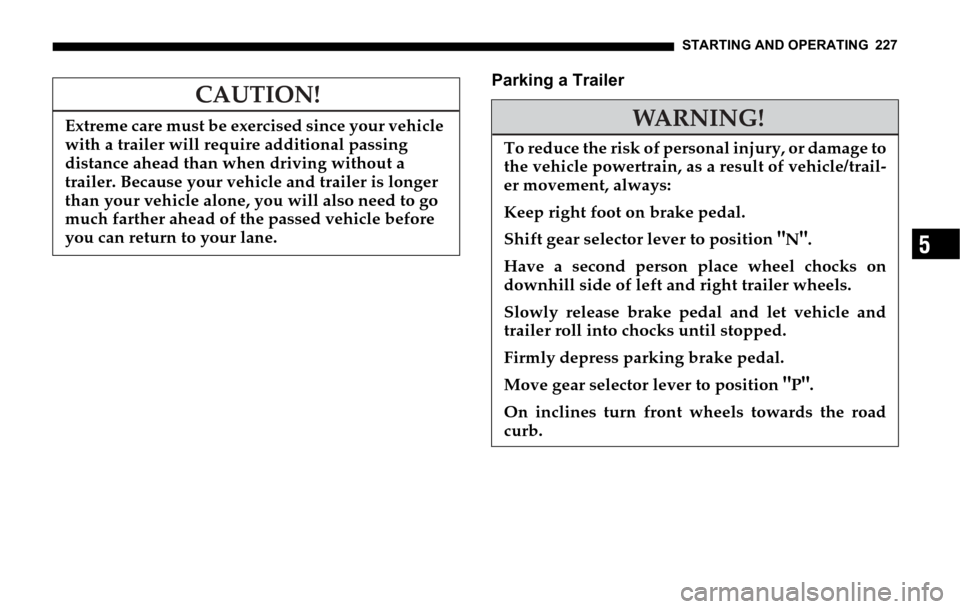
Parking a TrailerCAUTION!
Extreme care must be exercised since your vehicle
with a trailer will require additional passing
distance ahead than when driving without a
trailer. Because your vehicle and trailer is longer
than your vehicle alone, you will also need to go
much farther ahead of the passed vehicle before
you can return to your lane.WARNING!
To reduce the risk of personal injury, or damage to
the vehicle powertrain, as a result of vehicle/trail-
er movement, always:
Keep right foot on brake pedal.
Shift gear selector lever to position
"N".
Have a second person place wheel chocks on
downhill side of left and right trailer wheels.
Slowly release brake pedal and let vehicle and
trailer roll into chocks until stopped.
Firmly depress parking brake pedal.
Move gear selector lever to position
"P".
On inclines turn front wheels towards the road
curb.
Page 231 of 330

WHAT TO DO IN EMERGENCIES 231
6
Q Hazard Warning Flasher Switch . . . . . . . . . . . . . 232
Q Fire Extinguisher (Optional) . . . . . . . . . . . . . . . . . 233
Q Vehicle Tool Kit . . . . . . . . . . . . . . . . . . . . . . . . . . . 233
Q Changing the Tire . . . . . . . . . . . . . . . . . . . . . . . . . . 234
…Spare Wheel Location . . . . . . . . . . . . . . . . . . . . 236
Q Jack . . . . . . . . . . . . . . . . . . . . . . . . . . . . . . . . . . . . . . 239
…Using the Jack . . . . . . . . . . . . . . . . . . . . . . . . . . . 239
Q Removing a Wheel . . . . . . . . . . . . . . . . . . . . . . . . . 242
Q Installing a Wheel . . . . . . . . . . . . . . . . . . . . . . . . . . 242
Q Jump Starting . . . . . . . . . . . . . . . . . . . . . . . . . . . . . . 246
Q Towing the Vehicle . . . . . . . . . . . . . . . . . . . . . . . . . 248
…If the Engine is Damaged . . . . . . . . . . . . . . . . . 249
…If the Transmission is Damaged . . . . . . . . . . . . 249
…If the Front Axle is Damaged . . . . . . . . . . . . . . 249
…If the Rear Axle is Damaged . . . . . . . . . . . . . . . 249
Page 234 of 330

234 WHAT TO DO IN EMERGENCIES
CHANGING THE TIRE
If you get a flat tire while driving, gradually decrease your
speed. Hold the steering wheel firmly and slowly move to
a safe place on the side of the road. The pressure of the
spare wheel always has to be checked regularly (at least
after every tenth time at the filling station).
WARNING!
Fitting other wheel sizes to the vehicle will change
the vehicle’s handling characteristics andmay lead
to an accident resulting in death, severe personal
injuries and property damage.
Only certain tires meeting the tire size/load/speed
rating specifications contained in the Tire
Pressure Tables are certified to conform to
FMVSS 110 for the Sprinter vehicle at this time.
Please check your side walls of your originally
equipped tires for specific makes/sizes, and speed
load ratings when you need to replace your tires.
To prevent accidents resulting in possible death,
sever injury or property damage, use only the correct
tire and wheel sizes with load ratings approved for
your vehicle for your tire replacement.
WARNING!
The jack is designed exclusively for jacking up the
vehicle at the jack take-up brackets built into ei-
ther side of the vehicle. To help avoid personal in-
jury, use the jack only to lift the vehicle during a
wheel change. Never get beneath the vehicle
while it is supported by the jack only.
Keep hands and feet away from the area under the
lifted vehicle. Always firmly set parking brake
and block wheels before raising vehicle with jack.
Do not disengage parking brake while the vehicle
is raised.
Always use the jack on a level surface.
Do not change wheels on either steep uphill or
downhill grades. Be sure that the jack arm end is
fully seated in the jack take-up bracket. The
vehicle may begin to move and fall from the jack
which could cause serious or fatal personal injury
and property damage.
Always lower the vehicle onto sufficient capacity
jack stands before working under the vehicle.
Page 235 of 330

WHAT TO DO IN EMERGENCIES 235
6
Procedure:
1. Park the vehicle on a firm, level, non-slippery
surface.
2. Switch on the hazard warning flasher switch, apply
the parking brake, and place the transmission
selector in "P".3. Everyone must leave the vehicle before you jack it
up.
4. Everyone must leave the danger zone, before
jacking the vehicle.
5. The vehicle must be safeguarded in accordance
with legal regulations (such as using a warning
triangle).
6. Prevent vehicle from rolling away by blocking
wheels with wheel chocks (not supplied with
vehicle) or sizable wood block or stone.
On a level road, place one chock in front of and one
behind the wheel that is diagonally opposite to the
wheel being changed.
When changing a wheel on mild uphill or downhill
grades, place chocks on the downhill side blocking
both wheels of the other axle.
WARNING!
Do not jack the vehicle up more than 1.2 in (30
mm) between the tire and the surface. Otherwise,
the vehicle may tip over and may cause serious in-
jury or death to you or others.
Always lower the vehicle onto sufficient capacity
jack stands before working under the vehicle.
Precautions when changing a wheel:
For tire inflation pressures, see “Tire Pressures”
For the torque, refer to "Installing a wheel";
Do not damage, grease or oil wheel bolts or their
threads.
WARNING!
Do not change wheels on either steep uphill or
downhill grades. The vehicle may begin to move
and fall from the jack which could cause personal
injury and property damage.