2006 DODGE SPRINTER steering
[x] Cancel search: steeringPage 204 of 330

204 STARTING AND OPERATING
Vehicle Capacity Weight
Rated cargo and luggage load plus 68 kilograms (150
lbs) times the vehicle’s designated seating capacity.
Vehicle Maximum Load on the Tire
Load on an individual tire that is determined by
distributing to each axle its share of the maximum
loaded vehicle weight and dividing it by two.
Rotating Tires
Tires on the front and rear axles of vehicles operate at
different loads and perform different steering, driving
and braking functions. For these reasons, they wear at
unequal rates, and develop irregular wear patterns.
These effects can be reduced by timely rotation of tires.
The benefits of rotation are especially worthwhile with
aggressive tread designs such as those on On/Off
Road type tires. Rotation will increase tread life, help tomaintain mud, snow, and wet traction levels, and
contribute to a smooth, quiet ride.
If applicable to your vehicle's tire configuration, tires
can be rotated according to the tire manufacturer’s
recommended intervals in the tire manufacturer’s
warranty pamphlet located in your vehicle literature
portfolio. If none is available, tires should be rotated
every 10000 miles (16000 km), or sooner if necessary,
according to the degree of tire wear.
The same rotation (spinning) direction must be
maintained when fitted, see "Direction of Rotation".
Rotate tires before the characteristic tire wear pattern
becomes visible (shoulder wear on front tires and
treadcenter wear on rear tires).
The reasons for any rapid or unusual wear should be
corrected prior to rotation being performed.
Thoroughly clean the mounting face of wheels and
brake disks, i.e. the inner side of the wheels/tires,
during each rotation. Check for and ensure proper tire
inflation pressure, refer to "Recommended Tire
Inflation Pressure".
WARNING!
Rotate front and rear wheels only if the tires are of
the same dimension.
Page 217 of 330

STARTING AND OPERATING 217
5
capacity of your vehicle, called the Gross Vehicle
Weight Rating (GVWR). The GVWR includes the
weight of the vehicle, all occupants, fuel and cargo.
The Certification Label also tells you about the front
and rear axle weight capacity, called the Gross Axle
Weight Rating (GAWR). The GAWR is the total
allowable weight that can be carried by a single axle
(front or rear). Never exceed the GVWR or GAWR
for either the front axle or rear axle.
Following is a discussion on how to work with the
information contained on the two placards with
regards to loading your Sprinter vehicle.Tire and Loading Information
WARNING!
Do not overload the tires by exceeding the speci-
fied load limit as indicated on the Tire and Load-
ing Information placard on the driver’s door B-
pillar. Overloading the tires can overheat them,
possibly causing a blowout. Overloading the tires
can also result in handling or steering problems,
or brake failure.
Overloading of tires is dangerous. Overloading
can cause tire failure, affect vehicle handling, and
increase the stopping distance. Use tires of the
recommended load capacity for the vehicle. Never
overload them.
The vehicle maximum load on the tire must not
exceed the load carrying capacity of the tire on
your vehicle. You will not exceed the tire’s load
carrying capacity if you adhere to the loading
conditions, tire size and cold tire inflation
pressures specified on the Tire and Loading
Information placard and this section.
Page 225 of 330

STARTING AND OPERATING 225
5
Towing a Trailer
There are many different laws, including speed limit
restrictions, having to do with trailer towing. Make
sure that your vehicle-trailer combination will be legal,
not only for where you reside, but also for where you
will be driving. A good source for this information can
be the police or local authorities.
Before you start driving with the trailer, check the
trailer hitch, break-away switch, safety chains,
electrical connections, lighting and tires. Also adjust
the mirrors to permit unobstructed view beyond rear
of trailer.
If the trailer has electric brakes, start your vehicle and
trailer moving slowly, and then apply only the trailer
brake controller by hand to be sure the brakes are
working properly.
When towing a trailer, check occasionally to be sure
that the load is secure, and that lighting and trailer
brakes (if so equipped) are functioning properly.
Always secure items in the trailer to prevent load shifts
while driving.Take into consideration that when towing a trailer, the
handling characteristics are different and less stable
from those when operating the vehicle without a
trailer. It is important to avoid sudden maneuvers. The
vehicle and trailer combination is heavier, and
therefore is limited in acceleration and climbing ability,
and requires longer stopping distances. It is more
prone to reacting to side wind gusts, and requires more
sensitive steering input.
In order to gain skill and an understanding of the
vehicle’s behavior, you should practice turning, stopping
and backing up in an area which is free from traffic.
If possible, do not brake abruptly, but rather engage
the brake slightly at first to permit the trailer to activate
its brake. Then increase the braking force.
Page 232 of 330

232 WHAT TO DO IN EMERGENCIES
HAZARD WARNING FLASHER SWITCH
The switch is located on top of the steering column
housing.
When the hazard warning flasher switch is switched
on, the indicator lamp in the switch and the turn signal
indicator lamp in the instrument cluster both flash.
WARNING!
If the rear cargo doors are opened to 90° (detent
position), the rear lights will be concealed. The
vehicle is then not sufficiently safeguarded at the
rear and may only be seen by other road users
when they are close to the vehicle. This could
lead to an accident.
The vehicle must then be clearly marked in
accordance with state and local laws, e.g., with a
warning triangle.
Page 234 of 330

234 WHAT TO DO IN EMERGENCIES
CHANGING THE TIRE
If you get a flat tire while driving, gradually decrease your
speed. Hold the steering wheel firmly and slowly move to
a safe place on the side of the road. The pressure of the
spare wheel always has to be checked regularly (at least
after every tenth time at the filling station).
WARNING!
Fitting other wheel sizes to the vehicle will change
the vehicle’s handling characteristics andmay lead
to an accident resulting in death, severe personal
injuries and property damage.
Only certain tires meeting the tire size/load/speed
rating specifications contained in the Tire
Pressure Tables are certified to conform to
FMVSS 110 for the Sprinter vehicle at this time.
Please check your side walls of your originally
equipped tires for specific makes/sizes, and speed
load ratings when you need to replace your tires.
To prevent accidents resulting in possible death,
sever injury or property damage, use only the correct
tire and wheel sizes with load ratings approved for
your vehicle for your tire replacement.
WARNING!
The jack is designed exclusively for jacking up the
vehicle at the jack take-up brackets built into ei-
ther side of the vehicle. To help avoid personal in-
jury, use the jack only to lift the vehicle during a
wheel change. Never get beneath the vehicle
while it is supported by the jack only.
Keep hands and feet away from the area under the
lifted vehicle. Always firmly set parking brake
and block wheels before raising vehicle with jack.
Do not disengage parking brake while the vehicle
is raised.
Always use the jack on a level surface.
Do not change wheels on either steep uphill or
downhill grades. Be sure that the jack arm end is
fully seated in the jack take-up bracket. The
vehicle may begin to move and fall from the jack
which could cause serious or fatal personal injury
and property damage.
Always lower the vehicle onto sufficient capacity
jack stands before working under the vehicle.
Page 249 of 330

WHAT TO DO IN EMERGENCIES 249
6
*Vehicle Type 2500 onlyIf the Engine is Damaged
For towing distances up to 30 miles (about 50 km)
Shift gear selector lever to "N" position.
Do not exceed a towing speed of 30 mph (50 km / h).
For towing distances greater than 30 miles (about
50 km)
Remove the propeller shafts leading to the drive
axles.
The vehicle can be towed without restriction.
If the Transmission is Damaged
Remove the propeller shafts leading to the drive
axles.
If the Front Axle is Damaged
Raise the front axle.
Observe the same towing restrictions as for engine
damage.
If the Rear Axle is Damaged
Raise the rear axle.
NOTE: Comply with local legal regulations regarding
towing vehicles.
WARNING!
Do not tow the vehicle if the key cannot be turned
in the ignition lock.
If the key cannot be turned, the ignition lock re-
mains locked and the vehicle cannot be steered.
With the engine not running there is no power
assistance for the braking and steering systems.
In this case, it is important to keep in mind that a
considerably higher degree of effort is necessary
to brake and steer the vehicle.
The vehicle must not be towed with the front axle
raised and the key in position 2 in the ignition
lock as the drive wheels could then lock due to the
acceleration skid control (ASR) or the optional
Electronic Stability Program (ESP
®)*.
Page 252 of 330

252 MAINTAINING YOUR VEHICLE
…Headlamps, Taillamps, Identification Lamps,
Turn Signal Lenses . . . . . . . . . . . . . . . . . . . . . . . 273
…Reversing Aid Sensors . . . . . . . . . . . . . . . . . . . . 273
…Window Cleaning . . . . . . . . . . . . . . . . . . . . . . . 274
…Wiper Blade . . . . . . . . . . . . . . . . . . . . . . . . . . . . . 274
…Light Alloy Wheels . . . . . . . . . . . . . . . . . . . . . . 275
…Instrument Cluster . . . . . . . . . . . . . . . . . . . . . . . 275
…Steering Wheel and Gear Selector Lever . . . . 275
…Cup Holder . . . . . . . . . . . . . . . . . . . . . . . . . . . . . 275
…Seat Belts . . . . . . . . . . . . . . . . . . . . . . . . . . . . . . . 275
…Headliner and Shelf Below Rear Window . . . 275
…Upholstery . . . . . . . . . . . . . . . . . . . . . . . . . . . . . . 276
…Hard Plastic Trim Items . . . . . . . . . . . . . . . . . . 276
…Plastic and Rubber Parts . . . . . . . . . . . . . . . . . . 276
Q Electrical Fuses . . . . . . . . . . . . . . . . . . . . . . . . . . . . 276
…Standard Fuse and Relay Equipment . . . . . . . 277
…Relay Assignment, Standard Equipment . . . . 281
…Fuse and Relay Optional Equipment . . . . . . . 281
Q Bulb Replacement . . . . . . . . . . . . . . . . . . . . . . . . . . 284
…Front Lamp Unit . . . . . . . . . . . . . . . . . . . . . . . . . 284
…Taillamps . . . . . . . . . . . . . . . . . . . . . . . . . . . . . . . 289
…License Plate Lamps
(Cargo/Passenger Vans Only) . . . . . . . . . . . . . 291
…Additional Brake Lamp
(Cargo/Passenger Vans Only) . . . . . . . . . . . . . 291
…Side-Mounted Turn Signals . . . . . . . . . . . . . . . 292
…Side-Marker Lamps,
Standing Lamps (Optional) . . . . . . . . . . . . . . . . 292
…Identification Lamps
(Cargo/passenger vans only) . . . . . . . . . . . . . . 293
…Interior Lighting in Passenger
Compartment and Load Compartment . . . . . 293
…Interior Lighting with Reading Lamp . . . . . . . 294
…Interior Lighting with Interior Sensor
Protection . . . . . . . . . . . . . . . . . . . . . . . . . . . . . . . 294
…Exit Lamps (Optional) . . . . . . . . . . . . . . . . . . . . 295
Q Capacities . . . . . . . . . . . . . . . . . . . . . . . . . . . . . . . . . 296
…Recommended Fluids and Lubricants . . . . . . 297
Page 260 of 330
260 MAINTAINING YOUR VEHICLE
Check the engine oil level at regular intervals with the
vehicle standing on a level surface.
Check engine oil level about 5 minutes after
stopping the engine, which should have reached its
regular operating temperature. The normal
operating temperature should have been reached
and maintained for some time.
Wipe the dipstick clean with a lint-free cloth before
checking.
The engine oil level must be between the
lower (MIN) and upper (MAX) marks on
the dipstick.
Add engine oil only up to the MAX mark.
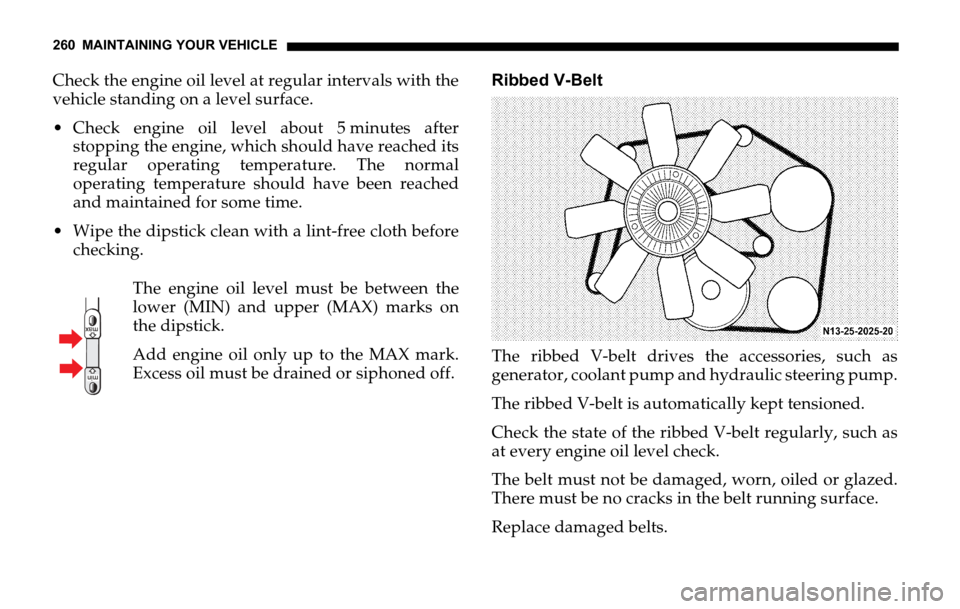
Excess oil must be drained or siphoned off.Ribbed V-Belt
The ribbed V-belt drives the accessories, such as
generator, coolant pump and hydraulic steering pump.
The ribbed V-belt is automatically kept tensioned.
Check the state of the ribbed V-belt regularly, such as
at every engine oil level check.
The belt must not be damaged, worn, oiled or glazed.
There must be no cracks in the belt running surface.
Replace damaged belts.