Page 204 of 344

The ABS light monitors the Anti-Lock Brake Sys-
tem. The light will come on when the ignition
switch is turned to the ON position and may stay on for
as long as four seconds.
If the ABS light remains on or comes on while driving, it
indicates that the Anti-Lock portion of the brake system
is not functioning and that service is required. However,
the conventional brake system will continue to operate
normally if the BRAKE warning light is not on.
If the ABS light is on, the brake system should be serviced
as soon as possible to restore the benefits of Anti-Lock
brakes. If the ABS light does not come on when the
Ignition switch is turned to the ON position, have the
bulb repaired as soon as possible.
If both the Brake Warning Light and the ABS Light
remain on, the Anti-Lock brakes (ABS) and Electronic
Brake Force Distribution (EBD) systems are not function-
ing. Immediate repair to the ABS system is required.
When the vehicle is driven over 7 mph (11 km/h), you
may also hear a slight clicking sound as well as somerelated motor noises. These noises are the system per-
forming its self check cycle to ensure that the ABS system
is working properly. This self check occurs each time the
vehicle is started and accelerated past 7 mph (11 km/h).
ABS is activated during braking under certain road or
stopping conditions. ABS-inducing conditions can in-
clude ice, snow, gravel, bumps, railroad tracks, loose
debris, or panic stops.
You also may experience the following when the brake
system goes into Anti-lock:
•The ABS motor running (it may continue to run for a
short time after the stop),
•the clicking sound of solenoid valves,
•brake pedal pulsations,
•and a slight drop or fall away of the brake pedal at the
end of the stop.
These are all normal characteristics of ABS.
204 STARTING AND OPERATING
Page 262 of 344

▫Windshield Washers/Headlight Washers.....277
▫Exhaust System......................277
▫Cooling System.......................278
▫Hoses And Vacuum/Vapor Harnesses.......283
▫Brakes.............................283
▫Brake Fluid Level Check................284
▫Fuel System Hoses....................285
▫Automatic Transmission................286
▫Front And Rear Wheel Bearings...........287
▫Appearance Care And Protection From
Corrosion...........................287
▫Cleaning The Center Console Cup Holders . . . 290
�Power Distribution Centers...............290
▫Front Power Distribution Center...........290▫Rear Power Distribution Center...........293
�Vehicle Storage........................296
�Replacement Light Bulbs................296
�Bulb Replacement......................297
▫Low Beam Headlamp, High Beam Headlamp,
And Park/Turn Lamp..................297
▫Tail/Stop, Turn Signal Lamp, And Backup
Lamp..............................299
▫License Lamp........................301
�Fluids And Capacities...................302
�Fluids, Lubricants And Genuine Parts.......303
▫Engine.............................303
▫Chassis............................303
262 MAINTAINING YOUR VEHICLE
Page 265 of 344

EMISSIONS INSPECTION AND MAINTENANCE
PROGRAMS
In some localities, it may be a legal requirement to pass
an inspection of your vehicle’s emissions control system.
Failure to pass could prevent vehicle registration.
For states which have an I/M (Inspection and
Maintenance) requirement, this check verifies the
following: the MIL (Malfunction Indicator Lamp)
is functioning and is not on when the engine is running,
and that the OBD (On Board Diagnostic) system is ready
for testing.
Normally, the OBD system will be ready. The OBD
system maynotbe ready if your vehicle was recently
serviced, if you recently had a dead battery, or a battery
replacement. If the OBD system should be determined
not ready for the I/M test, your vehicle may fail the test.
Your vehicle has a simple ignition key actuated test
which you can use prior to going to the test station. To
check if your vehicle’s OBD system is ready, you must do
the following:
1. Insert your ignition key into the ignition switch.2. Turn the ignition to the ON position, but do not crank
or start the engine.
3. If you crank or start the engine, you will have to start
this test over.
4. As soon as you turn your key to the ON position, you
will see your MIL symbol come on as part of a normal
bulb check.
5. Approximately 15 seconds later, one of two things will
happen:
a. The MIL will flash for about 10 seconds and then
return to being fully illuminated until you turn off
the ignition key or start the engine. This means that
your vehicle’s OBD system isnot readyand you
shouldnotproceed to the I/M station.
b. The MIL will not flash at all and will remain fully
illuminated until you turn off the ignition key or
start the engine. This means that your vehicle’s OBD
system isreadyand you can proceed to the I/M
station.
MAINTAINING YOUR VEHICLE 265
7
Page 296 of 344

VEHICLE STORAGE
If you are leaving your vehicle dormant for more than 21
days you may want to take steps to protect your battery.
You may:
•Disconnect the negative cable from the battery.
•Anytime you store your vehicle, or keep it out of
service (i.e. vacation) for two weeks or more, run the
air conditioning system at idle for about five minutes
in the fresh air and high blower setting. This will
insure adequate system lubrication to minimize the
possibility of compressor damage when the system is
started again.
REPLACEMENT LIGHT BULBS
LIGHT BULBS — Interior Bulb Number
Rear Courtesy/Reading Lights.............. W5W
Rear Compartment (Liftgate) Light............ 578
Overhead Console Reading Lights............. 578
Visor Vanity Lights.....................A6220
Glove Box Light......................... 194
Door Courtesy.......................... 562
Shift Indicator Light.................JKLE14140
NOTE:For lighted switches, see your dealer for re-
placement instructions.
All of the interior bulbs are glass wedge base or glass
cartridge types. Aluminum base bulbs are not approved
and should not be used for replacement.
296 MAINTAINING YOUR VEHICLE
Page 297 of 344
LIGHT BULBS — Exterior Bulb Number
Low Beam Headlamp.....................9006
High Beam Headlamp....................9005
Front Park/Turn Lamp...................3457A
Front Fog Lamp—If Equipped...........9145/H10
(Serviced at Dealer)
Front Sidemarker......................194NA
(Serviced at Dealer)
Tail/Stop/Turn Lamp..............3157KP27/7W
Rear Sidemarker.................3757APY27/7W
Backup Lamp......................921/W16W
Center High Mount Stop Lamp (CHMSL)....... LED
License.............................. W5WBULB REPLACEMENT
Low Beam Headlamp, High Beam Headlamp, and
Park/Turn Lamp
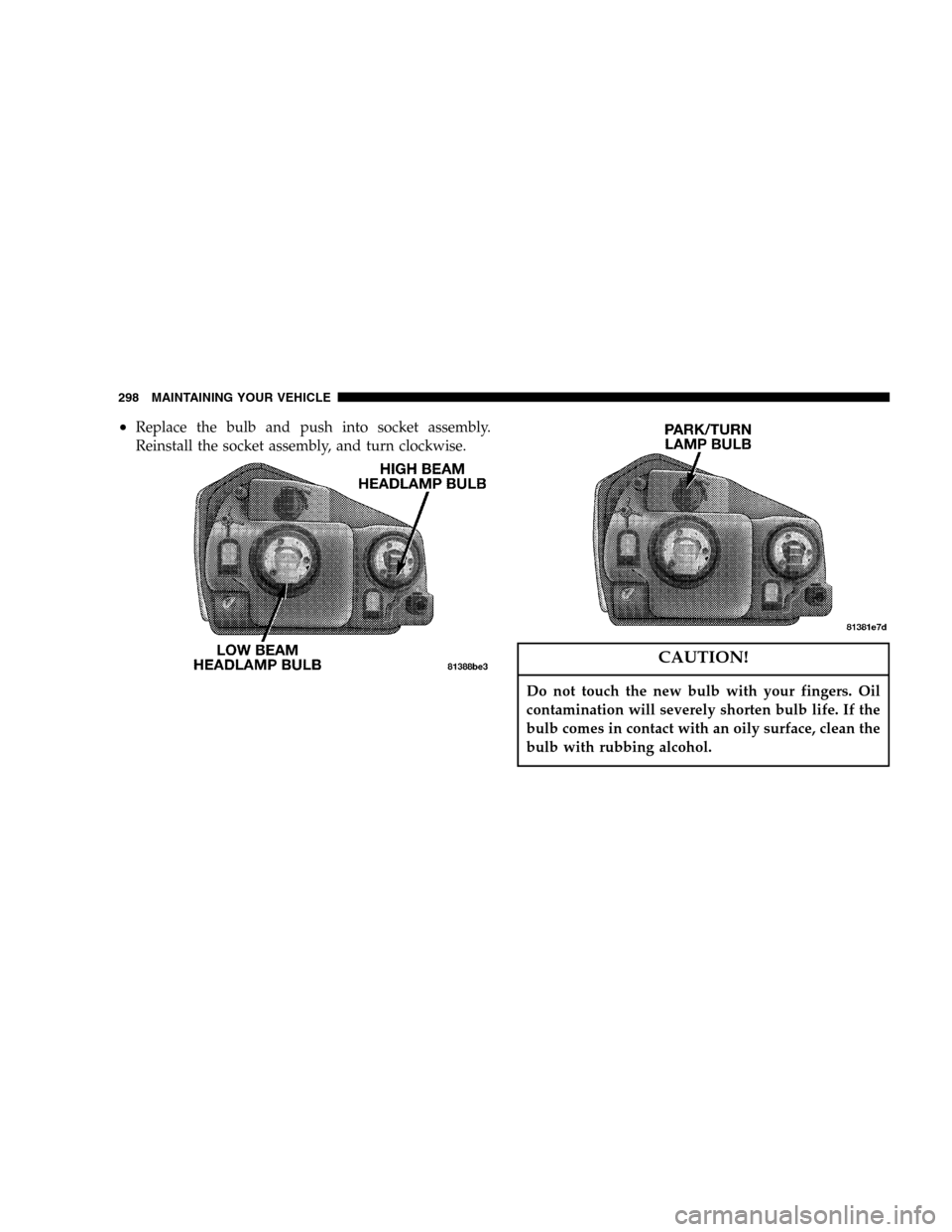
•
Open the hood.
•Twist the appropriate bulb socket assembly counter-
clockwise and pull out. Pull the bulb out of the socket
assembly.
NOTE:Removal of the air cleaner filter housing may be
necessary prior to replacing bulbs on driver’s side head-
lamp assembly.
MAINTAINING YOUR VEHICLE 297
7
Page 298 of 344
•Replace the bulb and push into socket assembly.
Reinstall the socket assembly, and turn clockwise.
CAUTION!
Do not touch the new bulb with your fingers. Oil
contamination will severely shorten bulb life. If the
bulb comes in contact with an oily surface, clean the
bulb with rubbing alcohol.
298 MAINTAINING YOUR VEHICLE
Page 300 of 344
7. Pull tail lamp assembly clear from vehicle to access
bulbs. Turn bulb sockets counter-clockwise to remove.
8. Pull the appropriate bulb to remove it from the socket.
300 MAINTAINING YOUR VEHICLE
Page 301 of 344
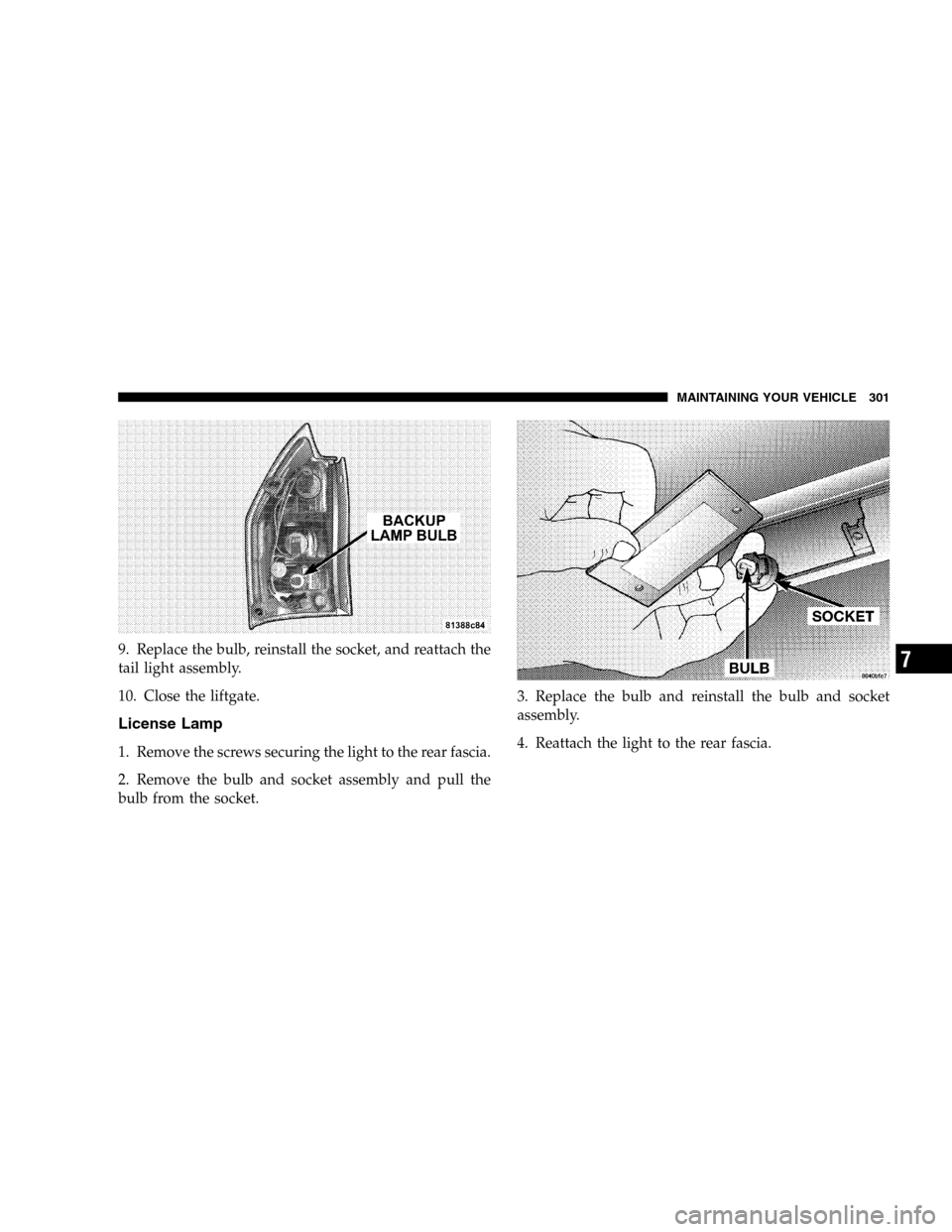
9. Replace the bulb, reinstall the socket, and reattach the
tail light assembly.
10. Close the liftgate.
License Lamp
1. Remove the screws securing the light to the rear fascia.
2. Remove the bulb and socket assembly and pull the
bulb from the socket.3. Replace the bulb and reinstall the bulb and socket
assembly.
4. Reattach the light to the rear fascia.
MAINTAINING YOUR VEHICLE 301
7