Page 424 of 504

WARNING!Overfilling the brake fluid reservoir can result in
spilling brake fluid on hot engine parts and the
brake fluid catching fire.
Use only brake fluid that has been in a tightly closed
container to avoid contamination from foreign matter or
moisture.
CAUTION!Do not allow petroleum base fluid to contaminate
the brake fluid, all brake seal components could be
damaged causing partial or complete brake failure. Fuel System Hoses
Electronic Fuel Injection high pressure fuel systems are
designed with hoses which have unique material charac-
teristics to provide adequate sealing and resist attack by
deteriorated gasoline.
Use only the manufacturers specified hoses in any fuel
system servicing. It is mandatory to replace all clamps
that have been loosened or removed during service. Care
should be taken in installing new clamps to insure they
are properly torqued.
Automatic Transmission
The automatic transmission and differential assembly are
contained within a single housing.
All automatic transmissions are equipped with a conven-
tional filler tube and dipstick. If fluid is added, it should
be added through the dipstick hole in the case.424 MAINTAINING YOUR VEHICLE
Page 426 of 504

Procedure For Checking Fluid Level
The fluid level in the automatic transmission should be
checked whenever the vehicle is serviced. Operation with
an improper fluid level will greatly reduce the life of the
transmission and of the fluid.
To properly check the automatic transmission fluid level,
the following procedure must be used:
1. The vehicle must be on level ground.
2. The engine should be running at curb idle speed for a
minimum of 60 seconds.
3. Fully apply parking brake.
4. Place the gear selector momentarily in each gear
position ending with the lever in P (PARK). Wipe the area
around the dipstick clean to eliminate the possibility of
dirt entering the transmission. 5. Remove the dipstick and determine if the fluid is hot
or warm. Hot fluid is approximately 180 ° F (82 ° C), which
is the normal operating temperature after the vehicle has
been driven at least 15 miles (24 km). The fluid cannot be
comfortably held between the finger tips. Cold is when
the fluid is below 80 ° F (27 ° C).
6. Wipe the dipstick clean and reinsert until seated.
Remove dipstick and note reading.
a. If the fluid is hot, the reading should be in the
crosshatched area marked “ HOT ” (between the upper
two holes in the dipstick).
b. If the fluid is cold, the fluid level should be between
the lower two holes in the area marked “ COLD ” .
If the fluid level indicates low, add sufficient fluid to
bring to the proper level.426 MAINTAINING YOUR VEHICLE
Page 436 of 504

CAUTION!• When installing the Integrated Power Module
cover, it is important to ensure the cover is prop-
erly positioned and fully latched. Failure to do so
may allow water to get into the Integrated Power
Module, and possibly result in a electrical system
failure.
• When replacing a blown fuse, it is important to
use only a fuse having the correct amperage
rating. The use of a fuse with a rating other than
indicated may result in a dangerous electrical
system overload. If a properly rated fuse contin-
ues to blow, it indicates a problem in the circuit
that must be corrected.
The Heated Mirrors, Lower Instrument Panel Power
Outlet and Removable Floor Console, when in the front position are fused with self resetting fuses that are only
serviceable by an authorized dealer. The power seats are
fused by a 30 Amp circuit breaker located under the
driver ’ s seat. The Power Windows are fused by a 25 Amp
circuit breaker located under the instrument panel near
the steering column. If you experience temporary or
permanent loss of these systems see your authorized
dealer for service.
VEHICLE STORAGE
If you are leaving your vehicle dormant for more than 21
days you may want to take steps to protect your battery.
You may:
• Remove the 20 Amp mini fuse in the Integrated Power
Module labeled Ignition-Off Draw (IOD).
• Or, disconnect the negative cable from the battery.
• Anytime you store your vehicle, or keep it out of
service (i.e. vacation) for two weeks or more, run the436 MAINTAINING YOUR VEHICLE
Page 448 of 504

EMISSION CONTROL SYSTEM MAINTENANCE
The “ Scheduled ” maintenance services, listed in bold
type must be done at the times or mileages specified to
assure the continued proper functioning of the emission
control system. These, and all other maintenance services
included in this manual, should be done to provide best
vehicle performance and reliability. More frequent main-
tenance may be needed for vehicles in severe operating
conditions such as dusty areas and very short trip
driving.
Inspection and service also should be done any time a
malfunction is suspected.
NOTE: Maintenance, replacement, or repair of the emis-
sion control devices and systems on your vehicle may be
performed by any automotive repair establishment or
individual using any automotive part which has been
certified pursuant to U.S. EPA or, in the State of Califor-
nia, California Air Resources Board regulations. MAINTENANCE SCHEDULES
There are two maintenance schedules that show the
required service for your vehicle.
First is Schedule “ B ” . It is for vehicles that are operated
under the conditions that are listed below and at the
beginning of the schedule.
• Day or night temperatures are below 32 ° F(0 ° C).
• Stop and go driving.
• Extensive engine idling.
• Driving in dusty conditions.
• Short trips of less than 10 miles (16 km).
• More than 50% of your driving is at sustained high
speeds during hot weather, above 90 ° F (32 ° C).
• Trailer towing. �448 MAINTENANCE SCHEDULES
8 M
A
I
N
T
E
N
A
N
C
E
S
C
H
E
D
U
L
E
S
Page 449 of 504

• Taxi, police, or delivery service (commercial ser-
vice). �
• Off-road or desert operation.
NOTE: Most vehicles are operated under the conditions
listed for Schedule � B � .
Second is Schedule “ A ” . It is for vehicles that are not
operated under any of the conditions listed under Sched-
ule � B � .
Use the schedule that best describes your driving condi-
tions. Where time and mileage are listed, follow the
interval that occurs first.
CAUTION!Failure to perform the required maintenance items
may result in damage to the vehicle. At Each Stop for Fuel
• Check the engine oil level about 5 minutes after a fully
warmed engine is shut off. Checking the oil level while
the vehicle is on level ground will improve the accu-
racy of the oil level reading. Add oil only when the
level is at or below the ADD or MIN mark.
• Check the windshield washer solvent and add if
required.
Once a Month
• Check tire pressure and look for unusual wear or
damage.
• Inspect the battery and clean and tighten the terminals
as required.
• Check the fluid levels of coolant reservoir, brake
master cylinder and transmission; add as needed. MAINTENANCE SCHEDULES 449
8 M
A
I
N
T
E
N
A
N
C
E
S
C
H
E
D
U
L
E
S
Page 451 of 504
SCHEDULE “ B ”
Follow schedule “ B ” if you usually operate your vehicle
under one or more of the following conditions. Change
the automatic transmission fluid and filter every 60,000
miles (96 000 km) if the vehicle is usually operated under
one or more of the conditions marked with an � .
• Day or night temperatures are below 32 ° F(0 ° C).
• Stop and go driving.
• Extensive engine idling. • Driving in dusty conditions.
• Short trips of less than 10 miles (16 km).
• More than 50% of your driving is at sustained high
speeds during hot weather, above 90 ° F (32 ° C).
• Trailer towing. �
• Taxi, police, or delivery service (commercial ser-
vice). �
• Off-road or desert operation. SCHEDULE “ B ” 451
8 M
A
I
N
T
E
N
A
N
C
E
S
C
H
E
D
U
L
E
S
Page 462 of 504
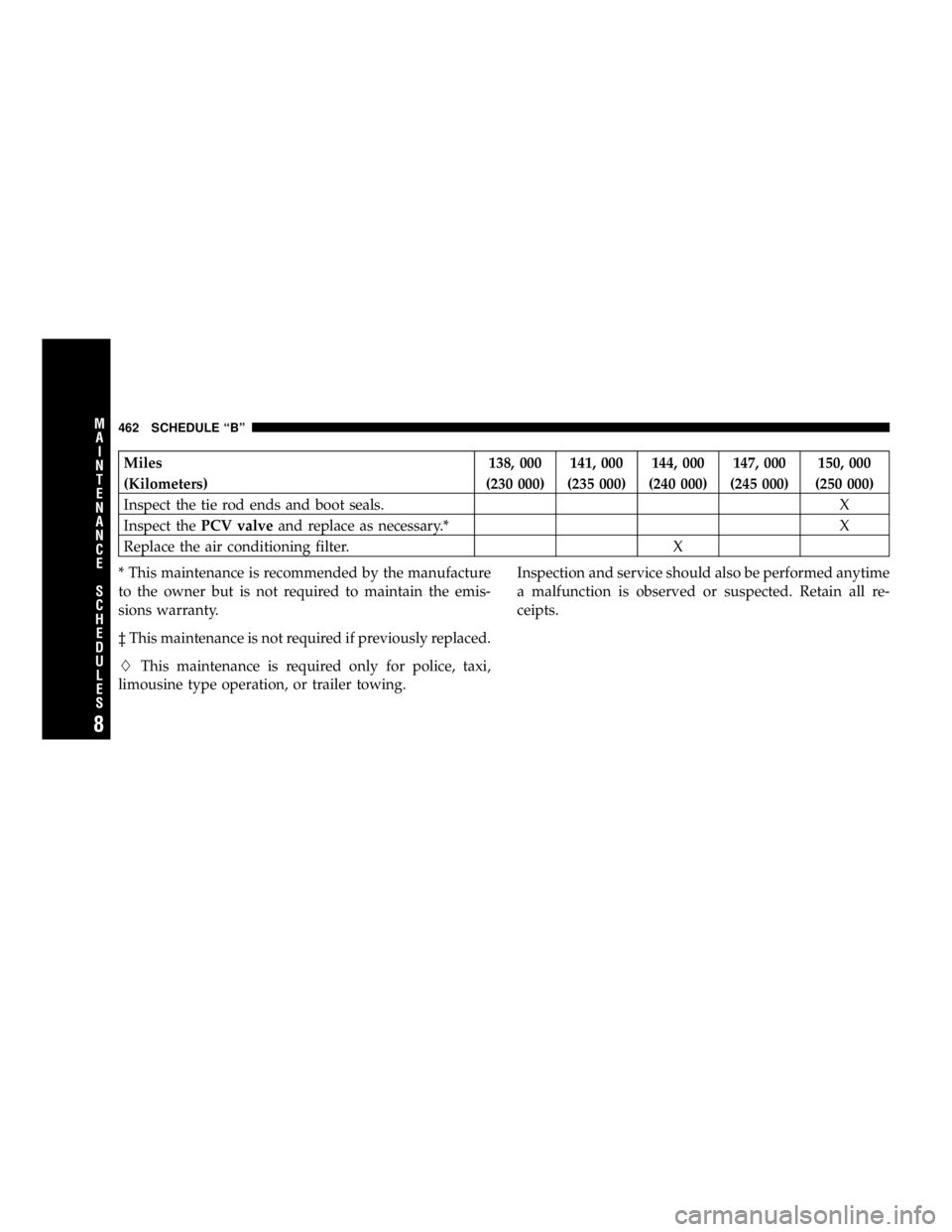
Miles 138, 000 141, 000 144, 000 147, 000 150, 000
(Kilometers) (230 000) (235 000) (240 000) (245 000) (250 000)
Inspect the tie rod ends and boot seals. X
Inspect the PCV valve and replace as necessary.* X
Replace the air conditioning filter. X
* This maintenance is recommended by the manufacture
to the owner but is not required to maintain the emis-
sions warranty.
‡ This maintenance is not required if previously replaced.
� This maintenance is required only for police, taxi,
limousine type operation, or trailer towing. Inspection and service should also be performed anytime
a malfunction is observed or suspected. Retain all re-
ceipts.462 SCHEDULE “ B ”
8 M
A
I
N
T
E
N
A
N
C
E
S
C
H
E
D
U
L
E
S
Page 471 of 504
Miles 126, 000 132, 000 138, 000 144, 000 150, 000
(Kilometers) (210 000) (220 000) (230 000) (240 000) (250 000)
[Months] [126] [132] [138] [144] [150]
Inspect the serpentine drive belt on 3.3 liter and
3.8 liter engines, replace if necessary. ‡ XX
Replace the air conditioning filter. X X
* This maintenance is recommended by the manufacture
to the owner but is not required to maintain the emis-
sions warranty.
‡ This maintenance is not required if previously replaced.
Inspection and service should also be performed anytime
a malfunction is observed or suspected. Retain all re-
ceipts. WARNING!You can be badly injured working on or around a
motor vehicle. Do only that service work for which
you have the knowledge and the right equipment. If
you have any doubt about your ability to perform a
service job, take your vehicle to a competent me-
chanic. SCHEDULE “ A ” 471
8 M
A
I
N
T
E
N
A
N
C
E
S
C
H
E
D
U
L
E
S

![DODGE GRAND CARAVAN 2006 Owners Manual Miles 126, 000 132, 000 138, 000 144, 000 150, 000
(Kilometers) (210 000) (220 000) (230 000) (240 000) (250 000)
[Months] [126] [132] [138] [144] [150]
Inspect the serpentine drive belt on 3.3 liter](/manual-img/12/58711/w960_58711-470.png "DODGE GRAND CARAVAN 2006 Owners Manual Miles 126, 000 132, 000 138, 000 144, 000 150, 000
(Kilometers) (210 000) (220 000) (230 000) (240 000) (250 000)
[Months] [126] [132] [138] [144] [150]
Inspect the serpentine drive belt on 3.3 liter")