Page 66 of 440

•If the shoulder belt contacts the face or neck, move the
child closer to the center of the vehicle. Never allow a
child to put the shoulder belt under an arm.
WARNING!
•Improper installation can lead to failure of an
infant or child restraint. It could come loose in a
collision. The child could be badly injured or
killed. Follow the manufacturer’s directions ex-
actly when installing an infant or child restraint.
•A rearward facing infant restraint should only be
used in a rear seat. A rearward facing infant
restraint in the front seat may be struck by a
deploying passenger airbag which may cause se-
vere or fatal to the infant.
Here are some tips for getting the most out of your child
restraint:
•Before buying any restraint system, make sure that it
has a label certifying that it meets all applicable Safety
Standards. The manufacturer recommends that you
try a child restraint in the vehicle seats where you will
use it before you buy it.
•The restraint must be appropriate for your child’s
weight and height. Check the label on the restraint for
weight and height limits.
•Carefully follow the instructions that come with the
restraint. If you install the restraint improperly, it may
not work when you need it.
•The second row outside seating positions and all third
row seats have cinching latch plates. The second row
center position has an automatic locking retractor.
These are designed to keep the lap portion tight
around the child restraint so that it is not necessary to
use a locking clip. If the seat belt has a cinching latch
plate, pulling up on the shoulder portion of the
66 THINGS TO KNOW BEFORE STARTING YOUR VEHICLE
Page 68 of 440

restraints, many child restraint manufacturers offer
add-on tether strap kits or retro-fit kits. You are urged to
take advantage of all the available attachments provided
with your child restraint in any vehicle.
All three second row seating positions have lower an-
chorages that are capable of accommodating LATCH-
compatible child seats having flexible, webbing-mounted
lower attachments. Child seats with fixed lower attach-
ments must be installed in the outboard positions only.
Regardless of the specific type of lower attachment,
NEVERinstall LATCH-compatible child seats such that
two seats share a common lower anchorage. If you are
installing LATCH-compatible child restraints in adjacent
rear seating positions, you can use the LATCH anchors or
the vehicle’s seat belt for the outboard position, but you
must use the vehicle’s seat belt at the center position. If
your child restraints are not LATCH-compatible, you canonly install the child restraints using the vehicle’s seat
belts. Please refer to the next section for typical installa-
tion instructions.
Second Row Seat Left Side
68 THINGS TO KNOW BEFORE STARTING YOUR VEHICLE
Page 71 of 440

WARNING!
Improper installation of a child restraint to the
LATCH anchorages can lead to failure of an infant or
child restraint. The child could be badly injured or
killed. Follow the manufacturer’s directions exactly
when installing an infant or child restraint.
Installing Child Restraints Using the Vehicle Seat
Belt
The second and third row seats have either cinching latch
plates or automatic locking retractors which are designed
to keep the lap portion tight around the child restraint so
that it is not necessary to use a locking clip. If the seat belthas a cinching latch plate, pulling up on the shoulder
portion of the lap/shoulder belt will tighten the belt. The
cinching latch plate will keep the belt tight, however, any
seat belt system will loosen with time, so check the belt
occasionally and pull it tight if necessary. If the seat belt
has a automatic locking retractor, it will have a distinctive
label. Pull the belt from the retractor until there is enough
to allow you to pass through the child restraint and slide
the latch plate into the buckle. Then, pull the belt until it
is all extracted from the retractor. Allow the belt to return
to the retractor, pulling on the excess webbing to tighten
the lap portion about the child restraint. Refer to�Auto-
matic Locking Mode�earlier in this section.
THINGS TO KNOW BEFORE STARTING YOUR VEHICLE 71
2
Page 73 of 440

Child Restraints in Third Row Seating (If
Equipped)
The third seating row is not capable of installing child
restraints that require the use of a tether strap. There are
no tether anchor provisions for the third seating row in
your vehicle, the hooks in the rear floor are not designed
to withstand the forces that may occur during a crash.
WARNING!
An incorrectly anchored tether strap could lead to
increased head motion and possible injury to the
child. Use only the anchor positions directly behind
the child seat to secure a child restraint top tether
strap. Do not install a child restraint that requires a
tether strap in the third seating row (if equipped) of
this vehicle.
Child Restraint Tether Anchor
There are tether strap anchorages behind each seating
position in the second row. For vehicles equipped with
third row seating, there is no Child Tether Anchorage
provided for the third row of seats. To install child
restraint tethers follow these instructions.
1. Place the child restraint in the second row of seats.
2. Route the tether strap under the head restraint and
between the two posts.
3. Attach the tether strap hook of the child restraint to
the tether anchor located on the seat back and remove the
slack in the tether strap according to the manufacturer’s
instructions.
THINGS TO KNOW BEFORE STARTING YOUR VEHICLE 73
2
Page 80 of 440

�Seats................................111
▫Front Seat Manual Seat Adjustment........111
▫Front Seats Manual Seat Recliners..........112
▫Manual Lumbar Support Adjustment — If
Equipped...........................113
▫Adjustable Head Restraints — All Seating
Positions...........................113
▫8 - Way Driver’s Power Seat — If Equipped . . 114
▫4 - Way Passenger’s Power Seat — If
Equipped...........................115
▫Front Heated Seats — If Equipped.........115
▫Second Row 40/20/40 Seat — Fold And
Tumble............................117
▫Third Row Seat Bench — If Equipped.......120▫Third Row 60/40 Folding — If Equipped....122
�Driver Memory System — If Equipped.......125
▫Setting Memory Positions And Linking Remote
Keyless Entry Transmitter To Memory.......126
▫Memory Position Recall.................127
▫To Disable A Transmitter Linked To Memory . . 127
▫Self-Limiting Control...................128
▫Driver Easy Exit And Easy Entry Control....128
�To Open And Close The Hood.............129
�Lights...............................131
▫Interior Lights.......................132
▫Battery Saver........................132
▫Headlight Delay......................133
80 UNDERSTANDING THE FEATURES OF YOUR VEHICLE
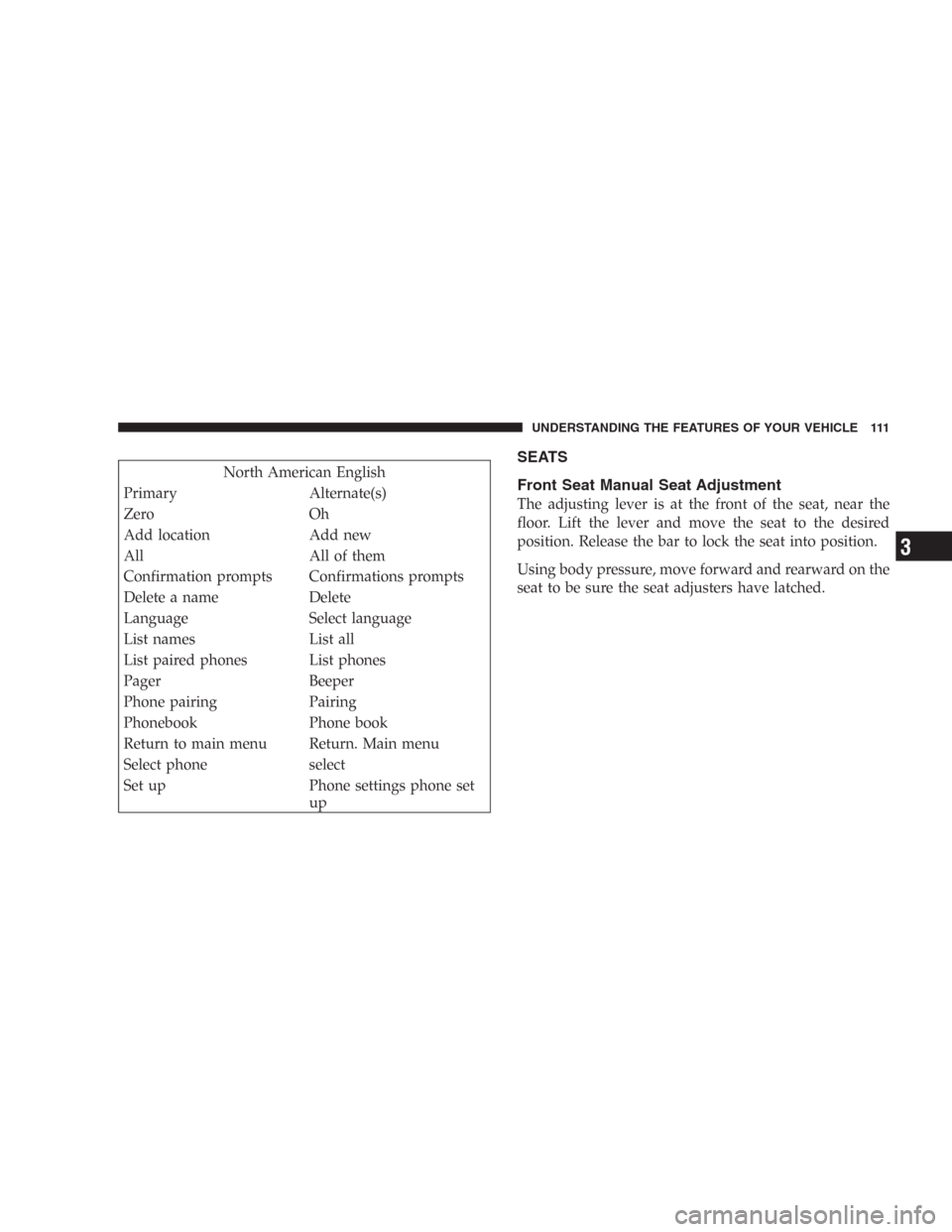
Page 111 of 440
North American English
Primary Alternate(s)
Zero Oh
Add location Add new
All All of them
Confirmation prompts Confirmations prompts
Delete a name Delete
Language Select language
List names List all
List paired phones List phones
Pager Beeper
Phone pairing Pairing
Phonebook Phone book
Return to main menu Return. Main menu
Select phone select
Set up Phone settings phone set
upSEATS
Front Seat Manual Seat Adjustment
The adjusting lever is at the front of the seat, near the
floor. Lift the lever and move the seat to the desired
position. Release the bar to lock the seat into position.
Using body pressure, move forward and rearward on the
seat to be sure the seat adjusters have latched.
UNDERSTANDING THE FEATURES OF YOUR VEHICLE 111
3
Page 112 of 440
WARNING!
Adjusting a seat while the vehicle is moving is
dangerous. The sudden movement of the seat could
cause you to lose control. The seat belt might not be
properly adjusted and you could be injured. Adjust
any seat only while the vehicle is parked.
Front Seats Manual Seat Recliners
The bucket seats are equipped with recliners. The reclin-
ing mechanism is operated by a lever located on the right
side of the passenger’s seat and the left side of the driver
seat. To recline, lean forward slightly before lifting the
lever, then push back to the desired position and release
the lever. Lean forward and lift the lever to return the
seatback to its normal position. Using body pressure, lean
forward and rearward on the seat to be sure the seatback
is locked.
Manual Seat Adjuster
112 UNDERSTANDING THE FEATURES OF YOUR VEHICLE
Page 115 of 440
4 - Way Passenger’s Power Seat — If Equipped
The front passenger’s power seat switches are located on
the right side of the passenger seat lower side trim. The
bottom switch controls forward/rearward adjustment.
The top switch controls the seatback recline adjustment.
NOTE:The 4 - way seat does not have an up/down
adjustment.
Front Heated Seats — If Equipped
This feature heats the driver and front passenger seats.
The controls for the front heated seats are located on the
center of the instrument panel, below the climate con-
trols. The heated seat system allows the driver and front
Heated Seat Switches
UNDERSTANDING THE FEATURES OF YOUR VEHICLE 115
3