2006 CHRYSLER SEBRING SEDAN tow
[x] Cancel search: towPage 20 of 300

2. Using a currently programmed transmitter, press the
Unlock button on the transmitter. Continue to hold the
Unlock button, wait at least 4 but no longer than 10
seconds, then press and hold the Panic button for at least
one second. Release both buttons simultaneously. You
will hear a chime to signal that you can proceed with
programming the new transmitter.
3. Press and release the Lock and Unlock buttons simul-
taneously, followed by a press and release of ANY button
on each new transmitter to be programmed as well as the
original transmitter. You will hear a chime when a
transmitter has been successfully programmed. You will
have 30 seconds to finish programming all new transmit-
ters. A chime will sound when the 30 seconds is over or
the ignition switch is turned to the LOCK position.General Information
This transmitter complies with FCC rules part 15 and
with RS-210 of Industry Canada. Operation is subject to
the following two conditions:
1. This device may not cause harmful interference
2. This device must accept any interference that may be
received, including interference that may cause undes-
ired operation
If your Remote Lock Control fails to operate from a
normal distance, check for these two conditions:
1. Weak batteries in transmitter. The expected life of
batteries is from one to two years
2. Closeness to a radio transmitter such as a radio station
tower, airport transmitter, and some mobile or CB radios.
20 THINGS TO KNOW BEFORE STARTING YOUR VEHICLE
Page 28 of 300

4. Position the lap belt across your thighs, below your
abdomen. To remove slack in the lap belt portion, pull up
a bit on the shoulder belt. To loosen the lap belt if it is too
tight, tilt the latch plate and pull on the lap belt. A snug
belt reduces the risk of sliding under the belt in a
collision.WARNING!
•A lap belt worn too high can increase the risk of
internal injury in a collision. The belt forces won’t
be at the strong hip and pelvic bones, but across your
abdomen. Always wear the lap belt as low as pos-
sible and keep it snug.
•A twisted belt can’t do its job as well. In a collision
it could even cut into you. Be sure the belt is straight.
If you can’t straighten a belt in your vehicle, take it
to your dealer and have it fixed.
5. Position the shoulder belt on your chest so that it is
comfortable and not resting on your neck. The retractor
will withdraw any slack in the belt.
6. To release the belt, push the red button on the buckle.
The belt will automatically retract to its stowed position.
If necessary, slide the latch plate down the webbing to
allow the belt to retract fully.
28 THINGS TO KNOW BEFORE STARTING YOUR VEHICLE
Page 29 of 300
WARNING!
A frayed or torn belt could rip apart in a collision
and leave you with no protection. Inspect the belt
system periodically, checking for cuts, frays, or loose
parts. Damaged parts must be replaced immediately.
Do not disassemble or modify the system. Seat belt
assemblies must be replaced after a collision if they
have been damaged (bent retractor, torn webbing,
etc.).
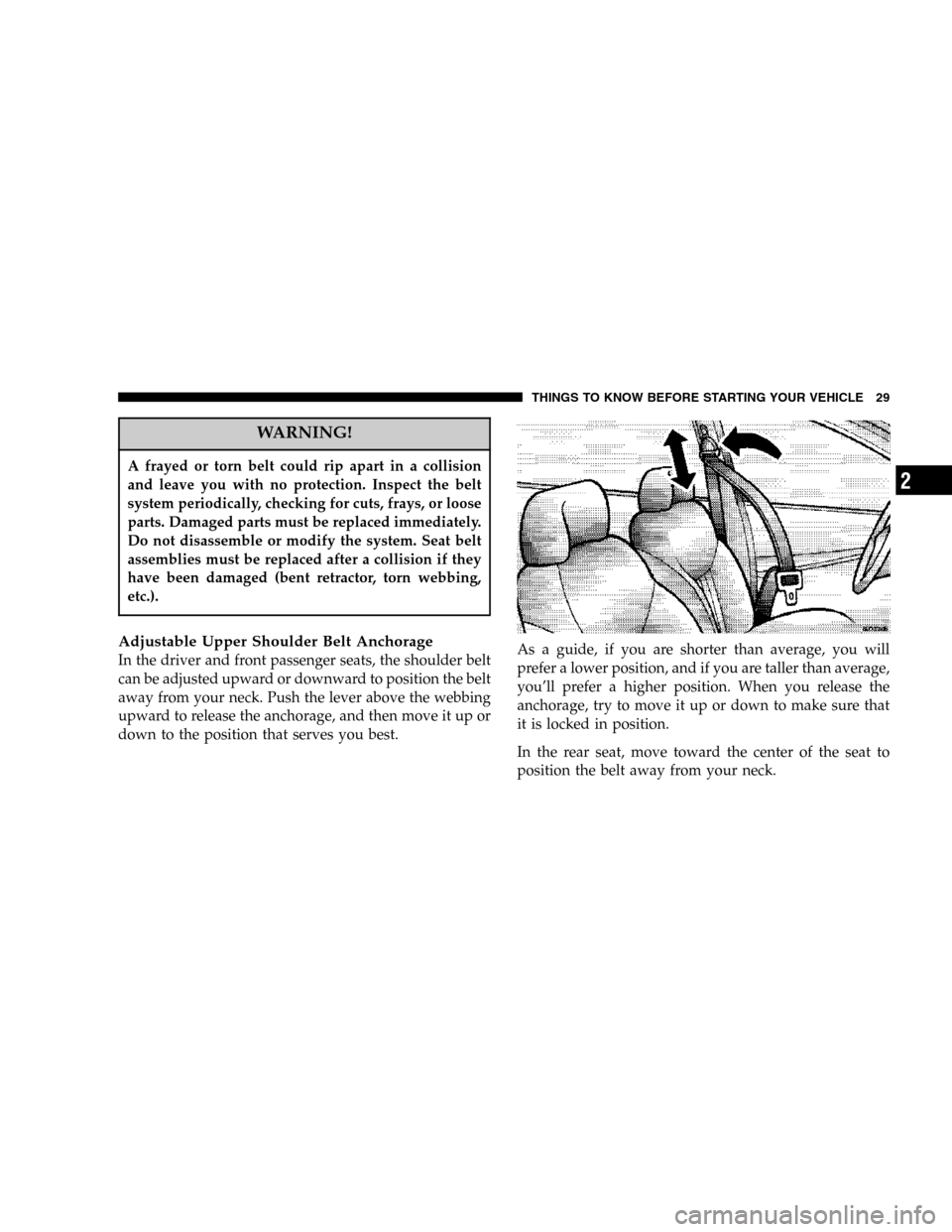
Adjustable Upper Shoulder Belt Anchorage
In the driver and front passenger seats, the shoulder belt
can be adjusted upward or downward to position the belt
away from your neck. Push the lever above the webbing
upward to release the anchorage, and then move it up or
down to the position that serves you best.As a guide, if you are shorter than average, you will
prefer a lower position, and if you are taller than average,
you’ll prefer a higher position. When you release the
anchorage, try to move it up or down to make sure that
it is locked in position.
In the rear seat, move toward the center of the seat to
position the belt away from your neck.
THINGS TO KNOW BEFORE STARTING YOUR VEHICLE 29
2
Page 43 of 300

Again, carefully follow the installation instructions that
were provided with the child restraint system.
The rear seat lower anchorages are round bars, located at
the rear of the seat cushion where it meets the seat back,
and are just visible when you lean into the rear seat to
install the child restraint. You will easily feel them if you
run your finger along the intersection of the seatback and
seat cushion surfaces.
In addition, there are tether strap anchorages
behind each rear seating position located in the
panel between the rear seat back and the rear
window. These tether strap anchorages are
under a hinged plastic cover with this symbol on it.
Many, but not all restraint systems will be equipped with
separate straps on each side, with each having a hook or
connector for attachment to the lower anchorage and a
means of adjusting the tension in the strap. Forward-
facing toddler restraints and some rear-facing infant
restraints will also be equipped with a tether strap, a
hook for attachment to the tether strap anchorage and a
means of adjusting the tension of the strap.You will first loosen the adjusters on the lower straps and
on the tether strap so that you can more easily attach the
hooks or connectors to the vehicle anchorages. Next
attach the lower hooks or connectors over the top of the
anchorage bars, pushing aside the seat cover material.
Then rotate the tether anchorage cover directly behind
the seat where you are placing the child restraint and
attach the tether strap to the anchorage, being careful to
route the tether strap to provide the most direct path
between the anchor and the child restraint. If your
vehicle is equipped with adjustable rear head restraints,
raise the head restraint and, where possible, route the
tether strap under the head restraint and between the two
posts. If not possible, lower the head restraint and route
the tether strap around the outboard side of the head
restraint. Finally, tighten all three straps as you push the
child restraint rearward and downward into the seat,
removing slack in the straps according to the child
restraint manufacturer’s instructions.
NOTE:When using the LATCH attaching system to
install a child restraint, please ensure that all seat belts
not being used for occupant restraints are stowed and out
of reach of children. It is recommended that before
THINGS TO KNOW BEFORE STARTING YOUR VEHICLE 43
2
Page 44 of 300

installing the child restraint buckle the seat belt so the
seat belt is tucked behind the child restraint and out of
reach. If the buckled seat belt interferes with the child
restraint installation, instead of tucking the seat belt
behind the child restraint, route the seat belt through the
child restraint belt path and then buckle it. This should
stow the seat belt out of the reach of an inquisitive child.
Remind all children in the vehicle that the seat belts are
not toys and should not be played with, and never leave
your child unattended in the vehicle.
WARNING!
Improper installation of a child restraint to the
LATCH anchorages can lead to failure of an infant or
child restraint. The child could be badly injured or
killed. Follow the manufacturer’s directions exactly
when installing an infant or child restraint.
Installing Child Restraints Using the Vehicle Seat
belt
The passenger seat belts are equipped with cinching latch
plates which are designed to keep the lap portion tightaround the child restraint so that it is not necessary to use
a locking clip. Pulling up on the shoulder portion of the
lap/shoulder belt will tighten the belt. The cinching latch
plate will keep the belt tight, however, any seat belt
system will loosen with time, so check the belt occasion-
ally and pull it tight if necessary.
In the rear seat, you may have trouble tightening the
lap/shoulder belt on the child restraint because the
buckle or latch plate is too close to the belt path opening
on the restraint. Disconnect the latch plate from the
buckle and twist the short buckle-end belt several times
to shorten it. Insert the latch plate into the buckle with the
release button facing out.
If the belt still can’t be tightened, or if by pulling and
pushing on the restraint loosens the belt, you may need
to do something more. Disconnect the latch plate from
the buckle, turn the buckle around, and insert the latch
plate into the buckle again. If you still can’t make the
child restraint secure, try a different seating position.
44 THINGS TO KNOW BEFORE STARTING YOUR VEHICLE
Page 52 of 300

CONSOLE FEATURES
Console Features — Without Heated Seats
The front console has two cup holders in the front and a
storage bin. An optional removable ashtray may be
located in the driver’s side cup holder.The center console/armrest has a pencil /tire gage holder
and a tissue holder mounted on the underside of the
cover. The bottom of the console bin also has built in
holders for compact discs or cassette tapes. There are also
two cup holders for rear seat passengers located directly
in the back of the center console.
Two coin holders are located toward the front of the
inside of the console bin. The right side coin holder can
accommodate dimes, nickels or pennies, while the left
side coin holder can hold quarters, dimes, nickels, or
pennies. Both can also accommodate various combina-
tions of different types of coins, including some interna-
tional currencies. The slot on the far left side is not for
coins, but for an optional power outlet, if so equipped.
Console
52 UNDERSTANDING THE FEATURES OF YOUR VEHICLE
Page 53 of 300

Console Features — With Heated Seats
The front console has two cup holders. An optional
removable ashtray may be located in the driver’s side cup
holder.The center console/armrest has a pencil /tire gage holder
and a tissue holder mounted on the underside of the
cover. The bottom of the console bin also has built in
holders for compact discs or cassette tapes. The power
outlet is also mounted inside the center console (if
equipped). There are also two cup holders for rear seat
passengers and a rear courtesy lamp located directly in
back of the center console.
Two coin holders are located toward the front of the
inside of the console bin. The right side coin holder can
accommodate dimes, nickels or pennies, while the left
side coin holder can hold quarters, dimes, nickels, or
pennies. Both can also accommodate various combina-
tions of different types of coins, including some interna-
tional currencies.
Console
UNDERSTANDING THE FEATURES OF YOUR VEHICLE 53
3
Page 54 of 300

MIRRORS
Inside Day/Night Mirror— If Equipped
Adjust the mirror to center on the view through the rear
window. A two point pivot system allows for horizontal
and vertical mirror adjustment.
Annoying headlight glare can be reduced by moving the
small control under the mirror to the night position
(toward rear of vehicle). The mirror should be adjusted
while set in the day position (toward windshield).
Automatic Dimming Mirror— If Equipped
This mirror will automatically adjust for annoying head-
light glare from vehicles behind you. Push in the button
on the face of the mirror to activate the dimming feature.
Adjusting Rearview Mirror
Automatic Dimming Mirror
54 UNDERSTANDING THE FEATURES OF YOUR VEHICLE