Page 58 of 296
To Raise The Top:
1. Make sure the rear cargo compartment divider is still
secured in the vertical position.
2. Make sure the decklid is closed.
3. Turn the ignition key to the ON/RUN position and
press down on the front of the convertible top switch.4. If the windows are raised, they will lower as soon as
the convertible switch is pressed down. The tonneau
cover will open, and the top will then close until it
reaches approximately 8 inches (200 mm) from the
header. The tonneau cover will then close and the rear of
the top will close and latch. At the completion of this
cycle, a single audible signal will sound.
NOTE:If the top is latched to the windshield header
before the rear of the top is properly latched, an audible
warning will sound.
5. Pull the latch handle down from the storage position
and turn it clockwise just over one quarter turn.
58 UNDERSTANDING THE FEATURES OF YOUR VEHICLE
Page 61 of 296
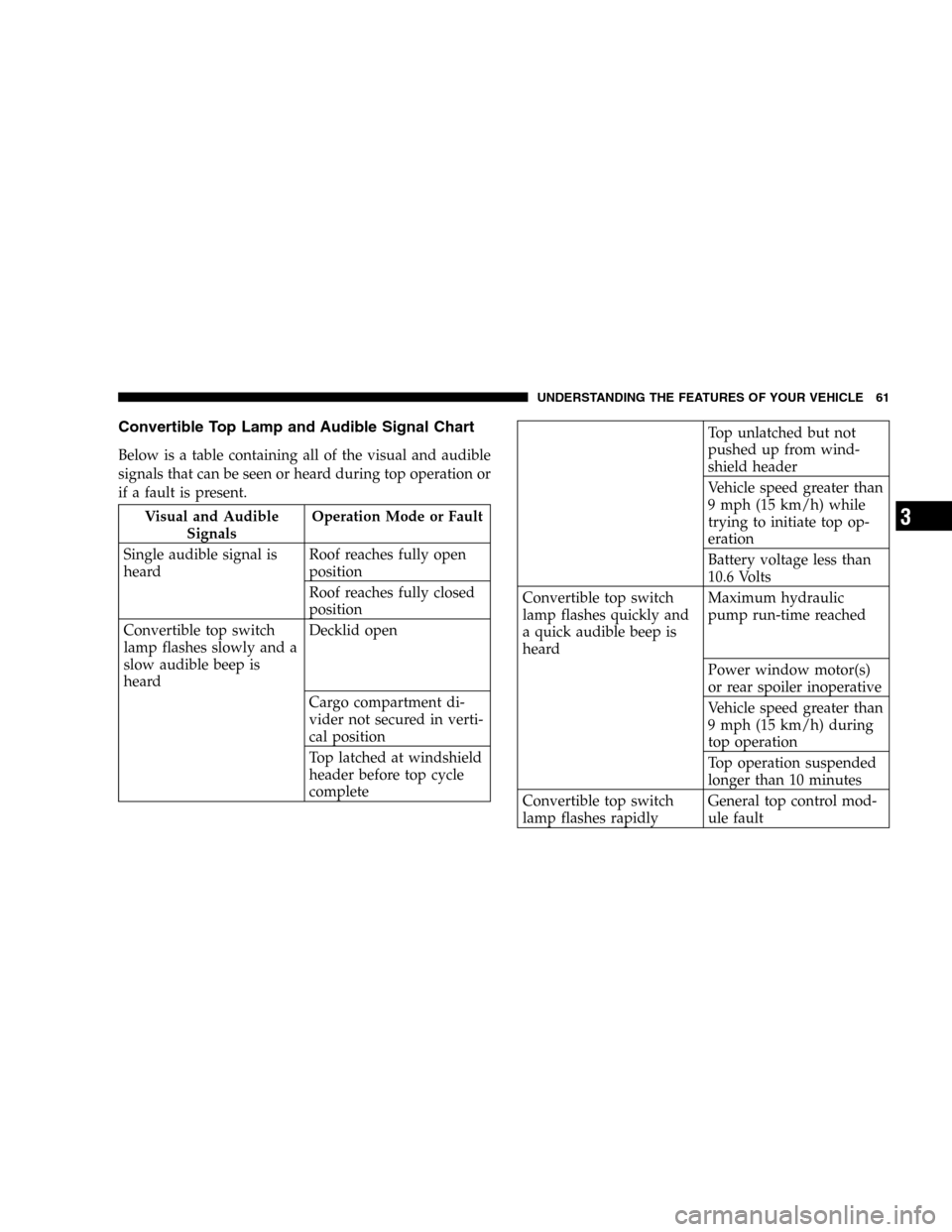
Convertible Top Lamp and Audible Signal Chart
Below is a table containing all of the visual and audible
signals that can be seen or heard during top operation or
if a fault is present.
Visual and Audible
SignalsOperation Mode or Fault
Single audible signal is
heardRoof reaches fully open
position
Roof reaches fully closed
position
Convertible top switch
lamp flashes slowly and a
slow audible beep is
heardDecklid open
Cargo compartment di-
vider not secured in verti-
cal position
Top latched at windshield
header before top cycle
complete
Top unlatched but not
pushed up from wind-
shield header
Vehicle speed greater than
9 mph (15 km/h) while
trying to initiate top op-
eration
Battery voltage less than
10.6 Volts
Convertible top switch
lamp flashes quickly and
a quick audible beep is
heardMaximum hydraulic
pump run-time reached
Power window motor(s)
or rear spoiler inoperative
Vehicle speed greater than
9 mph (15 km/h) during
top operation
Top operation suspended
longer than 10 minutes
Convertible top switch
lamp flashes rapidlyGeneral top control mod-
ule fault
UNDERSTANDING THE FEATURES OF YOUR VEHICLE 61
3
Page 62 of 296
CONSOLE FEATURES
The console has a power outlet/cigar lighter, an ash tray
with a coin holder, a cupholder (if equipped), and the
passenger airbag light. In addition, there are switches to
control the heated seats (if equipped), rear spoiler, elec-
tronic stability program (ESP), hazard flashers, central
locking, rear defroster and towing alarm.
Operating controls for the heating and air conditioning
systems, power windows, power mirrors, convertible top
switch (if equipped), and the automatic transmission
program mode selector switch (if equipped) are also
located in the console.
62 UNDERSTANDING THE FEATURES OF YOUR VEHICLE
Page 67 of 296

MIRRORS
Inside Day/Night Mirror
Adjust the mirror to center on the view through the rear
window. A two point pivot system allows for horizontal
and vertical mirror adjustment.
Annoying headlight glare can be reduced by moving the
small control under the mirror to the night position
(toward rear of vehicle) The mirror should be adjusted
with the glare control set in the day position (toward
windshield).
Exterior Mirrors Folding Feature
All exterior mirrors are hinged to move forward or
rearward to resist damage. The hinges have three detent
positions: full forward, full rearward, and normal.
Heated Remote Control Mirrors (If Equipped)
Both outside mirrors are heated to melt frost or ice when
the Rear Window Defroster switch is depressed.
Outside Mirrors
Adjust the outside mirrors to center on the adjacent lane
of traffic, with a slight overlap of the view seen in the
inside mirror.
WARNING!
Vehicles and other objects seen in the passenger side
convex mirror will look smaller and farther away
than they actually are. Relying too much on your
passenger side mirror could cause you to collide
with another vehicle or other object. Use your inside
mirror to judge the size or distance of objects seen in
the convex mirror.
UNDERSTANDING THE FEATURES OF YOUR VEHICLE 67
3
Page 87 of 296
REAR SPOILER
CAUTION!
Do not push or pull on the spoiler when deployed.
Damage to the spoiler could result.
A rear spoiler enhances vehicle stability. The rear spoiler
deploys automatically when vehicle speed reaches ap-
proximately 62 mph (100 km/h). The spoiler begins to
retract at 39 mph (62 km/h). When retracted, the spoiler
fits between the quarter panels, and aft of the liftgate
window or tonneau cover.The spoiler can also be deployed at lower speeds using
an override switch mounted in the center console.
Once manually deployed, the spoiler will only retract by
pressing the bottom of the spoiler switch. The spoiler will
then retract in steps as long as the switch is depressed. If
the switch is depressed until the spoiler is fully retracted,
a short beep will be heard, and automatic control will be
reestablished.
UNDERSTANDING THE FEATURES OF YOUR VEHICLE 87
3
Page 118 of 296

CHECKING ENGINE OIL LEVEL
A sensor in the oil pan allows oil level to be checked
without opening the hood. It provides an accurate mea-
surement of oil level, whereas the low engine oil level
indicator warns that oil level is definitely too low. With
the vehicle parked on a level surface, the engine is
warmed up and shut off for approximately five minutes.
When the ignition switch is turned to the ON/RUN
position, an ISO oil level icon appears in the trip odom-
eter window and a “clock” icon in the cumulative
odometer display. Pressing the knob to the left of the
speedometer twice within one second displays one of the
following messages:
•OK
•-1.0 Q (-1.0L)
•-1.5 Q (-1.5L)
•-2.0 Q (-2.0L)
•HIThe indicated amount of oil must be added to the engine
if the message -2.0 Q (-2.0L) blinks and a signal sounds.
The HI message indicates that the excess oil must be
removed from the pan to avoid possible engine or
catalytic converter damage. If the ISO oil level icon and
“clock” icon remain on when attempting to check oil
level and no message follows, or if the low engine oil
level warning lamp comes on, a malfunction in the
engine oil level system is indicated. A conveniently
located dipstick allows manual checking of the oil level.
If no leaks are noted, continue to drive to the nearest
service station where the engine oil should be topped to
the “full” mark on the dipstick with an approved oil.
29. Low Fuel Warning Light
When the fuel level drops to about 2 gallons (7.5
liters), this symbol will light and remains lit until
fuel is added.
118 UNDERSTANDING YOUR INSTRUMENT PANEL
Page 127 of 296

Call up the user menu, then press the right rotary
control/push button repeatedly until AUDIO PH or PH
MUTE is displayed (depending on the currently selected
setting, you may need to turn the knob also for your
selection).
COMPACT DISC MAINTENANCE
To keep the compact discs in good condition, take the
following precautions:
1. Handle the disc by its edge; avoid touching the
surface.
2. If the disc is stained, clean the surface with a soft cloth,
wiping from center to edge.
3. Do not apply paper or tape to the disc; avoid scratch-
ing the disc.
4. Do not use solvents such as benzine, thinner, cleaners,
or antistatic sprays.
5. Store the disc in its case after playing.
6. Do not expose the disc to direct sunlight.7. Do not store the disc where temperatures may become
too high.
RADIO ANTENNA
The radio antenna is located in the rear liftgate glass on
the coupe vehicles and mounted on the left rear body
panel on the roadster vehicles. The antenna requires no
maintenance.
CAUTION!
Window tint films applied to the liftgate glass of
coupe vehicles can significantly degrade radio recep-
tion if they contain any metallic content. Before
applying any film to increase occupant privacy or
reduce the heating effect of the sun, make sure that
the film does not contain any metallic substances.
UNDERSTANDING YOUR INSTRUMENT PANEL 127
4
Page 128 of 296

RADIO OPERATION AND CELLULAR PHONES
Under certain conditions, the operation of a cellular
phone in your vehicle can cause erratic or noisy perfor-
mance from your radio. This condition may be lessened
or eliminated by relocating the cellular phone antenna.
This condition is not harmful to the radio. If your radio
performance does not satisfactorily “clear” by the repo-
sitioning of the antenna, it is recommended that the radio
volume be turned down or off during cellular phone
operation.
CLIMATE CONTROLS
1. Driver Temperature Control
2. Passenger Temperature Control
3. Fan Speed Control
4. Air Recirculation/REST
5. Air Conditioning ON/OFF
6. Rear Window Defroster
7. Air Distribution (Mode) Control
The climate control system allows you to balance the
temperature, amount and direction of the air circulating
throughout the vehicle.
The system is always at operational readiness, except
when manually switched off. The climate control only
operates with the engine running.
The climate control removes a considerable amount of
moisture from the air during operation in the air condi-
tioning mode, therefore it is considered normal operation
for water to drip on the ground through ducts in the
underbody.
128 UNDERSTANDING YOUR INSTRUMENT PANEL


