Page 212 of 296

Engine Oil Selection
For best performance and maximum protection under all
types of operating conditions, only use synthetic engine
oils, approved to MB 229.3 or MB 229.5, such as Mobil 1
SAE 0W-40. The FSS may not alert for an oil change at the
proper interval if an unapproved engine oil is used;
engine damage and reduced engine life may result.
Materials Added To Engine Oils
Do not add materials (other than leak detection dyes) to
engine oil. Engine oil is an engineered product and its
performance may be impaired by supplemental addi-
tives.
Disposing of Used Engine Oil
Care should be taken in disposing of used engine oil from
your vehicle. Used oil, indiscriminately discarded, can
present a problem to the environment. Contact your
dealer, service station, or governmental agency for advice
on how and where used oil can be safely discarded in
your area.
Engine Oil Filter
The engine oil filter should be replaced at every engine
oil change.
Engine Oil Filter Selection
All DaimlerChrysler Corporation engines have a full-
flow type disposable oil filter. Use a filter of this type for
replacement. The quality of replacement filters varies
considerably. Only high quality filters should be used to
assure most efficient service. Mopar�Engine Oil Filters
are high quality oil filters and are recommended.
212 MAINTAINING YOUR VEHICLE
Page 219 of 296

Insert the key into the lock cylinder and rotate from the
unlocked to the locked position without adding more
lubricant. Repeat this procedure three or four times. Wipe
all the lubricant off the key with a clean cloth, to avoid
soiling clothing.
Windshield Wiper Blades
Clean the rubber edges of the wiper blades and the
windshield periodically with a sponge or soft cloth and a
mild non-abrasive cleaner, or use the washer solvent.
This will remove accumulations of salt or road film and
help reduce streaking, chatter, and smearing.
Operation of the wipers on dry glass for long periods
may cause deterioration of the wiper blades. Always use
washer fluid when using the wipers to remove salt or dirt
from a dry windshield. Avoid using the wiper blades to
remove frost or ice from the windshield. Make sure that
they are not frozen to the glass before turning them on to
avoid damaging the blade. Keep the blade rubber out of
contact with petroleum products such as engine oil,
gasoline, etc.
Windshield Wiper Blade Replacement
1. Lift the wiper arm away from the glass.
2. Rotate the blade 45 degrees to gain access to the
release tab.
3. Push the release tab as shown in the illustration and
slide the wiper blade assembly down along the arm.
Gently place the wiper arm on the windshield.
4. Install the new blade assembly onto the wiper arm tip
until it locks in place.
MAINTAINING YOUR VEHICLE 219
7
Page 221 of 296
Exhaust System
The best protection against carbon monoxide entry into
the vehicle body is a properly maintained engine exhaust
system.
If you notice a change in the sound of the exhaust system,
or if exhaust fumes can be detected inside the vehicle, or
when the underside or rear of the vehicle is damaged,
have a competent technician inspect the complete ex-
haust system and adjacent body areas for broken, dam-
aged, deteriorated, or mispositioned parts. Open seams
or loose connections could permit exhaust fumes to seep
into the passenger compartment. In addition, inspect the
exhaust system each time the vehicle is raised for lubri-
cation or oil change. Replace as required.WARNING!
Exhaust gases can injure or kill. They contain carbon
monoxide which is colorless and odorless. Breathing
it can make you unconscious and can eventually
poison you. Follow the above precautions to keep
your exhaust system as safe as possible.
MAINTAINING YOUR VEHICLE 221
7
Page 226 of 296

WARNING!
Riding the brakes can lead to brake failure and
possibly an accident. Driving with your foot resting
or riding on the brake pedal can result in abnormally
high brake temperatures, excessive lining wear, and
possible brake damage. You wouldn’t have your full
braking capacity in an emergency.
Brake and Power Steering System Hoses
When servicing the vehicle for scheduled maintenance,
inspect surface of hoses and nylon tubing for evidence of
heat and mechanical damage. Hard and brittle rubber,
cracking, checking, tears, cuts, abrasions, and excessive
swelling suggest deterioration of the rubber. Particular
attention should be made to examining those hose sur-
faces nearest to high heat sources, such as the exhaust
manifold.
Inspect all hose clamps and couplings to make sure they
are secure and no leaks are present.
Insure nylon tubing in these areas has not melted or
collapsed.
NOTE:Often, fluids such as oil, power steering fluid,
and brake fluid are used during assembly plant opera-
tions to ease the assembly of hoses to couplings. There-
fore, oil wetness at the hose-coupling area is not neces-
sarily an indication of leakage. Actual dripping of hot
fluid when systems are under pressure (during vehicle
operation) should be noted before a hose is replaced
based on leakage.
NOTE:Inspection of brake hoses should be done
whenever the brake system is serviced and at every
engine oil change.
WARNING!
Worn brake hoses can burst and cause brake failure.
You could have an accident. If you see any signs of
cracking, scuffing, or worn spots, have the brake
hoses replaced immediately.
226 MAINTAINING YOUR VEHICLE
Page 229 of 296

NOTE:Refer to Section 8 of this manual for Mainte-
nance Schedules.
Manual Transmission
Selection of Lubricant
No fluid service is required. Use only fluid approved to
MB 236.2. SAE 5W-20 engine oil, meeting API SL or GF-3,
may be substituted. Refer to the Recommended Fluids,
Lubricants and Genuine Parts section for the correct fluid
type.
Fluid Level Check
Check the fluid level by removing the fill plug. The fluid
level should be between the bottom of the fill hole and a
point not more than 3/16 inch (4.76 mm) below the
bottom of the hole.
CAUTION!
Do not overfill. Dirt and water in the transmission
can cause serious damage. To prevent dirt and water
from entering the transmission after checking or
replenishing fluid, make certain that the dipstick cap
is seated properly.
Add fluid, if necessary, to maintain the proper level.
Frequency of Fluid Change
Under normal operation conditions, the fluid installed at
the factory will give satisfactory lubrication for the life of
the vehicle. Fluid changes are not necessary unless the
lubricant has become contaminated with water. If con-
taminated with water, the fluid should be changed im-
mediately.
Special Additives
Do not add any fluid additives to the transmission. The
only exception to this policy is the use of special dyes to
aid in detecting fluid leaks. The use of transmission
sealers should be avoided as this may adversely affect
seals.
MAINTAINING YOUR VEHICLE 229
7
Page 239 of 296
Underhood Accessory Fuse Block Fuses
Cavity Fuse Circuits
1 5 Amp
BeigeGarage Door Opening Signal,
TPM and Seat Heater
2 5 Amp
BeigeOccupant Restraint Controller
Passenger Airbag Off
3 5 Amp
BeigeIndicator, Safety Restraint System
and Indicator, Passenger Airbag
Off
4 7.5 Amp
BrownHeated Mirror
5 15 Amp
BlueRadio (Coupe)
5 20 Amp
YellowRoof Control Module (Roadster)
6 5 Amp
BeigeExterior Mirror Adjustment, Left
And Right (Coupe)
6 40 Amp
OrangeRoof Hydraulic Unit (Roadster)
7 5 Amp
BeigeElectronic Transmission Control
(Park/Reversing Lock) and BCM
Cavity Fuse Circuits
8 15 Amp
BlueRadio
9 10 Amp
RedRoof Light, Horn, Anti-Theft
Alarm, Cargo Lamp and Tire
Pressure Control
10 5 Amp
BeigeSpeed Control
11 15 Amp
BlueIgnition Coil 6 Cyl.
12 10 Amp
RedHeated Washer Nozzles
13 Spare
14 10 Amp
RedDiagnostic Socket
15 5 Amp
BeigeResidual Engine Heat Utilization
16 10 Amp
RedSpoiler Motor
17 40 Amp
OrangeElectronic Stability Program
MAINTAINING YOUR VEHICLE 239
7
Page 247 of 296

the vehicle and then readjust the headlights to the
original position. If any further adjustments are neces-
sary contact your manufacturer’s dealer. A detailed ser-
vice procedure is contained in the manufacturer’s Service
Manual. Information on purchasing a Service Manual can
be found at the back of this Owner’s Manual.
VEHICLE STORAGE
We recommend that you follow these guidelines before
storing your Crossfire for extended periods.
•Fill the gas tank. This will prevent water condensation
inside the tank. If you plan on storing your vehicle
more than two months, add an anti-oxidant fuel
stabilizer to the gas tank.
•Change the oil to remove any corrosive combustion-
related acids in the crankcase.
•Wash and wax the vehicle to protect the finish.
•Cover the vehicle whenever possible to prevent acci-
dental damage to the finish.
•Store the vehicle in a dry, well-ventilated location.
•If the vehicle will be subjected to freezing tempera-
tures, remove the battery and store it in a dry, well-
ventilated place. If the vehicle is not going to be driven
in the next three weeks, follow the battery recharge
procedure in the Service Manual, then disconnect the
battery at the negative terminal.
CAUTION!
Use care when disconnecting the remote positive
cable. It is connected to the battery and can short out
to any metal on the vehicle. Always tape or wrap the
exposed cable end to prevent electrical shorts.
Disconnecting the battery causes the engine control sys-
tem to lose memory of some “learned” functions. The
engine may run rough when first started after a battery
disconnect until the control module “relearns” these
functions.
MAINTAINING YOUR VEHICLE 247
7
Page 251 of 296
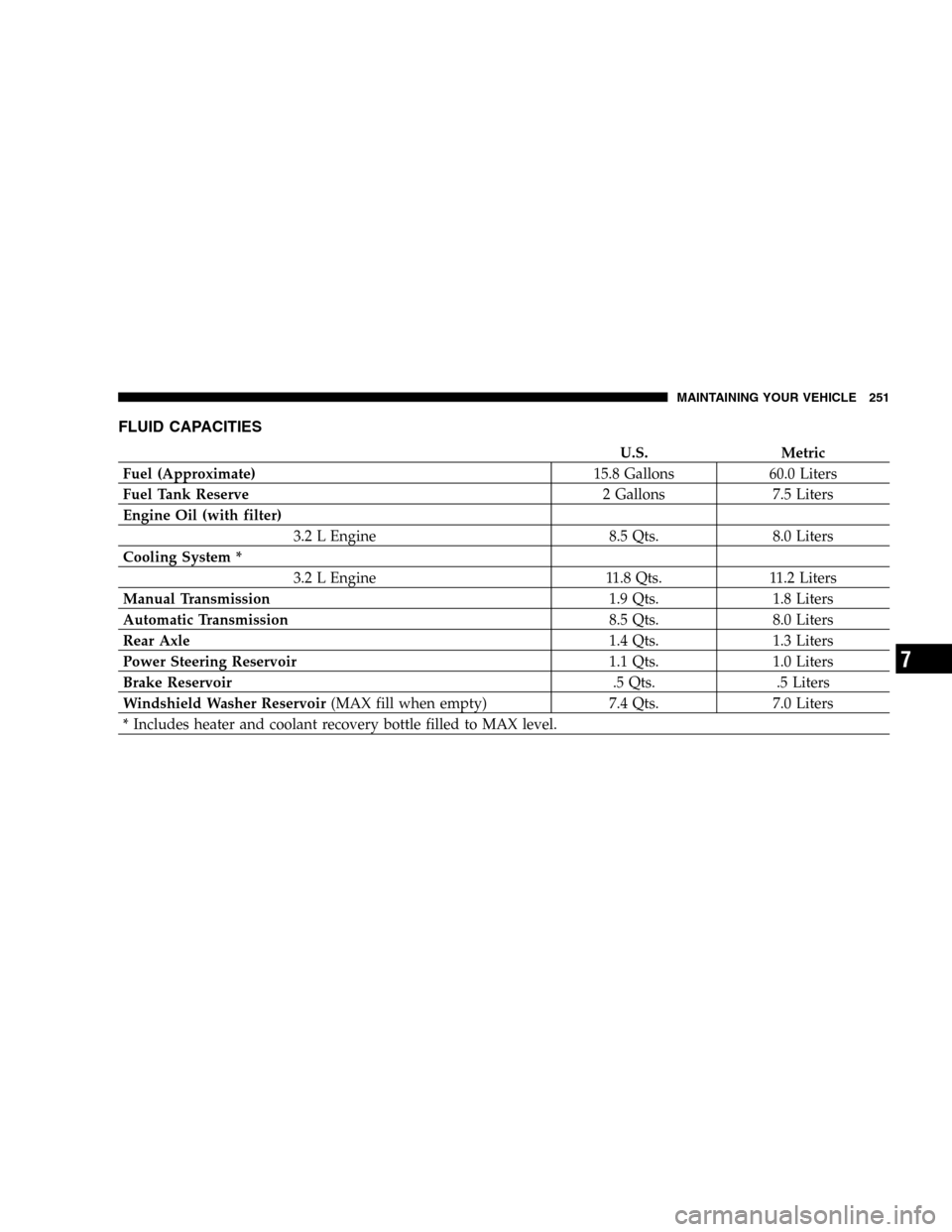
FLUID CAPACITIES
U.S. Metric
Fuel (Approximate)15.8 Gallons 60.0 Liters
Fuel Tank Reserve2 Gallons 7.5 Liters
Engine Oil (with filter)
3.2 L Engine 8.5 Qts. 8.0 Liters
Cooling System *
3.2 L Engine 11.8 Qts. 11.2 Liters
Manual Transmission1.9 Qts. 1.8 Liters
Automatic Transmission8.5 Qts. 8.0 Liters
Rear Axle1.4 Qts. 1.3 Liters
Power Steering Reservoir1.1 Qts. 1.0 Liters
Brake Reservoir.5 Qts. .5 Liters
Windshield Washer Reservoir(MAX fill when empty) 7.4 Qts. 7.0 Liters
* Includes heater and coolant recovery bottle filled to MAX level.
MAINTAINING YOUR VEHICLE 251
7