Page 224 of 296

Please note that it is the owner’s responsibility to main-
tain the proper level of protection against freezing,
according to the temperatures occurring in the area
where the vehicle is operated.
Cooling System Pressure Cap
The cap must be fully tightened to prevent loss of
coolant, and to insure that coolant will return to the
radiator from the coolant reserve tank.
The cap should be inspected and cleaned if there is any
accumulation of foreign material on the sealing surfaces.
WARNING!
The warning words “DO NOT OPEN WHEN HOT”
near the cooling system reservoir cap are a safety
precaution. Never add coolant when the engine is
overheated. Do not loosen or remove the cap to cool
an overheated engine. Heat causes pressure to build
up in the cooling system. To prevent scalding or
injury, do not remove the pressure cap while the
system is hot or under pressure.
WARNING!
Do not use a pressure cap other than the one speci-
fied for your vehicle. Personal injury or engine
damage may result.
Points to Remember
NOTE:
When the vehicle is stopped after a few miles/
kilometers of operation, you may observe vapor coming
from the front of the engine compartment. This is nor-
mally a result of moisture from rain, snow, or high
humidity accumulation on the radiator and being vapor-
ized when the thermostat opens, allowing hot water to
enter the radiator.
If an examination of your engine compartment shows no
evidence of radiator or hose leaks, the vehicle may be
safely driven. The vapor will soon dissipate.
•Do not overfill the coolant bottle.
•Check coolant freeze point in the system.
224 MAINTAINING YOUR VEHICLE
Page 225 of 296

•If frequent coolant additions are required, or if the
level in the recovery bottle does not drop when the
engine cools, the cooling system should be pressure
tested for leaks.
•Maintain a coolant concentration of a minimum of 50%
ethylene glycol Extended Life Coolant and high qual-
ity water with recommended antifreeze for proper
corrosion protection of your engine cooling system
that contains aluminum components.
•Make sure that the radiator and coolant bottle hoses
are not kinked or obstructed.
•Keep the front of the radiator clean. If your vehicle has
air conditioning, keep the front of the condenser clean,
also.
•Do not change the thermostat for summer or winter
operation. If replacement is ever necessary, install
ONLY the correct type thermostat. Other designs may
result in unsatisfactory coolant performance, poor fuel
economy, and increased emissions.
Hoses And Vacuum/Vapor Harnesses
Inspect surfaces of hoses and nylon tubing for evidence
of heat and mechanical damage. Hard or soft spots,
brittle rubber, cracking, checking, tears, cuts, abrasions,
and excessive swelling indicate deterioration of the rub-
ber.
Pay particular attention to the hoses nearest to high heat
sources such as the exhaust manifold. Inspect hose rout-
ing to be sure hoses do not touch any heat source or
moving component that may cause heat damage or
mechanical wear.
Insure nylon tubing in these areas has not melted or
collapsed. Inspect all hose connections such as clamps
and couplings to make sure they are secure and no leaks
are present. Components should be replaced immedi-
ately if there is any evidence of degradation that could
cause failure.
Brakes
In order to assure brake system performance, all brake
system components should be inspected periodically.
Suggested service intervals can be found in the Mainte-
nance section.
MAINTAINING YOUR VEHICLE 225
7
Page 251 of 296
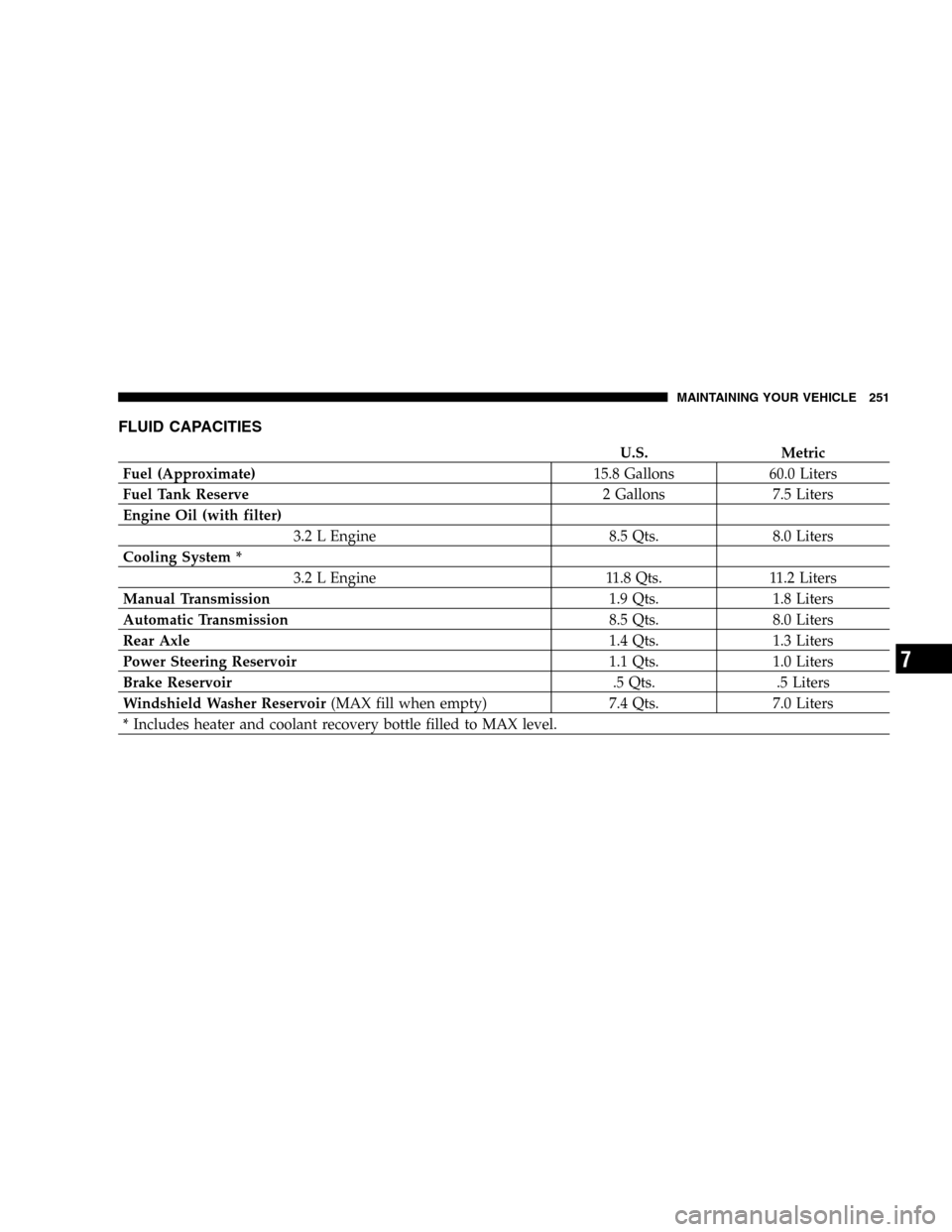
FLUID CAPACITIES
U.S. Metric
Fuel (Approximate)15.8 Gallons 60.0 Liters
Fuel Tank Reserve2 Gallons 7.5 Liters
Engine Oil (with filter)
3.2 L Engine 8.5 Qts. 8.0 Liters
Cooling System *
3.2 L Engine 11.8 Qts. 11.2 Liters
Manual Transmission1.9 Qts. 1.8 Liters
Automatic Transmission8.5 Qts. 8.0 Liters
Rear Axle1.4 Qts. 1.3 Liters
Power Steering Reservoir1.1 Qts. 1.0 Liters
Brake Reservoir.5 Qts. .5 Liters
Windshield Washer Reservoir(MAX fill when empty) 7.4 Qts. 7.0 Liters
* Includes heater and coolant recovery bottle filled to MAX level.
MAINTAINING YOUR VEHICLE 251
7
Page 258 of 296

Your Flexible Service System (FSS) — see Understanding
Your Instrument Panel section — should give you an
exact indication of when your vehicle should be sched-
uled for service and which schedule to follow.
Additional Periodic Maintenanceitems should also be
performed beyond the items listed in the following charts
to assure the optimum performance of your Crossfire.
SCOPE OF WORK FOR “A” SCHEDULE
MAINTENANCE SERVICE
Oil Change
•Change oil and replace filter
Maintenance
•Lubricate hood hinges, latch, and secondary latch
•Reset FSS Display
Function Check
•Horn, hazard warning flashers, turn signals, and indi-
cator lamps
•Headlamps and exterior lighting
•Windshield wipers and washer system
Inspection
•Check front and rear brake pads for lining thickness
•Check tires for damage and general condition
•Check tire inflation pressures and correct if necessary
Fluid Levels
Check fluid levels for the following systems and correct if
necessary. Should there be a loss of fluid that cannot be
explained by regular use, trace and eliminate the cause.
•Engine cooling system (check corrosion inhibitor/
antifreeze)
•Hydraulic brake system
•Power steering system
•Windshield washer system
258 MAINTENANCE SCHEDULES
8
M
A
I
N
T
E
N
A
N
C
E
S
C
H
E
D
U
L
E
S
Page 260 of 296
Fluid Levels
Check fluid levels for the following systems and correct if
necessary. Should there be a loss of fluid that cannot be
explained by regular use, trace and eliminate the cause.
•Engine cooling system (check corrosion inhibitor/
antifreeze)
•Hydraulic brake system
•Power steering system
•Windshield washer system
FSS SYSTEM
The Flexible Service System (FSS) permits a flexible service
schedule that is directly related to the operating conditions
of the vehicle. See the Understanding Your Instrument
Panel section for details on how to use the FSS.
The oil change interval for your Crossfire is initially set at
7,000 miles (Canada: 11,000 km). Very light duty driving
cycles (most trips more than 10 miles [16 km] at moderate
speeds in moderate temperature conditions) can extend
the service interval beyond 7,000 miles (Canada: 11,000km). IfANYof the following apply to your driving, the
oil change interval can be reduced significantly:
Day or night temperatures are below 32°F (0°C).
Stop and go driving.
Extensive engine idling.
Driving in dusty conditions.
Short trips of less than 10 miles (16 km).
More than 50% of your driving is at sustained high
speeds during hot weather, above 90°F (32°C).
There are two symbols which will appear in the main
odometer display field prior to the next suggested service.
This symbol represents Service A.
This second symbol represents Service B. Ser-
vice B rotates with Service A and includes
additional service tasks.
260 MAINTENANCE SCHEDULES
8
M
A
I
N
T
E
N
A
N
C
E
S
C
H
E
D
U
L
E
S
Page 283 of 296

Carbon Monoxide Warning................ 47
Cargo Compartment
Capacity............................ 175
Catalytic Converter..................... 214
CD Player......................... 119,123
Chains, Tire........................... 167
Changing A Flat Tire.................... 180
Charging System Light................... 112
Checks, Safety.......................... 47
Child Restraint......................... 40
Child Restraint Tether Anchors............. 45
Cigar Lighter........................... 65
Circuit Breakers........................ 237
Clean Air Gasoline...................... 171
Cleaning
Glass.............................. 233
Headlights.......................... 233
Climate Control........................ 128
Coin Holder........................... 65
Compact Disc Maintenance............... 127
Console............................... 62
Contract, Service....................... 268
Converter, Catalytic..................... 183Convertible............................ 52
Convertible Top......................... 52
Convertible Top Maintenance.............. 234
Convertible Top Manual Override.......... 195
Coolant (Antifreeze)..................223,264
Cooling System........................ 222
Adding Coolant (Antifreeze)............. 223
Coolant Level........................ 222
Disposal of Used Coolant............... 223
Drain, Flush, and Refill................. 222
Points to Remember................... 224
Pressure Cap........................ 224
Rubber and Plastic Components.......... 225
Selection of Coolant (Antifreeze).......... 223
Corrosion Protection.................... 230
Crankcase Emission Control System......... 215
Cup Holder............................ 66
Customer Assistance.................... 266
Cylinders, Lock........................ 218
Dealer Service......................... 208
Deck Lid.............................. 19
Defroster, Windshield..................... 48
INDEX 283
10