2006 CHEVROLET UPLANDER parking brake
[x] Cancel search: parking brakePage 351 of 458
{CAUTION:
Batteries can hurt you. They can be dangerous
because:
They contain acid that can burn you.
They contain gas that can explode or ignite.
They contain enough electricity to
burn you.
If you do not follow these steps exactly, some or
all of these things can hurt you.
Notice:Ignoring these steps could result in costly
damage to your vehicle that would not be covered
by your warranty.
Trying to start your vehicle by pushing or pulling it
will not work, and it could damage your vehicle.
1. Check the other vehicle. It must have a 12-volt
battery with a negative ground system.Notice:If the other vehicle’s system is not a 12-volt
system with a negative ground, both vehicles can
be damaged. Only use vehicles with 12-volt systems
with negative grounds to jump start your vehicle.
2. Get the vehicles close enough so the jumper cables
can reach, but be sure the vehicles are not touching
each other. If they are, it could cause a ground
connection you do not want. You would not be able
to start your vehicle, and the bad grounding
could damage the electrical systems.
To avoid the possibility of the vehicles rolling, set
the parking brake rmly on both vehicles involved in
the jump start procedure. Put an automatic
transaxle in PARK (P) or a manual transaxle in
NEUTRAL before setting the parking brake.
Notice:If you leave your radio or other accessories
on during the jump starting procedure, they could
be damaged. The repairs would not be covered
by your warranty. Always turn off your radio and
other accessories when jump starting your vehicle.
3. Turn off the ignition on both vehicles. Unplug
unnecessary accessories plugged into the cigarette
lighter or the accessory power outlet. Turn off
the radio and all lamps that are not needed. This
will avoid sparks and help save both batteries. And
it could save the radio!
5-39
ProCarManuals.com
Page 379 of 458
{CAUTION:
Changing a tire can be dangerous. The vehicle
can slip off the jack and roll over or fall on you
or other people. You and they could be badly
injured or even killed. Find a level place to
change your tire. To help prevent the vehicle
from moving:
1. Set the parking brake rmly.
2. Put the shift lever in PARK (P).
3. Turn off the engine and do not restart
while the vehicle is raised.
4. Do not allow passengers to remain in the
vehicle.
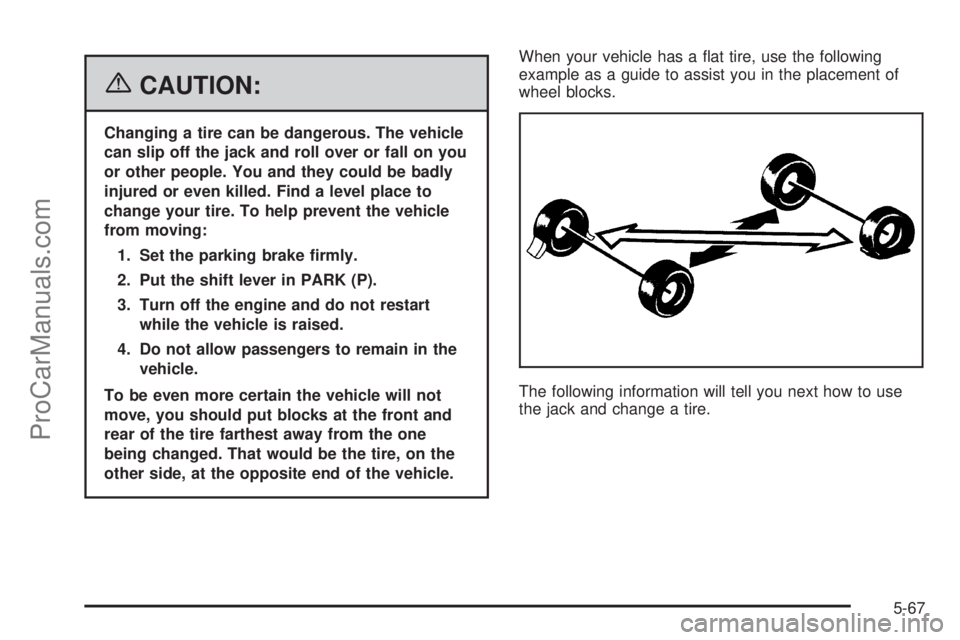
To be even more certain the vehicle will not
move, you should put blocks at the front and
rear of the tire farthest away from the one
being changed. That would be the tire, on the
other side, at the opposite end of the vehicle.When your vehicle has a at tire, use the following
example as a guide to assist you in the placement of
wheel blocks.
The following information will tell you next how to use
the jack and change a tire.
5-67
ProCarManuals.com
Page 419 of 458

Maintenance Footnotes
#Lubricate the suspension, steering linkage, transaxle
shift linkage, and the underbody contact points and
linkage.
(a)Visually inspect brake lines and hoses for proper
hook-up, binding, leaks, cracks, chang, etc. Inspect
disc brake pads for wear and rotors for surface
condition. Inspect other brake parts, including calipers,
parking brake, etc. Check parking brake adjustment.
(b)Visually inspect front and rear suspension and
steering system for damaged, loose, or missing parts,
signs of wear, or lack of lubrication. Inspect power
steering lines and hoses for proper hook-up, binding,
leaks, cracks, chang, etc.
(c)Visually inspect hoses and have them replaced if
they are cracked, swollen, or deteriorated. Inspect
all pipes, ttings and clamps; replace with genuine GM
parts as needed. To help ensure proper operation, a
pressure test of the cooling system and pressure
cap and cleaning the outside of the radiator and air
conditioning condenser is recommended at least
once a year.
(d)Visually inspect wiper blades for wear or cracking.
Replace wiper blades that appear worn or damaged
or that streak or miss areas of the windshield.(e)Make sure the safety belt reminder light and all your
belts, buckles, latch plates, retractors, and anchorages
are working properly. If your vehicle has a built-in
child restraint, make sure the harness straps, latch
plates, buckle, clip, child head restraint, and anchorages
are working properly. Look for any other loose or
damaged safety belt system parts. If you see anything
that might keep a safety belt system from doing its
job, have it repaired. Have any torn or frayed safety belts
replaced. Also look for any opened or broken airbag
coverings, and have them repaired or replaced.
The airbag system does not need regular maintenance.
(f)Lubricate all key lock cylinders, hood latch
assemblies, secondary latches, pivots, spring anchor
and release pawl, hood and door hinges, rear folding
seats, liftgate hinges, fuel door hinge, power sliding door
cable, and sliding door track(s). More frequent
lubrication may be required when exposed to a corrosive
environment. Applying silicone grease on weatherstrips
with a clean cloth will make them last longer, seal
better, and not stick or squeak.
(g)If you drive regularly under dusty conditions, inspect
the lter at each engine oil change.
6-7
ProCarManuals.com
Page 421 of 458

Engine Coolant Level Check
Check the engine coolant level and add
DEX-COOL®coolant mixture if necessary. SeeEngine
Coolant on page 5-23for further details.
Windshield Washer Fluid Level Check
Check the windshield washer uid level in the windshield
washer uid reservoir and add the proper uid if
necessary.
At Least Once a Month
Tire Ination Check
Visually inspect your vehicle’s tires and make sure they
are inated to the correct pressures. Do not forget to
check the spare tire. SeeTires on page 5-50for further
details. Check to make sure the spare tire is stored
securely. SeeChanging a Flat Tire on page 5-66.
Tire Wear Inspection
Tire rotation may be required for high mileage highway
drivers prior to the Engine Oil Life System service
notication. Check the tires for wear and, if necessary,
rotate the tires. SeeTire Inspection and Rotation on
page 5-57.
At Least Once a Year
Starter Switch Check
{CAUTION:
When you are doing this inspection, the
vehicle could move suddenly. If the vehicle
moves, you or others could be injured.
1. Before you start, be sure you have enough room
around the vehicle.
2. Firmly apply both the parking brake and the regular
brake. SeeParking Brake on page 2-37.
Do not use the accelerator pedal, and be ready to
turn off the engine immediately if it starts.
3. Try to start the engine in each gear. The vehicle
should start only in PARK (P) or NEUTRAL (N). If
the vehicle starts in any other position, contact your
GM Goodwrench
®dealer for service.
6-9
ProCarManuals.com
Page 422 of 458

Automatic Transaxle Shift Lock Control
System Check
{CAUTION:
When you are doing this inspection, the
vehicle could move suddenly. If the vehicle
moves, you or others could be injured.
1. Before you start, be sure you have enough room
around the vehicle. It should be parked on a level
surface.
2. Firmly apply the parking brake. SeeParking Brake
on page 2-37.
Be ready to apply the regular brake immediately if
the vehicle begins to move.3. With the engine off, turn the ignition to RUN, but do
not start the engine. Without applying the regular
brake, try to move the shift lever out of PARK (P)
with normal effort. If the shift lever moves out
of PARK (P), contact your GM Goodwrench
®dealer
for service.
Ignition Transaxle Lock Check
While parked, and with the parking brake set, try to turn
the ignition to LOCK in each shift lever position.
The ignition should turn to LOCK only when the
shift lever is in PARK (P).
The key should come out only in LOCK.
Contact your GM Goodwrench
®dealer if service is
required.
6-10
ProCarManuals.com
Page 423 of 458

Parking Brake and Automatic Transaxle
Park (P) Mechanism Check
{CAUTION:
When you are doing this check, your vehicle
could begin to move. You or others could be
injured and property could be damaged. Make
sure there is room in front of your vehicle in
case it begins to roll. Be ready to apply the
regular brake at once should the vehicle begin
to move.
Park on a fairly steep hill, with the vehicle facing
downhill. Keeping your foot on the regular brake, set the
parking brake.
To check the parking brake’s holding ability: With
the engine running and transaxle in NEUTRAL (N),
slowly remove foot pressure from the regular
brake pedal. Do this until the vehicle is held by the
parking brake only.
To check the PARK (P) mechanism’s holding ability:
With the engine running, shift to PARK (P).
Then release the parking brake followed by the
regular brake.
Contact your GM Goodwrench
®dealer if service is
required.
Underbody Flushing Service
At least every spring, use plain water to ush any
corrosive materials from the underbody. Take care to
clean thoroughly any areas where mud and other debris
can collect.
6-11
ProCarManuals.com
Page 446 of 458

Audio System(s) (cont.)
Setting the Time..........................................3-78
Theft-Deterrent Feature...............................3-113
Understanding Radio Reception...................3-115
XM™ Satellite Radio Antenna System...........3-116
Automatic Door Lock.......................................2-12
Automatic Transaxle
Fluid..........................................................5-21
Operation...................................................2-34
B
Battery..........................................................5-38
Run-Down Protection...................................3-19
Before Leaving on a Long Trip.........................4-22
Brake
Anti-Lock Brake System (ABS)........................ 4-6
Emergencies................................................ 4-8
Parking......................................................2-37
System Warning Light..................................3-38
Brakes..........................................................5-35
Braking........................................................... 4-5
Braking in Emergencies..................................... 4-8
Break-In, New Vehicle.....................................2-30
Bucket Seats, Rear........................................... 1-7
Built-in Child Restraint.....................................1-64
Bulb Replacement...........................................5-45
Front Turn Signal, Parking and Daytime
Running Lamps........................................5-47Bulb Replacement (cont.)
Halogen Bulbs............................................5-45
Replacement Bulbs......................................5-48
Taillamps, Turn Signal, Stoplamps and
Back-up Lamps........................................5-47
Buying New Tires...........................................5-59
C
California Fuel.................................................. 5-6
California Proposition 65 Warning....................... 5-3
Canadian Owners................................................ ii
Capacities and Specications............................5-99
Captain Chairs, Rear.......................................1-14
Carbon Monoxide...................2-22, 2-40, 4-25, 4-37
Care of
Safety Belts and Built-in Child
Restraint Harness.....................................5-87
Your CD and DVD Player...........................3-116
Your CDs and DVDs..................................3-115
Cargo Lamp...................................................3-19
Chains, Tire...................................................5-64
Charging System Light....................................3-38
Check
Engine Light...............................................3-41
Checking Things Under the Hood......................5-10
Chemical Paint Spotting...................................5-90
Child Restraints
Built-In Child Restraint..................................1-64
2
ProCarManuals.com
Page 453 of 458

N
New Vehicle Break-In......................................2-30
Normal Maintenance Replacement Parts............6-14
O
Odometer......................................................3-33
Odometer, Trip...............................................3-33
Off-Road Recovery..........................................4-14
Oil
Engine.......................................................5-15
Pressure Light.............................................3-44
Oil, Engine Oil Life System..............................5-18
Older Children, Restraints................................1-40
Online Owner Center........................................ 7-4
OnStar
®System, see OnStar®Manual...............2-42
Other Warning Devices...................................... 3-6
Outlet Adjustment............................................3-27
Outside
Convex Mirror.............................................2-42
Heated Mirrors............................................2-42
Power Mirrors.............................................2-41
Overhead Console..................................2-49, 2-50
Overhead Console Switchbank..........................3-20
Overheated Engine Protection Operating Mode.....5-27
Owner Checks and Services.............................. 6-8
Owners, Canadian............................................... ii
P
Park Aid........................................................3-20
Park (P)
Shifting Into................................................2-38
Shifting Out of............................................2-39
Parking
Assist........................................................3-20
Brake........................................................2-37
Over Things That Burn.................................2-39
Passenger Airbag Status Indicator.....................3-35
Passenger Compartment Air Filter.....................3-29
Passenger Sensing System..............................1-82
Passing.........................................................4-14
PASS-Key
®III ................................................2-28
PASS-Key®III Operation..................................2-29
Power
Accessory Outlet(s)......................................3-22
Door Locks.................................................2-11
Electrical System.........................................5-93
Outlet 115 Volt Alternating Current.................3-23
Rear Quarter Windows.................................2-26
Retained Accessory (RAP)............................2-31
Six-Way Seats.............................................. 1-3
Sliding Door................................................2-16
Steering Fluid.............................................5-34
Windows....................................................2-25
Pretensioners, Safety Belt................................1-39
Programmable Automatic Door Unlock...............2-13
9
ProCarManuals.com