Page 80 of 370

If your vehicle has a security light, the light will turn off
when you unlock the door using the key or the
optional keyless entry transmitter. The light will turn on
when you lock the door using the key or the keyless
entry transmitter. The security light is located on
the base of the driver’s door lock.
From the inside, you can lock and unlock all of the
doors by pushing or pulling the manual door lock located
on the window sill on each door. You can also lock
and unlock the doors with the optional power door lock
switches located on the driver’s door.
Central Door Unlocking System
Your vehicle may have a central door unlocking system.
The central door unlocking system is activated from
the driver’s door.
From the outside, you can lock or unlock all of the
doors on your vehicle from the driver’s door by using
either the key or the optional keyless entry transmitter.
From the inside, you can lock or unlock all of the
doors using the driver’s door lock.
Power Door Locks
Your vehicle may have power door locks.
With the power door locks,
you can unlock or lock the
doors on your vehicle
using the driver’s door lock
switch.
Push down the front part of the switch to unlock the
doors. Push down on the back part of the switch to lock
the doors.
Door Ajar Reminder
If one of the doors on your
vehicle is not closed
properly while the ignition is
on, the door ajar light on
the instrument panel cluster
will come on and stay on
until the doors are closed.
SeeDoor Ajar Light on
page 3-42for additional
information.
2-8
Page 81 of 370

Rear Door Security Locks
Your vehicle has rear door
security locks on each rear
door that help prevent
passengers from opening
the rear doors on your
vehicle from the inside.
Using the Rear Door Security Lock
1. Move the lever upward to lock.
2. Close the door.
3. Do the same thing to the other rear door lock.
Notice:Pulling the inside door handle while the
rear door security locks are engaged could damage
your vehicle. Do not pull the inside door handle
while the rear door security locks are engaged.
The rear doors on your vehicle cannot be opened from
the inside while this feature is in use.
Opening a Rear Door When the
Security Lock is On
1. Unlock the door from the inside.
2. Open the door from the outside.
If you do not cancel the security lock, adults or older
children who ride in the rear will not be able to open the
rear door from the inside. You should let adults and
older children know how to cancel the locks.
Canceling the Rear Door Security Lock
1. Unlock the door from the inside and open the
door from the outside.
2. Move the lever downward to unlock.
3. Do the same for the other rear door.
The rear door locks will now work normally.
2-9
Page 86 of 370

3. Lock the door using the remote keyless entry
transmitter. The transmitter must be used to activate
the theft-deterrent system.
•The LED light on the transmitter will flash once.
•All of the doors will lock.
•The hazard warning lamps will flash once and
the horn will chirp.
•The theft-deterrent mode will activate.
•The security light will flash once every second to
indicate that the theft-deterrent system is armed.
The security light is located on the base of
the driver’s door lock.
To avoid activating the alarm by accident, use one of
the following methods:
•Unlock the driver’s or passenger’s door using
the key.
•Press the unlock button on the remote keyless
entry transmitter.
Unlocking a door any other way will activate the alarm
when a door, the trunk or liftgate is opened.
If you do not want to arm the theft-deterrent system,
lock the vehicle using the key or the manual door locks.
Disarming the System
To disarm the system, use one of the following methods:
•Unlock the driver’s or passenger’s door using
the key.
•Press the unlock button on the transmitter.
- The LED light on the transmitter will
flash once.
- All of the doors will unlock.
- The hazard warning lamps will flash twice.
- The theft-deterrent mode will deactivate.
If the door is not opened or if the engine is not started
within 30 seconds after disarming the system with
the transmitter, all of the doors will automatically lock
and the theft-deterrent mode will reactivate.
2-14
Page 107 of 370
Sunglasses Storage Compartment
The sunglasses storage compartment is located above
the driver’s door. To open the sunglasses storage
compartment, pull down and hold the upper part of the
cover. To close the compartment, let go of the cover
and the compartment will automatically close.
Front Storage Area
Your vehicle may have a sliding storage tray located
under the front passenger seat. To use the tray, pull up
on the end of the tray and pull it toward the instrument
panel. Push the tray toward the seat to return it to
its original position.
Front Armrest Storage Area
Your vehicle has a front armrest storage area. To open
the storage area, pull up on the lift lever and raise
the lid. To close the storage area, lower the lid and push
it down until it latches securely.
2-35
Page 108 of 370

Roof Rack (Wagon Only)
{CAUTION:
If you try to carry something on top of your
vehicle that is longer or wider than the roof
rack— like paneling, plywood, a mattress and
so forth — the wind can catch it as you drive
along. This can cause you to lose control.
What you are carrying could be violently torn
off, and this could cause you or other drivers
to have a collision, and of course damage your
vehicle. You may be able to carry something
like this inside. But, never carry something
longer or wider than the roof rack on top of
your vehicle.
A roof rack allows you to load things on top of your
vehicle. The roof rack has side rails attached to the roof.
These let you load some things on top of your vehicle,
as long as they are not wider or longer than the
roof rack.Notice:Loading cargo on the roof rack that weighs
more than 220 lbs (100 kg) or hangs over the rear
or sides of the vehicle may damage your vehicle.
Load cargo so that it rests on the slats as far
forward as possible and against the side rails,
making sure to fasten it securely.
Don’t exceed the maximum vehicle capacity when
loading your vehicle. For more information on vehicle
capacity and loading, seeLoading Your Vehicle on
page 4-28.
To prevent damage or loss of cargo as you’re driving,
check now and then to make sure cargo is still securely
fastened.
Rear Seat Armrest
Your vehicle may have a rear seat armrest that contains
two cupholders. To access the cupholders, pull the
armrest down from the rear seatback.
Convenience Net
The convenience net can help keep small loads from
moving during sharp turns or quick starts and stops.
Hang the four net hooks in the metal rings on each
corner of the floor.
2-36
Page 210 of 370
Include an ice scraper, a small brush or broom, a
supply of windshield washer fluid, a rag, some winter
outer clothing, a small shovel, a flashlight, a red
cloth, and a couple of reflective warning triangles. And,
if you will be driving under severe conditions, include
a small bag of sand, a piece of old carpet, or a couple of
burlap bags to help provide traction. Be sure you
properly secure these items in your vehicle.
Driving on Snow or Ice
Most of the time, those places where the tires meet the
road probably have good traction.
However, if there is snow or ice between the tires and the
road, you can have a very slippery situation. You will
have a lot less traction, or grip, and will need to be very
careful.
What is the worst time for this? Wet ice. Very cold snow
or ice can be slick and hard to drive on.
4-24
Page 219 of 370
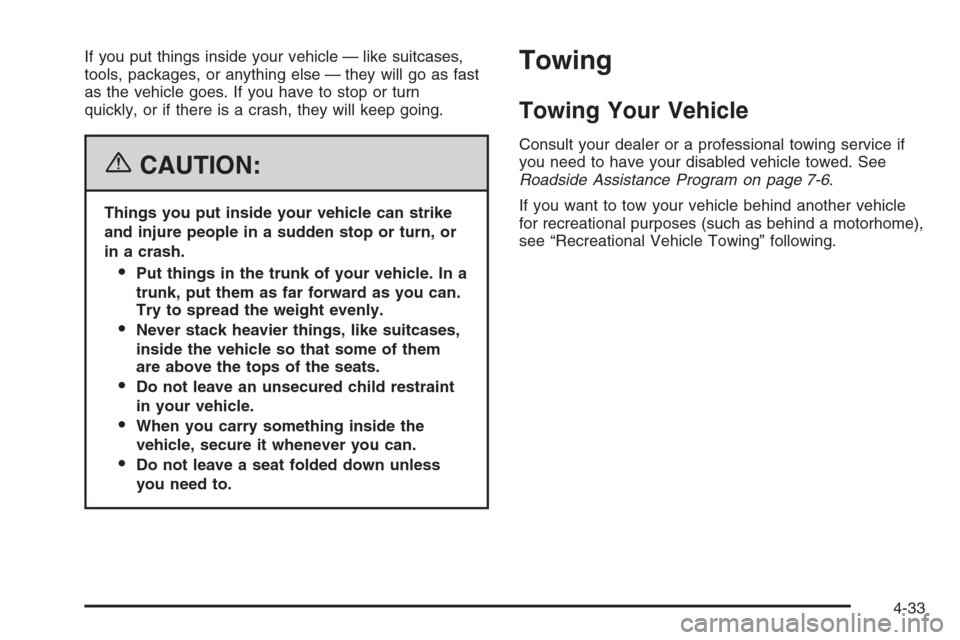
If you put things inside your vehicle — like suitcases,
tools, packages, or anything else — they will go as fast
as the vehicle goes. If you have to stop or turn
quickly, or if there is a crash, they will keep going.
{CAUTION:
Things you put inside your vehicle can strike
and injure people in a sudden stop or turn, or
in a crash.
Put things in the trunk of your vehicle. In a
trunk, put them as far forward as you can.
Try to spread the weight evenly.
Never stack heavier things, like suitcases,
inside the vehicle so that some of them
are above the tops of the seats.
Do not leave an unsecured child restraint
in your vehicle.
When you carry something inside the
vehicle, secure it whenever you can.
Do not leave a seat folded down unless
you need to.
Towing
Towing Your Vehicle
Consult your dealer or a professional towing service if
you need to have your disabled vehicle towed. See
Roadside Assistance Program on page 7-6.
If you want to tow your vehicle behind another vehicle
for recreational purposes (such as behind a motorhome),
see “Recreational Vehicle Towing” following.
4-33
Page 245 of 370

{CAUTION:
You can be burned if you spill coolant on hot
engine parts. Coolant contains ethylene glycol,
and it will burn if the engine parts are hot
enough. Do not spill coolant on a hot engine.
When replacing the pressure cap, make sure it is
hand-tight and fully seated.
Coolant Surge Tank Pressure Cap
Notice:If the pressure cap is not tightly installed,
coolant loss and possible engine damage may
occur. Be sure the cap is properly and tightly
secured.
Engine Overheating
You will find a coolant temperature gage on your
vehicle’s instrument panel cluster. SeeEngine Coolant
Temperature Gage on page 3-36.
If Steam Is Coming From Your Engine
{CAUTION:
Steam from an overheated engine can burn
you badly, even if you just open the hood. Stay
away from the engine if you see or hear steam
coming from it. Just turn it off and get
everyone away from the vehicle until it cools
down. Wait until there is no sign of steam or
coolant before you open the hood.
If you keep driving when your engine is
overheated, the liquids in it can catch re. You
or others could be badly burned. Stop your
engine if it overheats, and get out of the
vehicle until the engine is cool.
Notice:If your engine catches re because you
keep driving with no coolant, your vehicle can
be badly damaged. The costly repairs would not be
covered by your warranty.
5-23

