Page 244 of 398
6. Use the palm of your hand to repeatedly press and
release the plunger (1) at the top of the fuel filter
priming pump. Continue until the plunger resistance
becomes firm. This may take from 20 to 100 times,
depending upon fuel tank location.
7. Turn the fuel filter breather valve screw (2)
counterclockwise several turns to open the breather
valve.
8. Use the palm of your hand to repeatedly press and
release the plunger (1) at the top of the fuel filter
priming pump until fuel begins to seep from
the breather valve.9. Tighten the fuel filter breather screw (2) to the
specified torque, 4.9Y(43 in. lbs).
10. Use the palm of your hand to press and release the
plunger (1) at the top of the fuel filter priming pump
about 20 more times. This sends fuel to the
engine.
11. Use a clean cloth to remove any fuel from the fuel
filter and surrounding area.
12. Start the engine and allow it to idle for a few
minutes.
13. Check the fuel filter for leakage.
5-16
Page 247 of 398

3. Remove the filter element. If there is any dirt on the
filter sealing surface, clean it off. Remove and
reuse the water sensor float switch located on the
bottom of the fuel filter.
4. Install the new filter element.
5. Reinstall and tighten the filter container and
reconnect the water sensor wire to the filter.
6. Use the fuel filter priming procedure earlier in this
section to prime the fuel filter.
7. Tighten the air bleed valve by turning it clockwise
until hand-tight.
8. Start your engine and let it idle for five minutes.
Check your fuel filter and air bleed valve for
leaks.Fuels in Foreign Countries
If you plan on driving in another country outside the
United States or Canada, the proper fuel may be hard
to find. Never use leaded gasoline or any other fuel
not recommended in the previous text on fuel. Costly
repairs caused by use of improper fuel would not
be covered by your warranty.
To check the fuel availability, ask an auto club, or
contact a major oil company that does business in the
country where you will be driving.
5-19
Page 248 of 398
Filling the Tank
{CAUTION:
Fuel vapor is highly ammable. It burns
violently, and that can cause very bad injuries.
Do not smoke if you are near fuel or refueling
your vehicle. Keep sparks, ames and smoking
materials away from fuel.The fuel cap can be on either or both sides of your
vehicle depending on option content.
To take off the cap, turn it slowly counterclockwise.
{CAUTION:
If you get fuel on yourself and then something
ignites it, you could be badly burned. Fuel can
spray out on you if you open the fuel cap too
quickly. This spray can happen if your tank is
nearly full, and is more likely in hot weather.
Open the fuel cap slowly and wait for any
“hiss” noise to stop. Then unscrew the cap all
the way.
When you put the cap back on, turn it clockwise until it
is tight. C4/C5 Models shown,
C6/C7/C8 Models
with Gasoline Engines
similar
C6/C7/C8 Models with
Diesel Engines
5-20
Page 273 of 398
{CAUTION:
Adding only plain water to your cooling
system can be dangerous. Plain water, or
some other liquid such as alcohol, can boil
before the proper coolant mixture will. Your
vehicle’s coolant warning system is set for the
proper coolant mixture. With plain water or the
wrong mixture, your engine could get too hot
but you would not get the overheat warning.
Your engine could catch re and you or others
could be burned. Use a 50/50 mixture of clean,
drinkable water and DEX-COOL
®coolant.
Notice:In cold weather, water can freeze and crack
the engine, radiator, heater core and other parts.
Use the recommended coolant and the proper
coolant mixture.
{CAUTION:
You can be burned if you spill coolant on hot
engine parts. Coolant contains ethylene glycol
and it will burn if the engine parts are hot
enough. Do not spill coolant on a hot engine.
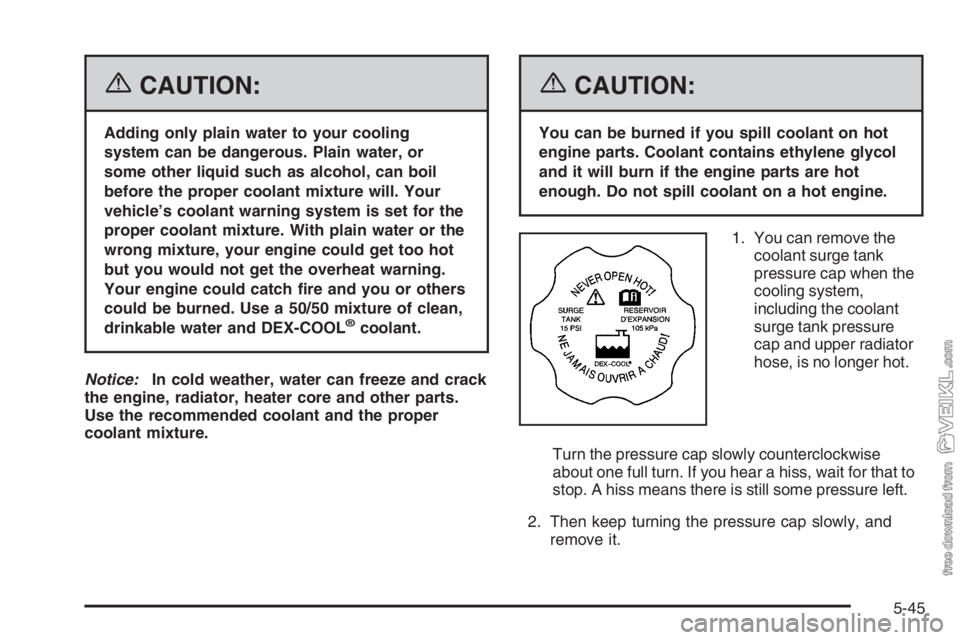
1. You can remove the
coolant surge tank
pressure cap when the
cooling system,
including the coolant
surge tank pressure
cap and upper radiator
hose, is no longer hot.
Turn the pressure cap slowly counterclockwise
about one full turn. If you hear a hiss, wait for that to
stop. A hiss means there is still some pressure left.
2. Then keep turning the pressure cap slowly, and
remove it.
5-45
Page 300 of 398
Automatic Ether Injection System
(Caterpillar
®Diesel)
If you have a Caterpillar®
diesel engine, you may
have this feature. The
ether cylinder is located in
the engine compartment
on the driver’s side of
the vehicle.
To change an empty ether cylinder, follow these steps.
1. Loosen the screw head on the cylinder-to-bracket
clamp.
2. Spread the clamp apart.3. Clean any dirt from the neck of the cylinder and the
top of the valve before you take out the cylinder.
4. Check the inside of the valve for any foreign matter.
Clean the valve as necessary.
5. Cover the valve to protect it from dirt and take out
the cylinder.
6. Install a new gasket whenever you take out the
cylinder. Use only one gasket and spread a light
film of clean oil on it before installation.
7. Put in the new cylinder. Turn it clockwise until it just
starts to contact the gasket.
8. Tighten the cylinder another half turn (180 degrees).
Don’t over-tighten.
9. Retighten the cylinder clamp.
5-72
Page 306 of 398
First, use these pictures to decide what kind of wheels
you have.
Then, refer to the following steps for the wheels
you have.Hub-Piloted Wheels, 8-Hole or 10-Hole
The studs and nuts used with these wheels have
right-hand threads.
1. With intermittent pilot pads, position a pad at
12 o’clock to center the wheel and reduce run-out.
2. Put the tire and rim assembly on the axle hub.
Install the outer rear tire and rim assembly so
that its valve stem is exactly opposite the valve
stem on the inner tire and rim assembly.
3. Put on the wheel nuts.
4. Finger-tighten the nuts.
5. Oil the surfaces (B)
between the nuts (C)
and washers (A). Do
not oil the studs or the
threads of the nut. Hub-Piloted Type,
8-Hole
Hub-Piloted Type,
10-Hole
5-78


