Page 53 of 394
Lower Anchor and Top Tether
Anchor Locations
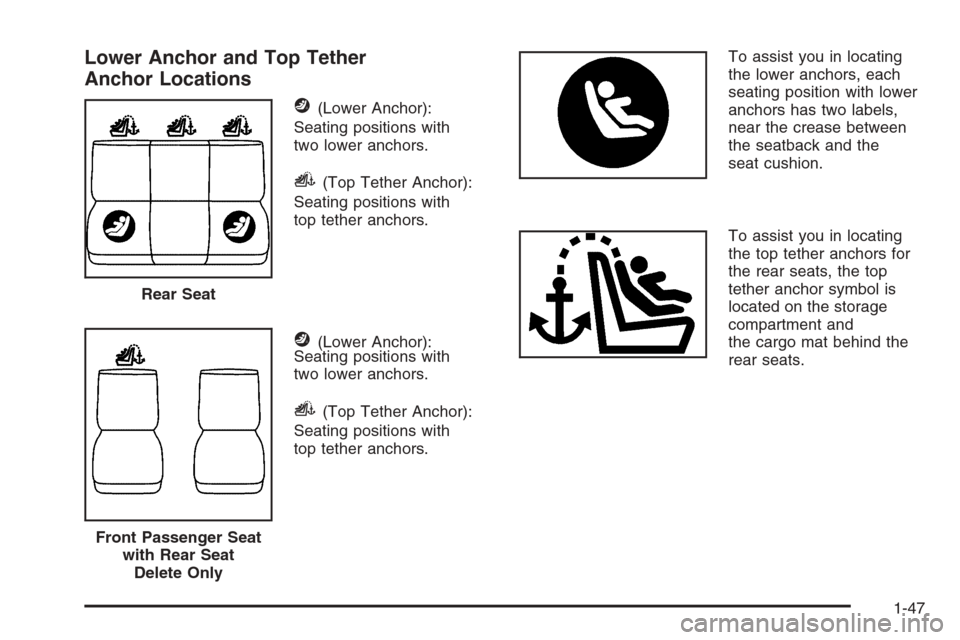
j(Lower Anchor):
Seating positions with
two lower anchors.
i(Top Tether Anchor):
Seating positions with
top tether anchors.
j(Lower Anchor):
Seating positions with
two lower anchors.
i(Top Tether Anchor):
Seating positions with
top tether anchors.To assist you in locating
the lower anchors, each
seating position with lower
anchors has two labels,
near the crease between
the seatback and the
seat cushion.
To assist you in locating
the top tether anchors for
the rear seats, the top
tether anchor symbol is
located on the storage
compartment and
the cargo mat behind the
rear seats. Rear Seat
Front Passenger Seat
with Rear Seat
Delete Only
1-47
Page 54 of 394
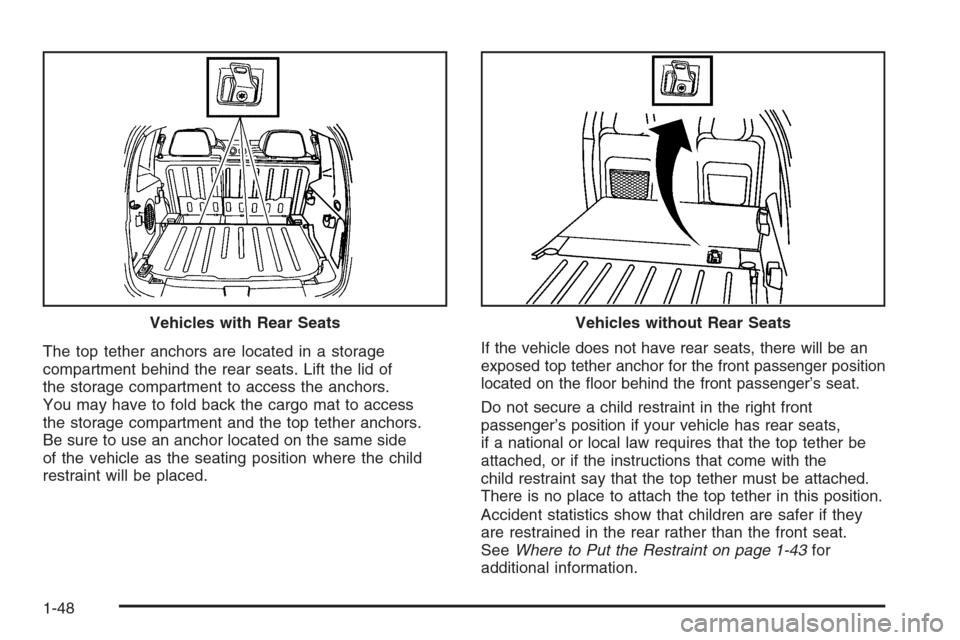
The top tether anchors are located in a storage
compartment behind the rear seats. Lift the lid of
the storage compartment to access the anchors.
You may have to fold back the cargo mat to access
the storage compartment and the top tether anchors.
Be sure to use an anchor located on the same side
of the vehicle as the seating position where the child
restraint will be placed.If the vehicle does not have rear seats, there will be an
exposed top tether anchor for the front passenger position
located on the oor behind the front passenger’s seat.
Do not secure a child restraint in the right front
passenger’s position if your vehicle has rear seats,
if a national or local law requires that the top tether be
attached, or if the instructions that come with the
child restraint say that the top tether must be attached.
There is no place to attach the top tether in this position.
Accident statistics show that children are safer if they
are restrained in the rear rather than the front seat.
SeeWhere to Put the Restraint on page 1-43for
additional information. Vehicles with Rear Seats
Vehicles without Rear Seats
1-48
Page 57 of 394
2. If the child restraint manufacturer recommends that
the top tether be attached, attach and tighten the
top tether to the top tether anchor, if equipped.
Refer to the child restraint instructions and
the following steps:
2.1. For vehicles with rear seats, nd the storage
compartments behind the rear seats.
You may have to fold back the cargo mat to
access the storage compartment and top
tether anchors.
2.2. Lift the lid of the storage compartments to
access the top tether anchors.
2.3. For vehicles without rear seats, nd the top
tether anchor.
2.4. If the position you are using has an
adjustable head restraint, raise it.
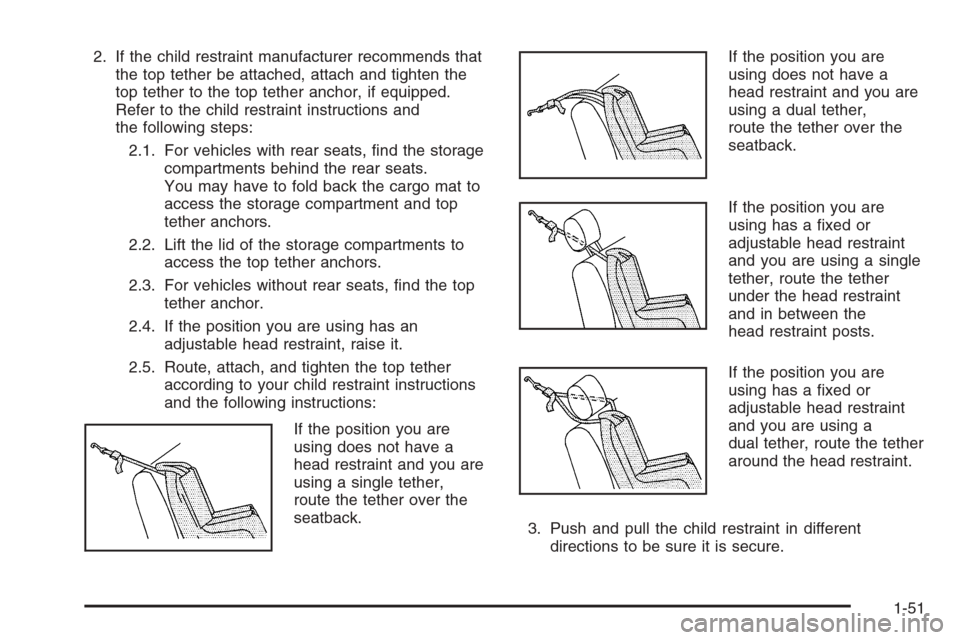
2.5. Route, attach, and tighten the top tether
according to your child restraint instructions
and the following instructions:
If the position you are
using does not have a
head restraint and you are
using a single tether,
route the tether over the
seatback.If the position you are
using does not have a
head restraint and you are
using a dual tether,
route the tether over the
seatback.
If the position you are
using has a xed or
adjustable head restraint
and you are using a single
tether, route the tether
under the head restraint
and in between the
head restraint posts.
If the position you are
using has a xed or
adjustable head restraint
and you are using a
dual tether, route the tether
around the head restraint.
3. Push and pull the child restraint in different
directions to be sure it is secure.
1-51
Page 61 of 394
If your vehicle does not have a rear seat that will
accommodate a rear-facing child restraint, never put a
child in a rear-facing child restraint in the right front
passenger seat unless the passenger airbag status
indicator shows off. Never put a rear facing child
restraint in the right front passenger seat unless the
airbag is off. Here is why:
{CAUTION:
A child in a rear-facing child restraint can be
seriously injured or killed if the right front
passenger’s airbag inates. This is because the
back of the rear facing child restraint would be
very close to the inating airbag. Be sure the
airbag is off before using a rear-facing child
restraint in the passenger’s position.
Even though the passenger sensing system is
designed to turn off the passenger’s frontal
airbag and side impact airbag (if equipped) if
the system detects a rear-facing child restraint,
CAUTION: (Continued)
CAUTION: (Continued)
no system is fail-safe, and no one can
guarantee that an airbag will not deploy under
some unusual circumstance, even though it is
turned off. We recommend that rear-facing
child restraints be transported in vehicles with
a rear seat that will accommodate a rear-facing
child restraint, whenever possible.
If you need to secure a forward-facing child restraint
in the right front seat position, move the seat as far back
as it will go before securing the forward-facing child
restraint. SeeManual Seats on page 1-2.
If your child restraint is equipped with the LATCH
system, seeLower Anchors and Tethers for Children
(LATCH) on page 1-45.
1-55
Page 62 of 394
If your vehicle has a rear seat, there is no top tether
anchor at the right front seating position. Do not secure
a child seat in this position if a national or local law
requires that the top tether be anchored or if the
instructions that come with the child restraint say that
the top tether must be anchored. SeeLower Anchors
and Tethers for Children (LATCH) on page 1-45if
the child restraint has a top tether.
You will be using the lap-shoulder belt to secure the
child restraint in this position. Be sure to follow the
instructions that came with the child restraint. Secure
the child in the child restraint when and as the
instructions say.
1. Your vehicle has a right front passenger’s frontal
airbag. SeePassenger Sensing System on
page 1-67. General Motors recommends that
rear-facing child restraints be secured in a rear seat,
even if the airbag is off. If your child restraint is
forward-facing, move the seat as far back as it will
go before securing the child restraint in this
seat. SeeManual Seats on page 1-2.
When the passenger sensing system has turned off
the right front passenger’s frontal airbag, the off
indicator in the passenger airbag status indicator
should light and stay lit when you turn the ignition to
RUN or START. SeePassenger Airbag Status
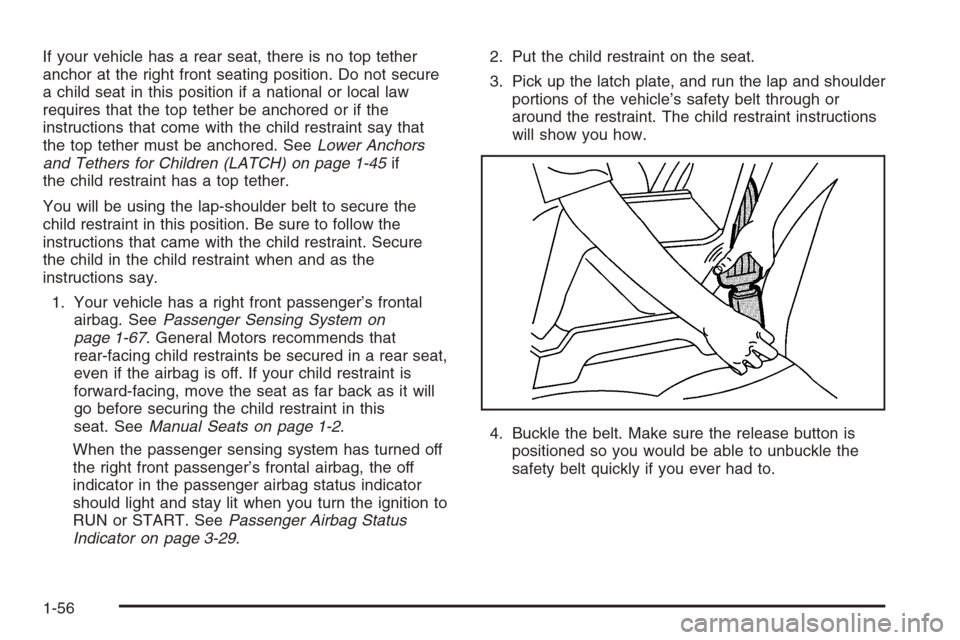
Indicator on page 3-29.2. Put the child restraint on the seat.
3. Pick up the latch plate, and run the lap and shoulder
portions of the vehicle’s safety belt through or
around the restraint. The child restraint instructions
will show you how.
4. Buckle the belt. Make sure the release button is
positioned so you would be able to unbuckle the
safety belt quickly if you ever had to.
1-56
Page 79 of 394

Adding Equipment to Your
Airbag-Equipped Vehicle
Q:Is there anything I might add to the front or
sides of the vehicle that could keep the
airbags from working properly?
A:Yes. If you add things that change your vehicle’s
frame, bumper system, front end or side sheet
metal or height, they may keep the airbag system
from working properly. Also, the airbag system may
not work properly if you relocate any of the airbag
sensors. If you have any questions about this,
you should contact Customer Assistance before you
modify your vehicle. The phone numbers and
addresses for Customer Assistance are in Step Two
of the Customer Satisfaction Procedure in this
manual. SeeCustomer Satisfaction Procedure on
page 7-2.
Q:Because I have a disability, I have to get my
vehicle modied. How can I nd out whether
this will affect my airbag system?
A:Changing or moving any parts of the front seats,
safety belts, the airbag sensing and diagnostic
module (located under the center console), or the
instrument panel can affect the operation of
the airbag system. If you have questions, call
Customer Assistance. The phone numbers
and addresses for Customer Assistance are in
Step Two of the Customer Satisfaction Procedure
in this manual. SeeCustomer Satisfaction
Procedure on page 7-2.
1-73
Page 109 of 394
Automatic Transaxle Operation
If your vehicle is equipped with an automatic transaxle,
the shift lever is located on the console between
the seats.
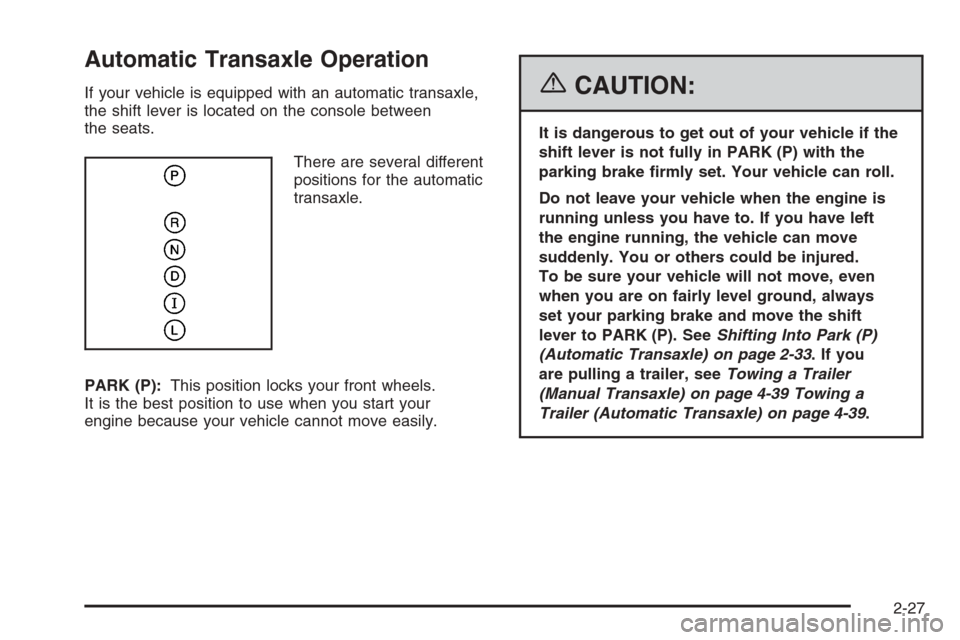
There are several different
positions for the automatic
transaxle.
PARK (P):This position locks your front wheels.
It is the best position to use when you start your
engine because your vehicle cannot move easily.{CAUTION:
It is dangerous to get out of your vehicle if the
shift lever is not fully in PARK (P) with the
parking brake rmly set. Your vehicle can roll.
Do not leave your vehicle when the engine is
running unless you have to. If you have left
the engine running, the vehicle can move
suddenly. You or others could be injured.
To be sure your vehicle will not move, even
when you are on fairly level ground, always
set your parking brake and move the shift
lever to PARK (P). SeeShifting Into Park (P)
(Automatic Transaxle) on page 2-33.Ifyou
are pulling a trailer, seeTowing a Trailer
(Manual Transaxle) on page 4-39 Towing a
Trailer (Automatic Transaxle) on page 4-39.
2-27
Page 114 of 394
Parking Brake
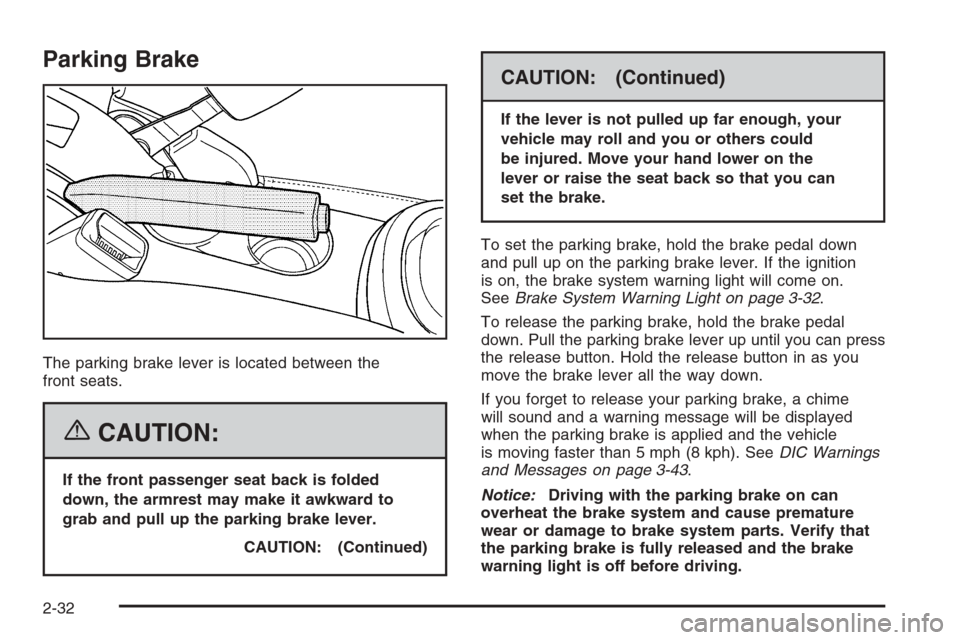
The parking brake lever is located between the
front seats.
{CAUTION:
If the front passenger seat back is folded
down, the armrest may make it awkward to
grab and pull up the parking brake lever.
CAUTION: (Continued)
CAUTION: (Continued)
If the lever is not pulled up far enough, your
vehicle may roll and you or others could
be injured. Move your hand lower on the
lever or raise the seat back so that you can
set the brake.
To set the parking brake, hold the brake pedal down
and pull up on the parking brake lever. If the ignition
is on, the brake system warning light will come on.
SeeBrake System Warning Light on page 3-32.
To release the parking brake, hold the brake pedal
down. Pull the parking brake lever up until you can press
the release button. Hold the release button in as you
move the brake lever all the way down.
If you forget to release your parking brake, a chime
will sound and a warning message will be displayed
when the parking brake is applied and the vehicle
is moving faster than 5 mph (8 kph). SeeDIC Warnings
and Messages on page 3-43.
Notice:Driving with the parking brake on can
overheat the brake system and cause premature
wear or damage to brake system parts. Verify that
the parking brake is fully released and the brake
warning light is off before driving.
2-32