Page 273 of 394
A. Windshield Washer Fluid Reservoir. See “Adding
Washer Fluid” underWindshield Washer Fluid
on page 5-29.
B. Pressure Cap. SeePressure Cap on page 5-23.
C. Coolant Recovery Tank. See “Checking Coolant”
underEngine Coolant on page 5-20.
D. Engine Air Cleaner/Filter. SeeEngine Air
Cleaner/Filter on page 5-18.
E. Engine Oil Fill Cap. See “When to Add Engine Oil”
underEngine Oil on page 5-13.
F. Engine Oil Dipstick (Out of View). See “Checking
Engine Oil” underEngine Oil on page 5-13.
G. Brake Master Cylinder Reservoir. SeeBrakes on
page 5-30andHydraulic Clutch on page 5-20.
H. Remote Positive (+) Terminal. SeeJump Starting
on page 5-33.
I. Engine Compartment Fuse Block. SeeEngine
Compartment Fuse Block on page 5-85.Engine Oil
Checking Engine Oil
It is a good idea to check your engine oil every time you
get fuel. In order to get an accurate reading, the oil
must be warm and the vehicle must be on level ground.
The engine oil dipstick handle is a yellow loop. See
Engine Compartment Overview on page 5-12for
the location of the engine oil dipstick.
1. Turn off the engine and give the oil several minutes
to drain back into the oil pan. If you do not do this,
the oil dipstick might not show the actual level.
2. Pull the dipstick and clean it with a paper towel or
cloth, then push it back in all the way. Remove it
again, keeping the tip down and check the level.
5-13
Page 282 of 394

Checking Coolant
The coolant recovery tank
cap has this symbol on it.
The tank is located in
the engine compartment
toward the front of the
engine on the passenger’s
side of the vehicle.
SeeEngine Compartment Overview on page 5-12for
more information on location.
The vehicle must be on a level surface when checking
the coolant level.
When the engine is cold, the coolant level should be
at the COLD FILL line or a little higher. The COLD FILL
line is near the bottom of the tank and sticks out
from the rear of the tank.
Adding Coolant
If more coolant is needed, add the proper DEX-COOL®
coolant mixture at the coolant recovery tank, but
only when the engine is cool.
If the coolant recovery tank is completely empty, a
special ll procedure is necessary. SeeCooling System
on page 5-25for more information.
{CAUTION:
Turning the radiator pressure cap when the
engine and radiator are hot can allow steam
and scalding liquids to blow out and burn
you badly. With the coolant recovery tank,
you will almost never have to add coolant at
the radiator. Never turn the radiator pressure
cap — even a little — when the engine and
radiator are hot.
5-22
Page 285 of 394
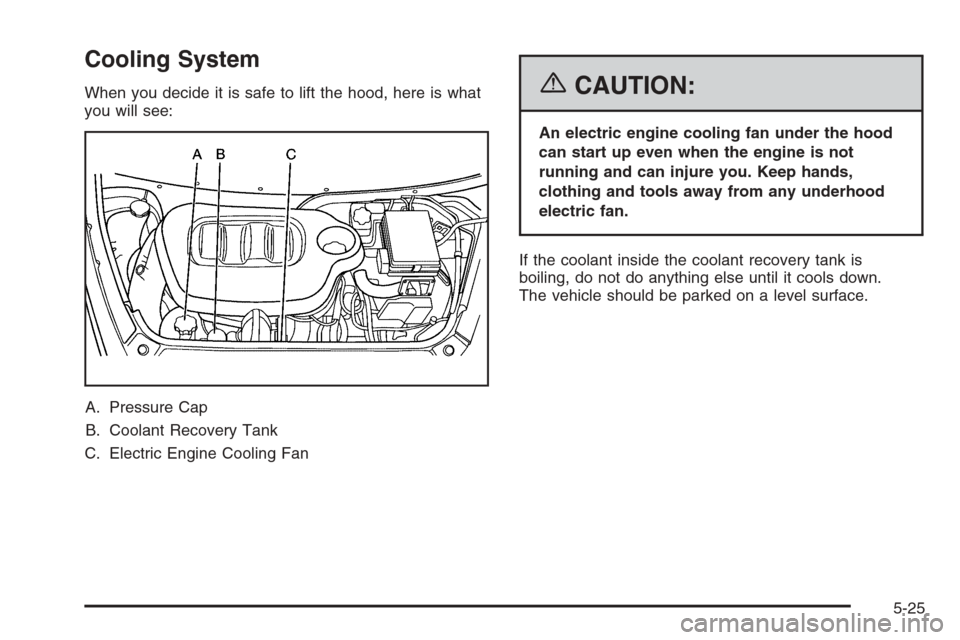
Cooling System
When you decide it is safe to lift the hood, here is what
you will see:
A. Pressure Cap
B. Coolant Recovery Tank
C. Electric Engine Cooling Fan{CAUTION:
An electric engine cooling fan under the hood
can start up even when the engine is not
running and can injure you. Keep hands,
clothing and tools away from any underhood
electric fan.
If the coolant inside the coolant recovery tank is
boiling, do not do anything else until it cools down.
The vehicle should be parked on a level surface.
5-25
Page 286 of 394

When the engine is cold, the coolant level should
be at or above the COLD FILL line. If it is not, you
may have a leak at the pressure cap or in the radiator
hoses, heater hoses, radiator, water pump, or
somewhere in the cooling system.
{CAUTION:
Heater and radiator hoses, and other engine
parts, can be very hot. Do not touch them.
If you do, you can be burned.
Do not run the engine if there is a leak. If you
run the engine, it could lose all coolant. That
could cause an engine re, and you could be
burned. Get any leak xed before you drive
the vehicle.
If there seems to be no leak, with the engine on, check
to see if the electric engine cooling fan is running. If
the engine is overheating, the fan should be running.
If it is not, your vehicle needs service.Notice:Engine damage from running your engine
without coolant is not covered by your warranty.
Notice:Using coolant other than DEX-COOL
®may
cause premature engine, heater core or radiator
corrosion. In addition, the engine coolant may
require changing sooner, at 30,000 miles (50 000 km)
or 24 months, whichever occurs rst. Any repairs
would not be covered by your warranty. Always use
DEX-COOL
®(silicate-free) coolant in your vehicle.
How to Add Coolant to the Cooling
System
Notice:Your engine has a specic cooling system
drain and ll procedure. Failure to follow this
procedure could cause your engine to overheat
and be severely damaged. If your engine’s cooling
system needs to be drained and re-lled, please
see your dealer.
If you have not found a problem yet, but the coolant
level in the coolant recovery tank is below the COLD
FILL line, add a 50/50 mixture of clean, drinkable
water and DEX-COOL
®engine coolant at the coolant
recovery tank. SeeEngine Coolant on page 5-20
for more information.
5-26
Page 287 of 394

If no coolant is visible in the coolant recovery tank,
add coolant at the pressure cap as follows:
{CAUTION:
Steam and scalding liquids from a hot cooling
system can blow out and burn you badly.
They are under pressure, and if you turn the
pressure cap — even a little — they can come
out at high speed. Never turn the cap when the
cooling system, including the pressure cap, is
hot. Wait for the cooling system and pressure
cap to cool if you ever have to turn the
pressure cap.
{CAUTION:
Adding only plain water to your cooling
system can be dangerous. Plain water, or
some other liquid such as alcohol, can boil
before the proper coolant mixture will. Your
vehicle’s coolant warning system is set for the
proper coolant mixture. With plain water or the
wrong mixture, your engine could get too hot
but you would not get the overheat warning.
Your engine could catch re and you or others
could be burned. Use a 50/50 mixture of clean,
drinkable water and DEX-COOL
®coolant.
Notice:In cold weather, water can freeze and crack
the engine, radiator, heater core and other parts.
Use the recommended coolant and the proper
coolant mixture.
5-27
Page 288 of 394

{CAUTION:
You can be burned if you spill coolant on hot
engine parts. Coolant contains ethylene glycol
and it will burn if the engine parts are hot
enough. Do not spill coolant on a hot engine.
1. You can remove the
pressure cap when
the cooling system,
including the pressure
cap and upper
radiator hose, is no
longer hot. Turn
the pressure cap slowly
counterclockwise.
If you hear a hiss, wait for that to stop. A hiss
means there is still some pressure left to be vented.
2. Then keep turning the pressure cap and remove it.
3. Add the proper DEX-COOL
®coolant mixture to
the coolant ll port, up to the base of the port.
SeeEngine Coolant on page 5-20for more
information about the proper coolant mixture.4. Rinse or wipe any spilled coolant from the engine
and the compartment.
5. Then ll the coolant recovery tank to the COLD
FILL line.
6. Put the cap back on the coolant recovery tank,
but leave the pressure cap off.
7. Start the engine and let it run until you can feel
the upper radiator hose getting hot. Watch out
for the engine cooling fan.
8. By this time, the coolant level inside the radiator
ller port may be lower. If the level is lower, add
more of the proper DEX-COOL
®coolant mixture
through the ll port until the level reaches the
base of the ll port.
9. Then replace the pressure cap. At any time during
this procedure, if coolant begins to ow out of the
ll port, reinstall the pressure cap. Be sure the
pressure cap is hand-tight and fully seated.
10. When the engine has cooled, check the coolant in
the coolant recovery tank. The level in the coolant
recovery tank should be at the COLD FILL line
when the engine is cold.
5-28
Page 289 of 394
Windshield Washer Fluid
What to Use
When you need windshield washer uid, be sure to
read the manufacturer’s instructions before use. If you
will be operating your vehicle in an area where the
temperature may fall below freezing, use a uid that
has sufficient protection against freezing.
Adding Washer Fluid
Open the cap with the
washer symbol on it.
Add washer uid until the
tank is full. SeeEngine
Compartment Overview
on page 5-12for reservoir
location.Notice:
When using concentrated washer uid, follow
the manufacturer’s instructions for adding
water.
Do not mix water with ready-to-use washer uid.
Water can cause the solution to freeze and
damage your washer uid tank and other parts
of the washer system. Also, water does not
clean as well as washer uid.
Fill your washer uid tank only three-quarters
full when it is very cold. This allows for
expansion if freezing occurs, which could
damage the tank if it is completely full.
Do not use engine coolant (antifreeze) in your
windshield washer. It can damage your washer
system and paint.
5-29
Page 298 of 394
Headlamp Aiming
The vehicle has a visual optical headlamp aiming
system. The aim has been preset at the factory and
should need no further adjustment.
However, if the vehicle is damaged in an accident, the
headlamp aim may be affected and adjustment may
be necessary.
If oncoming vehicles ash their high beams at you, this
may also mean the vertical aim needs to be adjusted.
It is recommended that the vehicle is taken to your
dealer for service if the headlamps need to be re-aimed.
It is possible however, to re-aim the headlamps as
described in the following procedure.
The vehicle should be properly prepared as follows:
The vehicle should be placed so the headlamps
are 25 ft. (7.6 m) from a light colored wall or
other at surface.
The vehicle must have all four tires on a level
surface which is level all the way to the wall or
other at surface.
The vehicle should be placed so it is perpendicular
to the wall or other at surface.
The vehicle should not have any snow, ice, or mud
on it.
The vehicle should be fully assembled and all other
work stopped while headlamp aiming is being
performed.
The vehicle should be normally loaded with a full
tank of fuel and one person or 160 lbs (75 kg)
sitting on the driver’s seat.
Tires should be properly inated.
The spare tire is in its original location in the
vehicle.
Headlamp aiming is done with the vehicle’s low-beam
headlamps. The high-beam headlamps will be correctly
aimed if the low-beam headlamps are aimed properly.
5-38