2006 CHEVROLET EXPRESS CARGO VAN oil change
[x] Cancel search: oil changePage 334 of 406
{CAUTION:
Rust or dirt on the wheel, or on the parts to
which it is fastened, can make the wheel nuts
become loose after a time. The wheel could
come off and cause an accident. When you
change a wheel, remove any rust or dirt from
the places where the wheel attaches to the
vehicle. In an emergency, you can use a cloth
or a paper towel to do this; but be sure to use
a scraper or wire brush later, if needed, to get
all the rust or dirt off.
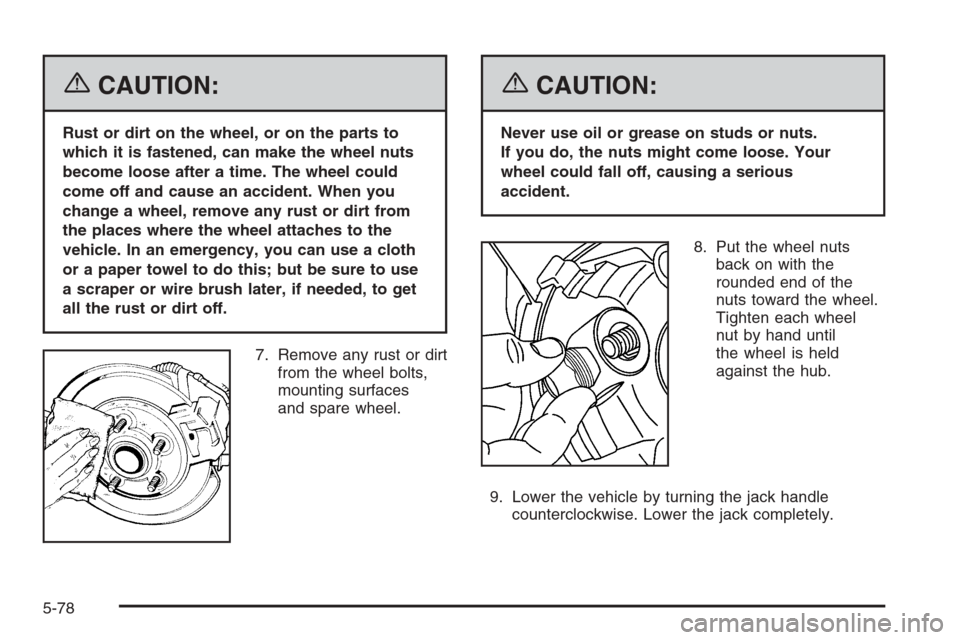
7. Remove any rust or dirt
from the wheel bolts,
mounting surfaces
and spare wheel.
{CAUTION:
Never use oil or grease on studs or nuts.
If you do, the nuts might come loose. Your
wheel could fall off, causing a serious
accident.
8. Put the wheel nuts
back on with the
rounded end of the
nuts toward the wheel.
Tighten each wheel
nut by hand until
the wheel is held
against the hub.
9. Lower the vehicle by turning the jack handle
counterclockwise. Lower the jack completely.
5-78
Page 358 of 406
Maintenance Schedule
Introduction
This maintenance section applies to vehicles with a
gasoline engine. If your vehicle has a diesel engine,
see the maintenance schedule section in the
DURAMAX
®Diesel Engine Supplement.
Important: Keep engine oil at the proper level and
change as recommended.
Have you purchased the GM Protection Plan? The Plan
supplements your new vehicle warranties. See your
Warranty and Owner Assistance booklet or your dealer
for details.
Maintenance Requirements
Notice:Maintenance intervals, checks, inspections,
replacement parts, and recommended uids and
lubricants as prescribed in this manual are necessary
to keep your vehicle in good working condition.
Any damage caused by failure to follow scheduled
maintenance may not be covered by warranty.
Your Vehicle and the Environment
Proper vehicle maintenance not only helps to keep your
vehicle in good working condition, but also helps the
environment. All recommended maintenance is
important. Improper vehicle maintenance can even
affect the quality of the air we breathe. Improper fluid
levels or the wrong tire inflation can increase the level of
emissions from your vehicle. To help protect our
environment, and to keep your vehicle in good condition,
be sure to maintain your vehicle properly.
6-2
Page 360 of 406
If you want to purchase service information, seeService
Publications Ordering Information on page 7-16.
Owner Checks and Services on page 6-9tells you what
should be checked, when to check it, and what you can
easily do to help keep your vehicle in good condition.
The proper replacement parts, fluids, and lubricants to
use are listed inRecommended Fluids and Lubricants
(Gasoline Engine) on page 6-13andNormal
Maintenance Replacement Parts on page 6-15. When
your vehicle is serviced, make sure these are used.
All parts should be replaced and all necessary repairs
done before you or anyone else drives the vehicle.
We recommend the use of genuine GM parts.
Scheduled Maintenance
(Gasoline Engine)
This maintenance section applies to vehicles with a
gasoline engine. If your vehicle has a diesel engine, see
the maintenance schedule section in the DURAMAX
®
Diesel Engine Supplement.
When the change engine oil light comes on, it means
that service is required for your vehicle. Have your
vehicle serviced as soon as possible within the next
600 miles (1 000 km). It is possible that, if you are
driving under the best conditions, the engine oil life
system may not indicate that vehicle service is necessary
for over a year. However, your engine oil and filter must
be changed at least once a year and at this time thesystem must be reset. Your GM Goodwrench
®dealer has
GM-trained service technicians who will perform this work
using genuine GM parts and reset the system.
If the engine oil life system is ever reset accidentally,
you must service your vehicle within 3,000 miles
(5 000 km) since your last service. Remember to reset
the oil life system whenever the oil is changed. See
Engine Oil Life System (Gasoline Engine) on page 5-16
for information on the Engine Oil Life System and
resetting the system.
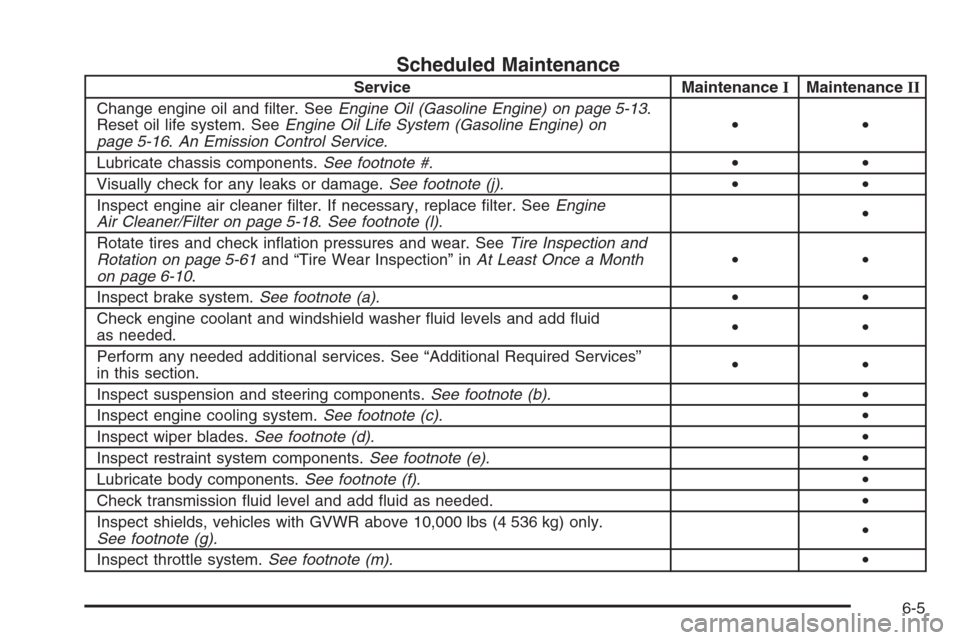
When the change engine oil light appears, certain
services, checks, and inspections are required.
Required services are described in the following for
“MaintenanceI” and “MaintenanceII.” Generally, it is
recommended that your first service be MaintenanceI,
your second service be MaintenanceII, and that you
alternate MaintenanceIand MaintenanceIIthereafter.
However, in some cases, MaintenanceIImay be
required more often.
MaintenanceI— Use MaintenanceIif the change
engine oil light comes on within 10 months since
the vehicle was purchased or MaintenanceIIwas
performed.
MaintenanceII— Use MaintenanceIIif the previous
service performed was MaintenanceI. Always use
MaintenanceIIwhenever the message comes on
10 months or more since the last service or if the
message has not come on at all for one year.
6-4
Page 361 of 406
Scheduled Maintenance
Service MaintenanceIMaintenanceII
Change engine oil and filter. SeeEngine Oil (Gasoline Engine) on page 5-13.
Reset oil life system. SeeEngine Oil Life System (Gasoline Engine) on
page 5-16.An Emission Control Service.••
Lubricate chassis components.See footnote #.••
Visually check for any leaks or damage.See footnote (j).••
Inspect engine air cleaner filter. If necessary, replace filter. SeeEngine
Air Cleaner/Filter on page 5-18.See footnote (l).•
Rotate tires and check inflation pressures and wear. SeeTire Inspection and
Rotation on page 5-61and “Tire Wear Inspection” inAt Least Once a Month
on page 6-10.••
Inspect brake system.See footnote (a).••
Check engine coolant and windshield washer fluid levels and add fluid
as needed.••
Perform any needed additional services. See “Additional Required Services”
in this section.••
Inspect suspension and steering components.See footnote (b).•
Inspect engine cooling system.See footnote (c).•
Inspect wiper blades.See footnote (d).•
Inspect restraint system components.See footnote (e).•
Lubricate body components.See footnote (f).•
Check transmission fluid level and add fluid as needed.•
Inspect shields, vehicles with GVWR above 10,000 lbs (4 536 kg) only.
See footnote (g).•
Inspect throttle system.See footnote (m).•
6-5
Page 365 of 406
(i)Drain, ush, and rell cooling system. This service
can be complex; you should have your dealer perform
this service. See Engine Coolant on page 5-22 for
what to use. Inspect hoses. Clean radiator, condenser,
pressure cap, and ller neck. Pressure test the
cooling system and pressure cap.
(j)A uid loss in any vehicle system could indicate a
problem. Have the system inspected and repaired and
the uid level checked. Add uid if needed.
(k)Inspect system. Check all fuel and vapor lines and
hoses for proper hook-up, routing, and condition. Check
that the purge valve works properly, if equipped.
Replace as needed.
(l)If you drive regularly under dusty conditions, inspect
the lter at each engine oil change.
(m)Check system for interference or binding and for
damaged or missing parts. Replace parts as needed.
Replace any components that have high effort or
excessive wear. Do not lubricate accelerator or cruise
control cables.
(n)Visually inspect belt for fraying, excessive cracks,
or obvious damage. Replace belt if necessary.Owner Checks and Services
These owner checks and services should be performed
at the intervals specified to help ensure the safety,
dependability, and emission control performance of your
vehicle. Your GM Goodwrench
®dealer can assist you
with these checks and services.
Be sure any necessary repairs are completed at once.
Whenever any fluids or lubricants are added to your
vehicle, make sure they are the proper ones, as shown
inRecommended Fluids and Lubricants (Gasoline
Engine) on page 6-13.
At the First 100, 1,000 and 6,000 Miles
(160, 1 600 and 10 000 km)
For vehicles with dual wheels, check dual wheel nut
torque. For proper torque, seeCapacities and
Specications on page 5-99.
6-9
Page 397 of 406
Engine
Air Cleaner/Filter.........................................5-18
Battery.......................................................5-38
Change Engine Oil Light...............................3-40
Check and Service Engine Soon Light............3-36
Coolant......................................................5-22
Coolant Heater............................................2-20
Coolant Temperature Gage...........................3-36
Engine Compartment Overview......................5-12
Exhaust.....................................................2-27
Fan Noise..................................................5-32
Fuel Regulator............................................2-20
Oil .............................................................5-13
Oil Life System...........................................5-16
Overheating................................................5-25
Reduced Power Light...................................3-41
Starting......................................................2-19
Entry Lighting.................................................3-16
Event Data Recorders (EDR)............................7-10
Exit Lighting...................................................3-16
Extender, Safety Belt.......................................1-31
Exterior Lamps...............................................3-13F
Filter
Engine Air Cleaner......................................5-18
Finish Damage...............................................5-91
Fixed Mast Antenna........................................3-79
Flashers, Hazard Warning.................................. 3-6
Flash-to-Pass................................................... 3-9
Flat Tire........................................................5-70
Flat Tire, Changing.........................................5-71
Flat Tire, Storing.............................................5-82
Fluid
Automatic Transmission................................5-19
Power Steering...........................................5-32
Windshield Washer......................................5-33
Front Axle......................................................5-44
Fuel............................................................... 5-5
Additives...................................................... 5-6
California Fuel.............................................. 5-6
Filling a Portable Fuel Container....................5-10
Filling Your Tank........................................... 5-8
Fuels in Foreign Countries.............................. 5-7
Gage .........................................................3-43
Gasoline Octane........................................... 5-5
Gasoline Specifications.................................. 5-5
Regulator...................................................2-20
5
Page 398 of 406
Fuses
Engine Compartment Fuse Block...................5-96
Floor Console Fuse Block.............................5-95
Fuses and Circuit Breakers...........................5-94
Windshield Wiper.........................................5-94
G
Gage
Check Gages Warning Light..........................3-42
Engine Coolant Temperature.........................3-36
Fuel..........................................................3-43
Oil Pressure...............................................3-39
Speedometer..............................................3-25
Voltmeter Gage...........................................3-32
Gasoline
Octane........................................................ 5-5
Specifications............................................... 5-5
GM Mobility Reimbursement Program.................. 7-6
H
Hazard Warning Flashers................................... 3-6
Headlamp Wiring............................................5-94
Headlamps....................................................5-47
Bulb Replacement.......................................5-46
Daytime Running Lamps...............................3-14
Flash-to-Pass............................................... 3-9
Front Turn Signal, Sidemarker and
Parking Lamps.........................................5-49
Halogen Bulbs............................................5-47
High/Low Beam Changer................................ 3-8
On Reminder..............................................3-14
Heater...........................................................3-18
Highbeam On Light.........................................3-42
Highway Hypnosis...........................................4-23
Hill and Mountain Roads..................................4-24
Hood
Checking Things Under................................5-10
Release.....................................................5-11
Horn ............................................................... 3-6
How to Use This Manual...................................... ii
How to Wear Safety Belts Properly...................1-16
6
Page 399 of 406
I
Ignition Positions.............................................2-18
Infants and Young Children, Restraints...............1-34
Inflation - Tire Pressure...................................5-59
Instrument Panel
Overview..................................................... 3-4
Instrument Panel (I/P)
Brightness..................................................3-15
Cluster.......................................................3-24
J
Jump Starting.................................................5-39
K
Keyless Entry System....................................... 2-3
Keys............................................................... 2-2
L
Labeling, Tire Sidewall.....................................5-54
Lamps
Battery Run-Down Protection.........................3-16
Dome ........................................................3-15
Dome Lamp Override...................................3-15
Exterior......................................................3-13
Reading.....................................................3-16
LATCH System
Child Restraints...........................................1-43
Light
Airbag Off..................................................3-28
Airbag Readiness........................................3-27
Anti-Lock Brake System Warning...................3-34
Brake System Warning.................................3-33
Change Engine Oil......................................3-40
Charging System.........................................3-32
Check Gages Warning.................................3-42
Cruise Control.............................................3-41
Daytime Running Lamps Indicator..................3-42
Highbeam On.............................................3-42
7