Page 259 of 382
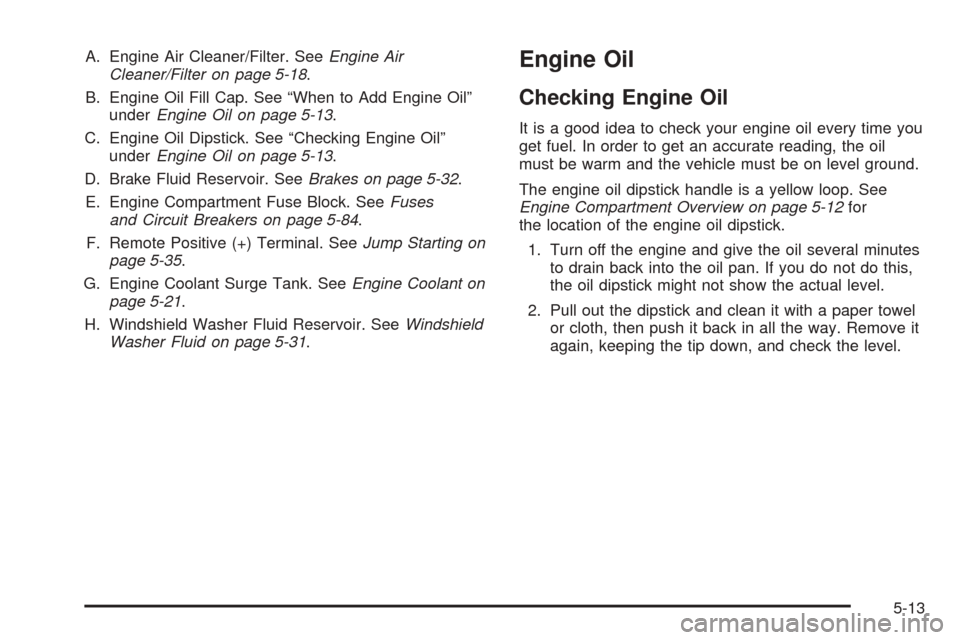
A. Engine Air Cleaner/Filter. SeeEngine Air
Cleaner/Filter on page 5-18.
B. Engine Oil Fill Cap. See “When to Add Engine Oil”
underEngine Oil on page 5-13.
C. Engine Oil Dipstick. See “Checking Engine Oil”
underEngine Oil on page 5-13.
D. Brake Fluid Reservoir. SeeBrakes on page 5-32.
E. Engine Compartment Fuse Block. SeeFuses
and Circuit Breakers on page 5-84.
F. Remote Positive (+) Terminal. SeeJump Starting on
page 5-35.
G. Engine Coolant Surge Tank. SeeEngine Coolant on
page 5-21.
H. Windshield Washer Fluid Reservoir. SeeWindshield
Washer Fluid on page 5-31.Engine Oil
Checking Engine Oil
It is a good idea to check your engine oil every time you
get fuel. In order to get an accurate reading, the oil
must be warm and the vehicle must be on level ground.
The engine oil dipstick handle is a yellow loop. See
Engine Compartment Overview on page 5-12for
the location of the engine oil dipstick.
1. Turn off the engine and give the oil several minutes
to drain back into the oil pan. If you do not do this,
the oil dipstick might not show the actual level.
2. Pull out the dipstick and clean it with a paper towel
or cloth, then push it back in all the way. Remove it
again, keeping the tip down, and check the level.
5-13
Page 282 of 382
Notice:If you leave your radio or other accessories
on during the jump starting procedure, they could
be damaged. The repairs would not be covered
by your warranty. Always turn off your radio and
other accessories when jump starting your vehicle.
3. Turn off the ignition on both vehicles. Unplug
unnecessary accessories plugged into the cigarette
lighter or the accessory power outlet. Turn off
the radio and all lamps that are not needed. This
will avoid sparks and help save both batteries. And
it could save your radio!
4. Open the hoods and locate the positive (+) and
negative (−) terminal locations on each vehicle.
You will not need to access your battery for jump
starting. Your vehicle has a remote positive (+) and
a remote negative (−) jump starting terminal for
that purpose.
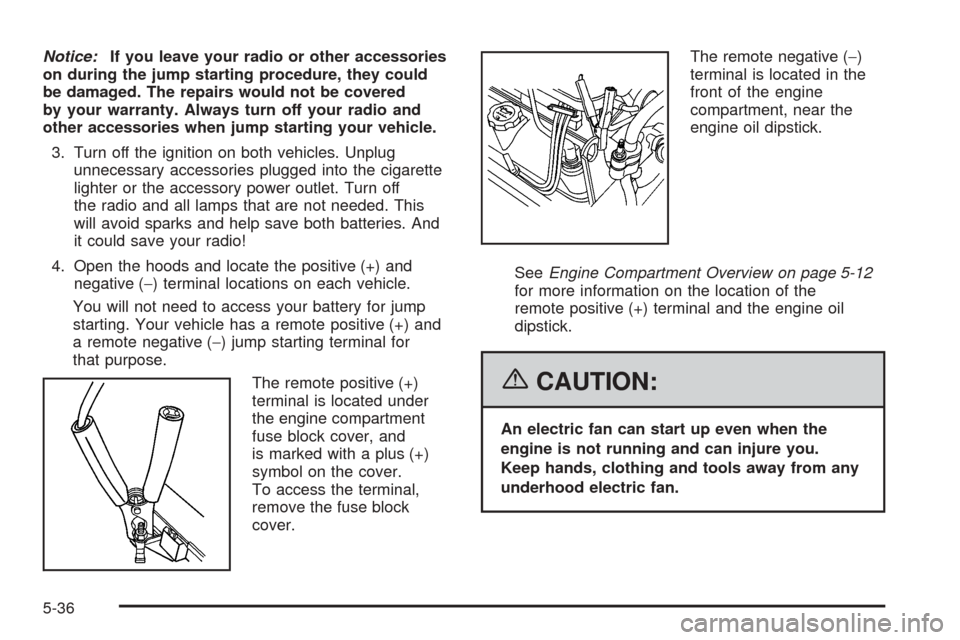
The remote positive (+)
terminal is located under
the engine compartment
fuse block cover, and
is marked with a plus (+)
symbol on the cover.
To access the terminal,
remove the fuse block
cover.The remote negative (−)
terminal is located in the
front of the engine
compartment, near the
engine oil dipstick.
SeeEngine Compartment Overview on page 5-12
for more information on the location of the
remote positive (+) terminal and the engine oil
dipstick.
{CAUTION:
An electric fan can start up even when the
engine is not running and can injure you.
Keep hands, clothing and tools away from any
underhood electric fan.
5-36
Page 285 of 382
Notice:If the jumper cables are connected or
removed in the wrong order, electrical shorting may
occur and damage the vehicle. The repairs would
not be covered by your warranty. Always connect
and remove the jumper cables in the correct
order, making sure that the cables do not touch
each other or other metal.
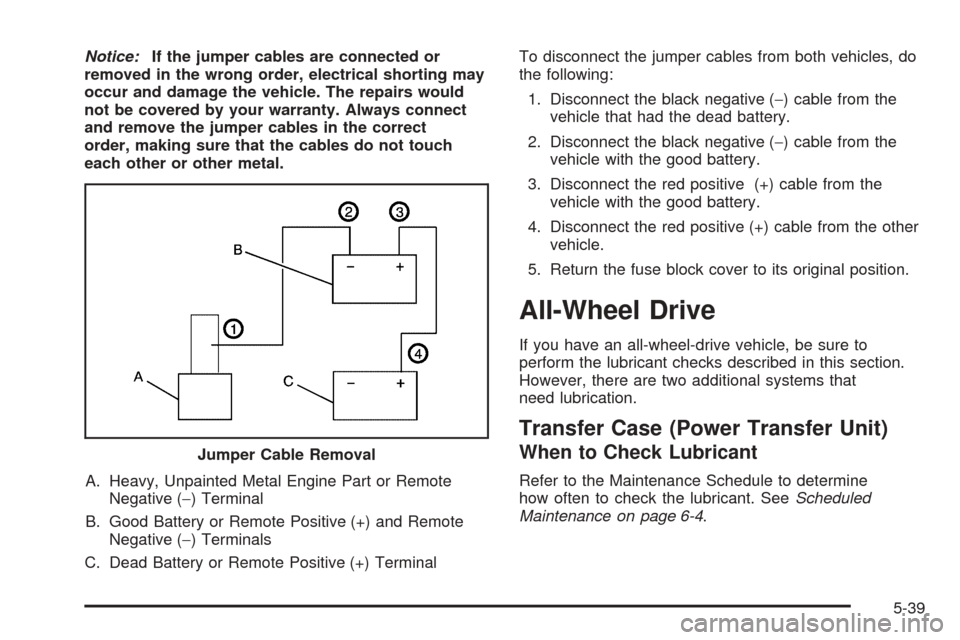
A. Heavy, Unpainted Metal Engine Part or Remote
Negative (−) Terminal
B. Good Battery or Remote Positive (+) and Remote
Negative (−) Terminals
C. Dead Battery or Remote Positive (+) TerminalTo disconnect the jumper cables from both vehicles, do
the following:
1. Disconnect the black negative (−) cable from the
vehicle that had the dead battery.
2. Disconnect the black negative (−) cable from the
vehicle with the good battery.
3. Disconnect the red positive (+) cable from the
vehicle with the good battery.
4. Disconnect the red positive (+) cable from the other
vehicle.
5. Return the fuse block cover to its original position.
All-Wheel Drive
If you have an all-wheel-drive vehicle, be sure to
perform the lubricant checks described in this section.
However, there are two additional systems that
need lubrication.
Transfer Case (Power Transfer Unit)
When to Check Lubricant
Refer to the Maintenance Schedule to determine
how often to check the lubricant. SeeScheduled
Maintenance on page 6-4. Jumper Cable Removal
5-39
Page 330 of 382
Electrical System
Add-On Electrical Equipment
Notice:Don’t add anything electrical to your vehicle
unless you check with your dealer rst. Some
electrical equipment can damage your vehicle and
the damage wouldn’t be covered by your warranty.
Some add-on electrical equipment can keep other
components from working as they should.
Your vehicle has an airbag system. Before attempting to
add anything electrical to your vehicle, seeServicing
Your Airbag-Equipped Vehicle on page 1-64.
Windshield Wiper Fuses
The windshield wiper motor is protected by a circuit
breaker and a fuse. If the motor overheats due to heavy
snow or ice, the wiper will stop until the motor cools.
If the overload is caused by some electrical problem,
have it xed.
Power Windows and Other
Power Options
Circuit breakers in the fuse panel protect the power
seats. When the current load is too heavy, the circuit
breaker opens and closes, protecting the circuit until the
problem is xed.
Fuses and Circuit Breakers
The wiring circuits in your vehicle are protected from
short circuits by fuses. This greatly reduces the
chance of circuit overload and re caused by
electrical problems.
There are two fuse blocks — the underhood fuse block,
and the instrument panel fuse block.
To identify and check fuses and relays, refer to the
Fuse Usage Chart on the inside surface of the
fuse panel door.
5-84
Page 331 of 382
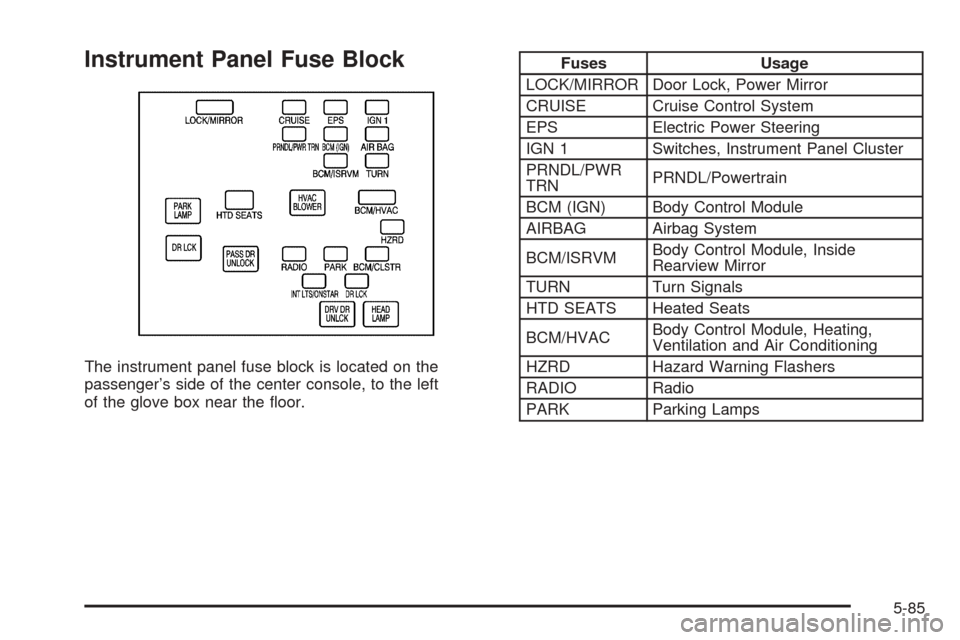
Instrument Panel Fuse Block
The instrument panel fuse block is located on the
passenger’s side of the center console, to the left
of the glove box near the oor.
Fuses Usage
LOCK/MIRROR Door Lock, Power Mirror
CRUISE Cruise Control System
EPS Electric Power Steering
IGN 1 Switches, Instrument Panel Cluster
PRNDL/PWR
TRNPRNDL/Powertrain
BCM (IGN) Body Control Module
AIRBAG Airbag System
BCM/ISRVMBody Control Module, Inside
Rearview Mirror
TURN Turn Signals
HTD SEATS Heated Seats
BCM/HVACBody Control Module, Heating,
Ventilation and Air Conditioning
HZRD Hazard Warning Flashers
RADIO Radio
PARK Parking Lamps
5-85
Page 332 of 382
Fuses Usage
BCM/CLSTRBody Control Module, Instrument
Panel Cluster
INT LTS/
ONSTAR
®Interior Lights/OnStar®
DR LCK Door Locks
Relays Usage
PARK LAMP Parking Lamps Relay
HVAC
BLOWERHeating, Ventilation and Air
Conditioning Blower Motor
DR LCK Door Locks Relay
PASS DR
UNLOCKPassenger Door Unlock Relay
DRV DR
UNLCKDriver Door Unlock Relay
HEAD LAMP Headlamps
Engine Compartment Fuse Block
The engine compartment fuse block is located on the
driver’s side of the engine compartment.
SeeEngine Compartment Overview on page 5-12
for more information on location.
5-86
Page 333 of 382
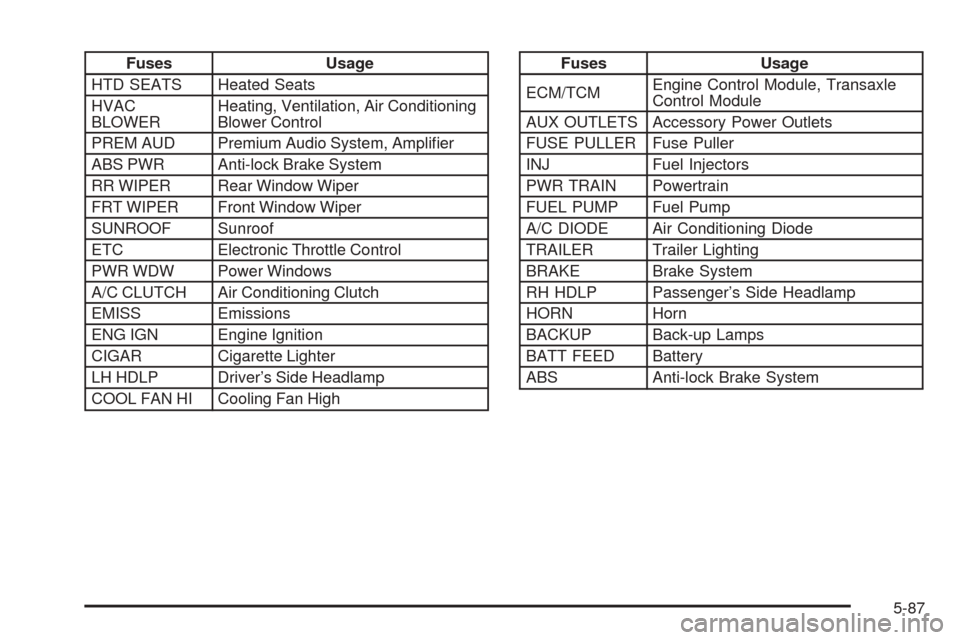
Fuses Usage
HTD SEATS Heated Seats
HVAC
BLOWERHeating, Ventilation, Air Conditioning
Blower Control
PREM AUD Premium Audio System, Amplier
ABS PWR Anti-lock Brake System
RR WIPER Rear Window Wiper
FRT WIPER Front Window Wiper
SUNROOF Sunroof
ETC Electronic Throttle Control
PWR WDW Power Windows
A/C CLUTCH Air Conditioning Clutch
EMISS Emissions
ENG IGN Engine Ignition
CIGAR Cigarette Lighter
LH HDLP Driver’s Side Headlamp
COOL FAN HI Cooling Fan HighFuses Usage
ECM/TCMEngine Control Module, Transaxle
Control Module
AUX OUTLETS Accessory Power Outlets
FUSE PULLER Fuse Puller
INJ Fuel Injectors
PWR TRAIN Powertrain
FUEL PUMP Fuel Pump
A/C DIODE Air Conditioning Diode
TRAILER Trailer Lighting
BRAKE Brake System
RH HDLP Passenger’s Side Headlamp
HORN Horn
BACKUP Back-up Lamps
BATT FEED Battery
ABS Anti-lock Brake System
5-87
Page 334 of 382
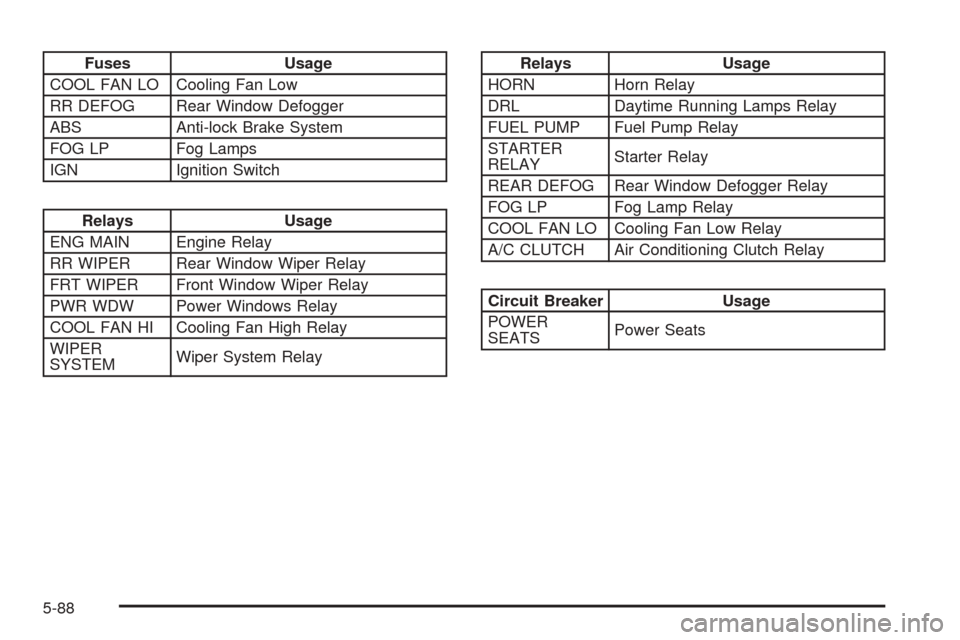
Fuses Usage
COOL FAN LO Cooling Fan Low
RR DEFOG Rear Window Defogger
ABS Anti-lock Brake System
FOG LP Fog Lamps
IGN Ignition Switch
Relays Usage
ENG MAIN Engine Relay
RR WIPER Rear Window Wiper Relay
FRT WIPER Front Window Wiper Relay
PWR WDW Power Windows Relay
COOL FAN HI Cooling Fan High Relay
WIPER
SYSTEMWiper System Relay
Relays Usage
HORN Horn Relay
DRL Daytime Running Lamps Relay
FUEL PUMP Fuel Pump Relay
STARTER
RELAYStarter Relay
REAR DEFOG Rear Window Defogger Relay
FOG LP Fog Lamp Relay
COOL FAN LO Cooling Fan Low Relay
A/C CLUTCH Air Conditioning Clutch Relay
Circuit Breaker Usage
POWER
SEATSPower Seats
5-88