2006 CHEVROLET EQUINOX check engine light
[x] Cancel search: check engine lightPage 207 of 382
Avoid needless heavy braking. Some people drive in
spurts — heavy acceleration followed by heavy
braking — rather than keeping pace with traffic. This is
a mistake. Your brakes may not have time to cool
between hard stops. Your brakes will wear out much
faster if you do a lot of heavy braking. If you keep pace
with the traffic and allow realistic following distances,
you will eliminate a lot of unnecessary braking.
That means better braking and longer brake life.
If your engine ever stops while you are driving, brake
normally but do not pump your brakes. If you do,
the pedal may get harder to push down. If your engine
stops, you will still have some power brake assist.
But you will use it when you brake. Once the power
assist is used up, it may take longer to stop and
the brake pedal will be harder to push.
Adding non-GM accessories can affect your vehicle’s
performance. SeeAccessories and Modications
on page 5-3.Anti-Lock Brake System (ABS)
Your vehicle may have the Anti-Lock Brake System
(ABS), an advanced electronic braking system that
will help prevent a braking skid.
If your vehicle has ABS,
this warning light on the
instrument panel will come
on briey when you
start your vehicle.
When you start your engine, or when you begin to
drive away, your ABS will check itself. You may hear
a momentary motor or clicking noise while this test
is going on, and you may even notice that your brake
pedal moves or pulses a little. This is normal.
4-7
Page 262 of 382
Notice:Use only engine oil identied as meeting
GM Standard GM6094M and showing the American
Petroleum Institute Certied For Gasoline Engines
starburst symbol. Failure to use the recommended
oil can result in engine damage not covered by
your warranty.
GM Goodwrench
®oil meets all the requirements for
your vehicle.
If you are in an area of extreme cold, where the
temperature falls below−20°F (−29°C), it is
recommended that you use either an SAE 5W-30
synthetic oil or an SAE 0W-30 oil. Both will provide
easier cold starting and better protection for your engine
at extremely low temperatures.
Engine Oil Additives
Do not add anything to your oil. The recommended oils
with the starburst symbol that meet GM Standard
GM6094M are all you will need for good performance
and engine protection.
Engine Oil Life System
When to Change Engine Oil
Your vehicle has a computer system that lets you know
when to change the engine oil and lter. This is based
on engine revolutions and engine temperature, and not
on mileage. Based on driving conditions, the mileage
at which an oil change will be indicated can vary
considerably. For the oil life system to work properly,
you must reset the system every time the oil is changed.
When the system has calculated that oil life has been
diminished, it will indicate that an oil change is
necessary. A change engine oil light will come on.
Change your oil as soon as possible within the next
600 miles (1 000 km). It is possible that, if you are
driving under the best conditions, the oil life system may
not indicate that an oil change is necessary for over
a year. However, your engine oil and lter must
be changed at least once a year and at this time the
system must be reset. Your dealer has GM-trained
service people who will perform this work using genuine
GM parts and reset the system. It is also important to
check your oil regularly and keep it at the proper level.
If the system is ever reset accidentally, you must
change your oil at 3,000 miles (5 000 km) since your
last oil change. Remember to reset the oil life system
whenever the oil is changed.
5-16
Page 267 of 382
Automatic Transaxle Fluid
It is not necessary to check the transaxle uid level.
A transaxle uid leak is the only reason for uid loss.
If a leak occurs, take your vehicle to the dealership
service department and have it repaired as soon
as possible.
Change the uid at the intervals listed inAdditional
Required Services on page 6-6, and be sure to use
the transaxle uid listed inRecommended Fluids and
Lubricants on page 6-12.
Notice:Use of the incorrect automatic transaxle
uid may damage your vehicle, and the damages may
not be covered by your warranty. Always use the
automatic transaxle uid listed inRecommended
Fluids and Lubricants on page 6-12.
Engine Coolant
The cooling system in your vehicle is lled with
DEX-COOL®engine coolant. This coolant is designed
to remain in your vehicle for ve years or 100,000 miles
(166 000 km), whichever occurs rst, if you add only
DEX-COOL
®extended life coolant.The following explains your cooling system and how
to add coolant when it is low. If you have a problem
with engine overheating, seeEngine Overheating
on page 5-24.
A 50/50 mixture of clean, drinkable water and
DEX-COOL
®coolant will:
Give freezing protection down to−34°F (−37°C).
Give boiling protection up to 265°F (129°C).
Protect against rust and corrosion.
Help keep the proper engine temperature.
Let the warning lights and gages work as they
should.
Notice:Using coolant other than DEX-COOL
®may
cause premature engine, heater core, or radiator
corrosion. In addition, the engine coolant may
require changing sooner, at the rst maintenance
service after each 30,000 miles (50 000 km) or
24 months, whichever occurs rst. Any repairs
would not be covered by your warranty. Always use
DEX-COOL
®(silicate-free) coolant in your vehicle.
5-21
Page 283 of 382
{CAUTION:
Using a match near a battery can cause battery
gas to explode. People have been hurt doing
this, and some have been blinded. Use a
ashlight if you need more light.
Be sure the battery has enough water. You do
not need to add water to the battery installed
in your new vehicle. But if a battery has ller
caps, be sure the right amount of uid is there.
If it is low, add water to take care of that rst.
If you do not, explosive gas could be present.
Battery uid contains acid that can burn you.
Do not get it on you. If you accidentally get it
in your eyes or on your skin, ush the place
with water and get medical help immediately.
{CAUTION:
Fans or other moving engine parts can injure
you badly. Keep your hands away from moving
parts once the engine is running.
5. Check that the jumper cables do not have loose
or missing insulation. If they do, you could get a
shock. The vehicles could be damaged, too.
Before you connect the cables, here are some
basic things you should know. Positive (+) will go to
positive (+) or to a remote positive (+) terminal if
the vehicle has one. Negative (−) will go to a heavy,
unpainted metal engine part or to a remote
negative (−) terminal if the vehicle has one.
Do not connect positive (+) to negative (−)oryou
will get a short that would damage the battery
and maybe other parts, too. And do not connect the
negative (−) cable to the negative (−) terminal on
the dead battery because this can cause sparks.
5-37
Page 370 of 382
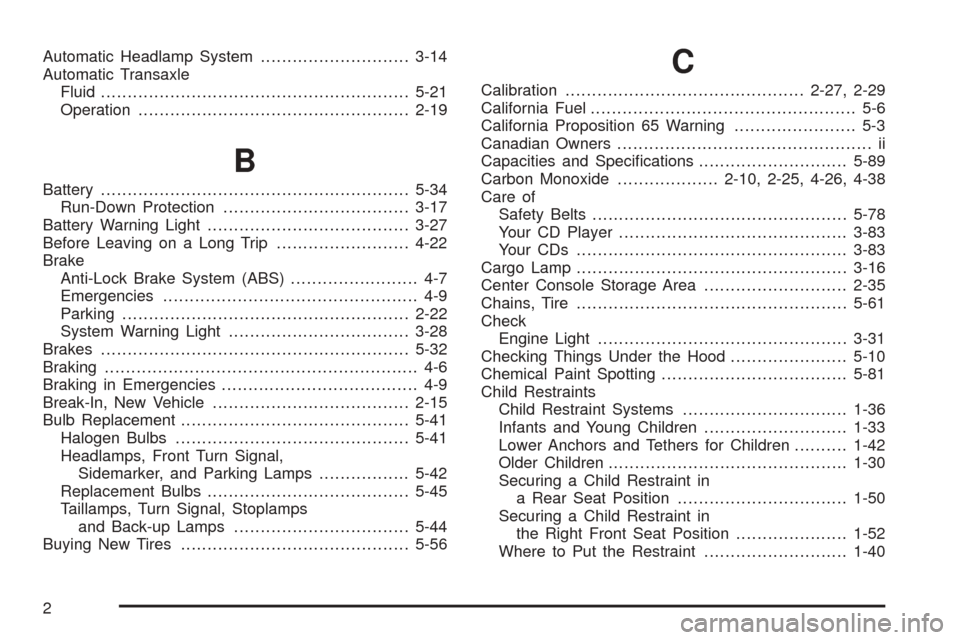
Automatic Headlamp System............................3-14
Automatic Transaxle
Fluid..........................................................5-21
Operation...................................................2-19
B
Battery..........................................................5-34
Run-Down Protection...................................3-17
Battery Warning Light......................................3-27
Before Leaving on a Long Trip.........................4-22
Brake
Anti-Lock Brake System (ABS)........................ 4-7
Emergencies................................................ 4-9
Parking......................................................2-22
System Warning Light..................................3-28
Brakes..........................................................5-32
Braking........................................................... 4-6
Braking in Emergencies..................................... 4-9
Break-In, New Vehicle.....................................2-15
Bulb Replacement...........................................5-41
Halogen Bulbs............................................5-41
Headlamps, Front Turn Signal,
Sidemarker, and Parking Lamps.................5-42
Replacement Bulbs......................................5-45
Taillamps, Turn Signal, Stoplamps
and Back-up Lamps.................................5-44
Buying New Tires...........................................5-56
C
Calibration.............................................2-27, 2-29
California Fuel.................................................. 5-6
California Proposition 65 Warning....................... 5-3
Canadian Owners................................................ ii
Capacities and Specications............................5-89
Carbon Monoxide...................2-10, 2-25, 4-26, 4-38
Care of
Safety Belts................................................5-78
Your CD Player...........................................3-83
Your CDs ...................................................3-83
Cargo Lamp...................................................3-16
Center Console Storage Area...........................2-35
Chains, Tire...................................................5-61
Check
Engine Light...............................................3-31
Checking Things Under the Hood......................5-10
Chemical Paint Spotting...................................5-81
Child Restraints
Child Restraint Systems...............................1-36
Infants and Young Children...........................1-33
Lower Anchors and Tethers for Children..........1-42
Older Children.............................................1-30
Securing a Child Restraint in
a Rear Seat Position................................1-50
Securing a Child Restraint in
the Right Front Seat Position.....................1-52
Where to Put the Restraint...........................1-40
2
Page 372 of 382
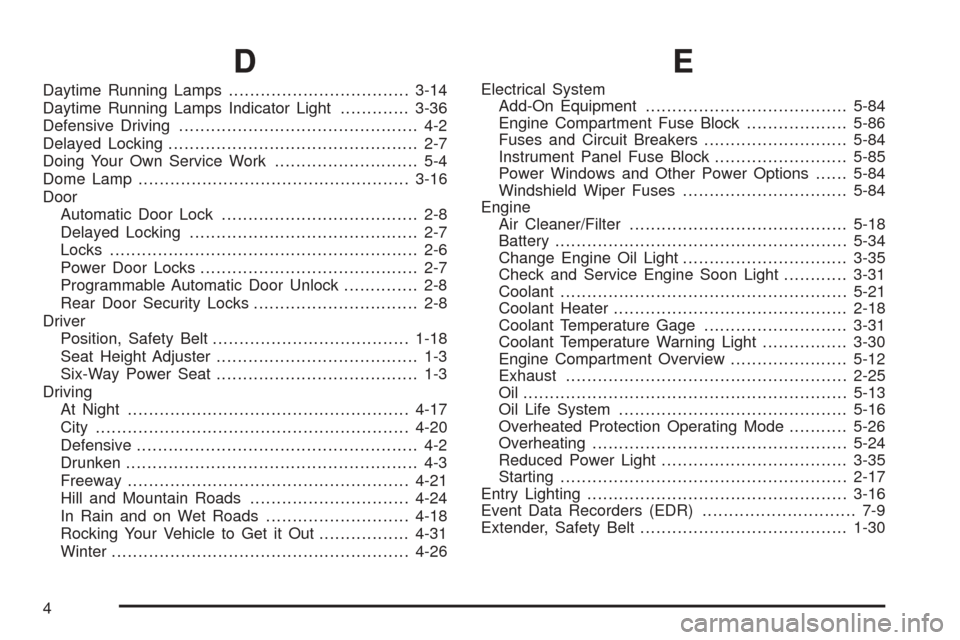
D
Daytime Running Lamps..................................3-14
Daytime Running Lamps Indicator Light.............3-36
Defensive Driving............................................. 4-2
Delayed Locking............................................... 2-7
Doing Your Own Service Work........................... 5-4
Dome Lamp...................................................3-16
Door
Automatic Door Lock..................................... 2-8
Delayed Locking........................................... 2-7
Locks.......................................................... 2-6
Power Door Locks......................................... 2-7
Programmable Automatic Door Unlock.............. 2-8
Rear Door Security Locks............................... 2-8
Driver
Position, Safety Belt.....................................1-18
Seat Height Adjuster...................................... 1-3
Six-Way Power Seat...................................... 1-3
Driving
At Night.....................................................4-17
City...........................................................4-20
Defensive..................................................... 4-2
Drunken....................................................... 4-3
Freeway.....................................................4-21
Hill and Mountain Roads..............................4-24
In Rain and on Wet Roads...........................4-18
Rocking Your Vehicle to Get it Out.................4-31
Winter........................................................4-26
E
Electrical System
Add-On Equipment......................................5-84
Engine Compartment Fuse Block...................5-86
Fuses and Circuit Breakers...........................5-84
Instrument Panel Fuse Block.........................5-85
Power Windows and Other Power Options......5-84
Windshield Wiper Fuses...............................5-84
Engine
Air Cleaner/Filter.........................................5-18
Battery.......................................................5-34
Change Engine Oil Light...............................3-35
Check and Service Engine Soon Light............3-31
Coolant......................................................5-21
Coolant Heater............................................2-18
Coolant Temperature Gage...........................3-31
Coolant Temperature Warning Light................3-30
Engine Compartment Overview......................5-12
Exhaust.....................................................2-25
Oil .............................................................5-13
Oil Life System...........................................5-16
Overheated Protection Operating Mode...........5-26
Overheating................................................5-24
Reduced Power Light...................................3-35
Starting......................................................2-17
Entry Lighting.................................................3-16
Event Data Recorders (EDR)............................. 7-9
Extender, Safety Belt.......................................1-30
4
Page 376 of 382
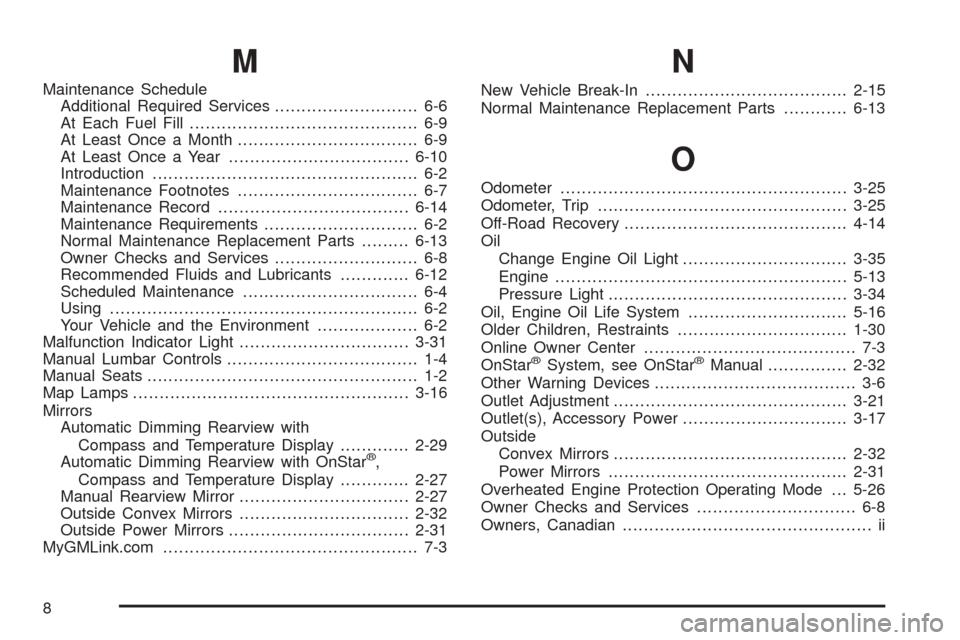
M
Maintenance Schedule
Additional Required Services........................... 6-6
At Each Fuel Fill........................................... 6-9
At Least Once a Month.................................. 6-9
At Least Once a Year..................................6-10
Introduction.................................................. 6-2
Maintenance Footnotes.................................. 6-7
Maintenance Record....................................6-14
Maintenance Requirements............................. 6-2
Normal Maintenance Replacement Parts.........6-13
Owner Checks and Services........................... 6-8
Recommended Fluids and Lubricants.............6-12
Scheduled Maintenance................................. 6-4
Using.......................................................... 6-2
Your Vehicle and the Environment................... 6-2
Malfunction Indicator Light................................3-31
Manual Lumbar Controls.................................... 1-4
Manual Seats................................................... 1-2
Map Lamps....................................................3-16
Mirrors
Automatic Dimming Rearview with
Compass and Temperature Display.............2-29
Automatic Dimming Rearview with OnStar
®,
Compass and Temperature Display.............2-27
Manual Rearview Mirror................................2-27
Outside Convex Mirrors................................2-32
Outside Power Mirrors..................................2-31
MyGMLink.com................................................ 7-3
N
New Vehicle Break-In......................................2-15
Normal Maintenance Replacement Parts............6-13
O
Odometer......................................................3-25
Odometer, Trip...............................................3-25
Off-Road Recovery..........................................4-14
Oil
Change Engine Oil Light...............................3-35
Engine.......................................................5-13
Pressure Light.............................................3-34
Oil, Engine Oil Life System..............................5-16
Older Children, Restraints................................1-30
Online Owner Center........................................ 7-3
OnStar
®System, see OnStar®Manual...............2-32
Other Warning Devices...................................... 3-6
Outlet Adjustment............................................3-21
Outlet(s), Accessory Power...............................3-17
Outside
Convex Mirrors............................................2-32
Power Mirrors.............................................2-31
Overheated Engine Protection Operating Mode . . . 5-26
Owner Checks and Services.............................. 6-8
Owners, Canadian............................................... ii
8
Page 378 of 382
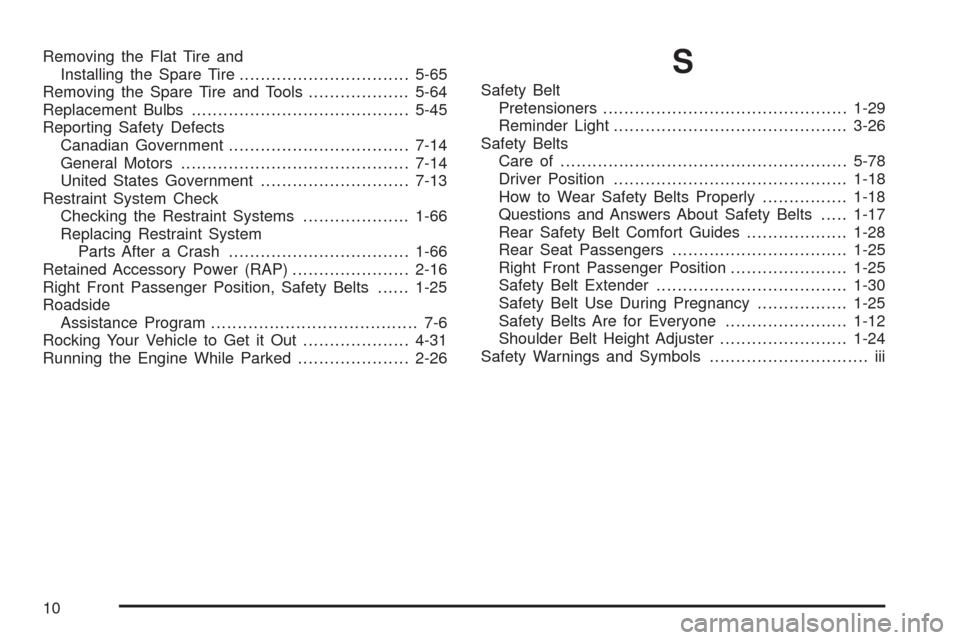
Removing the Flat Tire and
Installing the Spare Tire................................5-65
Removing the Spare Tire and Tools...................5-64
Replacement Bulbs.........................................5-45
Reporting Safety Defects
Canadian Government..................................7-14
General Motors...........................................7-14
United States Government............................7-13
Restraint System Check
Checking the Restraint Systems....................1-66
Replacing Restraint System
Parts After a Crash..................................1-66
Retained Accessory Power (RAP)......................2-16
Right Front Passenger Position, Safety Belts......1-25
Roadside
Assistance Program....................................... 7-6
Rocking Your Vehicle to Get it Out....................4-31
Running the Engine While Parked.....................2-26S
Safety Belt
Pretensioners..............................................1-29
Reminder Light............................................3-26
Safety Belts
Care of......................................................5-78
Driver Position............................................1-18
How to Wear Safety Belts Properly................1-18
Questions and Answers About Safety Belts.....1-17
Rear Safety Belt Comfort Guides...................1-28
Rear Seat Passengers.................................1-25
Right Front Passenger Position......................1-25
Safety Belt Extender....................................1-30
Safety Belt Use During Pregnancy.................1-25
Safety Belts Are for Everyone.......................1-12
Shoulder Belt Height Adjuster........................1-24
Safety Warnings and Symbols.............................. iii
10