2006 CHEVROLET EPICA check engine
[x] Cancel search: check enginePage 225 of 368
Service............................................................5-3
Accessories and Modifications..........................5-3
California Proposition 65 Warning.....................5-4
Doing Your Own Service Work.........................5-4
Adding Equipment to the Outside
of Your Vehicle...........................................5-5
Fuel................................................................5-5
Gasoline Octane............................................5-5
Gasoline Specifications....................................5-5
California Fuel...............................................5-6
Additives.......................................................5-6
Fuels in Foreign Countries...............................5-7
Filling the Tank..............................................5-8
Filling a Portable Fuel Container.....................5-10
Checking Things Under the Hood....................5-11
Hood Release..............................................5-11
Engine Compartment Overview.......................5-12
Engine Oil...................................................5-13
Engine Air Cleaner/Filter................................5-17
Automatic Transaxle Fluid..............................5-19
Engine Coolant.............................................5-19
Coolant Surge Tank Pressure Cap..................5-22
Engine Overheating.......................................5-22
Cooling System............................................5-24
Power Steering Fluid.....................................5-29Windshield Washer Fluid................................5-30
Brakes........................................................5-31
Battery........................................................5-34
Jump Starting...............................................5-35
Headlamp Aiming...........................................5-38
Bulb Replacement..........................................5-39
Halogen Bulbs..............................................5-39
Headlamps..................................................5-39
Front Turn Signal Lamps...............................5-41
Center High-Mounted Stoplamp (CHMSL).........5-42
Parking Lamps.............................................5-43
Taillamps, Turn Signal, Stoplamps and
Back-up Lamps.........................................5-44
Replacement Bulbs.......................................5-44
Windshield Wiper Blade Replacement..............5-45
Tires..............................................................5-46
Tire Sidewall Labeling...................................5-47
Tire Terminology and Definitions.....................5-49
Inflation - Tire Pressure.................................5-52
Tire Inspection and Rotation...........................5-53
When It Is Time for New Tires.......................5-54
Buying New Tires.........................................5-55
Different Size Tires and Wheels......................5-56
Uniform Tire Quality Grading..........................5-56
Section 5 Service and Appearance Care
5-1
Page 229 of 368
Your vehicle has an airbag system. Before attempting
to do your own service work, seeServicing Your
Airbag-Equipped Vehicle on page 1-62.
You should keep a record with all parts receipts and list
the mileage and the date of any service work you
perform. SeePart E: Maintenance Record on page 6-27.
Adding Equipment to the Outside
of Your Vehicle
Things you might add to the outside of your vehicle
can affect the airflow around it. This may cause
wind noise and affect windshield washer performance.
Check with your dealer before adding equipment to
the outside of your vehicle.
Fuel
Use of the recommended fuel is an important part of
the proper maintenance of your vehicle.
Gasoline Octane
Use regular unleaded gasoline with a posted octane
rating of 87 or higher. If the octane rating is less than 87,
you may notice an audible knocking noise when you
drive, commonly referred to as spark knock. If this
occurs, use a gasoline rated at 87 octane or higher as
soon as possible. If you are using gasoline rated at
87 octane or higher and you hear heavy knocking,
your engine needs service.
Gasoline Specications
At a minimum, gasoline should meet
ASTM specification D 4814 in the United States
or CAN/CGSB-3.5 in Canada. Some gasolines
may contain an octane-enhancing additive called
methylcyclopentadienyl manganese tricarbonyl (MMT).
General Motors recommends against the use of
gasolines containing MMT. SeeAdditives on
page 5-6for additional information.
5-5
Page 230 of 368
California Fuel
If your vehicle is certified to meet California Emissions
Standards, it is designed to operate on fuels that
meet California specifications. See the underhood
emission control label. If this fuel is not available
in states adopting California emissions standards,
your vehicle will operate satisfactorily on fuels meeting
federal specifications, but emission control system
performance may be affected. The malfunction
indicator lamp may turn on and your vehicle may fail
a smog-check test. SeeMalfunction Indicator Lamp
on page 3-40. If this occurs, return to your authorized
GM dealer for diagnosis. If it is determined that the
condition is caused by the type of fuel used, repairs
may not be covered by your warranty.
Additives
To provide cleaner air, all gasolines in the United States
are now required to contain additives that will help
prevent engine and fuel system deposits from forming,
allowing your emission control system to work
properly. In most cases, you should not have to add
anything to your fuel. However, some gasolines contain
only the minimum amount of additive required to
meet U.S. Environmental Protection Agency regulations.
To help keep fuel injectors and intake valves clean,
or if your vehicle experiences problems due to
dirty injectors or valves, look for gasoline that is
advertised as TOP TIER Detergent Gasoline. Also,
your GM dealer has additives that will help correct
and prevent most deposit-related problems.
Gasolines containing oxygenates, such as ethers and
ethanol, and reformulated gasolines may be available
in your area. General Motors recommends that you use
these gasolines if they comply with the specifications
described earlier. However, E85 (85% ethanol) and
other fuels containing more than 10% ethanol must
not be used in vehicles that were not designed for
those fuels.
5-6
Page 235 of 368
Checking Things Under
the Hood
{CAUTION:
An electric fan under the hood can start up
and injure you even when the engine is not
running. Keep hands, clothing and tools away
from any underhood electric fan.
{CAUTION:
Things that burn can get on hot engine parts
and start a re. These include liquids like fuel,
oil, coolant, brake uid, windshield washer
and other uids, and plastic or rubber. You or
others could be burned. Be careful not to drop
or spill things that will burn onto a hot engine.
Hood Release
To open the hood, do the following:
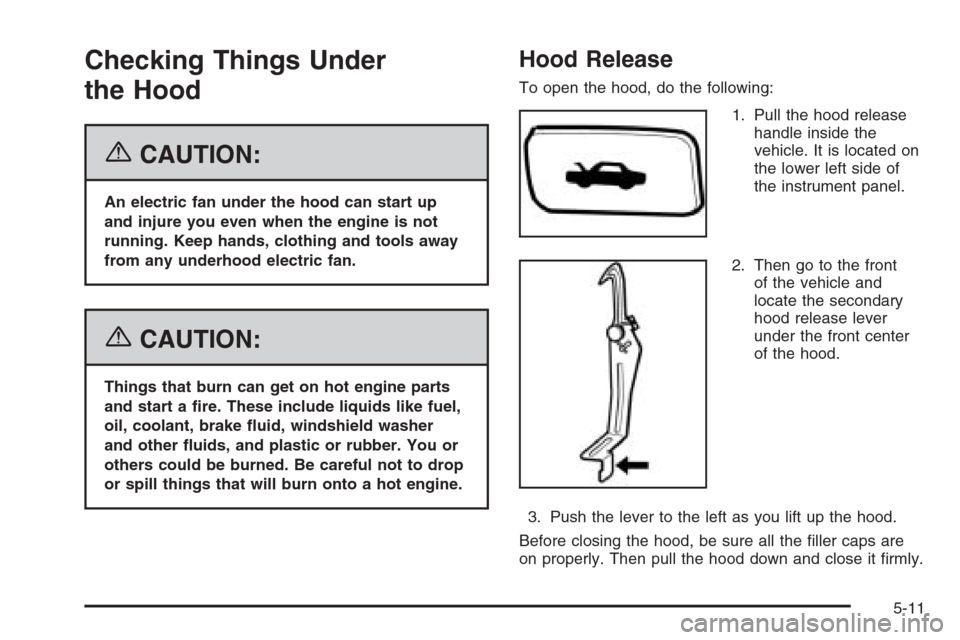
1. Pull the hood release
handle inside the
vehicle. It is located on
the lower left side of
the instrument panel.
2. Then go to the front
of the vehicle and
locate the secondary
hood release lever
under the front center
of the hood.
3. Push the lever to the left as you lift up the hood.
Before closing the hood, be sure all the filler caps are
on properly. Then pull the hood down and close it firmly.
5-11
Page 237 of 368
A. Windshield Washer Fluid Reservoir.
See “Adding Washer Fluid” under
Windshield Washer Fluid on page 5-30.
B. Power Steering Fluid Reservoir.
SeePower Steering Fluid on page 5-29.
C. Engine Coolant Surge Tank.
SeeCooling System on page 5-24.
D. Engine Oil Fill Cap.
See “When to Add Engine Oil”
underEngine Oil on page 5-13.
E. Engine Oil Dipstick.
See “Checking Engine Oil”
underEngine Oil on page 5-13.
F. Brake Fluid Reservoir.
See “Brake Fluid” underBrakes on page 5-31.
G. Engine Air Cleaner/Filter.
SeeEngine Air Cleaner/Filter on page 5-17.
H. Battery. SeeBattery on page 5-34.
I. Engine Compartment Fuse Block.
SeeEngine Compartment Fuse Block
on page 5-79.Engine Oil
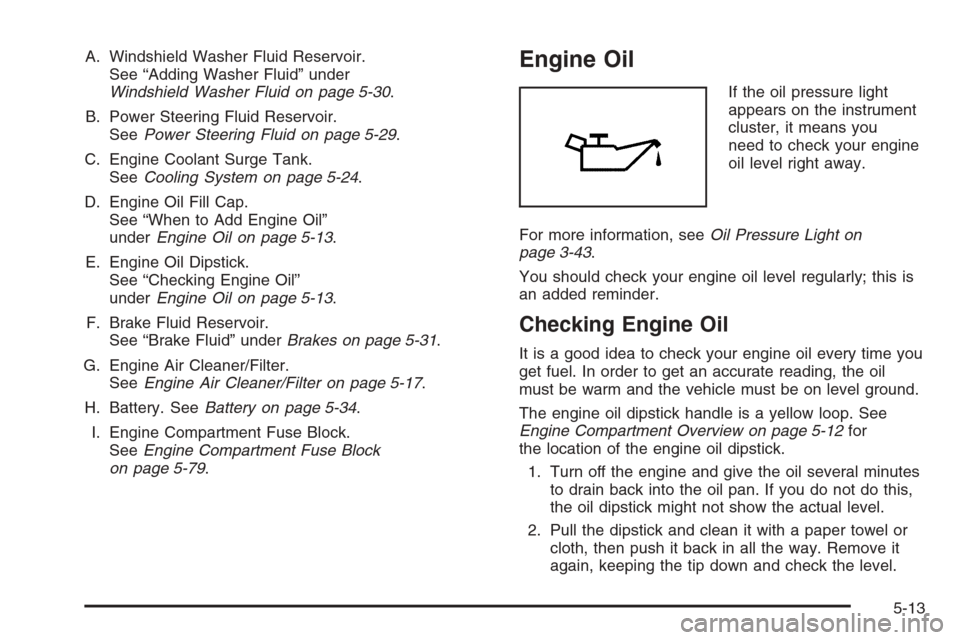
If the oil pressure light
appears on the instrument
cluster, it means you
need to check your engine
oil level right away.
For more information, seeOil Pressure Light on
page 3-43.
You should check your engine oil level regularly; this is
an added reminder.
Checking Engine Oil
It is a good idea to check your engine oil every time you
get fuel. In order to get an accurate reading, the oil
must be warm and the vehicle must be on level ground.
The engine oil dipstick handle is a yellow loop. See
Engine Compartment Overview on page 5-12for
the location of the engine oil dipstick.
1. Turn off the engine and give the oil several minutes
to drain back into the oil pan. If you do not do this,
the oil dipstick might not show the actual level.
2. Pull the dipstick and clean it with a paper towel or
cloth, then push it back in all the way. Remove it
again, keeping the tip down and check the level.
5-13
Page 243 of 368
Automatic Transaxle Fluid
It is not necessary to check the transaxle fluid level. If a
leak occurs, take the vehicle to the dealership service
department and have it repaired as soon as possible.
Have your dealer or service center change both the fluid
and filter every 50,000 miles (83 000 km) if the vehicle
is mainly driven under one or more of these conditions:
•In heavy city traffic where the outside temperature
regularly reaches 90°F (32°C) or higher.
•In hilly or mountainous terrain.
•Uses such as found in taxi, police or delivery
service.
If you do not use your vehicle under any of these
conditions, the fluid and filter do not require changing.
Notice:Use of automatic transaxle uid labeled
other than ESSO LT71141 or TOTAL ATF H50235
may damage your vehicle, and the damages may
not be covered by your warranty. Always use
ESSO LT71141 or TOTAL ATF H50235 labeled
automatic transaxle uid.
Engine Coolant
The following explains your cooling system and how
to add coolant when it is low. If you have a problem
with engine overheating, seeEngine Overheating
on page 5-22.
A 50/50 mixture of clean, drinkable water and proper
coolant will:
•Give freezing protection down to−34°F (−37°C).
•Give boiling protection up to 265°F (129°C).
•Protect against rust and corrosion.
•Help keep the proper engine temperature.
•Let the warning lights and gages work as
they should.
5-19
Page 244 of 368
What to Use
Use a 50/50 mixture of clean, drinkable water and
coolant that meets GM specification 1825M, which will
not damage aluminum parts. You can also use a recycled
coolant conforming to GM specification 1825M with a
complete coolant flush and refill. If you use this coolant
mixture, you do not need to add anything else.
{CAUTION:
Adding only plain water to your cooling
system can be dangerous. Plain water, or
some other liquid such as alcohol, can boil
before the proper coolant mixture will. Your
vehicle’s coolant warning system is set for
the proper coolant mixture. With plain water
or the wrong mixture, your engine could get
too hot but you would not get the overheat
warning. Your engine could catch re and you
or others could be burned. Use a 50/50 mixture
of clean, drinkable water and the proper
coolant.Notice:If you use an improper coolant mixture,
your engine could overheat and be badly damaged.
The repair cost would not be covered by your
warranty. Too much water in the mixture can freeze
and crack the engine, radiator, heater core and
other parts.
If you have to add coolant more than four times a year,
have your dealer check your cooling system.
Notice:If you use extra inhibitors and/or additives
in your vehicle’s cooling system, you could
damage your vehicle. Use only the proper mixture
of the engine coolant listed in this manual for
the cooling system. SeePart D: Recommended
Fluids and Lubricants on page 6-25for more
information.
5-20
Page 245 of 368
Checking Coolant
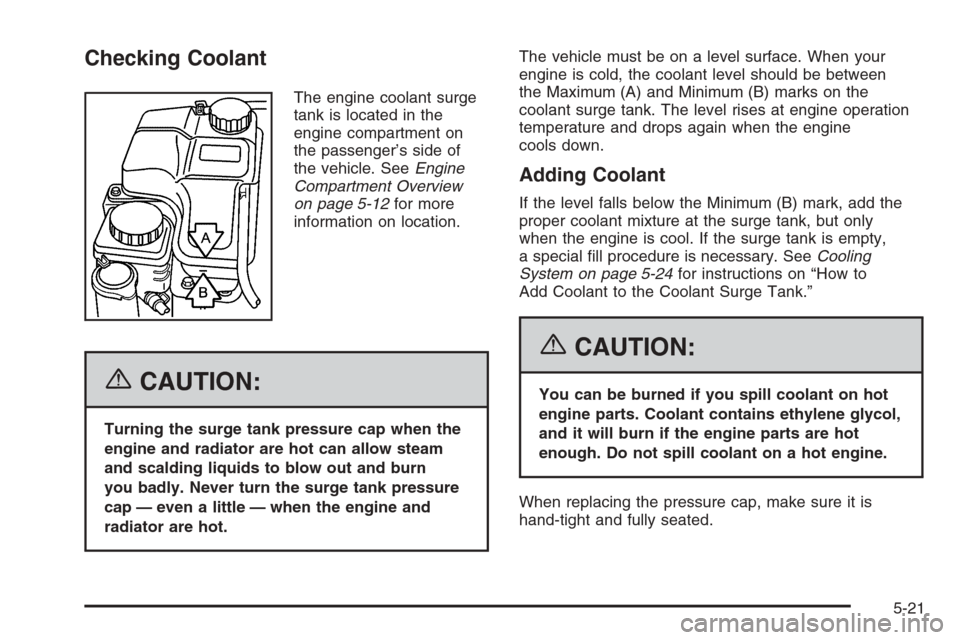
The engine coolant surge
tank is located in the
engine compartment on
the passenger’s side of
the vehicle. SeeEngine
Compartment Overview
on page 5-12for more
information on location.
{CAUTION:
Turning the surge tank pressure cap when the
engine and radiator are hot can allow steam
and scalding liquids to blow out and burn
you badly. Never turn the surge tank pressure
cap — even a little — when the engine and
radiator are hot.The vehicle must be on a level surface. When your
engine is cold, the coolant level should be between
the Maximum (A) and Minimum (B) marks on the
coolant surge tank. The level rises at engine operation
temperature and drops again when the engine
cools down.
Adding Coolant
If the level falls below the Minimum (B) mark, add the
proper coolant mixture at the surge tank, but only
when the engine is cool. If the surge tank is empty,
a special fill procedure is necessary. SeeCooling
System on page 5-24for instructions on “How to
Add Coolant to the Coolant Surge Tank.”
{CAUTION:
You can be burned if you spill coolant on hot
engine parts. Coolant contains ethylene glycol,
and it will burn if the engine parts are hot
enough. Do not spill coolant on a hot engine.
When replacing the pressure cap, make sure it is
hand-tight and fully seated.
5-21