2006 BUICK TERRAZA Rear end
[x] Cancel search: Rear endPage 377 of 454

{CAUTION:
Changing a tire can be dangerous. The vehicle
can slip off the jack and roll over or fall on you
or other people. You and they could be badly
injured or even killed. Find a level place to
change your tire. To help prevent the vehicle
from moving:
1. Set the parking brake rmly.
2. Put the shift lever in PARK (P).
3. Turn off the engine and do not restart
while the vehicle is raised.
4. Do not allow passengers to remain in the
vehicle.
To be even more certain the vehicle will not
move, you should put blocks at the front and
rear of the tire farthest away from the one
being changed. That would be the tire, on the
other side, at the opposite end of the vehicle.When your vehicle has a at tire, use the following
example as a guide to assist you in the placement of
wheel blocks.
The following information will tell you next how to use
the jack and change a tire.
5-71
Page 379 of 454
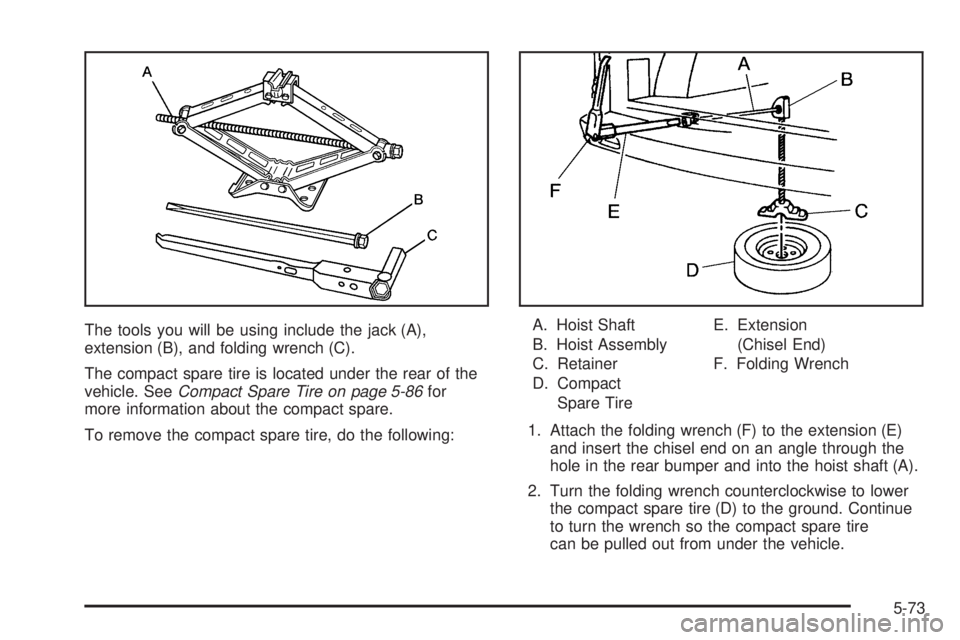
The tools you will be using include the jack (A),
extension (B), and folding wrench (C).
The compact spare tire is located under the rear of the
vehicle. SeeCompact Spare Tire on page 5-86for
more information about the compact spare.
To remove the compact spare tire, do the following:A. Hoist Shaft
B. Hoist Assembly
C. Retainer
D. Compact
Spare TireE. Extension
(Chisel End)
F. Folding Wrench
1. Attach the folding wrench (F) to the extension (E)
and insert the chisel end on an angle through the
hole in the rear bumper and into the hoist shaft (A).
2. Turn the folding wrench counterclockwise to lower
the compact spare tire (D) to the ground. Continue
to turn the wrench so the compact spare tire
can be pulled out from under the vehicle.
5-73
Page 393 of 454

Notice:When the compact spare is installed, do
not take your vehicle through an automatic car wash
with guide rails. The compact spare can get
caught on the rails. That can damage the tire and
wheel, and maybe other parts of your vehicle.
Do not use the compact spare on other vehicles.
And do not mix the compact spare tire or wheel with
other wheels or tires. They will not t. Keep the
spare tire and its wheel together.
Notice:Tire chains will not t your compact spare.
Using them can damage your vehicle and can
damage the chains too. Do not use tire chains on
your compact spare.
Appearance Care
Cleaning the Inside of Your Vehicle
Your vehicle’s interior will continue to look its best if
it is cleaned often. Although not always visible, dust and
dirt can accumulate on your upholstery. Dirt can
damage carpet, fabric, leather, and plastic surfaces.
Regular vacuuming is recommended to remove particles
from your upholstery. It is important to keep your
upholstery from becoming and remaining heavily soiled.
Soils should be removed as quickly as possible. Your
vehicle’s interior may experience extremes of heat
that could cause stains to set rapidly.Lighter colored interiors may require more frequent
cleaning. Use care because newspapers and garments
that transfer color to your home furnishings may also
transfer color to your vehicle’s interior.
When cleaning your vehicle’s interior, only use cleaners
specically designed for the surfaces being cleaned.
Permanent damage may result from using cleaners on
surfaces for which they were not intended. Use glass
cleaner only on glass. Remove any accidental over-spray
from other surfaces immediately. To prevent over-spray,
apply cleaner directly to the cleaning cloth.
Notice:If you use abrasive cleaners when cleaning
glass surfaces on your vehicle, you could scratch
the glass and/or cause damage to the rear window
defogger. When cleaning the glass on your
vehicle, use only a soft cloth and glass cleaner.
Many cleaners contain solvents that may become
concentrated in your vehicle’s breathing space. Before
using cleaners, read and adhere to all safety
instructions on the label. While cleaning your vehicle’s
interior, maintain adequate ventilation by opening
your vehicle’s doors and windows.
Dust may be removed from small buttons and knobs
using a small brush with soft bristles.
Your GM dealer has a product for cleaning your
vehicle’s glass. Should it become necessary, you can
also obtain a product from your GM dealer to remove
odors from your vehicle’s upholstery.
5-87
Page 402 of 454

Headlamp Wiring
The headlamp wiring is protected by four internal fuses
in the underhood fuse block. An electrical overload
will cause the lamps to go on and off, or in some cases
to remain off. If this happens, have your headlamp
wiring checked right away.
Windshield Wiper Fuses
The windshield wiper motor is protected by an internal
fuse in the underhood fuse block. If the motor overheats
due to heavy snow, etc., the wiper will stop until the
motor cools. If the overload is caused by some electrical
problem, be sure to get it xed.
The rear washer pump is controlled by a relay located
in the engine compartment, behind the windshield
washer uid reservoir. The rear wiper motor is protected
by a fuse located in the instrument panel fuse block.
Power Windows and Other
Power Options
Circuit breakers in the instrument panel fuse panel
protect the power windows and other power accessories.
When the current load is too heavy, the circuit breaker
opens and closes, protecting the circuit until the
problem is xed.
Fuses and Circuit Breakers
The wiring circuits in your vehicle are protected from
short circuits by a combination of fuses, circuit breakers,
and fusible thermal links.
Look at the silver-colored band inside the fuse. If the
band is broken or melted, replace the fuse. Be sure you
replace a bad fuse with a new one of the identical
size and rating.
If you ever have a problem on the road and do not have
a spare fuse, you can borrow one that has the same
amperage or use one of the spare fuses in the
underhood fuse block. Just pick some feature of your
vehicle that you can get along without – like the radio or
cigarette lighter – and use its fuse, if it is the right
amperage. Replace it as soon as you can.
There are two fuse blocks in your vehicle, the instrument
panel fuse block and the underhood fuse block.
Instrument Panel Fuse Block
The instrument panel fuse block is located at the right
end of the instrument panel, on the passenger’s
side of the vehicle. Open the front passegner’s door,
and remove the cover, to access the fuse block.
Your vehicle may not have all of the fuses listed.
5-96
Page 408 of 454

Capacities and Specications
The following approximate capacities are given in English and metric measurements. SeeRecommended Fluids and
Lubricants on page 6-11for more information.
ApplicationCapacities
English Metric
Automatic Transaxle — Pan Removal and Replacement 7.4 qt 7.0 L
AWD Automatic Transaxle — Pan Removal and Replacement 8.7 qt 8.3 L
Cooling System
Front A/C 11.3 qt 10.7 L
Front and Rear A/C 12.8 qt 12.2 L
Engine Oil with Filter 4.0 qt 3.8 L
Fuel Capacity 25.1 gal 95.0 L
Wheel Nut Torque 100 ft-lb 140Y
All capacities are approximate. When adding, be sure to ll to the approximate level, as recommended in this
manual. Recheck uid level after lling.
Engine VIN Code Transaxle Spark Plug Gap
3.5L V6 L Automatic 0.060 inches (1.5 mm)
3.9L V6 1 Automatic 0.040 inches (1.1 mm)
5-102
Page 415 of 454

Maintenance Footnotes
#Lubricate the suspension, steering linkage, transaxle
shift linkage, and the underbody contact points and
linkage.
(a)Visually inspect brake lines and hoses for proper
hook-up, binding, leaks, cracks, chang, etc. Inspect
disc brake pads for wear and rotors for surface
condition. Inspect other brake parts, including calipers,
parking brake, etc. Check parking brake adjustment.
(b)Visually inspect front and rear suspension and
steering system for damaged, loose, or missing parts,
signs of wear or lack of lubrication. Inspect power
steering lines and hoses for proper hook-up, binding,
leaks, cracks, chang, etc.
(c)Visually inspect hoses and have them replaced if they
are cracked, swollen, or deteriorated. Inspect all pipes,
ttings and clamps; replace with genuine GM parts as
needed. To help ensure proper operation, a pressure test
of the cooling system and pressure cap and cleaning the
outside of the radiator and air conditioning condenser is
recommended at least once a year.(d)Visually inspect wiper blades for wear or cracking.
Replace wiper blades that appear worn or damaged
or that streak or miss areas of the windshield.
(e)Make sure the safety belt reminder light and all your
belts, buckles, latch plates, retractors, and anchorages
are working properly. Look for any other loose or
damaged safety belt system parts. If you see anything
that might keep a safety belt system from doing its
job, have it repaired. Have any torn or frayed safety belts
replaced. Also look for any opened or broken airbag
coverings, and have them repaired or replaced.
The airbag system does not need regular maintenance.
(f)Lubricate all key lock cylinders, hood latch
assemblies, secondary latches, pivots, spring anchor
and release pawl, hood and door hinges, rear folding
seats, liftgate hinges, fuel door hinge, power sliding door
cable, and sliding door track(s). More frequent
lubrication may be required when exposed to a corrosive
environment. Applying silicone grease on weatherstrips
with a clean cloth will make them last longer, seal
better and not stick or squeak.
(g)If you drive regularly under dusty conditions, inspect
the lter at each engine oil change.
6-7
Page 450 of 454

Power (cont.)
Retained Accessory (RAP)............................2-33
Six-Way Seats.............................................. 1-2
Sliding Door................................................2-17
Steering Fluid.............................................5-37
Windows....................................................2-27
Pretensioners, Safety Belt................................1-33
Programmable Automatic Door Unlock...............2-14
Q
Questions and Answers About Safety Belts.........1-18
R
Radiator Pressure Cap....................................5-26
Radios..........................................................3-80
Care of Your CD and DVD Player................3-119
Care of Your CDs and DVDs.......................3-119
Navigation/Radio System, see Navigation
Manual.................................................3-101
Radio with CD............................................3-82
Rear Seat Audio........................................3-115
Setting the Time..........................................3-81
Theft-Deterrent..........................................3-117
Understanding Reception............................3-118Rear Climate Control System............................3-30
Rear Reading Lamps......................................3-20
Rear Safety Belt Comfort Guides......................1-31
Rear Seat Audio (RSA)..................................3-115
Rear Seat Entertainment System.....................3-101
Rear Seat Operation......................................... 1-6
Rear Seat Passengers, Safety Belts..................1-28
Rear Windshield Washer/Wiper.........................3-10
Reclining Seatbacks.......................................... 1-4
Recommended Fluids and Lubricants.................6-11
Recreational Vehicle Towing.............................4-37
Remote Keyless Entry System............................ 2-4
Remote Keyless Entry System, Operation............ 2-5
Removing the Flat Tire and Installing the
Spare Tire..................................................5-75
Removing the Spare Tire and Tools...................5-72
Replacement Bulbs.........................................5-52
Reporting Safety Defects
Canadian Government..................................7-15
General Motors...........................................7-15
United States Government............................7-14
Restraint System Check
Checking the Restraint Systems....................1-72
Replacing Restraint System Parts After a
Crash.....................................................1-73
10
Page 451 of 454

Retained Accessory Power (RAP)......................2-33
Right Front Passenger Position, Safety Belts......1-28
Roadside
Assistance Program....................................... 7-6
Rocking Your Vehicle to Get it Out....................4-32
Running the Engine While Parked.....................2-43
S
Safety Belt
Passenger Reminder Light............................3-37
Pretensioners..............................................1-33
Reminder Light............................................3-37
Safety Belts
Care of......................................................5-90
Driver Position............................................1-19
How to Wear Safety Belts Properly................1-19
Questions and Answers About Safety Belts.....1-18
Rear Safety Belt Comfort Guides...................1-31
Rear Seat Passengers.................................1-28
Right Front Passenger Position......................1-28
Safety Belt Extender....................................1-34
Safety Belt Use During Pregnancy.................1-28
Safety Belts Are for Everyone.......................1-14
Shoulder Belt Height Adjuster........................1-27
Safety Warnings and Symbols.............................. iii
Scheduled Maintenance..................................... 6-4Seats
Captain Chairs.............................................. 1-6
Eight-Way Power Seats.................................. 1-3
Head Restraints............................................ 1-6
Heated Seats............................................... 1-3
Manual Passenger......................................... 1-2
Memory.....................................................2-57
Rear Seat Operation...................................... 1-6
Reclining Seatbacks...................................... 1-4
Six-Way Power Seats.................................... 1-2
Third Row Seat...........................................1-11
Secondary Latch System.................................5-81
Securing a Child Restraint
Rear Seat Position......................................1-51
Right Front Seat Position..............................1-53
Security Light.................................................3-47
Service........................................................... 5-3
Accessories and Modications......................... 5-3
Adding Equipment to the Outside of Your
Vehicle..................................................... 5-4
California Proposition 65 Warning.................... 5-3
Doing Your Own Work................................... 5-4
Engine Soon Light.......................................3-44
Publications Ordering Information...................7-15
Servicing Your Airbag-Equipped Vehicle..............1-70
Setting the Time.............................................3-81
Sheet Metal Damage.......................................5-93
Shifting Into Park (P).......................................2-40
11