2006 BUICK LUCERNE sport
[x] Cancel search: sportPage 115 of 416

OnStar®Personal Calling
As an OnStar®subscriber, the Personal Calling
capability allows you to make hands-free calls using a
wireless system that is integrated into the vehicle.
Calls can be placed nationwide using simple voice
commands with no additional contracts and no additional
roaming charges. To nd out more about OnStar
®
Personal Calling, refer to the OnStar®User’s Guide in
the vehicle’s glove box, visit www.onstar.com or
www.onstar.ca, or speak with an OnStar
®advisor by
pressing the OnStar®button or calling 1-888-4-ONSTAR
(1-888-466-7827).
OnStar®Virtual Advisor
Your vehicle may have Virtual Advisor. It is a feature of
OnStar®Personal Calling that uses your minutes to
access weather, local traffic reports and sports updates.
By pressing the phone button and giving a few simple
voice commands, you can browse through the
various topics. Customize your information prole at
www.myonstar.com. See the OnStar
®user’s guide for
more information.
OnStar®Steering Wheel Controls
Your vehicle may be
equipped with a Talk/Mute
button that can be used
to interact with OnStar
®.
SeeAudio Steering Wheel
Controls on page 3-99
for more information.
When calling into voice mail systems or to dial directory
numbers, press the control, wait for the “number
please” response, say the number(s) to be dialed, wait
for the number(s) to be repeated and then say “dial.”
See the OnStar
®User’s Guide for more information.
2-39
Page 206 of 416

Radio with CD (MP3)Radio Data System (RDS)
The audio system has a Radio Data System (RDS).
The RDS feature is available for use only on FM stations
that broadcast RDS information. This system relies
upon receiving specic information from these stations
and will only work when the information is available.
While the radio is tuned to an FM-RDS station,
the station name or call letters will appear on the display.
In rare cases, a radio station may broadcast incorrect
information that will cause the radio features to
work improperly. If this happens, contact the radio
station.
XM™ Satellite Radio Service
XM™ is a satellite radio service that is based in the
48 contiguous United States and in Canada (if available).
XM™ offers over 100 coast-to-coast channels including
music, news, sports, talk, traffic/weather, and children’s
programming. XM™ provides digital quality audio and
text information that includes song title and artist name.
A service fee is required in order to receive the XM™
service. For more information, contact XM™ at
www.xmradio.com or call 1-800-852-XMXM (9696). Radio with CD (MP3) shown, Radio with
Six-Disc CD (MP3) similar
3-82
Page 325 of 416

Tire Sidewall Labeling
Useful information about a tire is molded into its
sidewall. The examples below show a typical passenger
vehicle tire and a compact spare tire sidewall.
(A) Tire Size:The tire size is a combination of letters
and numbers used to dene a particular tire’s width,
height, aspect ratio, construction type, and service
description. See the “Tire Size” illustration later in this
section for more detail.(B) TPC Spec (Tire Performance Criteria
Specication):Original equipment tires designed to
GM’s specic tire performance criteria have a TPC
specication code molded onto the sidewall. GM’s TPC
specications meet or exceed all federal safety
guidelines.
(C) DOT (Department of Transportation):The
Department of Transportation (DOT) code indicates that
the tire is in compliance with the U.S. Department of
Transportation Motor Vehicle Safety Standards.
(D) Tire Identication Number (TIN):The letters and
numbers following DOT (Department of Transportation)
code is the Tire Identication Number (TIN). The
TIN shows the manufacturer and plant code, tire size,
and date the tire was manufactured. The TIN is molded
onto both sides of the tire, although only one side
may have the date of manufacture.
(E) Tire Ply Material:The type of cord and number of
plies in the sidewall and under the tread.
(F) Uniform Tire Quality Grading (UTQG):Tire
manufacturers are required to grade tires based on
three performance factors: treadwear, traction,
and temperature resistance. For more information see
Uniform Tire Quality Grading on page 5-68.
(G) Maximum Cold Ination Load Limit:Maximum
load that can be carried and the maximum pressure
needed to support that load. Passenger (P-Metric) Tire Example
5-57
Page 326 of 416
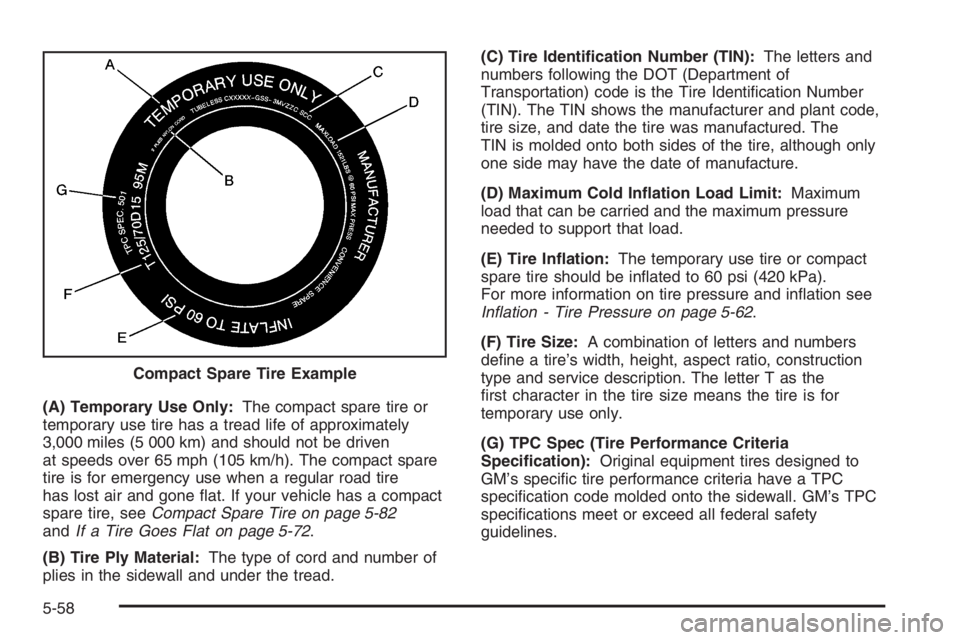
(A) Temporary Use Only:The compact spare tire or
temporary use tire has a tread life of approximately
3,000 miles (5 000 km) and should not be driven
at speeds over 65 mph (105 km/h). The compact spare
tire is for emergency use when a regular road tire
has lost air and gone at. If your vehicle has a compact
spare tire, seeCompact Spare Tire on page 5-82
andIf a Tire Goes Flat on page 5-72.
(B) Tire Ply Material:The type of cord and number of
plies in the sidewall and under the tread.(C) Tire Identication Number (TIN):The letters and
numbers following the DOT (Department of
Transportation) code is the Tire Identication Number
(TIN). The TIN shows the manufacturer and plant code,
tire size, and date the tire was manufactured. The
TIN is molded onto both sides of the tire, although only
one side may have the date of manufacture.
(D) Maximum Cold Ination Load Limit:Maximum
load that can be carried and the maximum pressure
needed to support that load.
(E) Tire Ination:The temporary use tire or compact
spare tire should be inated to 60 psi (420 kPa).
For more information on tire pressure and ination see
Ination - Tire Pressure on page 5-62.
(F) Tire Size:A combination of letters and numbers
dene a tire’s width, height, aspect ratio, construction
type and service description. The letter T as the
rst character in the tire size means the tire is for
temporary use only.
(G) TPC Spec (Tire Performance Criteria
Specication):Original equipment tires designed to
GM’s specic tire performance criteria have a TPC
specication code molded onto the sidewall. GM’s TPC
specications meet or exceed all federal safety
guidelines. Compact Spare Tire Example
5-58
Page 328 of 416

Aspect Ratio:The relationship of a tire’s height to
its width.
Belt:A rubber coated layer of cords that is located
between the plies and the tread. Cords may be made
from steel or other reinforcing materials.
Bead:The tire bead contains steel wires wrapped by
steel cords that hold the tire onto the rim.
Bias Ply Tire:A pneumatic tire in which the plies are
laid at alternate angles less than 90 degrees to the
centerline of the tread.
Cold Ination Pressure:The amount of air pressure in
a tire, measured in pounds per square inch (psi) or
kilopascals (kPa) before a tire has built up heat
from driving. SeeInation - Tire Pressure on page 5-62.
Curb Weight:This means the weight of a motor
vehicle with standard and optional equipment including
the maximum capacity of fuel, oil and coolant, but
without passengers and cargo.
DOT Markings:A code molded into the sidewall of a
tire signifying that the tire is in compliance with the U.S.
Department of Transportation (DOT) motor vehicle
safety standards. The DOT code includes the Tire
Identication Number (TIN), an alphanumeric designator
which can also identify the tire manufacturer, production
plant, brand and date of production.GVWR:Gross Vehicle Weight Rating, seeLoading
Your Vehicle on page 4-29.
GAWR FRT:Gross Axle Weight Rating for the front
axle, seeLoading Your Vehicle on page 4-29.
GAWR RR:Gross Axle Weight Rating for the rear axle,
seeLoading Your Vehicle on page 4-29.
Intended Outboard Sidewall:The side of an
asymmetrical tire, that must always face outward when
mounted on a vehicle.
Kilopascal (kPa):The metric unit for air pressure.
Light Truck (LT-Metric) Tire:A tire used on light duty
trucks and some multipurpose passenger vehicles.
Load Index:An assigned number ranging from 1 to 279
that corresponds to the load carrying capacity of a tire.
Maximum Ination Pressure:The maximum air
pressure to which a cold tire may be inated. The
maximum air pressure is molded onto the sidewall.
Maximum Load Rating:The load rating for a tire at the
maximum permissible ination pressure for that tire.
Maximum Loaded Vehicle Weight:The sum of curb
weight; accessory weight; vehicle capacity weight;
and production options weight.
5-60
Page 387 of 416

Customer Assistance and Information...............7-2
Customer Satisfaction Procedure......................7-2
Online Owner Center......................................7-3
Customer Assistance for Text
Telephone (TTY) Users................................7-4
Customer Assistance Offices............................7-4
GM Mobility Reimbursement Program................7-5
Roadside Assistance Program..........................7-6
Courtesy Transportation...................................7-7Vehicle Data Collection and Event Data
Recorders..................................................7-9
Collision Damage Repair................................7-10
Reporting Safety Defects................................7-13
Reporting Safety Defects to the United States
Government..............................................7-13
Reporting Safety Defects to the Canadian
Government..............................................7-14
Reporting Safety Defects to
General Motors.........................................7-14
Service Publications Ordering Information.........7-14
Section 7 Customer Assistance and Information
7-1
Page 393 of 416

While we hope you never have the occasion to use our
service, it is added security while traveling for you
and your family. Remember, we are only a phone call
away. Buick Roadside Assistance:1-800-252-1112, text
telephone (TTY) users, call1-888-889-2438.
Buick reserves the right to limit services or
reimbursement to an owner or driver when, in Buick’s
judgement, the claims become excessive in frequency or
type of occurrence.
Roadside Assistance is not part of or included in the
coverage provided by the New Vehicle Limited Warranty.
Buick reserves the right to make any changes or
discontinue the Roadside Assistance program at any
time without notication.
Canadian Roadside Assistance
Vehicles purchased in Canada have an extensive
roadside assistance program accessible from anywhere
in Canada or the United States. Please refer to the
Warranty and Owner Assistance Information book.
Courtesy Transportation
To enhance your ownership experience, we and our
participating dealers are proud to offer Courtesy
Transportation, a customer support program for
new vehicles.
The Courtesy Transportation program is offered to
customers in conjunction with the Bumper-to-Bumper
coverage provided by the New Vehicle Limited Warranty.
Several transportation options are available when
warranty repairs are required. This will reduce your
inconvenience during warranty repairs.
Scheduling Service Appointments
When your vehicle requires warranty service, you should
contact your dealer and request an appointment. By
scheduling a service appointment and advising
your service consultant of your transportation needs,
your dealer can help minimize your inconvenience.
If your vehicle cannot be scheduled into the service
department immediately, keep driving it until it can be
scheduled for service, unless, of course, the problem is
safety-related. If it is, please call your dealership, let
them know this, and ask for instructions.
If the dealer requests that you simply drop the vehicle off
for service, you are urged to do so as early in the work
day as possible to allow for the same day repair.
7-7
Page 394 of 416

Transportation Options
Warranty service can generally be completed while you
wait. However, if you are unable to wait, GM helps
to minimize your inconvenience by providing several
transportation options. Depending on the circumstances,
your dealer can offer you one of the following:
Shuttle Service
Participating dealers can provide you with shuttle
service to get you to your destination with minimal
interruption of your daily schedule. This includes
one-way or round trip shuttle service to a destination
up to 10 miles (16 km) from the dealership.
Public Transportation or Fuel
Reimbursement
If your vehicle requires overnight warranty repairs,
reimbursement of public transportation expenses may
be available, for up to a maximum of ve days. In
addition, should you arrange transportation through a
friend or relative, reimbursement for reasonable
fuel expenses may be available, up to a ve-day
maximum. Claim amounts should reect actual costs
and be supported by original receipts.
Courtesy Rental Vehicle
Your dealer may arrange to provide you with a courtesy
rental vehicle or reimburse you for a rental vehicle
that you obtain if your vehicle is kept for a warranty
repair. Reimbursement will be limited to a maximum
amount per day and must be supported by receipts. This
requires that you sign and complete a rental agreement
and meet state, local and rental vehicle provider
requirements. Requirements vary and may include
minimum age requirements, insurance coverage, credit
card, etc. You are responsible for fuel usage charges
and may also be responsible for taxes, levies,
usage fees, excessive mileage or rental usage beyond
the completion of the repair.
Generally it is not possible to provide a like-vehicle as a
courtesy rental.
Additional Program Information
Courtesy Transportation is available during the
Bumper-to-Bumper warranty coverage period, but it is
not part of the New Vehicle Limited Warranty. A
separate booklet entitledWarranty and Owner
Assistance Informationfurnished with each new vehicle
provides detailed warranty coverage information.
7-8