Page 326 of 444

Checking Coolant
The coolant recovery tank
is located in the engine
compartment toward
the rear of the engine on
the passenger’s side of
the vehicle. SeeEngine
Compartment Overview
on page 5-12for more
information on location.
The vehicle must be on a level surface when checking
the coolant level.
When the engine is cold, the coolant level should be
at the cold ll line or a little higher. The cold ll line
is near the bottom of the surge tank and has an arrow
pointing down at it.
Adding Coolant
If more coolant is needed, add the proper DEX-COOL®
coolant mixture at the coolant recovery tank, but be
careful not to spill it.
If the coolant recovery tank is completely empty, add
coolant to the radiator. SeeEngine Overheating
on page 5-27.
{CAUTION:
Turning the radiator pressure cap when the
engine and radiator are hot can allow steam
and scalding liquids to blow out and burn
you badly. With the coolant recovery tank,
you will almost never have to add coolant at
the radiator. Never turn the radiator pressure
cap — even a little — when the engine and
radiator are hot. 3.8L V6 Engine shown,
3.6L V6 Engine
similar
5-26
Page 327 of 444

{CAUTION:
You can be burned if you spill coolant on hot
engine parts. Coolant contains ethylene glycol,
and it will burn if the engine parts are hot
enough. Do not spill coolant on a hot engine.
Occasionally check the coolant level in the radiator.
For information on how to add coolant to the radiator,
seeCooling System on page 5-30.
Radiator Pressure Cap
Notice:If the pressure cap is not tightly installed,
coolant loss and possible engine damage may
occur. Be sure the cap is properly and tightly
secured.
The radiator pressure cap is located in the front of the
engine compartment on the passenger’s side of the
vehicle. SeeEngine Compartment Overview on
page 5-12for more information on location.
Engine Overheating
There is a coolant temperature gage and a warning
light on the instrument panel cluster that indicate
an overheated engine condition. SeeEngine Coolant
Temperature Gage on page 3-41andEngine Coolant
Temperature Warning Light on page 3-40for more
information.
In addition, if your vehicle is equipped with a Driver
Information Center (DIC), you will nd an ENGINE
COOLANT HOT and a REDUCED POWER STOP
WHEN SAFE message displayed on the DIC.
SeeDIC Warnings and Messages on page 3-59
for more information.
5-27
Page 331 of 444

If the coolant inside the coolant recovery tank is boiling,
do not do anything else until it cools down. The
vehicle should be parked on a level surface.
When the engine is cold, the coolant level should be
at or above the cold ll line on the coolant recovery tank.
If it is not, there may be a leak at the pressure cap or
in the radiator hoses, heater hoses, radiator, water
pump, or somewhere else in the cooling system.
{CAUTION:
Heater and radiator hoses, and other engine
parts, can be very hot. Do not touch them.
If you do, you can be burned.
Do not run the engine if there is a leak. If you
run the engine, it could lose all coolant. That
could cause an engine re, and you could be
burned. Get any leak xed before you drive the
vehicle.If there seems to be no leak, with the engine on, check
to see if the electric engine cooling fans are running.
If the engine is overheating, the fans should be running.
If the fans are not running, the vehicle needs service.
Notice:Engine damage from running your engine
without coolant is not covered by your warranty. See
Overheated Engine Protection Operating Mode on
page 5-29for information on driving to a safe place
in an emergency.
Notice:Using coolant other than DEX-COOL
®may
cause premature engine, heater core or radiator
corrosion. In addition, the engine coolant may
require changing sooner, at 30,000 miles (50 000 km)
or 24 months, whichever occurs rst. Any repairs
would not be covered by your warranty. Always use
DEX-COOL
®(silicate-free) coolant in your vehicle.
5-31
Page 357 of 444
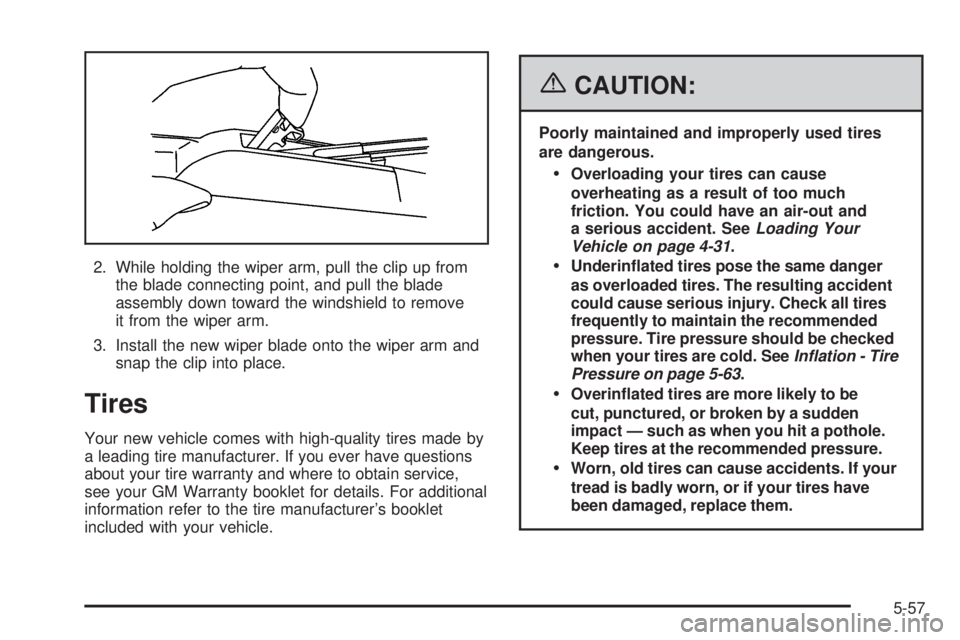
2. While holding the wiper arm, pull the clip up from
the blade connecting point, and pull the blade
assembly down toward the windshield to remove
it from the wiper arm.
3. Install the new wiper blade onto the wiper arm and
snap the clip into place.
Tires
Your new vehicle comes with high-quality tires made by
a leading tire manufacturer. If you ever have questions
about your tire warranty and where to obtain service,
see your GM Warranty booklet for details. For additional
information refer to the tire manufacturer’s booklet
included with your vehicle.
{CAUTION:
Poorly maintained and improperly used tires
are dangerous.
Overloading your tires can cause
overheating as a result of too much
friction. You could have an air-out and
a serious accident. SeeLoading Your
Vehicle on page 4-31.
Underinated tires pose the same danger
as overloaded tires. The resulting accident
could cause serious injury. Check all tires
frequently to maintain the recommended
pressure. Tire pressure should be checked
when your tires are cold. SeeInflation - Tire
Pressure on page 5-63.
Overinated tires are more likely to be
cut, punctured, or broken by a sudden
impact — such as when you hit a pothole.
Keep tires at the recommended pressure.
Worn, old tires can cause accidents. If your
tread is badly worn, or if your tires have
been damaged, replace them.
5-57
Page 435 of 444

E
Electrical System
Add-On Equipment......................................5-93
Fuses and Circuit Breakers...........................5-93
Headlamp Wiring.........................................5-93
Instrument Panel Fuse Block.........................5-94
Power Windows and Other Power Options......5-93
Underhood Fuse Block.................................5-95
Windshield Wiper Fuses...............................5-93
Engine
Air Cleaner/Filter.........................................5-20
Battery.......................................................5-42
Change Engine Oil Light...............................3-45
Check and Service Engine Soon Light............3-41
Coolant......................................................5-24
Coolant Heater............................................2-25
Coolant Temperature Gage...........................3-41
Coolant Temperature Warning Light................3-40
Engine Compartment Overview......................5-12
Exhaust.....................................................2-34
Oil .............................................................5-15
Oil Life System...........................................5-18
Overheated Protection Operating Mode...........5-29
Overheating................................................5-27
Reduced Power Light...................................3-46
Starting......................................................2-24
Entry Lighting.................................................3-16Event Data Recorders (EDR)............................7-10
Extender, Safety Belt.......................................1-30
Exterior Lamps...............................................3-13
Exterior Lighting Battery Saver..........................3-15
F
Filter
Engine Air Cleaner......................................5-20
Finish Damage...............................................5-90
Flashers, Hazard Warning.................................. 3-6
Flash-to-Pass................................................... 3-8
Flat Tire........................................................5-72
Flat Tire, Changing.........................................5-73
Flat Tire, Storing.............................................5-82
Fluid
Automatic Transaxle.....................................5-21
Power Steering...........................................5-37
Windshield Washer......................................5-38
Fog Lamps....................................................3-15
Folding Rear Seat............................................ 1-8
Fuel............................................................... 5-5
Additives...................................................... 5-6
California Fuel.............................................. 5-6
Check Gas Cap Light...................................3-49
Filling a Portable Fuel Container....................5-10
Filling Your Tank........................................... 5-8
Fuels in Foreign Countries.............................. 5-7
5