2006 BMW Z4 COUPE Climate
[x] Cancel search: ClimatePage 72 of 128

Special operating instructions
70
Special operating instructions
Break-in procedures
Moving parts need to be given some time until
they can interact smoothly with one another. To
ensure that your vehicle provides maximum
economy throughout a long service life, we
request that you observe the following:
Always obey all official speed limits.
Engine and differential
Up to 1,200 miles/2,000 km
Drive at varying engine and road speeds, but do
not exceed 4,500 rpm or 100 mph/160 km/h.
Refrain from using full throttle and avoid press-
ing the accelerator beyond the kickdown point.
After driving 1,200 miles/2,000 km
Engine and vehicle speeds can be gradually
increased.
Tires
Due to technical factors associated with their
manufacture, tires do not achieve their full trac-
tion potential until an initial break-in period has
elapsed. Therefore, drive cautiously during the
first 200 miles/300 km.
Brake system
Brakes require an initial break-in period of
approx. 300 miles/500 km to achieve optimized
contact and wear patterns between brake pads
and rotors. Drive cautiously during this break-in
period.
Clutch
The function of the clutch reaches its optimal
level only after a distance driven of approx.
300 miles/500 km. Shift gears carefully during
the break-in period.
After replacing components
The same break-in procedures should be
observed if any of the components mentioned
above have to be renewed in the course of the
vehicle's operating life.
Driving notes
Closing the luggage compartment lid/
tailgate
Operate the vehicle only when the lug-
gage compartment lid/tailgate is closed.
Otherwise, exhaust fumes could enter the inte-
rior of the vehicle.<
Should it be absolutely necessary to operate
the vehicle with the luggage compartment lid/
tailgate open:
1.Coupe: close both windows.
Roadster: close all windows if the convert-
ible top is closed.
2.Greatly increase the air flow from the air
conditioning or automatic climate control,
refer to page58 or61.
Hot exhaust system
In all vehicles, extremely high tempera-
tures are generated in the exhaust sys-
tem. Never remove the heat shields installed in
the area of the exhaust system, nor apply
undercoating to their surfaces. When driving,
standing at idle or parking the vehicle, take care
to avoid contact between the hot exhaust sys-
tem and flammable materials, e.g. hay, leaves,
grass, etc. Such contact could lead to a fire,
resulting in serious personal injury and property
damage.<
Mobile communications in the vehicle
BMW advises against using mobile com-
munications devices, e.g. mobile phones,
inside the vehicle without connecting them
directly to an outside antenna. Otherwise, it
Page 74 of 128

Special operating instructions
72 high temperatures, brake wear and possibly
even brake failure.<
You can increase the engine's braking effect by
shifting down, all the way to first gear if neces-
sary. This strategy helps you avoid placing
excessive loads on the brake system. Down-
shifting in manual mode of the automatic trans-
mission, refer to page41.
Never drive with the clutch held down,
with the transmission in idle or with the
engine switched off; otherwise, engine braking
action will not be present or there will be no
power assistance to the brakes or steering.
Never allow floor mats, carpets or any other
objects to protrude into the area around the
pedals, otherwise pedal function could be
impaired.<
Corrosion on the brake rotors
Limited vehicle use, extended periods with the
vehicle parked or in storage, and operating con-
ditions in which braking is restricted to gentle,
low-pressure applications will all increase the
tendency for corrosion to form on the rotors and
contamination to accumulate on the brake
pads. This occurs because the minimal pres-
sure which must be exerted by the pads to
clean the rotors by brake applications is not
reached.
If the brake rotors are corroded, they will tend to
respond to braking with a pulsating effect which
even extended application will fail to cure.
When the vehicle is parked
Condensation forms while the air conditioning
or automatic climate control is in operation, and
then exits under the vehicle. Traces of con-
densed water on the ground underneath the
vehicle are thus normal.
Before driving into a car wash
For general information about taking care of
your BMW, refer to the Caring for your vehicle
brochure.
Cargo loading
Avoid overloading the vehicle so that the
permissible carrying capacity of the tires
is not exceeded. Otherwise, overheating and
inner damage to the tires may result. The ulti-
mate result can assume the form of a sudden air
loss.<
Determining the maximum load
1.Locate the following statement on your
vehicle's placard
*:
The combined weight of occupants
and cargo should never exceed
XXX kg or YYY lbs. Otherwise, overloading
can result in damage to the vehicle and
unstable driving conditions.<
2.Determine the combined weight of the
driver and passenger that will be riding in
your vehicle.
3.Subtract the combined weight of the driver
and passenger from XXX kilograms or
YYY pounds.
4.The resulting figure equals the available
amount of cargo and luggage load capacity.
For example, if the YYY amount equals
551 lbs and there will be two 150 lbs occu-
pants in your vehicle, the amount of avail-
able cargo and luggage load capacity is
251 lbs.
551 lbs minus 300 lbs = 251 lbs
5.Determine the combined weight of luggage
and cargo being loaded on the vehicle. That
weight may not safely exceed the available
cargo and luggage load capacity calculated
in step 4.
Page 85 of 128

Reference
At a glance
Controls
Driving tips
Mobility
83
All passenger car tires must conform to
Federal Safety Requirements in addition
to these grades.<
Tread wear
The tread wear grade is a comparative rating
based on the wear rate of the tire when tested
under controlled conditions on a specified gov-
ernment test course.
For example, a tire graded 150 would wear one
and one-half, 1 γ, times as well on the govern-
ment course as a tire graded 100. The relative
performance of tires depends upon the actual
conditions of their use, however, and may
depart significantly from the norm due to varia-
tions in driving habits, service practices and dif-
ferences in road characteristics and climate.
Traction
The traction grades, from highest to lowest, are
AA, A, B and C.
Those grades represent the tire's ability to stop
on wet pavement as measured under controlled
conditions on specified government test sur-
faces of asphalt and concrete. A tire marked C
may have poor traction performance.
The traction grade assigned to this tire is
based on straight-ahead braking traction
tests, and does not include acceleration, cor-
nering, hydroplaning, or peak traction charac-
teristics.<
Temperature
The temperature grades are A, the highest, B
and C, representing the tire’s resistance to the
generation of heat and its ability to dissipate
heat when tested under controlled conditions
on a specified indoor laboratory test wheel.
Sustained high temperature can cause the
material of the tire to degenerate and reduce
tire life, and excessive temperature can lead to
sudden tire failure. The grade C corresponds to
a level of performance which all passenger car
tires must meet under the Federal Motor Vehi-
cle Safety Standard No. 109. Grades B and A
represent higher levels of performance on the
laboratory test wheel than the minimum
required by law.The temperature grade for this tire is
established for a tire that is properly
inflated and not overloaded. Excessive speed,
underinflation, or excessive loading, either sep-
arately or in combination, can cause heat
buildup and possible tire failure.<
RSC: Run-Flat Tires
Run-Flat tires are labeled on the sidewall with a
circular symbol containing the letters RSC.
Refer to page84.
M+S
Winter and all-season tires.
These have better winter performance proper-
ties than summer tires.
Tire condition
Inspect your tires frequently for tread wear,
signs of damage and for foreign objects lodged
in the tread. Check the tread depth.
Minimum tread depth
The tread depth should not drop below 1/8 in/
3 mm, although, for example, European legisla-
tion only specifies a minimum tread depth of
1/16 in/1.6 mm. At tread depths below 1/8 in/
3 mm there is an increased risk of high-speed
hydroplaning, even when only small amounts of
water are present on the road surface.
When winter tires wear down past a tread depth
of 1/6 in/4 mm, they become perceptibly less
suitable for winter conditions. In the interest of
safety, new tires should be installed.
Wear indicators in the base of the tread groove
are distributed around the tire's circumference;
Page 114 of 128

Everything from A to Z
112
Everything from A to Z
Index
A
ABS Antilock Brake
System49
– indicator lamp12
Accident, refer to Emergency
call98
Acknowledgment signal for
locking/unlocking vehicle19
Activated-charcoal filter for
automatic climate control63
Additives
– coolant89
– engine oil89
Adjusting
– seats30
Adjusting the thigh support32
Airbags52
– deactivating36
– indicator/warning lamp13
– passenger airbags indicator
lamp36
– reactivation36
– safe seating position30
Airbag switch, refer to Key
switch for passenger
airbags35
Air conditioning58
Air-conditioning operation,
refer to Cooling
function59,62
Air distribution
– air conditioning59
– automatic climate control62
– individual59,62
Air flow rate
– air conditioning59
– automatic climate control62
Airing out, refer to
Ventilation59,63
Air outlets, refer to
Ventilation59,63Air pressure, refer to Tire
inflation pressure80
Air recirculation, refer to
Recirculated-air
mode59,63
AKI, refer to Fuel
specifications79
Alarm system23
– avoiding unintentional
alarms24
– interior motion sensor24
– switching off an alarm24
– tilt alarm sensor24
All-season tires, refer to
Winter tires83,85
Ambient air, refer to
Recirculated-air
mode59,63
Ambient temperature
display46
Antenna, refer to the Caring
for your vehicle brochure
Antifreeze44,89
– coolant89
– washer fluids44
Antilock Brake System
ABS49
– indicator/warning lamp12
– indicator lamp13
Anti-theft alarm system, refer
to Alarm system23
Anti-theft protection19,23
Approved engine oils89
Artificial leather, refer to the
Caring for your vehicle
brochure
Ashtray65
Assistance systems, refer to
Driving stability control
systems49
AUC Automatic recirculated-
air control63Automatic
– air distribution62
– air flow rate62
– cruise control44
– headlamp control55
– luggage compartment lid
operation22
– recirculated-air control
AUC63
– tailgate operation21
Automatic car wash, refer to
the Caring for your vehicle
brochure
Automatic climate control61
Automatic convertible top27
Automatic lamps55
Automatic transmission with
Steptronic40
– indicator lamp13
– interlock38,40
– selector lever41
– selector lever lock40
– shiftlock40
– shift paddles on steering
wheel41
– towing the vehicle101
– tow-starting101
AUTO program for automatic
climate control62
Average fuel consumption48
– setting unit of measure48
Average speed48
– setting unit of measure48
Avoiding unintentional
alarms24
Axle loads, refer to
Weights109
B
Backrests, refer to Seat
adjustment31
Page 116 of 128
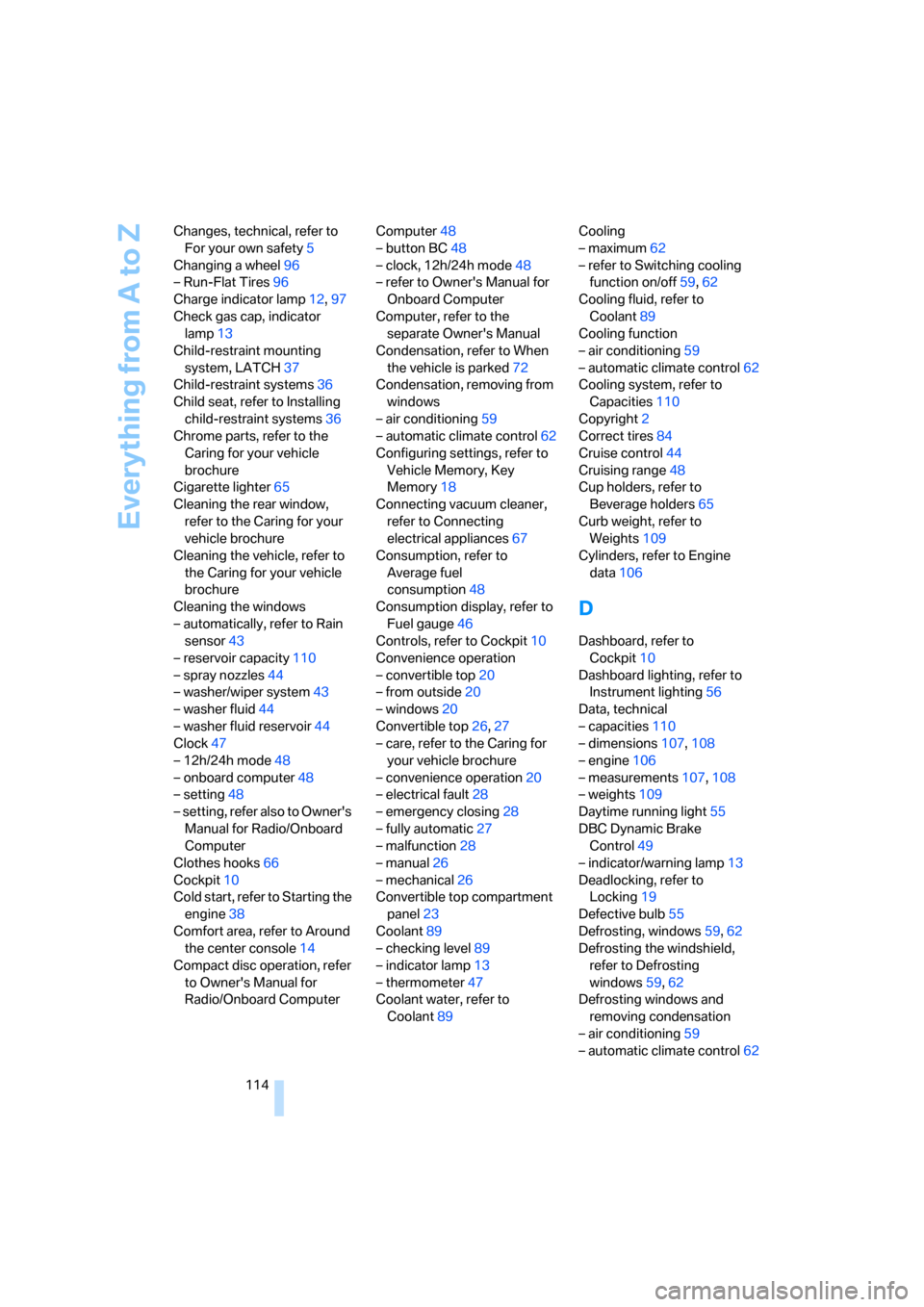
Everything from A to Z
114 Changes, technical, refer to
For your own safety5
Changing a wheel96
– Run-Flat Tires96
Charge indicator lamp12,97
Check gas cap, indicator
lamp13
Child-restraint mounting
system, LATCH37
Child-restraint systems36
Child seat, refer to Installing
child-restraint systems36
Chrome parts, refer to the
Caring for your vehicle
brochure
Cigarette lighter65
Cleaning the rear window,
refer to the Caring for your
vehicle brochure
Cleaning the vehicle, refer to
the Caring for your vehicle
brochure
Cleaning the windows
– automatically, refer to Rain
sensor43
– reservoir capacity110
– spray nozzles44
– washer/wiper system43
– washer fluid44
– washer fluid reservoir44
Clock47
– 12h/24h mode48
– onboard computer48
– setting48
– setting, refer also to Owner's
Manual for Radio/Onboard
Computer
Clothes hooks66
Cockpit10
Cold start, refer to Starting the
engine38
Comfort area, refer to Around
the center console14
Compact disc operation, refer
to Owner's Manual for
Radio/Onboard ComputerComputer48
– button BC48
– clock, 12h/24h mode48
– refer to Owner's Manual for
Onboard Computer
Computer, refer to the
separate Owner's Manual
Condensation, refer to When
the vehicle is parked72
Condensation, removing from
windows
– air conditioning59
– automatic climate control62
Configuring settings, refer to
Vehicle Memory, Key
Memory18
Connecting vacuum cleaner,
refer to Connecting
electrical appliances67
Consumption, refer to
Average fuel
consumption48
Consumption display, refer to
Fuel gauge46
Controls, refer to Cockpit10
Convenience operation
– convertible top20
– from outside20
– windows20
Convertible top26,27
– care, refer to the Caring for
your vehicle brochure
– convenience operation20
– electrical fault28
– emergency closing28
– fully automatic27
– malfunction28
– manual26
– mechanical26
Convertible top compartment
panel23
Coolant89
– checking level89
– indicator lamp13
– thermometer47
Coolant water, refer to
Coolant89Cooling
– maximum62
– refer to Switching cooling
function on/off59,62
Cooling fluid, refer to
Coolant89
Cooling function
– air conditioning59
– automatic climate control62
Cooling system, refer to
Capacities110
Copyright2
Correct tires84
Cruise control44
Cruising range48
Cup holders, refer to
Beverage holders65
Curb weight, refer to
Weights109
Cylinders, refer to Engine
data106D
Dashboard, refer to
Cockpit10
Dashboard lighting, refer to
Instrument lighting56
Data, technical
– capacities110
– dimensions107,108
– engine106
– measurements107,108
– weights109
Daytime running light55
DBC Dynamic Brake
Control49
– indicator/warning lamp13
Deadlocking, refer to
Locking19
Defective bulb55
Defrosting, windows59,62
Defrosting the windshield,
refer to Defrosting
windows59,62
Defrosting windows and
removing condensation
– air conditioning59
– automatic climate control62
Page 120 of 128

Everything from A to Z
118 Lighting of the instruments,
refer to Instrument
lighting56
LIGHTS ON warning56
Light switch55
Loads, refer to Cargo
loading72
Loads, securing73
Locking the doors
– from inside21
– from outside19,20
Locking the vehicle
– from inside21
– from outside19
Longlife oils
– approved engine oils89
Low beams55
– automatic55
– bulb replacement94
– indicator lamp, defective
lamp13
Luggage compartment
– capacity109
– floor panel93
– increasing capacity23
– opening and closing21,22
– opening from inside the
vehicle21,22
– opening from the
outside21,22
Luggage compartment lid22
– emergency release23
– indicator lamp13
– opening from inside the
vehicle22
– opening from the outside22
– remote control19
M
M+S tires, refer to Winter
tires85
Maintenance91
– refer to Service Booklet
– refer to Service interval
display47,91
Making telephone calls, refer
to Owner's Manual for
TelephoneMalfunction
– automatic transmission with
Steptronic41
– convertible top28
– door lock20
– fuel filler door78
– luggage compartment lid22
– storage compartments64
– tailgate22
Malfunction of electrical
accessory97
Manual
– air distribution62
– air flow rate62
Manual convertible top26
Manual mode, refer to
Automatic transmission with
Steptronic41
Manual operation
– door lock20
– driver's door20
– fuel filler door78
– luggage compartment lid22
– power convertible top28
– storage compartments64
– tailgate22
– transmission lock, automatic
transmission40
Manual transmission40
Manufacturer5
Master keys with remote
control18
Maximum cooling62
Maximum speed
– with winter tires85
MD operation, refer to
Owner's Manual for Radio/
Onboard Computer
Measurements, refer to
Dimensions107,108
Mechanical seat31
Memory
– Seat memory32
– Vehicle Memory, Key
Memory18
Microfilter
– air conditioning60
– automatic climate control63Microphone, refer to Mobile
phone preparation
package67
Minidisc operation, refer to
Owner's Manual for Radio/
Onboard Computer
Mirrors34
– exterior mirrors
34
– heating34
– interior rearview mirror34
Mobile communications in the
vehicle, refer to the separate
Owner's Manual
Mobile phone, refer to the
separate Owner's Manual
Mobile phone preparation
package67
Mobile phones, use inside the
car, refer to Mobile
communications in the
vehicle70
Modifications, technical, refer
to For your own safety5
M Sports seat31
Multifunctional steering
wheel, refer to Buttons on
the steering wheel11
Multifunction switch
– refer to Turn signal
indicators/headlamp
flasher42
– refer to Washer/wiper
system43
N
Navigation system, refer to the
separate Owner's Manual
Neck support, refer to Head
restraints32
Nets64
New
– keys18
– tires84
Nylon rope, refer to Tow
rope101
Page 121 of 128

Reference
At a glance
Controls
Driving tips
Mobility
119
O
OBD socket, refer to Socket
for On-Board Diagnosis
OBD91
Octane numbers, refer to Fuel
specifications79
Odometer46
Oil, refer to Engine oil87
Oil level87
– checking88
Oil service47
Onboard computer, refer to
Computer48
Onboard tool kit93
Opening
– from inside21
Opening and closing the
vehicle
– at the door lock20
– from inside21
– from outside19
– with the remote control19
Outlets, refer to
Ventilation59,63
Outside temperature display
– changing units of
measure48
– in the onboard computer48
Outside temperature
warning46
Overheated engine, refer to
Coolant temperature47
P
Paintwork, refer to the Caring
for your vehicle brochure
Parking brake39
– indicator lamp13,39
Parking lamps, refer to
Parking lamps/Low
beams55
Parking lamps/Low beams55
– bulb replacement94
Parking lock, refer to P
Parking40Passenger airbags
– deactivation36
– reactivation36
Passenger-side mirror tilt
function34
Pathway lighting56
Permissible axle load, refer to
Weights109
Permissible gross weight,
refer to Weights109
Pinch protection system
– windows25
Placing the vehicle in storage,
refer to the Caring for your
vehicle brochure
Plastic, refer to the Caring for
your vehicle brochure
Pollen
– refer to Microfilter60
– refer to Microfilter/activated-
charcoal filter63
Power
– windows, refer to
Windows25
Power convertible top27
Power failure97
Power output, refer to Engine
data106
Power steering, electric52
Power windows
– initializing25
Pressure, tires80
Pressure monitoring, tires,
refer to Flat Tire Monitor51
Protective function, refer to
Pinch protection system25
R
Radio, refer to the separate
Owner's Manual
Radio navigation, refer to the
separate Owner's Manual
Radio remote control key,
refer to Master keys with
remote control18
Rain sensor43
Reading lamps57Rear lamps
– bulb replacement96
– indicator lamp, defective
lamp13
Rearview mirror, refer to
Mirrors34
Rear window defroster
– air conditioning59
– automatic climate control63
Recirculated-air mode
– air conditioning59
– automatic climate control63
Recirculating the air, refer to
Recirculated-air
mode59,63
Reclining seat, refer to
Seats30
Refueling78
Releasing
– hood86
Remaining distance, refer to
Cruising range48
Remote control19
– luggage compartment lid19
– malfunction20
– tailgate19
Repairs
– refer to Maintenance
system91
Replacement key, refer to
New keys18
Replacement of tires84
Replacing lamps, refer to
Lamps and bulbs93
Replacing tires, refer to Wheel
and tire replacement84
Reserve
– indicator lamp, refer to Fuel
gauge46
Restraint systems
– for children36,37
– refer to Safety belts33
Reverse
– manual transmission40
Reverse gear
– automatic transmission with
Steptronic41
Roadside Assistance98
Roadside parking lamps56
Page 123 of 128

Reference
At a glance
Controls
Driving tips
Mobility
121
Starting assistance, refer to
Dynamic Stability Control
DSC49
Starting difficulties
– jump-starting99
– temperature39
Starting with a flat battery,
refer to Jump-starting99
Status of this Owner's Manual
at time of printing5
Steering wheel10
– adjusting34
– buttons on steering
wheel11
– lock38
Steptronic, refer to Sport
program and Manual
operation41
Storage compartments64
– electrical fault64
– eyeglasses compartment65
– glove compartment64
– opening manually64
Storage nets64
Storage space, refer to
– Cargo bay23
Storage space, refer to
Storage compartments64
Storing seat position, refer to
Seat memory32
Stowage, refer to Storage
compartments64
Summer tires, refer to Wheels
and tires80
Supply reservoir, refer to
Washer fluid reservoir44
Switches, refer to Cockpit10
Switch for passenger
airbags35
Switching cooling function on/
off manually59,62
Symbols4
T
Table of contents3
Tachometer46Tailgate21
– emergency operation22
– opening from inside the
vehicle21
– opening from the outside21
– opening manually22
– remote control19
– roller-blind cover65
Tail lamps, refer to Rear
lamps96
Tail lights, refer to Rear
lamps96
Tank contents
– refer to Capacities110
Tank indicator, refer to Fuel
gauge46
Technical data106
Technical modifications, refer
to For your own safety5
Telephone, refer to the
separate Owner's Manual
Telephone preparation
package67
Temperature
– air conditioning59
– automatic climate control62
– coolant, refer to Coolant
thermometer47
– engine47
Temperature display
– outside temperature46
– outside temperature
warning46
– setting unit of measure48
Tempomat, refer to Cruise
control44
Third brake lamp, refer to
Center high-mount brake
lamp96
Three-point safety belt, refer
to Safety belts33
Tilt alarm sensor25
Tilt function, passenger-side
mirror34
Tire inflation pressure80
– checking80
– loss51
– restoring80
Tire renewal84Tires
– age82,84
– break-in procedures70
– changing84
– coding82
– condition83
– damage84
– DOT quality grades82
– flat
51
– inflation pressure80
– pressure monitoring, refer to
Flat Tire Monitor51
– replacement84
– size80
– storage85
– temperature83
– traction83
– tread83
– tread wear83
– Uniform Tire Quality
Grading82
– wear indicators, refer to
Minimum tread depth83
– wheel and tire
replacement84
– winter tires85
– with emergency features,
refer to Run-Flat Tires84
Tire storage85
Tool kit, refer to Onboard tool
kit93
Torque, refer to Engine
data106
Tow bar101
Towing eyelet100
Towing the vehicle100
– methods101
– with automatic
transmission101
Tow rope101
Tow-starting101
Tow truck101
Track width, refer to
Dimensions107,108
Traction control, refer to
Dynamic Stability Control
DSC49