2006 BMW X3 2.5I ECU
[x] Cancel search: ECUPage 67 of 133

Reference
At a glance
Controls
Driving tips
Mobility
65
Practical interior accessories
Integrated universal remote
control*
The concept
The integrated universal remote control
replaces up to three different hand-held trans-
mitters for various items of radio-controlled
equipment such as door openers and house
alarm systems. The integrated universal remote
control recognizes and learns the transmitted
signal of each of the original hand-held trans-
mitters.
The signal of an original hand-held transmitter
can be programmed on one of the three mem-
ory buttons1. Once this is done, each of the
devices can be actuated with the appropriately
programmed memory button 1. The LED2 indi-
cates transmission of the signal.
Should you sell your vehicle one day, be sure to
delete the stored programs beforehand for your
security, refer to page66.
To prevent possible damage or injury,
before programming or using the inte-
grated universal remote control, always inspect
the immediate area to make certain that no peo-
ple, animals or objects are within the travel
range of the device. Also, comply with the
safety precautions of the original hand-held
transmitter.<
Checking compatibility
If you see this symbol on the packaging
or in the manual supplied with the origi-
nal hand-held transmitter, then it is safe
to assume that the radio-controlled device is
compatible with the integrated universal
remote control.
If you have additional questions, please
ask at your BMW Sports Activity Vehicle
Center or call: 1-800-355-3515.
You can find also information on the Internet at:
www.bmwusa.com or
www.homelink.com. HomeLink is a registered trademark of
Johnson Controls, Inc.<
Programming
1Memory buttons
2LED
Fixed-code hand-held transmitters
1.Turn the ignition key to position 2.
2.For initial use:
Press both outer buttons 1 for approx.
20 seconds, maintaining pressure until the
LED2 starts to flash. All stored programs
are deleted.
3.Hold the original hand-held transmitter at a
distance of approx. 2in/5cm to 8in/20cm
from the memory buttons1.
The required distance between the
hand-held transmitter and memory
buttons1 depends on the relevant system
of the original hand-held transmitter used.<
4.Simultaneously press the transmit button
on the original hand-held transmitter and
the desired memory button 1 of the inte-
grated universal remote control. Initially, the
LED2 flashes slowly. Release both buttons
as soon as the LED2 flashes rapidly. If the
LED2 does not flash rapidly after approx.
15 seconds, then change the distance.
5.To program other original hand-held trans-
mitters, repeat steps 3 and 4.
Page 72 of 133

Practical interior accessories
70
Securing load
After loading, secure the ski bag and its con-
tents. Tension the retaining strap on the ten-
sioning buckle for this purpose.
Always secure the ski bag in this way.
If you fail to do so, it can endanger occu-
pants during braking or evasive maneuvers.<
To store the ski bag, perform the above steps in
reverse order.
Inserting ski bag
The ski bag is located in the cargo area under
the floor cover.
1.Fold down the center armrest and pull off
the cover.
2.Remove the tray behind the cover with a
screwdriver by placing it against the indi-
cated location in the center of the tray.
3.Position the ski bag on the lower edge of the
opening, refer to arrow 1, then insert it, refer
to arrow 2.
Removing ski bag
Pull the handle forward and remove the ski bag
upward.
Do not position cargo at the opening. If
you do, it can endanger the passengers
during braking or evasive maneuvers.<
Cargo area
When loading, follow the instructions on
page78.
Enlarging cargo area
The rear backrest is split. You can fold down
both seats individually to enlarge the cargo
area.
Reach into the opening and pull forward, refer
to arrow.
Before folding down the rear backrest,
remove the cover caps for the LATCH
child-restraint fixing system
*. Otherwise,
impressions can be left in the seat cushion.<
When you fold back the backrest, be sure
that the catch engages securely. This
causes the red warning field in the recess to dis-
appear. Otherwise, cargo can be thrown into
the passenger compartment during braking or
Page 75 of 133
Reference
At a glance
Controls
Driving tips
Mobility
73
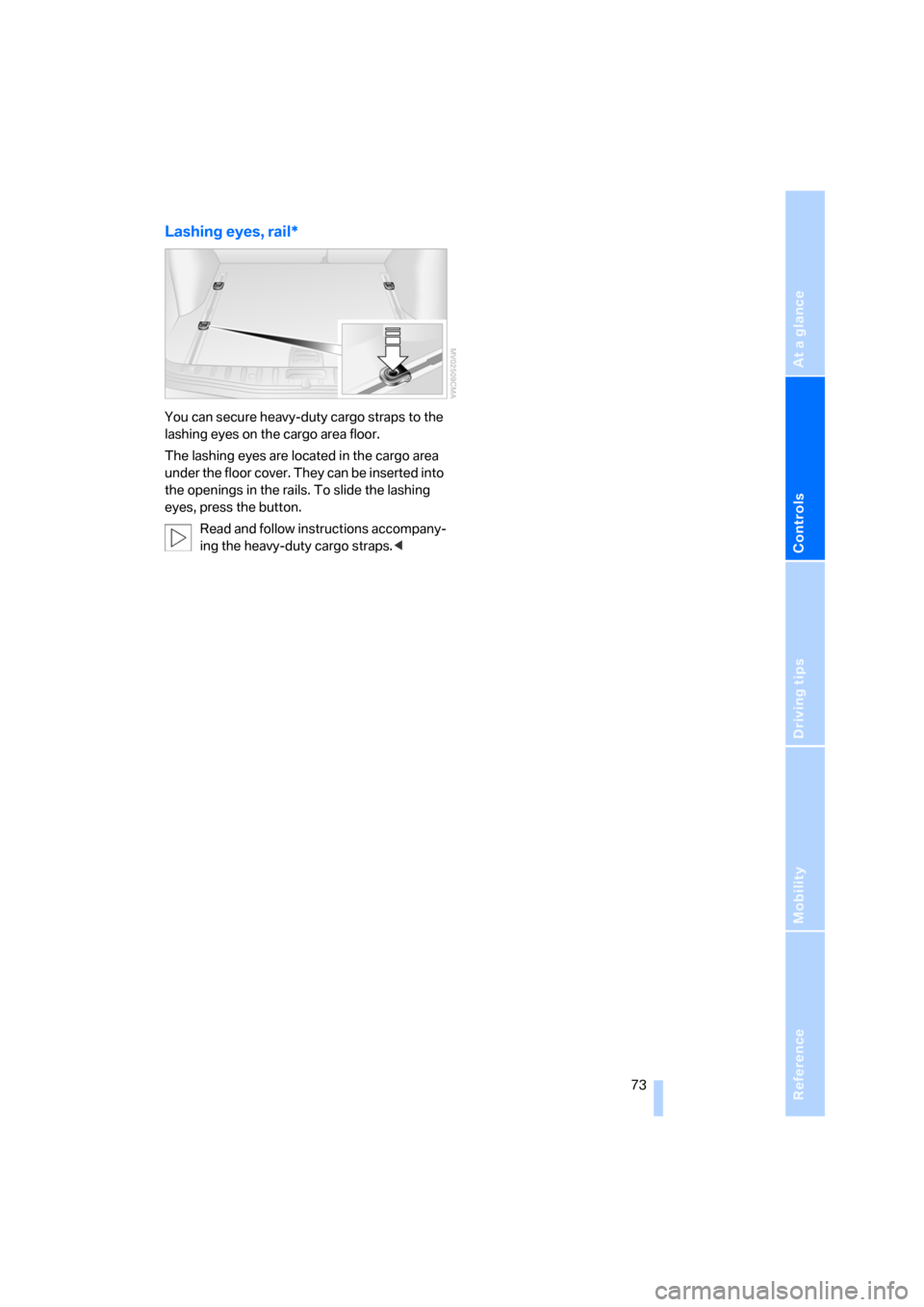
Lashing eyes, rail*
You can secure heavy-duty cargo straps to the
lashing eyes on the cargo area floor.
The lashing eyes are located in the cargo area
under the floor cover. They can be inserted into
the openings in the rails. To slide the lashing
eyes, press the button.
Read and follow instructions accompany-
ing the heavy-duty cargo straps.<
Page 81 of 133

Reference
At a glance
Controls
Driving tips
Mobility
79
3.Subtract the combined weight of the driver
and passengers from XXX lbs. or YYY kg.
4.The resulting figure equals the available
amount of cargo and luggage load capacity.
For example, if the XXX amount equals
990 lbs. and there will be five 150-lb. pas-
sengers in your vehicle, the amount of avail-
able cargo and luggage load capacity is
240 lbs.:
990 lbs. minus 750 lbs. = 240 lbs.
5.Determine the combined weight of luggage
and cargo being loaded into and/or onto the
vehicle. This combined weight may not
safely exceed the available cargo and lug-
gage load capacity calculated in step 4.
6.If your vehicle will be towing a trailer, part of
the load from your trailer will be transferred
to your vehicle. Consult the manual for
transporting a trailer to determine how this
may reduce the available cargo and luggage
load capacity of your vehicle.
Load
The permitted load is the total of the weight of
occupants and cargo/luggage. The greater the
weight of occupants, the less cargo/luggage
can be transported.
Stowing cargo
>To protect passengers, use the partition
net, refer to page72.
>Load heavy cargo as far forward and as low
as possible, placing it directly behind the
rear seat backrests.
>Cover sharp edges and corners.
>Do not stack cargo higher than the upper
edge of the backrests.
>Items that could bump against the rear win-
dow while driving must be adequately cov-
ered.
>For very heavy cargo when the rear seat is
not occupied, secure each safety belt in the
opposite buckle.
Securing cargo
>Use the luggage net* o r d ra w s t r a p s t o h o l d
down small and lightweight luggage and
cargo, refer to page73.
>For larger and heavier pieces, heavy-duty
cargo straps
* are available from your BMW
Sports Activity Vehicle Center. These
heavy-duty cargo straps are attached using
the lashing eyes in the cargo area, refer to
page73.
Page 82 of 133

Things to remember when driving
80 Please read the information provided with
the heavy-duty cargo straps.
Always position and secure cargo as
described above. If you do not, it can
endanger the passengers during braking or
evasive maneuvers.
Use only the lashing eyes, refer to page73, to
fasten the heavy-duty cargo straps; otherwise,
the heavy-duty cargo straps could loosen or the
vehicle could be damaged.
Never exceed either the approved gross vehicle
weight or either of the approved axle loads, refer
to page116, as excessive loads can pose a
safety hazard and may also place you in viola-
tion of road safety laws.
You should never transport heavy or hard
objects unsecured in the passenger compart-
ment, as they could be thrown about and pose a
safety hazard to the vehicle's occupants during
abrupt braking or evasive maneuvers.<
Roof-mounted luggage rack*
A special rack system is available as an optional
accessory for your BMW. Please observe the
information contained in the installation instruc-
tions.
Loading luggage rack
Because roof racks raise the vehicle's center of
gravity when loaded, they have a major effect on
its handling and steering response. You should
therefore always remember not to exceed the
approved roof load capacity, the approved
gross vehicle weight, or the axle loads when
loading the rack.
These specifications can be found under
Weights on page116.
Make sure that the load is evenly distributed,
and that it does not extend outward beyond the
limits of the loading surface. Always stow the
heaviest pieces at the bottom. Be sure that ade-
quate clearance is maintained for raising the
glass sunroof and that objects do not project
into the opening path of the liftgate.Secure roof-mounted cargo correctly and
securely to prevent it from shifting or falling off
while you drive.
Drive smoothly. Avoid sudden acceleration and
braking maneuvers. Take corners gently.
Driving on poor roads
Your X3 is at home on all paved and unpaved
roads. It combines all-wheel drive with the
advantages of a normal passenger car.
Driving on unpaved terrain can cause
damage to the vehicle.<
When you are driving on poor roads, there are a
few points which you should strictly observe –
for your own safety and that of your passengers,
as well as to protect the vehicle:
>Familiarize yourself with the vehicle before
you begin driving. Do not take risks with the
vehicle under any circumstances.
>Always adapt the driving speed to the road
conditions. The more steep and uneven the
roadway is, the lower the speed should be.
>You can operate your vehicle on uphill and
downhill gradients with a maximum slope
of 50 %. If you wish to drive on uphill and
downhill grades of this nature, make sure
beforehand that the engine oil and coolant
levels are near the MAX mark, refer to
pages94 and95.
>When descending very steep hills, use
HDC Hill Descent Control, refer to page49.
It is possible to start off on inclines of up
to 32 %.
The permitted side tilt is 32 %.
>While driving, watch carefully for obstacles
such as rocks or holes. Try to avoid these
obstacles whenever possible.
>Avoid having the body make contact with
the ground, e.g. on the crests of hills and
bumpy roads. The ground clearance of the
vehicle is a maximum of approx. 8.0 in/
20 cm. Please be aware that the ground
clearance can vary depending on the load
and operating conditions of the vehicle.
Page 94 of 133

Under the hood
92
Under the hood
Never attempt to perform any service or
repair operations on your vehicle without
the required professional technical training. If
you are not familiar with the regulations to be
observed, have work on your vehicle carried out
only by your BMW Sports Activity Vehicle Cen-
ter or at a workshop that works according to
BMW repair procedures with appropriately
trained personnel. If this work is not carried out
properly, there is a danger of subsequent dam-
age and related safety hazards.<
Hood
Unlocking
Pull the lever located under the left side of the
instrument cluster.
Opening
To avoid causing damage, make sure that
wiper arms are resting against the wind-
shield before opening the hood.<
Press the release handle and open the hood.
Closing
Close the hood with force by allowing it to fall
from a height of approx. 1 ft/30 cm. It must
engage audibly.
Avoid injuries by making sure that the
hood's closing region is clear and unob-
structed.
If you see any signs that the hood is not com-
pletely closed while driving your vehicle, you
should stop at once and close it securely.<
Page 101 of 133

Reference
At a glance
Controls
Driving tips
Mobility
99
Replacing components
Onboard tool kit
The onboard tool kit is located in a compart-
ment on the left in the cargo area.
Wiper blades
Replacing front wiper blades
1.Move the wiper into the fold-out position,
refer to page40.
2.Lift the wiper arm and press the securing
spring, refer to arrow.
3.Pull the wiper blade off toward the wiper
arm.
4.Insert the new blade and snap it into place.
To prevent damage to the wipers, always
fold them back down onto the windshield
before you turn the ignition key to position 1
or 2 or open the hood.<
Replacing rear wiper blade
1.Lift the wiper arm.
2.Pull off the wiper blade, refer to arrow.
3.Insert a new wiper blade.
Lamps and bulbs
Lamps and bulbs make a significant contribu-
tion to road safety. Therefore, comply fully with
the following instructions during bulb replace-
ment. If you are not familiar with the specified
procedures or they are not described here,
BMW recommends having this work carried out
at your BMW Sports Activity Vehicle Center.
Never touch the glass of new bulbs with
your bare fingers, as even minute
amounts of contamination will burn into the
bulb's surface and reduce its service life. Use
a clean cloth, paper towel, or the like or grasp
bulb by its base.<
A replacement bulb set is available from your
BMW Sports Activity Vehicle Center.
In all work on the electrical system, switch
off the relevant component to prevent
short circuits. To avoid possible injury or equip-
ment damage when replacing bulbs, follow any
instructions provided by the bulb manufac-
turer.<
When maintaining the headlamps, please follow
the instructions in the separate Caring for your
vehicle brochure.
Page 106 of 133

Replacing components
104 3.Turn the handle to the left as far as possible,
refer to arrow3.
Turning the handle releases the com-
pact wheel. Its weight of approx.
18 lbs./8 kg is then entirely supported by
the handle.<
4.Slowly lower the handle as far as possible,
refer to arrow4.
5.Pull the compact wheel to the rear so that it
is still securely resting in its compact wheel
receptacle.
6.If need be, turn the wheel in the compact
wheel receptacle so that the attachment of
the retaining strap to the rim points toward
the rear.
7.Rotate the clamp by 180°, refer to arrows 1,
and unhook the retaining strap from the
clamp, refer to arrow 2.
8.Take out the compact wheel toward the
back.
9.Fasten the retaining strap to the compact
wheel receptacle and resecure the compact
wheel receptacle by reversing the above
steps.
The width of the defective wheel prevents
it from fitting into the compact wheel receptacle in place of the compact wheel
itself.<
Inserting compact wheel
The compact wheel is reinserted in the reverse
sequence of its removal.
When attaching the retaining strap to the
compact wheel, make sure the belt is
threaded through 2 rim openings, with one
unoccupied hole between them; otherwise, the
compact wheel could come loose in an acci-
dent.<
Preparing wheel change
1.Observe the safety precautions on
page103.
2.Secure the vehicle to prevent it from rolling:
place the wheel chock behind the front
wheel on the side of the vehicle opposite
the side being raised. If the vehicle is parked
on a downward slope, place the wheel
chock securely in front of the tire. If the
wheel must be changed on a surface with
a more severe slope, take additional pre-
cautions to secure the vehicle from rolling.
3.Loosen the lug bolts by a γ turn.
Jacking up vehicle
1.Position the vehicle jack at the jacking point
closest to the wheel so that the entire sur-
face of the jack base perpendicularly con-
tacts the ground under the jacking point.
The vehicle jack is designed for
changing wheels only. Do not attempt
to raise another vehicle model with it or to
raise any load of any kind. To do so could
cause accidents and personal injury.<