Page 31 of 84
INSTRUMENT AND CONTROL FUNCTIONS
3-16
3
With the engine turned off:
1. Move the sidestand down.
2. Make sure that the engine stop switch is turned on.
3. Turn the key on.
4. Keep the front or rear brake applied.
5. Push the start switch.
Does the engine start?
With the engine still off:
6. Move the sidestand up.
7. Keep the front or rear brake applied.
8. Push the start switch.
Does the engine start?
With the engine still running:
9. Move the sidestand down.
Does the engine stall?
The system is OK. The scooter can be ridden.
This check is most reliable if performed with
a warmed-up engine.The sidestand switch may be defective.
The scooter should not be ridden until
checked by a Yamaha dealer.
The brake switch may be defective.
The scooter should not be ridden until
checked by a Yamaha dealer.
The sidestand switch may be defective.
The scooter should not be ridden until
checked by a Yamaha dealer.
YES NO YES NO NO YESNOTE:
Page 34 of 84

PRE-OPERATION CHECKS
4-2
4
EAU15603
Pre-operation check list
ITEM CHECKS PAGE
FuelCheck fuel level in fuel tank.
Refuel if necessary.
Check fuel line for leakage.3-10
Engine oilCheck oil level in engine.
If necessary, add recommended oil to specified level.
Check vehicle for oil leakage.6-10
Final transmission oilCheck vehicle for oil leakage. 6-12
CoolantCheck coolant level in reservoir.
If necessary, add recommended coolant to specified level.
Check cooling system for leakage.6-13
Front brakeCheck operation.
If soft or spongy, have Yamaha dealer bleed hydraulic system.
Check brake pads for wear.
Replace if necessary.
Check fluid level in reservoir.
If necessary, add recommended brake fluid to specified level.
Check hydraulic system for leakage.6-19, 6-20, 6-20
Rear brakeCheck operation.
If soft or spongy, have Yamaha dealer bleed hydraulic system.
Check brake pads for wear.
Replace if necessary.
Check fluid level in reservoir.
If necessary, add recommended brake fluid to specified level.
Check hydraulic system for leakage.6-19, 6-20, 6-20
Throttle gripMake sure that operation is smooth.
Check cable free play.
If necessary, have Yamaha dealer adjust cable free play and lubricate cable and
grip housing.6-16, 6-22
Page 35 of 84
PRE-OPERATION CHECKS
4-3
4
Wheels and tiresCheck for damage.
Check tire condition and tread depth.
Check air pressure.
Correct if necessary.6-17, 6-19
Brake leversMake sure that operation is smooth.
Lubricate lever pivoting points if necessary.6-22
Centerstand, sidestandMake sure that operation is smooth.
Lubricate pivots if necessary.6-23
Chassis fastenersMake sure that all nuts, bolts and screws are properly tightened.
Tighten if necessary.—
Instruments, lights, signals
and switchesCheck operation.
Correct if necessary.—
Sidestand switchCheck operation of ignition circuit cut-off system.
If system is defective, have Yamaha dealer check vehicle.3-15 ITEM CHECKS PAGE
Page 36 of 84

OPERATION AND IMPORTANT RIDING POINTS
5-1
5
EAU15980
WARNING
EWA10870
�
Become thoroughly familiar
with all operating controls and
their functions before riding.
Consult a Yamaha dealer re-
garding any control or function
that you do not thoroughly un-
derstand.
�
Never start the engine or oper-
ate it in a closed area for any
length of time. Exhaust fumes
are poisonous, and inhaling
them can cause loss of con-
sciousness and death within a
short time. Always make sure
that there is adequate ventila-
tion.
�
For safety, always start the en-gine with the centerstand down.
EAU16600
Starting the engine CAUTION:
ECA10250
See page 5-3 for engine break-in in-
structions prior to operating the ve-hicle for the first time.
In order for the ignition circuit cut-off
system to enable starting, the side-
stand must be up.
WARNING
EWA10290
�
Before starting the engine,
check the function of the igni-
tion circuit cut-off system ac-
cording to the procedure
described on page 3-15.
�
Never ride with the sidestanddown.
1. Turn the key to “” and make
sure that the engine stop switch is
set to “”.
2. Close the throttle completely.
3. Start the engine by pushing the
start switch while applying the front
or rear brake.
NOTE:If the engine does not start, release the
start switch, wait a few seconds, and
then try again. Each starting attempt
should be as short as possible to pre-
serve the battery. Do not crank the en-
gine more than 10 seconds on any one
attempt. If the engine does not start, trywith the throttle open 1/8 turn.CAUTION:
ECA11040
For maximum engine life, never ac-
celerate hard when the engine iscold!1. Rear brake lever
2. Engine stop switch
3. Start switch
4. Front brake lever
1234
ZAUM0418
Page 37 of 84

OPERATION AND IMPORTANT RIDING POINTS
5-2
5
EAU16760
Starting off NOTE:Before starting off, allow the engine towarm up.
1. While pulling the rear brake lever
with your left hand and holding the
grab bar with your right hand, push
the scooter off the centerstand.
2. Sit astride the seat, and then ad-
just the rear view mirrors.
3. Switch the turn signal on.
4. Check for oncoming traffic, and
then slowly turn the throttle grip (on
the right) in order to take off.
5. Switch the turn signal off.
EAU16780
Acceleration and deceleration The speed can be adjusted by opening
and closing the throttle. To increase the
speed, turn the throttle grip in direction
(a). To reduce the speed, turn the throt-
tle grip in direction (b).
EAU16791
Braking 1. Close the throttle completely.
2. Apply both front and rear brakes
simultaneously while gradually in-
creasing the pressure.
WARNING
EWA10300
�
Avoid braking hard or suddenly
(especially when leaning over to
one side), otherwise the scooter
may skid or overturn.
�
Railroad crossings, streetcar
rails, iron plates on road con-
struction sites, and manhole
covers become extremely slip-
pery when wet. Therefore, slow
down when approaching such
areas and cross them with cau-
tion.
1. Grab bar
1
ZAUM0419
(b)
(a)
ZAUM0199
PUSH
ZAUM0472
Page 41 of 84
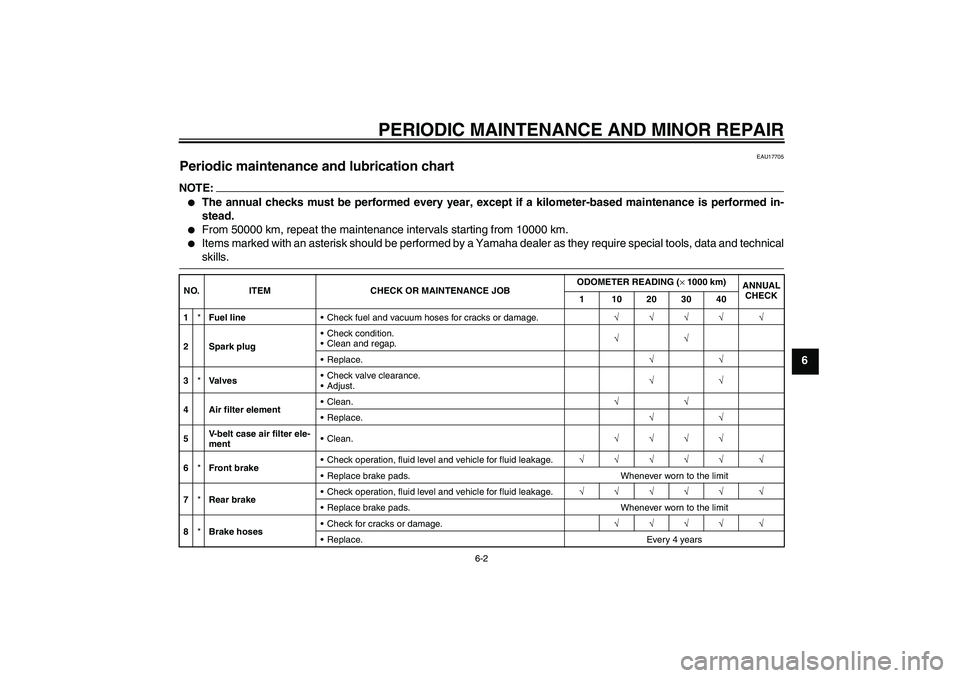
PERIODIC MAINTENANCE AND MINOR REPAIR
6-2
6
EAU17705
Periodic maintenance and lubrication chart NOTE:�
The annual checks must be performed every year, except if a kilometer-based maintenance is performed in-
stead.
�
From 50000 km, repeat the maintenance intervals starting from 10000 km.
�
Items marked with an asterisk should be performed by a Yamaha dealer as they require special tools, data and technicalskills.
NO. ITEM CHECK OR MAINTENANCE JOBODOMETER READING (× 1000 km)
ANNUAL
CHECK
1 10203040
1*Fuel lineCheck fuel and vacuum hoses for cracks or damage.√√√√ √
2 Spark plugCheck condition.
Clean and regap.√√
Replace.√√
3*ValvesCheck valve clearance.
Adjust.√√
4 Air filter elementClean.√√
Replace.√√
5V-belt case air filter ele-
mentClean.√√√√
6*Front brakeCheck operation, fluid level and vehicle for fluid leakage.√√√√√ √
Replace brake pads. Whenever worn to the limit
7*Rear brakeCheck operation, fluid level and vehicle for fluid leakage.√√√√√ √
Replace brake pads. Whenever worn to the limit
8*Brake hosesCheck for cracks or damage.√√√√ √
Replace. Every 4 years
Page 43 of 84
PERIODIC MAINTENANCE AND MINOR REPAIR
6-4
6
EAUM2070
NOTE:�
The air filter needs more frequent service if you are riding in unusually wet or dusty areas.
�
Hydraulic brake service
Regularly check and, if necessary, correct the brake fluid level.
Every two years change the brake fluid.Replace the brake hoses every four years and if cracked or damaged.
23*V- b e l tReplace. Every 20000 km
24*Front and rear brake
switchesCheck operation.√√√√√ √
25Moving parts and ca-
blesLubricate.√√√√ √
26*Throttle grip housing
and cableCheck operation and free play.
Adjust the throttle cable free play if necessary.
Lubricate the throttle grip housing and cable.√√√√ √
27*Lights, signals and
switchesCheck operation.
Adjust headlight beam.√√√√√ √ NO. ITEM CHECK OR MAINTENANCE JOBODOMETER READING (× 1000 km)
ANNUAL
CHECK
1 10203040
Page 57 of 84

PERIODIC MAINTENANCE AND MINOR REPAIR
6-18
6
WARNING
EWA11200
Because loading has an enormous
impact on the handling, braking,
performance and safety characteris-
tics of your vehicle, you should keep
the following precautions in mind.�
NEVER OVERLOAD THE VEHI-
CLE! Operation of an overload-
ed vehicle may result in tire
damage, loss of control, or se-
vere injury. Make sure that the
total weight of rider, passenger,
cargo, and accessories does
not exceed the specified maxi-
mum load for the vehicle.
�
Do not carry along loosely
packed items, which can shift
during a ride.
�
Securely pack the heaviest
items close to the center of the
vehicle and distribute the
weight evenly on both sides.
�
Adjust the tire air pressure with
regard to the load.
�
Check the tire condition and airpressure before each ride.Tire inspection
The tires must be checked before each
ride. If the center tread depth reaches
the specified limit, if the tire has a nail or
glass fragments in it, or if the sidewall is
cracked, have a Yamaha dealer re-
place the tire immediately.
NOTE:The tire tread depth limits may differ
from country to country. Always complywith the local regulations.Tire information
This model is equipped with tubeless
tires.
WARNING
EWA10470
�
Have a Yamaha dealer replace
excessively worn tires. Besides
being illegal, operating the vehi-
cle with excessively worn tires
decreases riding stability and
can lead to loss of control.
�
The replacement of all wheel
and brake related parts, includ-
ing the tires, should be left to a
Yamaha dealer, who has the
necessary professional knowl-edge and experience.
1. Tire tread depth
2. Tire sidewall
Minimum tire tread depth (front and
rear):
1.6 mm (0.06 in)
1
2
ZAUM0054
Front tire:
Size:
120/80-14 58P
Manufacturer/model:
MICHELIN/PILOT CITY TL
Rear tire:
Size:
150/70-14 66P
Manufacturer/model:
MICHELIN/PILOT CITY TL


