2005 VOLVO S40 bulb
[x] Cancel search: bulbPage 27 of 127

The front fog lights will only function with the ignition key in at least position II. These lights can only be used in
combination with the low beam headlights or the parking lights. These lights will be automatically switched off the
next time the car is started.
An LED in the switch indicates when the front fog lights are on.
4. Unlocking the fuel filler door
With the ignition switched off, press this button to unlock the fuel filler door. Please note that the fuel filler door will
remain unlocked until the car begins to move
pg. 46 Lighting panel
forward. An audible click will be heard when the fuel filler door re-locks.
Manually releasing the fuel filler door
If it should be necessary, the fuel filler door can be opened manually from the inside the trunk.
To do so:
1. Move the cover panel to one side.
2. This exposes a handle, located near the fuel filler door locking mechanism.
Pull the handle rearward to release the fuel filler door.
5. Rear fog light
The single rear fog light is located in the driver's side tail light cluster. The ignition key must be in at least position II
for the rear fog light to function. This light is considerably brighter than the normal tail lights and should be used only
when conditions such as fog, rain, snow, smoke or dust reduce visibility for other vehicles to less than 500 ft. (150
meters). An LED in the switch indicates when the rear fog light is on. The rear fog light will only function in
combination with the high/ low beam headlights or the optional front fog lights.
pg. 47 Left-side steering wheel lever
Turn signals, high/low beams, headlight flasher, exterior courtesy lights
Lane change position (1)
When changing lanes, the driver can flash the turn signals by moving the turn signal lever to the first stop and
releasing it. This will cause the turn signal to flash three times.
Position for normal turns (2)
NOTE: If the turn signal indicator flashes faster than normal, check for a burned-out turn signal bulb.
With the headlights on: high/low beams (3)
ProCarManuals.com
Page 61 of 127

Try to keep the fuel tank well filled - this prevents the formation of condensation in the tank. In addition, in
extremely cold weather conditions it is worthwhile to add fuel line de -icer before refueling.
The viscosity of the engine oil is important. Oil with low viscosity (thinner oil) improves cold-weather starting as
well as decreasing fuel consumption while the engine is warming up. For winter use, 5W -30 oil, particularly the
synthetic type
1 , is recommended. Be sure to use good quality oil but do not use cold-weather oil for hard driving or in
warm weather. See page 187
for more information.
The load placed on the battery is greater during the winter since the windshield wipers, lighting, etc. are used more
often. Moreover, the capacity of the battery decreases as the temperature drops. In very cold weather, a poorly charged
battery can freeze and be damaged. It is therefore advisable to check the state of charge more frequently and spray an
anti-rust oil on the battery posts.
Volvo recommends the use of snow tires on all four wheels for winter driving - see the chapter "Wheels and tires."
To prevent the washer fluid reservoir from freezing, add washer solvents containing antifreeze (see page 148 for the
location of the washer fluid reservoir). This is important since dirt is often splashed on the windshield during winter
driving, requiring the frequent use of the washers and wipers. Volvo Washer Solvent should be diluted as follows:
Down to 14° F (-10° C): 1 part washer solvent and 4 parts water, Down to 5° F (-15° C): 1 part washer solvent and 3
parts water, Down to 0° F (-18° C): 1 part washer solvent and 2 parts water, Down to -18° F (-28° C): 1 part washer
solvent and 1 part water.
Use Volvo Teflon Lock Spray in the locks.
NOTE: Avoid using de -icing sprays as they can cause damage to the locks.
1. Synthetic oil is not used when the oil is changed at the normal maintenance intervals except at owner request and at
additional charge. Please consult your Volvo retailer.
Conserving electrical current
Keep the following in mind to help minimize battery drain:
When the engine is not running, avoid turning the ignition key to position II. Many electrical systems (the audio
pg. 100 General information
system, the optional navigation system, power windows, etc) will function with the ignition key in position I. This
position reduces drain on the battery.
Please keep in mind that using systems, accessories, etc that consume a great deal of current when the engine is not
running could result in the battery being completely drained.
The optional 12 volt socket in the trunk provides electrical current even with the ignition switched off, which drains
the battery.
NOTE: If the ignition is switched on, a warning message will be displayed in the text window in the instrument panel
when the battery charge is low.
An energy conserving function designed into the vehicle's electrical system will switch off certain functions or reduce
the load on the battery by, e.g., reducing the audio system's volume.
W Winter/Wet driving mode- enhanced vehicle traction
Mode W will only function if the gear selector is in the (D)rive position.
Press the button at the base of the gear selector to engage/disengage this driving mode.
An LED in the button will light up to indicate that W is engaged.
This mode may be selected for starting/moving off on slippery roads.
Before a long distance trip
It is always worthwhile to have your vehicle checked at a Volvo retailer before driving long distances. Your retailer
will also be able to supply you with bulbs, fuses, spark plugs and wiper blades for your use in the event that problems
ProCarManuals.com
Page 88 of 127

2 0 0 5
VOLVO S40
Chapter 10 - Maintenance and servicing
pg. 145 Maintenance and servicing
Volvo maintenance146
Maintaining your car147
Hood and engine compartment148
Oils and fluids149
Wiper blades152
Battery153
Bulbs155
Replacing front bulbs156
Replacing tail light bulbs159
Replacing interior bulbs160
Fuses161
pg. 146 Volvo maintenance
Volvo maintenance
Volvo advises you to follow the maintenance program outlined in the Warranty and Service Records Information
booklet. This maintenance program contains inspections and services necessary for the proper function of your vehicle.
The maintenance services contain several checks that require special tools and training, and therefore must be
performed by a qualified technician. To keep your Volvo in top condition, specify time-tested and proven Genuine
Volvo Parts and Accessories.
The Federal Clean Air Act - U.S
The Federal Clean Air Act requires vehicle manufacturers to furnish written instructions to the ultimate purchaser to
assure the proper servicing and function of the components that control emissions. These services, which are listed in
the "Warranty and Service Records Information" booklet, are not covered by the warranty. You will be required to pay
for labor and material used.
Maintenance
Your Volvo passed several major inspections before it was delivered to you, in accordance with Volvo specifications.
The maintenance procedures outlined in the Warranty and Service Records Information booklet, many of which will
ProCarManuals.com
Page 116 of 127

driving in mountainous areas.
American Petroleum Institute (API) symbol
The API Service Symbol "donut" is divided into three parts:
The upper section describes the oil's performance level.
The center identifies the oil's viscosity.
The lower section indicates whether the oil has demonstrated energy-conserving properties in a standard test in
comparison to a reference oil.
pg. 188 Engine specifications
Engine designation B5244S4 B5244S7B5254T3
Output
kW/rps 125/100 125/100162/83
hp/rpm 168/6000 168/6000218/5000
Torque
Nm/rps 230/73 230/73320/25-80
ft. lbs./rpm 166/4400 166/4400236/1500-4800
No. of cylinders 5 55
Displacement (liters/cubic
inches) 2.44/148.6
2.44/148.62.52/153.8
Bore (mm/in.) 83/3.27 83/3.2783/3.27
Stroke (mm/in.) 90/3.54 90/3.5493.2/3.67
Compression ratio 10.3:1 10.3:19.0:1
Spark plugs
type Volvo kit no. 30650843 Volvo kit no. 30650843Volvo kit no.
30650379
gap inches/mm (3x) 0.024 ± 0.004 in./0.6 ±
0.1mm (3x) 0.024 ± 0.004 in./0.6 ±
0.1mm
0.027in./0.7mm
tightening torque ft. lbs./Nm 22.5 ft. lbs./30 Nm 22.5 ft. lbs./30 Nm22.5 ft. lbs./30 Nm
Charge air cooler (Intercooler)
Turbocharged engines employ a turbocompressor to force air into the engine inlet manifold and a charge air cooler to
cool the compressed inlet air. The resulting increase in air flow raises pressure in the intake manifold and increases
engine power over that developed by the normally-aspirated engine. The charge air cooler (which resembles a radiator)
is located between the turbo-compressor and inlet manifold.
Fuel system
The engine is equipped with a multiport fuel injection system.
pg. 189 Electrical system
General information
12-volt system with voltage controlled generator. Single wire system in which the chassis and engine block are used as
conductors, grounded on the chassis.
Bulbs
Please refer to page 155
for a list of the bulbs used in your car.
ProCarManuals.com
Page 120 of 127
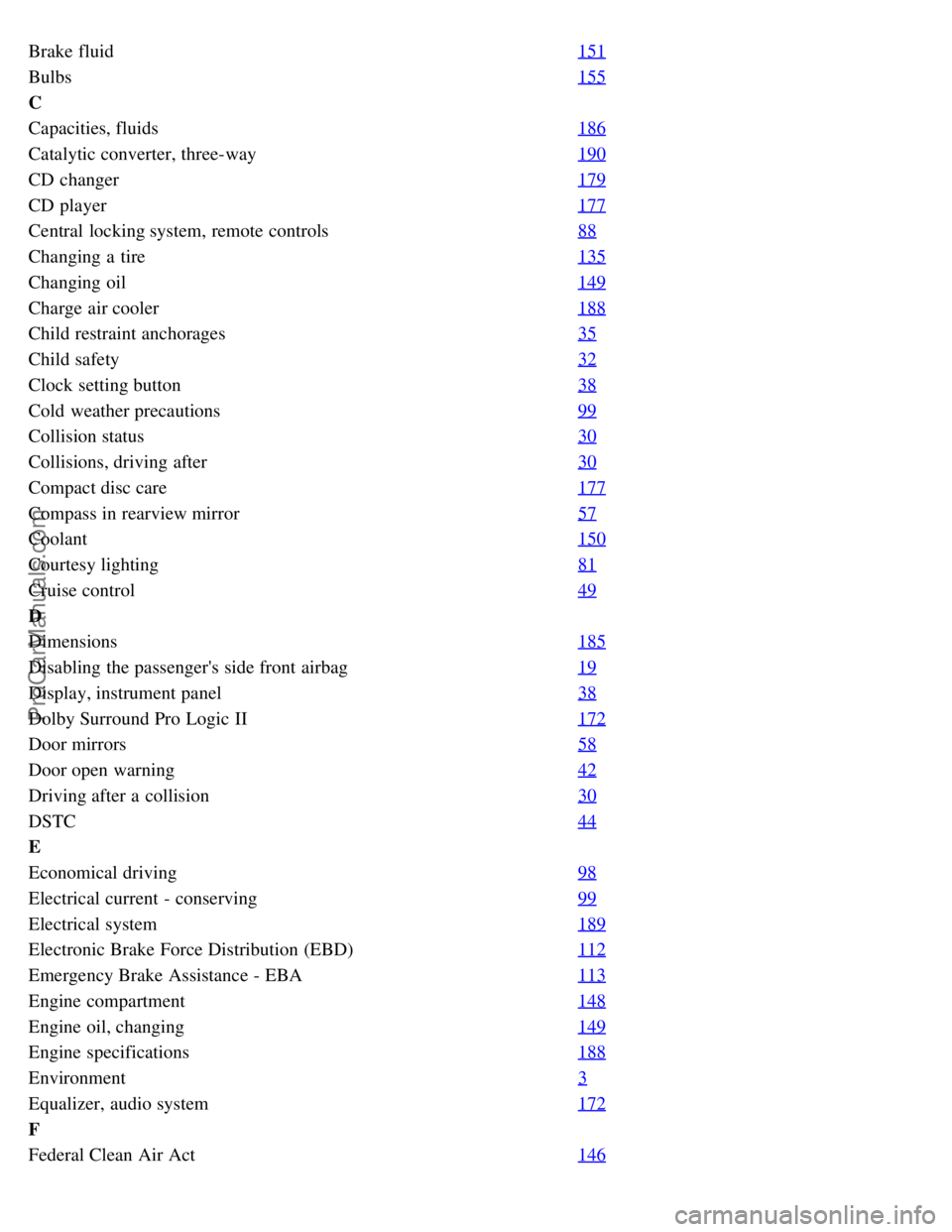
Brake fluid151
Bulbs155
C
Capacities, fluids186
Catalytic converter, three-way190
CD changer179
CD player177
Central locking system, remote controls88
Changing a tire135
Changing oil149
Charge air cooler188
Child restraint anchorages35
Child safety32
Clock setting button38
Cold weather precautions99
Collision status30
Collisions, driving after30
Compact disc care177
Compass in rearview mirror57
Coolant150
Courtesy lighting81
Cruise control49
D
Dimensions185
Disabling the passenger's side front airbag19
Display, instrument panel38
Dolby Surround Pro Logic II172
Door mirrors58
Door open warning42
Driving after a collision30
DSTC44
E
Economical driving98
Electrical current - conserving99
Electrical system189
Electronic Brake Force Distribution (EBD)112
Emergency Brake Assistance - EBA113
Engine compartment148
Engine oil, changing149
Engine specifications188
Environment3
Equalizer, audio system172
F
Federal Clean Air Act146
ProCarManuals.com
Page 121 of 127

Floor mats104
Floor mats, cleaning142
Front airbags17
Front fog light, replacing158
Front fog lights (option)45
Front seats, manual adjustment78
Front seats, power79
Fuel filler cap2
Fuel filler door2, 102
Fuel gauge38
Fuel requirements101
Fuel system188
Fuel tank capacity102
Fuse box in the passenger compartment, accessing163
Fuses161
Fuses in the engine compartment162
Fuses in the passenger compartment164
G
Gasoline101
Geartronic (manual shifting)108
Generator189
Generator warning light41
Glossary of tire terminology129
Glove compartment83
Glove compartment, locking93
Grocery bag holder (option)86
H
Hazard warning flashers53
Head restraints, rear seat84
Headlight flasher47
Headlight housing, removing156
Headlight washers51
Headlights45
High beam bulb, replacing157
High beam indicator38
High beams47
High/low beam headlights45
Home safe lighting47, 62
Hood, opening148
I
Ignition switch106
Immobilizer88, 104
Indicator and warning symbols38
Inflatable Curtain26
ProCarManuals.com
Page 122 of 127

Inflation pressure tables127
Information display38
Information display, messages in43
Information symbol38, 39
Instrument overview8
Instrument panel38
Instrument panel lighting45
Interior lighting81
ISOFIX/LATCH anchors32
J
Jack, positioning correctly136
Jump starting118
K
Key blade90
Key blade, locking and unlocking the car90
Keylock2, 104
Kickdown109
L
Label information184
LATCH anchors33
License plate lighting, replacing159
Lighting panel45
Loading the vehicle130
Long distance trips100
Low beam bulb, replacing156
M
Maintenance146
Malfunction indicator light40
Manual front seat adjustment78
Manual shifting (Geartronic)108
Manual transmission107
Mirror, rearview57
Mirrors, door-mounted58
Moonroof59
O
Occupant safety12
Occupant Weight Sensor (OWS), disabling front passenger's side airbag19
Octane rating101
Oil pressure warning light41
Oil, changing149
On Call Roadside Assistance191
Opening the hood148
P
Paint touch up143
ProCarManuals.com
Page 123 of 127

Panic alarm, central locking system remote control89
Parking assist115
Parking brake54
Parking light bulb, replacing157
Parking lights45
Passenger's side front airbag, disabling19
Personal settings61
PI (Program Information) seek175
Polishing141
Power door mirrors58
Power front seats79
Power moonroof59
Power steering fluid151
Power windows55
PremAir ®4
Program Information seek175
Program type, audio system175
PROPOSITION 65 WARNING153
R
Radio Broadcast Data System - RBDS175
Radio functions174
Radio station formats176
Radio text175
Rain sensor52
Reading lights, rear81
Rear fog light46
Rear park assist115
Rear reading lights81
Rear seat backrests, folding down84
Rear seat head restraints84
Rearview mirror57
Rearview mirror with compass (option)57
Refueling102
Remote control functions89
Remote control, battery replacement91
Remote controls, central locking system88
Removing a wheel136
Replacing fuses161
Reporting safety defects12
Restraint anchorages35
S
Safety defects, reporting12
Safety locks, child93
Safety system components, inspecting31
ProCarManuals.com