Page 343 of 480

05_SEQUOIA_U (L/O 0409)
333
2005 SEQUOIA from Sep. ’04 Prod. (OM34431U)
CAUTION
When you load cargo on the roof lug-
gage carrier, observe the following:
�Place the cargo so that its weight
is distributed evenly between the
front and rear axles.
�If loading long or wide cargo, never
exceed the vehicle overall length or
width. (See “Dimensions and
weights” on page 456 in Section 8
for information on your vehicle
overall length and width.)
�Before driving, make sure the cargo
is securely fastened on the roof
luggage carrier.
�Loading cargo on the roof luggage
carrier will make the center of the
vehicle gravity higher. Avoid high
speeds, sudden starts, sharp turns,
sudden braking or abrupt maneu-
vers, otherwise it may result in loss
of control or vehicle rollover due to
failure to operate this vehicle cor-
rectly.
�If driving for a long distance, on
rough roads, or at high speeds,
stop the vehicle now and then dur-
ing the trip to make sure the cargo
remains in its place.
�Do not exceed 68 kg (150 lb.) cargo
weight on the roof luggage carrier.
NOTICE
When loading the luggages, be careful
not to scratch the surface of the
moon roof.
Use a floor mat of the correct size.
If the floor carpet and floor mat have a
hole, then it is designed for use with a
locking clip. Fix the floor mat with locking
clip into the hole in the floor carpet.
Floor mat
Page 355 of 480

05_SEQUOIA_U (L/O 0409)
345
2005 SEQUOIA from Sep. ’04 Prod. (OM34431U)
�Driving with tire chains installed.
�Driving over the steps such as the
joints on the road.
�Driving on roads where the road
surface is pitted or has other differ-
ences in surface height.
Install all 4 tires of specified size at
appropriate pressure: The antilock
brake system detects vehicle speeds
using the speed sensors for respec-
tive wheels’ turning speeds. The use
of tires other than specified may fail
to detect the accurate turning speed
resulting in a longer stopping dis-
tance.
Ty p e A
Ty p e B
“ABS” warning light
The light comes on when the ignition key
is turned to the “ON” position. If the anti −
lock brake system and the brake assist
system work properly, the light turns off
after a few seconds. Thereafter, if either
of the systems malfunctions, the light
comes on again.
When the “ABS” warning light is on (and
the brake system warning light is off), the
anti −lock brake system, the brake assist
system and the traction control system
and/or the vehicle stability control system
do/does not operate, but the brake system
still operates conventionally.
When the “ABS” warning light is on (and
the brake system warning light is off), the
anti −lock brake system does not operate
so that the wheels could lock up during
a sudden braking or braking on slippery
road surfaces.
Page 359 of 480
05_SEQUOIA_U (L/O 0409)
349
2005 SEQUOIA from Sep. ’04 Prod. (OM34431U)
This illustration indicates typical tire
symbols.1. Tire size— F or det ails, see “— Ti re
size” on page 351.
2. DOT and Tire Identification Number (TIN)— For details, see
“—DOT and Tire Identification
Number (TIN)” on page 350.
3. Uniform tire quality grading— For details, see “—Uniform tire
quality grading” on page 352.
4. The location of the tread wear indicators— For details, see
“Checking and replacing tires” on
page 434.
5. Tire ply composition and mate- rials— Plies mean a layer of rub-
ber −coated parallel cords. Cords
mean the strands forming the plies
in the tire.
6. Radial tires or biasply tires— A
radial tire has “RADIAL” on the
sidewall. A tire not marked with
“RADIAL” is a bias −ply tir e.
Tire information—
—Tire symbols
Page 360 of 480

05_SEQUOIA_U (L/O 0409)
350
2005 SEQUOIA from Sep. ’04 Prod. (OM34431U)
7. “TUBELESS” or “TUBETYPE”— A tubeless tire does not
have a tube inside the tire and air
is directly filled in the tire. A tube
type tire has a tube inside the tire
and the tube maintains the air
pressure.
8. Load limit at maximum cold tire inflation pressure— For details,
see “Checking and replacing tires”
on page 434.
9. Maximum cold tire inflation pressure— This means the pres-
sure to which a tire may be in-
flated. For details about recom-
mended cold tire inflation
pressure, see “Tires” on page 460.
10.Summer tire or all season tire— An all season tire has “M+S”
on the sidewall. The tire not
marked with “M+S” is a summer
tire. For details, see “Types of
tires” on page 360.
This illustration indicates typical DOT
and Tire Identification Number (TIN).
1. “DOT” symbol
2. Tire Identification Number (TIN)
3. Tire manufacturer ’s identification mark
4. Tire size code
5. Manufacturer ’s optional tire type code
6. Manufacturing week
7. Manufacturing year The “DOT” symbol certifies that the
tire conforms to applicable Federal
Motor Vehicle Safety Standards.
—DOT and Tire Identification
Number (TIN)
Page 361 of 480
05_SEQUOIA_U (L/O 0409)
351
2005 SEQUOIA from Sep. ’04 Prod. (OM34431U)
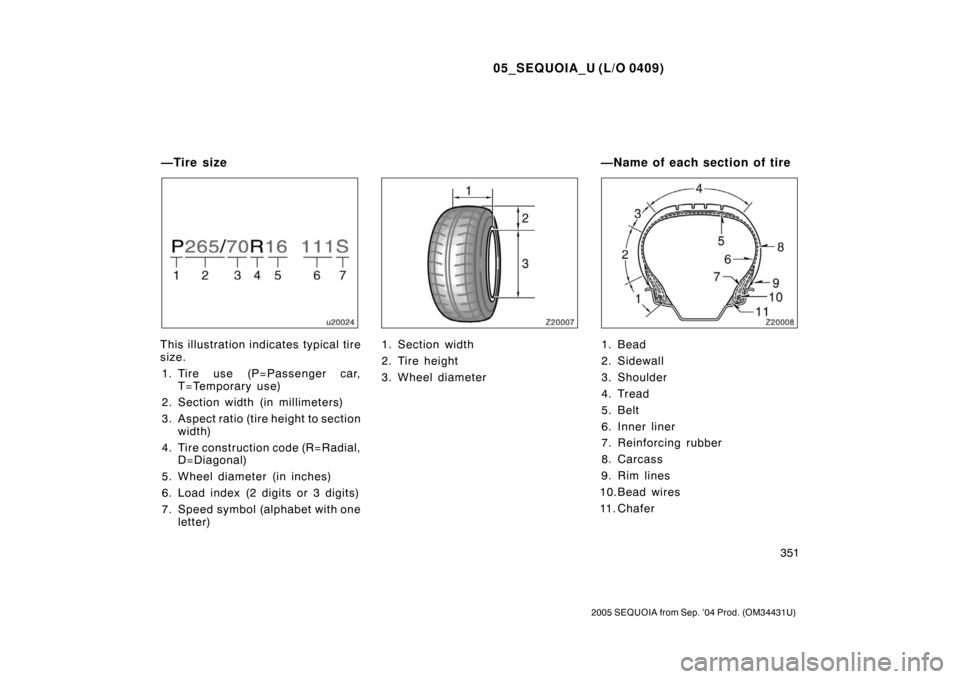
This illustration indicates typical tire
size.1. Tire use (P=Passenger car, T=Temporary use)
2. Section width (in millimeters)
3. Aspect ratio (tire height to section width)
4. Tire construction code (R=Radial, D=Diagonal)
5. Wheel diameter (in inches)
6. Load index (2 digits or 3 digits)
7. Speed symbol (alphabet with one letter)1. Section width
2. Tire height
3. Wheel diameter1. Bead
2. Sidewall
3. Shoulder
4. Tread
5. Belt
6. Inner liner
7. Reinforcing rubber
8. Carcass
9. Rim lines
10.Bead wires
11. Chafer
—Tire size —Name of each section of tire
Page 365 of 480

05_SEQUOIA_U (L/O 0409)
355
2005 SEQUOIA from Sep. ’04 Prod. (OM34431U)
Ti r e relat ed ter mMeaning
Normal occupant weight68 kg (150 lb.) times the number of occupants specified in the second
column of Table 1 that follows
Occupant distributiondistribution of occupants in a vehicle as specified in the third column of Table
1 that follows
Production options weight
the combined weight of those installed regular production options weighing
over 2.3 kg (5 lb.) in excess of those standard items which they replace,
not previously considered in curb weight or accessory weight, including
heavy duty brakes, ride levelers, roof rack, heavy duty battery, and special
trim
Recommended inflation pressurecold tire inflation pressure recommended by a manufacturer
Rima metal support for a tire or a tire and tube assembly upon which the tire beads
are seated
Rim diameter (Wheel diameter)nominal diameter of the bead seat
Rim size designationrim diameter and width
Rim type designationthe industry of manufacturer ’s designation for a rim by style or code
Rim widt hnominal distance between rim flanges
Vehicle capacity weight
(Total load capacity)the rated cargo and luggage load plus 68 kg (150 lb.) times the vehicle’s desig-
nated seating capacity
Vehicle maximum load on the tirethe load on an individual tire that is determined by distributing to each axle
its share of the maximum loaded vehicle weight and dividing by two
Page 367 of 480

05_SEQUOIA_U (L/O 0409)
357
2005 SEQUOIA from Sep. ’04 Prod. (OM34431U)
Vehicle load limits include total load
capacity, seating capacity, towing ca-
pacity and cargo capacity. Follow the
load limits shown below.
Total load capacity: 567 kg (1250 lb.)
Total load capacity means com-
bined weight of occupants, cargo
and luggage. Tongue load is in-
cluded when trailer towing.
Seating capacity: Vehicles with bench type second
seats: Total 8 (Front 2, Rear 6)
Vehicles with separate type second
seats: Total 7 (Front 2, Rear 5)
Seating capacity means the maxi-
mum number of occupants whose
estimated average weight is 68 kg
(150 lb.) per person. Depending on
the weight of each person, the seat-
ing capacity given may exceed the
total load capacity. NOTICE
Even if the number of occupants
are within the seating capacity,
do not exceed the total load ca-
pacity.
Towing capacity:
Tw o −wheel drive models
2948 kg (6500 lb.)
Four −wheel drive models
2812 kg (6200 lb.)
Towing capacity means the maxi-
mum gross trailer weight (trailer
weight plus its cargo weight) that
your vehicle is able to tow.
Cargo capacity
Cargo capacity may increase or de-
crease depending on the size (weight)
and the number of occupants. For de-
tails, see “Capacity and distribution”
that follows.
CAUTION
Do not apply the load more than
each load limit. That may cause
not only damage to the tires, but
also deterioration to the steering
ability and braking ability, which
may cause an accident.
Veh icle lo ad limit s
Page 371 of 480
05_SEQUOIA_U (L/O 0409)
361
2005 SEQUOIA from Sep. ’04 Prod. (OM34431U)
All season tires, however, do not have
adequate traction performance
compared with snow tires in heavy or
loose snow. Also, all season tires fall
short in acceleration and handling
performance compared with summer
tires in highway driving.
The details about how to distinguish
summer tires from all season tires are
described on page 349.
CAUTION
�Do not mix summer and all sea-
son tires on your vehicle as
this can cause dangerous han-
dling characteristics, resulting
in loss of control.
� Do not use tire other than the
manufacturer’s designated
tires, and never mix tires or
wheels of the sizes different
from the originals.