Page 274 of 336

274
INSIDE THE VEHICLE
Items listed below should be checked
regularly, e.g. while performing periodic
services, cleaning the vehicle, etc.
Lights
Make sure the headlights, stop lights, tail
lights, turn signal lights, and other lights
are all working. Check headlight aim.
Service reminder indicators and warning
buzzers
Check that all service reminder indicators
and warning buzzers function properly.
Steering wheel
Be alert for changes in steering condition,
such as hard steering or strange noise.
Seats
Check that all front seat controls such as
seat adjusters, seatback recliner, etc. op-
erate smoothly and that all latches lock
securely in any position. Check that the
head restraint move up and down smooth-
ly and that the locks hold securely in any
latched position.Seat belts
Check that the seat belt system such as
buckles, retractors and anchors operate
properly and smoothly. Make sure the belt
webbing is not cut, frayed, worn or dam-
aged.
Accelerator pedal
Check the pedal for smooth operation and
uneven pedal effort or catching.
Brake pedal
Check the pedal for smooth operation and
that the pedal has the proper clearance.
Check the brake booster function.
Brakes
In a safe place, check that the brakes do
not pull to one side when applied.
Parking brake
Check that the pedal has the proper travel
and that, on a safe incline, your vehicle
is held securely with only the parking
brake applied.
OUTSIDE THE VEHICLE
Items listed below should be performed
from time to time, unless otherwise
specified.
Fluid leaks
Check underneath for leaking fuel, oil, wa-
ter or other fluid after the vehicle has
been parked for a while. If you smell fuel
fumes or notice any leak, have the cause
found and corrected immediately.
Doors and engine hood
Check that all doors and trunk operate
smoothly and all latches lock securely.
Make sure the engine hood secondary
latch secures the hood from opening when
the primary latch is released.
Tire inflation pressure
Check the pressure with a gauge ev-
ery two weeks, or at least once a
month. See page 291 for additional
information.
Page 280 of 336
280
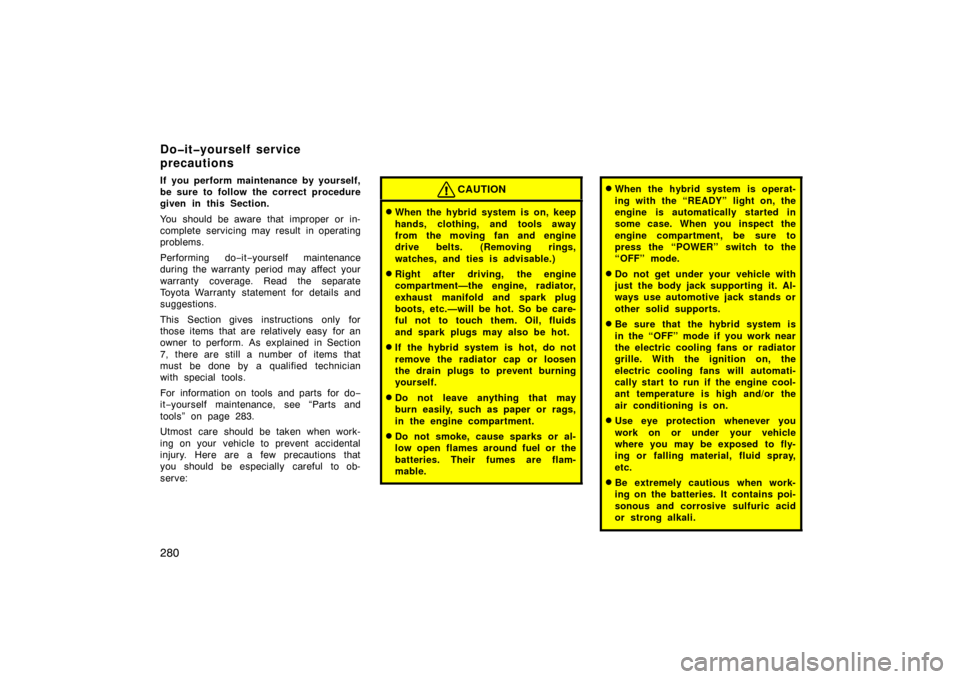
If you perform maintenance by yourself,
be sure to follow the correct procedure
given in this Section.
You should be aware that improper or in-
complete servicing may result in operating
problems.
Performing do−it−yourself maintenance
during the warranty period may affect your
warranty coverage. Read the separate
Toyota Warranty statement for details and
suggestions.
This Section gives instructions only for
those items that are relatively easy for an
owner to perform. As explained in Section
7, there are still a number of items that
must be done by a qualified technician
with special tools.
For information on tools and parts for do −
it −yourself maintenance, see “Parts and
tools” on page 283.
Utmost care should be taken when work-
ing on your vehicle to prevent accidental
injury. Here are a few precautions that
you should be especially careful to ob-
serve:CAUTION
�When the hybrid system is on, keep
hands, clothing, and tools away
from the moving fan and engine
drive belts. (Removing rings,
watches, and ties is advisable.)
�Right after driving, the engine
compartment—the engine, radiator,
exhaust manifold and spark plug
boots, etc.—will be hot. So be care-
ful not to touch them. Oil, fluids
and spark plugs may also be hot.
�If the hybrid system is hot, do not
remove the radiator cap or loosen
the drain plugs to prevent burning
yourself.
�Do not leave anything that may
burn easily, such as paper or rags,
in the engine compartment.
�Do not smoke, cause sparks or al-
low open flames around fuel or the
batteries. Their fumes are flam-
mable.
�When the hybrid system is operat-
ing with the “READY” light on, the
engine is automatically started in
some case. When you inspect the
engine compartment, be sure to
press the “POWER” switch to the
“OFF” mode.
�Do not get under your vehicle with
just the body jack supporting it. Al-
ways use automotive jack stands or
other solid supports.
�Be sure that the hybrid system is
in the “OFF” mode if you work near
the electric cooling fans or radiator
grille. With the ignition on, the
electric cooling fans will automati-
cally start to run if the engine cool-
ant temperature is high and/or the
air conditioning is on.
�Use eye protection whenever you
work on or under your vehicle
where you may be exposed to fly-
ing or falling material, fluid spray,
etc.
�Be extremely cautious when work-
ing on the batteries. It contains poi-
sonous and corrosive sulfuric acid
or strong alkali.
Doityourself service
precautions
Page 305 of 336
305
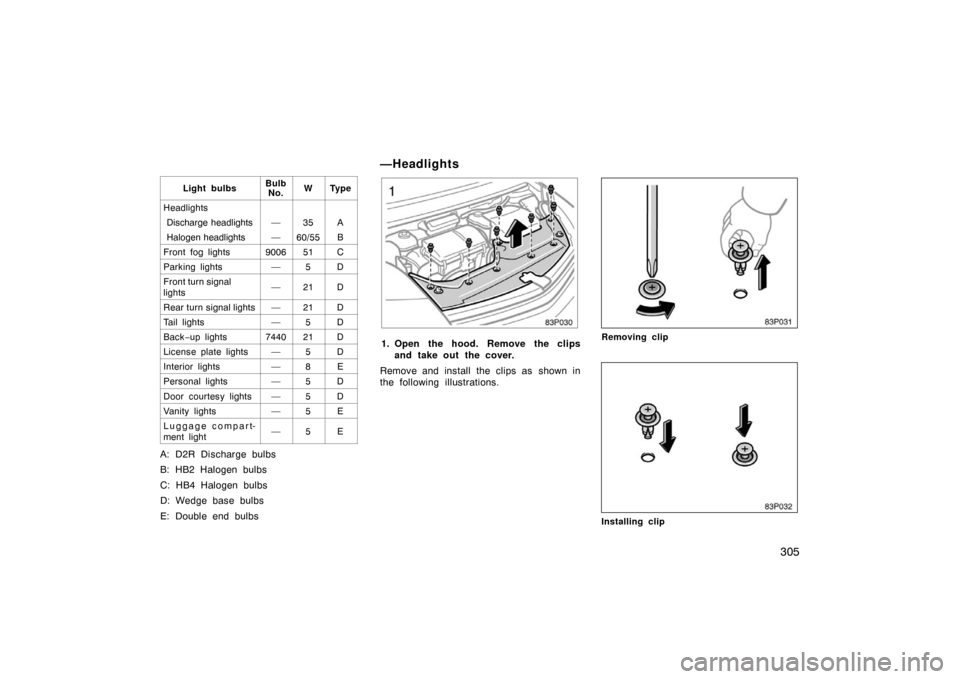
Light bulbsBulbNo.WTy p e
Headlights
Discharge headlights
Halogen headlights
—
—35
60/55A
B
Front fog lights900651C
Parking lights—5D
Front turn signal
lights—21D
Rear turn signal lights—21D
Tail lights—5D
Back −up lights744021D
License plate lights—5D
Interior lights—8E
Personal lights—5D
Door courtesy lights—5D
Vanity lights—5E
Luggage compart-
ment light—5E
A: D2R Discharge bulbs
B: HB2 Halogen bulbs
C: HB4 Halogen bulbs
D: Wedge base bulbs
E: Double end bulbs
—Headlights
83p030
1. Open the hood. Remove the clips
and take out the cover.
Remove and install the clips as shown in
the following illustrations.
83p031
Removing clip
83p032
Installing clip
Page 308 of 336
308
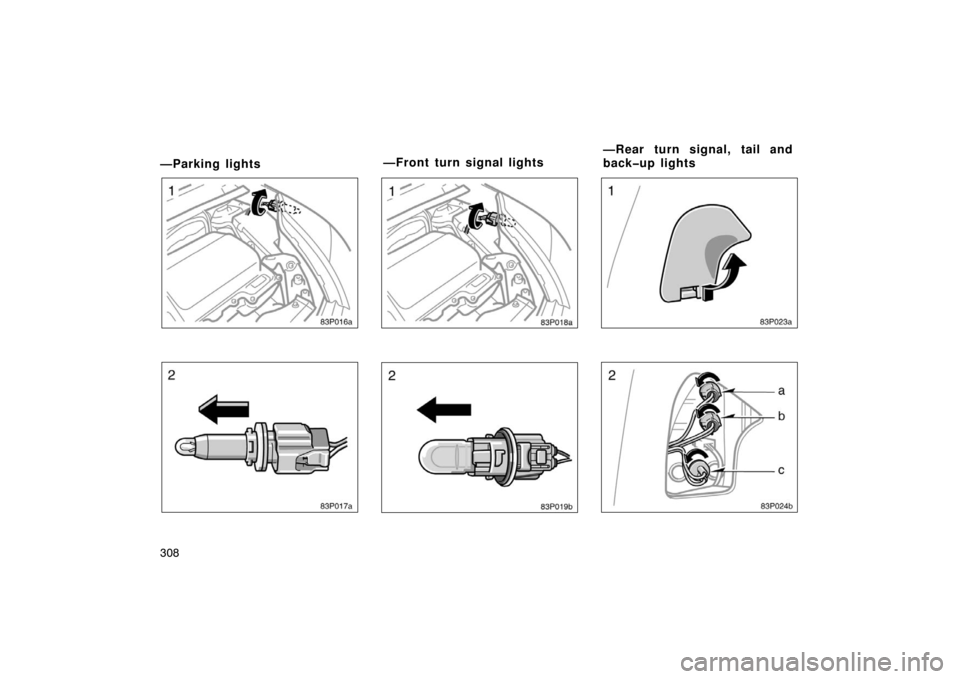
—Parking lights
83p016a
83p017a
83p018a
83p019b
83p023a
83p024b
—Front turn signal lights—Rear turn signal, tail and
backup lights
Page 309 of 336
309
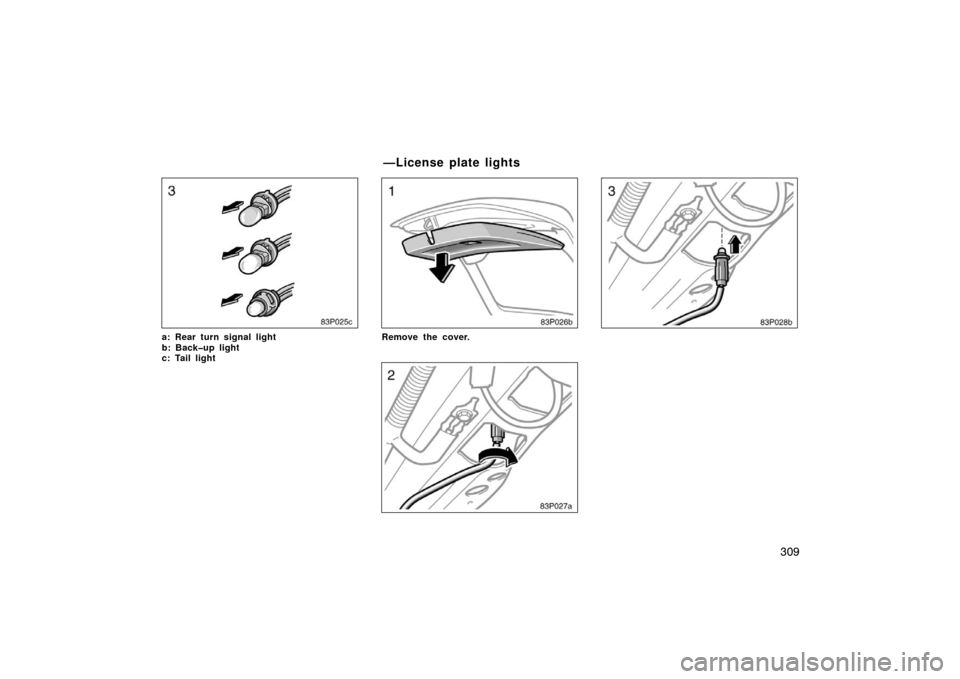
83p025c
a: Rear turn signal light
b: Backup light
c: Tail light
83p026b
Remove the cover.
83p027a
83p028b
—License plate lights
Page 315 of 336

315
AUXILIARY BATTERY
Open voltage at 20�C (68 �F):
12.6 − 12.8 V Fully charged
12.2 − 12.4 V Half charged
11 . 5 − 11.9 V Discharged
[Voltage that is checked 20 minutes after
the key is removed with all the lights
turned off]
Charging rates: 3.5 A max.
HYBRID TRANSAXLE
Fluid capacity (drain and refill),
L (qt., Imp.qt.): 3.6 (3.8, 3.2)
Fluid type: “Toyota Genuine ATF WS” or
equivalent
Please contact your Toyota dealer for further
details. BRAKES
Minimum pedal clearance when depressed
with the force of 196 N (20 kgf, 44 lbf)
with the traction motor running, mm (in.):
101.0 (3.98)
Pedal free play, mm (in.): 1 − 4 (0.04 − 0.16)
Parking brake adjustment when depressed
with the force of 294 N (30 kgf, 66 lbf): 6 − 9 clicks
Fluid type: SAE J1703 or FMVSS No. 116 DOT 3
STEERING
Wheel free play: Less than 30 mm (1.2 in.)
Tires
Tire size and inflation pressure:
Tire size kPa (kgf/cm
2 or ba r, ps i )
Standard Front P185/65R15 86S
240 (2. 4, 35)
Rear
P185/65R15 86S 230 (2. 3, 33)
Spare T125/70D16 96M
420 (4. 2, 60)
Wheel size: Standard 15 x 6JJ
S par e 16 x 4T
Wheel nut torque, N·m (kgf·m,
ft·lbf): 103 (10.5, 76)
NOTE: For a complete information on tires (e.g. replacing tires
or replacing wheels), see
“Checking tire inflation pres-
sure” through “Aluminum
wheel precautions”, page
291 through 298.
Page 316 of 336
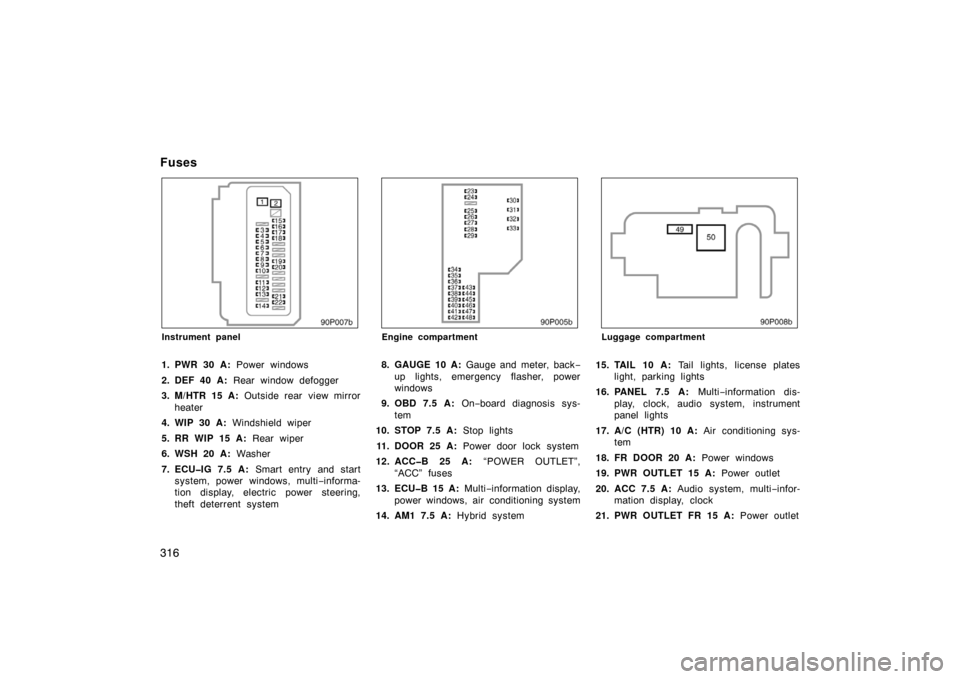
316
90p007b
Instrument panel
1. PWR 30 A: Power windows
2. DEF 40 A: Rear window defogger
3. M/HTR 15 A: Outside rear view mirror
heater
4. WIP 30 A: Windshield wiper
5. RR WIP 15 A: Rear wiper
6. WSH 20 A: Washer
7. ECUIG 7.5 A: Smart entry and start
system, power wi ndows, multi−informa-
tion display, electric power steering,
theft deterrent system
90p005b
Engine compartment
8. GAUGE 10 A: Gauge and meter, back −
up lights, emergency flasher, power
windows
9. OBD 7.5 A: On−board diagnosis sys-
tem
10. STOP 7.5 A: Stop lights
11. DOOR 25 A: Power door lock system
12. ACCB 25 A: “POWER OUTLET”,
“ACC” fuses
13. ECUB 15 A: Multi−information display,
power windows, air conditioning system
14. AM1 7.5 A: Hybrid system
90p008b
Luggage compartment
15. TAIL 10 A: Tail lights, license plates
light, parking lights
16. PANEL 7.5 A: Multi−information dis-
play, clock, audio system, instrument
panel lights
17. A/C (HTR) 10 A: Air conditioning sys-
tem
18. FR DOOR 20 A: Power windows
19. PWR OUTLET 15 A: Power outlet
20. ACC 7.5 A: Audio system, multi −infor-
mation display, clock
21. PWR OUTLET FR 15 A: Power outlet
Fuses