Page 247 of 336
247
6. After the coolant temperature hascooled to normal, again check the cool-
ant level in the reservoir. If necessary,
bring it up to half full again. Serious
coolant loss indicates a leak in the
system. You s hould have it checked as
soon as possible at your Toyota dealer.1. Reduce your speed gradually, keeping a straight line. Move cau-
tiously off the road to a safe place
well away from the traffic. Avoid
stopping on the center divider of
a highway. Park on a level spot
with firm ground.
2. Stop the hybrid system and turn on your emergency flashers.
3. Firmly set the parking brake.
4. Have everyone get out of the ve- hicle on the side away from traffic.
5. Read the following instructions thoroughly.CAUTION
When jacking, be sure to observe
the following to reduce the possi-
bility of personal injury:
�Follow jacking instructions.
� Do not put any part of your
body under a vehicle sup-
ported by a jack. Personal inju-
ry may occu r.
� Do not start or run the hybrid
system while your vehicle is
supported by the j ack.
� Stop the vehicle at a level firm
ground, firmly set the parking
brake. Block the wheel diago-
nally opposite to the one being
changed if necessary.
If you have a flat tire—
Page 258 of 336
258
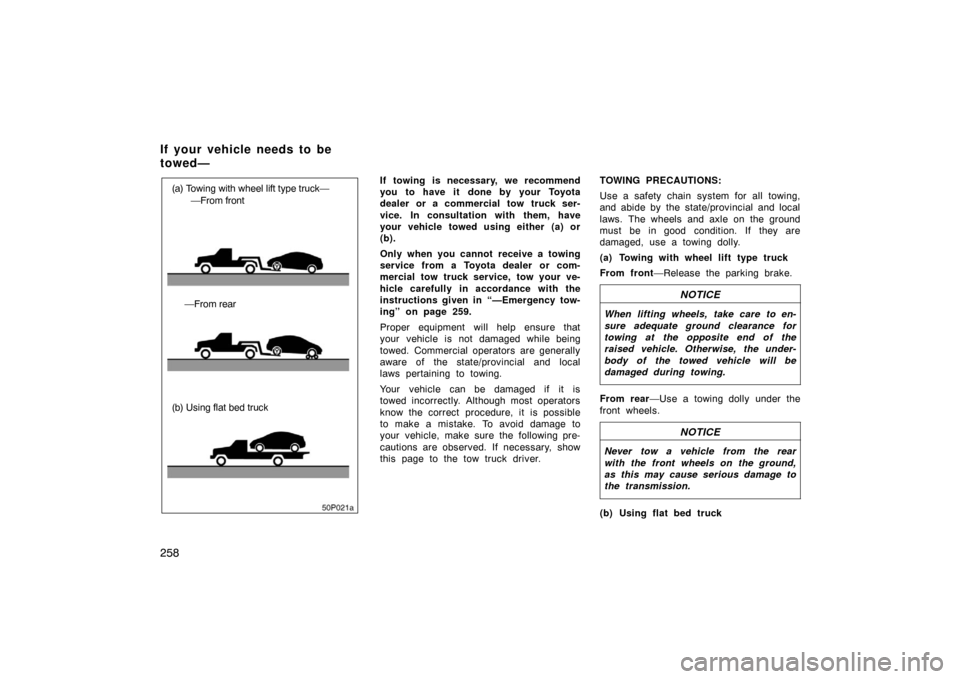
50p021a
(a) Towing with wheel lift type truck——From front
—From rear
(b) Using flat bed truck If towing is necessary, we recommend
you to have it done by your Toyota
dealer or a commercial tow truck ser-
vice. In consultation with them, have
your vehicle towed using either (a) or
(b).
Only when you cannot receive a towing
service from a Toyota dealer or com-
mercial tow truck service, tow your ve-
hicle carefully in accordance with the
instructions given in “—Emergency tow-
ing” on page 259.
Proper equipment will help ensure that
your vehicle is not damaged while being
towed. Commercial operators are generally
aware of the state/provincial and local
laws pertaining to towing.
Your vehicle can be damaged if it is
towed incorrectly. Although most operators
know the correct procedure, it is possible
to make a mistake. To avoid damage to
your vehicle, make sure the following pre-
cautions are observed. If necessary, show
this page to the tow truck driver. TOWING PRECAUTIONS:
Use a safety chain system for all towing,
and abide by the state/provincial and local
laws. The wheels and axle on the ground
must be in good condition. If they are
damaged, use a towing dolly.
(a) Towing with wheel lift type truck
From front
—Release the parking brake.
NOTICE
When lifting wheels, take care to en-
sure adequate ground clearance for
towing at the opposite end of the
raised vehicle. Otherwise, the under-
body of the towed vehicle will be
damaged during towing.
From rear—Use a towing dolly under the
front wheels.
NOTICE
Never tow a vehicle from the rear
with the front wheels on the ground,
as this may cause serious damage to
the transmission.
(b) Using flat bed truck
If your vehicle needs to be
towed—
Page 260 of 336
260
CAUTION
Use extreme caution when towing ve-
hicles. Avoid sudden starts or erratic
driving maneuvers which would place
excessive stress on the emergency
towing eyelet and towing cable or
chain. The eyelet and towing cable or
chain may break and cause serious
injury or damage.
NOTICE
Use only a cable or chain specifically
intended for use in towing vehicles.
Securely fasten the cable or chain to
the towing eyelet provided.
Before towing, release the parking brake
and put the hybrid transaxle in “N”. The
hybrid system must be in the “IG−ON”
mode.
In the following cases, as the front wheels
might be locked by means of the parking
lock mechanism, your vehicle cannot be
towed by another vehicle using a rope.
Have your vehicle carried with the front
wheels or all the wheels raised.
�If the parking mechanism fails.
�If the auxiliary battery is discharged.
CAUTION
If the hybrid system is not running,
the power assist for the brakes and
steering will not work so steering and
braking will be much harder than usu-
al.
50p046a
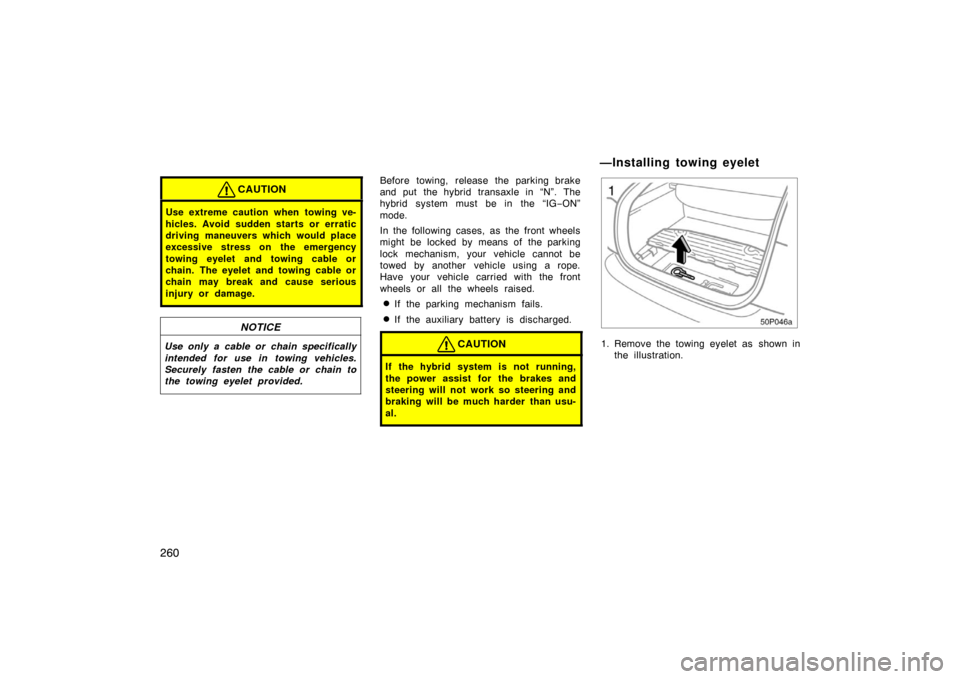
1. Remove the towing eyelet as shown in the illustration.
—Installing towing eyelet
Page 274 of 336

274
INSIDE THE VEHICLE
Items listed below should be checked
regularly, e.g. while performing periodic
services, cleaning the vehicle, etc.
Lights
Make sure the headlights, stop lights, tail
lights, turn signal lights, and other lights
are all working. Check headlight aim.
Service reminder indicators and warning
buzzers
Check that all service reminder indicators
and warning buzzers function properly.
Steering wheel
Be alert for changes in steering condition,
such as hard steering or strange noise.
Seats
Check that all front seat controls such as
seat adjusters, seatback recliner, etc. op-
erate smoothly and that all latches lock
securely in any position. Check that the
head restraint move up and down smooth-
ly and that the locks hold securely in any
latched position.Seat belts
Check that the seat belt system such as
buckles, retractors and anchors operate
properly and smoothly. Make sure the belt
webbing is not cut, frayed, worn or dam-
aged.
Accelerator pedal
Check the pedal for smooth operation and
uneven pedal effort or catching.
Brake pedal
Check the pedal for smooth operation and
that the pedal has the proper clearance.
Check the brake booster function.
Brakes
In a safe place, check that the brakes do
not pull to one side when applied.
Parking brake
Check that the pedal has the proper travel
and that, on a safe incline, your vehicle
is held securely with only the parking
brake applied.
OUTSIDE THE VEHICLE
Items listed below should be performed
from time to time, unless otherwise
specified.
Fluid leaks
Check underneath for leaking fuel, oil, wa-
ter or other fluid after the vehicle has
been parked for a while. If you smell fuel
fumes or notice any leak, have the cause
found and corrected immediately.
Doors and engine hood
Check that all doors and trunk operate
smoothly and all latches lock securely.
Make sure the engine hood secondary
latch secures the hood from opening when
the primary latch is released.
Tire inflation pressure
Check the pressure with a gauge ev-
ery two weeks, or at least once a
month. See page 291 for additional
information.
Page 282 of 336
282
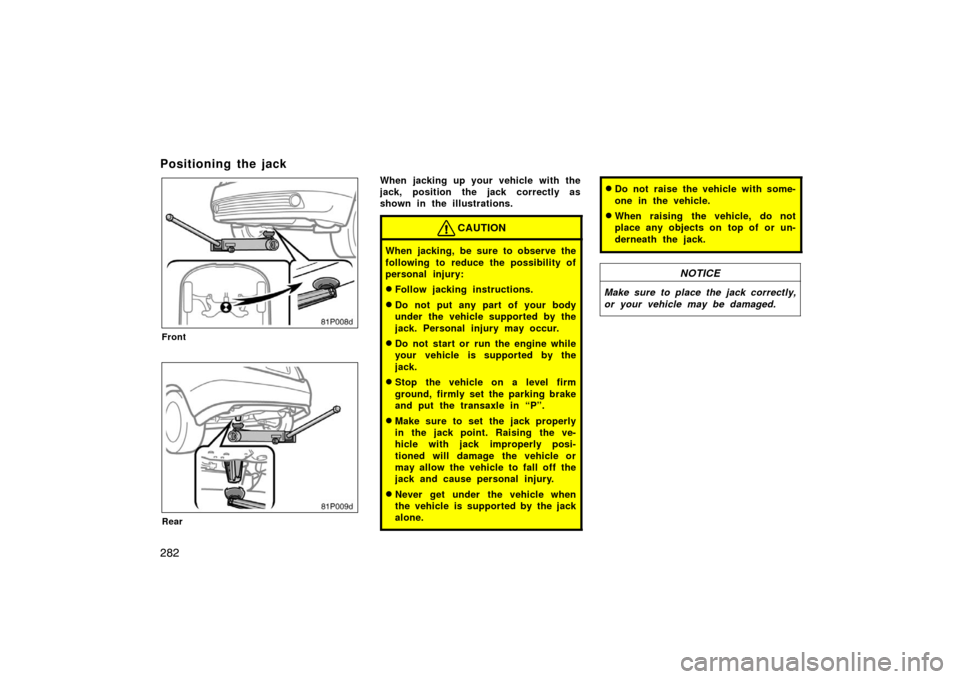
Positioning the jack
81p008d
Front
81p009d
Rear
When jacking up your vehicle with the
jack, position the jack correctly as
shown in the illustrations.
CAUTION
When jacking, be sure to observe the
following to reduce the possibility of
personal injury:
�Follow jacking instructions.
�Do not put any part of your body
under the vehicle supported by the
jack. Personal injury may occur.
�Do not start or run the engine while
your vehicle is supported by the
jack.
�Stop the vehicle on a level firm
ground, firmly set the parking brake
and put the transaxle in “P”.
�Make sure to set the jack properly
in the jack point. Raising the ve-
hicle with jack improperly posi-
tioned will damage the vehicle or
may allow the vehicle to fall off the
jack and cause personal injury.
�Never get under the vehicle when
the vehicle is supported by the jack
alone.
�Do not raise the vehicle with some-
one in the vehicle.
�When raising the vehicle, do not
place any objects on top of or un-
derneath the jack.
NOTICE
Make sure to place the jack correctly,
or your vehicle may be damaged.
Page 301 of 336
301
83p001c
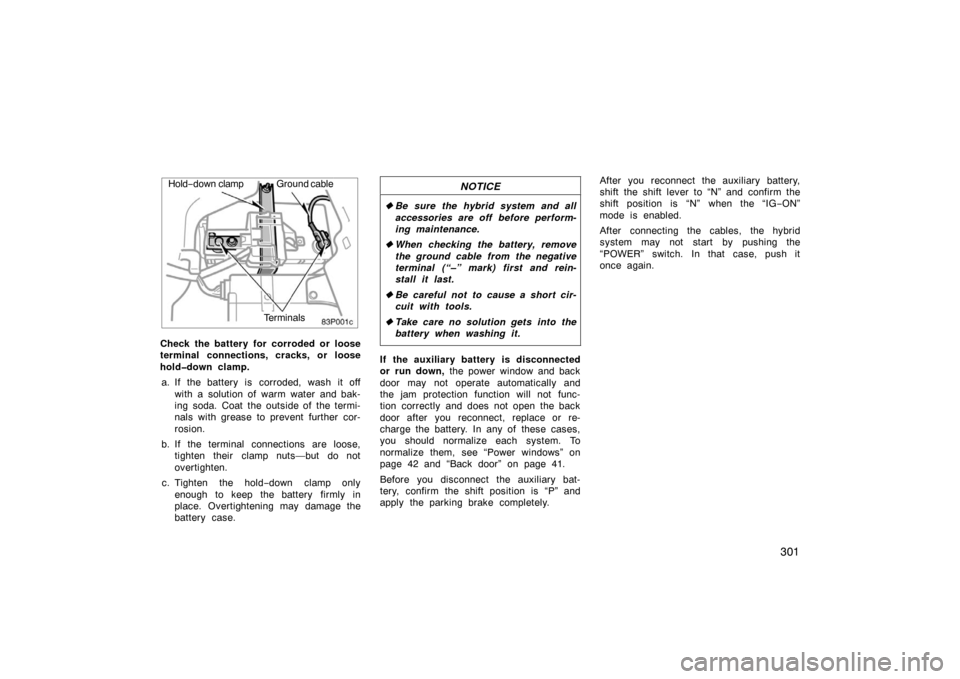
Terminals
Ground
cableHold−down clamp
Check the battery for corroded or loose
terminal connections, cracks, or loose
holddown clamp.
a. If the battery is corroded, wash it off with a solution of warm water and bak-
ing soda. Coat the outside of the termi-
nals with grease to prevent further cor-
rosion.
b. If the terminal connections are loose, tighten their clamp nuts—but do not
overtighten.
c. Tighten the hold− down clamp only
enough to keep the battery firmly in
place. Overtightening may damage the
battery case.
NOTICE
� Be sure the hybrid system and all
accessories are off before perform-
ing maintenance.
� When checking the battery, remove
the ground cable from the negative
terminal (“–” mark) first and rein-
stall it last.
� Be careful not to cause a short cir-
cuit with tools.
� Take care no solution gets into the
battery when washing it.
If the auxiliary battery is disc onnected
or run down, the power window and back
door may not operate automatically and
the jam protection function will not func-
tion correctly and does not open the back
door after you reconnect, replace or re-
charge the battery. In any of these cases,
you should normalize each system. To
normalize them, see “Power windows” on
page 42 and “Back door” on page 41.
Before you disconnect the auxiliary bat-
tery, confirm the shift position is “P” and
apply the parking brake completely. After you reconnect the auxiliary battery,
shift the shift lever to “N” and confirm the
shift position is “N” when the “IG
−ON”
mode is enabled.
After connecting the cables, the hybrid
system may not start by pushing the
“POWER” switch. In that case, push it
once again.
Page 305 of 336
305
Light bulbsBulbNo.WTy p e
Headlights
Discharge headlights
Halogen headlights
—
—35
60/55A
B
Front fog lights900651C
Parking lights—5D
Front turn signal
lights—21D
Rear turn signal lights—21D
Tail lights—5D
Back −up lights744021D
License plate lights—5D
Interior lights—8E
Personal lights—5D
Door courtesy lights—5D
Vanity lights—5E
Luggage compart-
ment light—5E
A: D2R Discharge bulbs
B: HB2 Halogen bulbs
C: HB4 Halogen bulbs
D: Wedge base bulbs
E: Double end bulbs
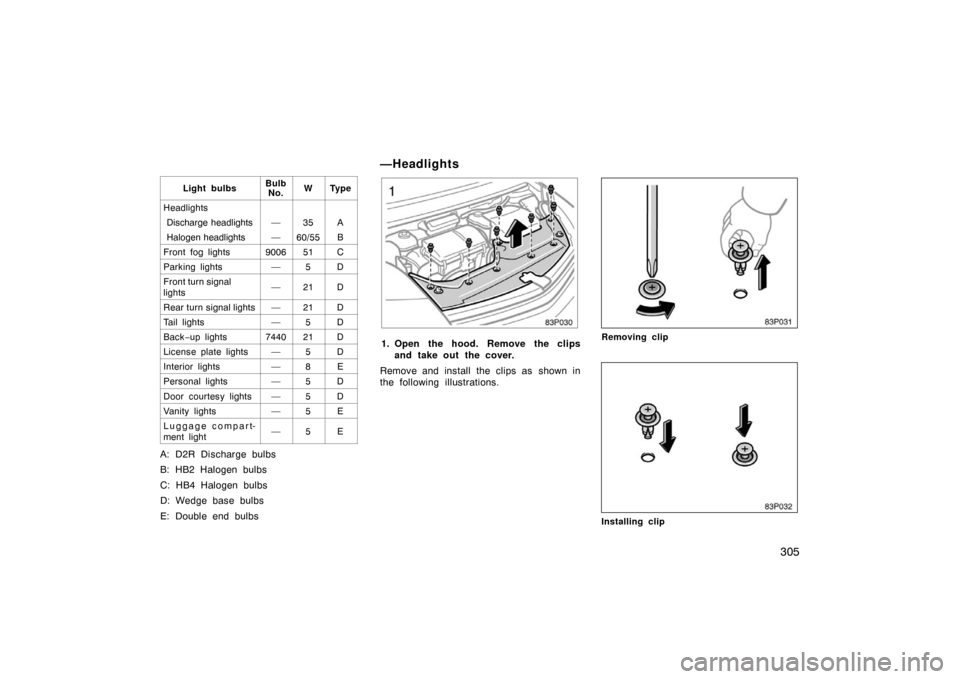
—Headlights
83p030
1. Open the hood. Remove the clips
and take out the cover.
Remove and install the clips as shown in
the following illustrations.
83p031
Removing clip
83p032
Installing clip
Page 308 of 336
308
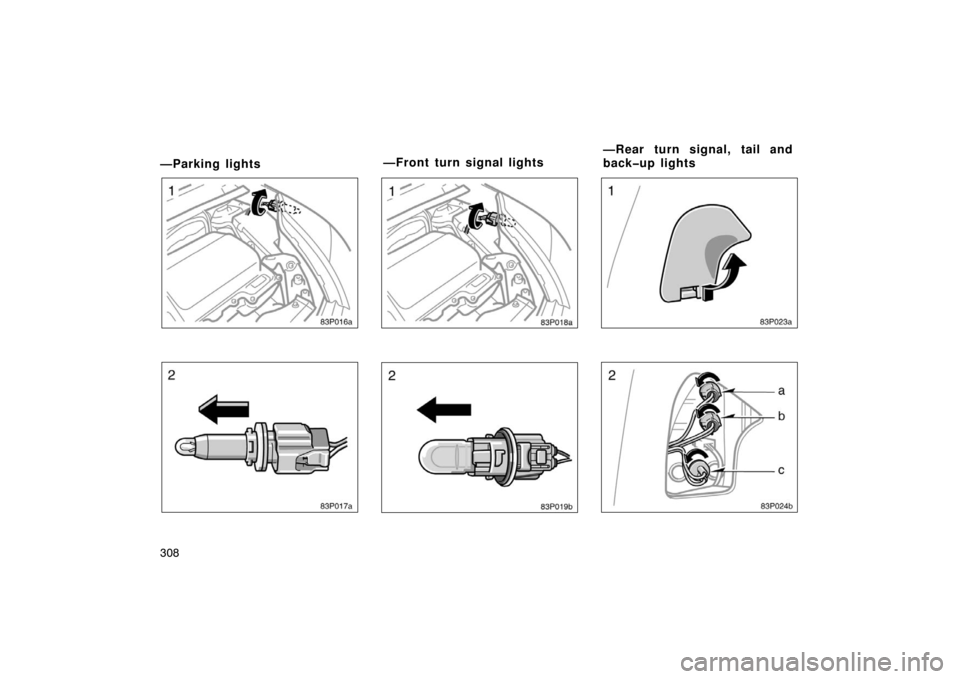
—Parking lights
83p016a
83p017a
83p018a
83p019b
83p023a
83p024b
—Front turn signal lights—Rear turn signal, tail and
backup lights