Page 228 of 336

228 Vehicle load limits include total load
capacity, seating capacity, towing ca-
pacity and cargo capacity. Follow the
load limits shown below.
Total load capacity:
379 kg (835 lb.)
Total load capacity means combined
weight of occupants, cargo and lug-
gage.
Seating capacity: Total 5 (Front 2, Rear 3)
Seating capacity means the maximum
number of occupants whose esti-
mated average weight is 68 kg (150
lb.) per person. Depending on the
weight of each person, the seating ca-
pacity given may exceed the total
load capacity.
NOTICE
Even if the number of occupants
are within the seating capacity,
do not exceed the total load ca-
pacity.
Towing capacity
Toyota does not recommend towing
a trailer with your vehicle. Your ve-
hicle is not designed for trailer towing.
Cargo capacity
Cargo capacity may increase or de-
crease depending on the size (weight)
and the number of occupants. For de-
tails, see “Capacity and distribution”
that follows.
CAUTION
Do not apply the load more than
each load limit. That may cause
not only damage to the tires, but
also deterioration to the steering
ability and braking ability, which
may cause an accident.
When stowing cargo and luggage in
the vehicle, observe the following:� Put cargo and luggage in the lug-
gage compartment when at all
possible. Be sure all items are se-
cured in place.
� Be careful to keep the vehicle bal-
anced. Locating the weight as far
forward as possible helps maintain
balance.
� For better fuel economy, do not
carry unneeded weight.
CAUTION
�To prevent cargo and l uggage
from sliding forward during
braking, do not stack anything
in the luggage compartment.
Keep cargo and luggage low,
as close to the floor as pos-
sible.
Vehicle load limits Cargo and luggage—
—Stowage precautions
Page 229 of 336

229
�Never allow anyone to ride in
the luggage compartment. It is
not designed for passengers.
They should ride in their seats
with their seat belts properly
fastened. Otherwise, they are
much more likely to suffer seri-
ous bodily injury, in the event
of sudden braking or a colli-
sion.
� Do not place anything on the
luggage cover. Such items may
be thrown about and possibly
injure people in the vehicle
during sudden braking or an
accident. Secure all items in a
safe place.
� Do not drive with objects left
on top of the instrument panel.
They may interfere with the
driver’s field of view. Or they
may move during sharp vehicle
acceleration or turning, and im-
pair the driver’s control of the
vehicle. In an accident they
may injure the vehicle occu-
pants.NOTICE
Do not load the vehicle beyond
the vehicle capacity weight giv-
en in Section 9.
Cargo capacity depends on the to-
tal weight of the occupants.
(Cargo capacity) = (Total load capac-
ity) – (Total weight of occupants)
STEPS FOR DETERMINING COR-
RECT LOAD LIMIT
1. Locate the statement “The com- bined weight of occupants and car-
go should never exceed XXX
pounds” on your vehicle’s placard.
2. Determine the combined weight of the driver and passengers that will
be riding in your vehicle.
3. Subtract the combined weight of the driver and passengers from
XXX kilograms or XXX pounds.
—Capacity and distribution
Page 230 of 336

2304. The resulting figure equals the
available amount of cargo and lug-
gage load capacity. For example,
if the “XXX” am ount equals 1400
lbs. and there will be five 150 lb.
passengers in your vehicle, the
amount of available cargo and lug-
gage load capacity is 650 lbs.
(1400–750 (5x150)=650 lbs).
5. Determine the combined weight of luggage and cargo being loaded on
the vehicle. That weight may not
safely exceed the available cargo
and luggage load capacity calcu-
lated in Step 4.
6. If your vehicle will be towing a trail- er, load from your trailer will be
transferred to your vehicle. Consult
this manual to determine how this
reduces the available cargo and
luggage load capacity of your ve-
hicle. Toyota does not recommend towing
a trailer with your vehicle. Your ve-
hicle is not designed for trailer towing.
Total load
capacity Cargo
capacity
EXAMPLE ON YOUR VEHICLE
In case that 2 people with the com-
bined weight of 166 kg (366 lb.) are
riding in your vehicle with the total
load capacity of 379 kg (835 lb.), the
available amount of cargo and lug-
gage load capacity will be as follows:
379 kg – 166 kg = 213 kg.
( 835 lb. – 366 lb. = 469 lb. )
From this condition, if 3 more passen-
gers with the combined weight of 176
kg (388 lb.) get on , the av ailable car-
go and luggage load will be reduced
as follows:
Page 231 of 336

231
213 kg – 176 kg = 37 kg.
( 469 lb. – 388 lb. = 81 lb. )
As shown in the above example, if the
number of occupants increases, the
cargo and luggage load equaling the
combined weight of occupants who
got on later must be reduced. In other
words, if the incr
ease in the number
of occupants causes the excess of
the total load capacity (combined
weight of occupants plus cargo and
luggage load), you have to reduce the
cargo and luggage on your vehicle.
For details about total load capacity,
see “Vehicle load limits” on page 228.
CAUTION
Even if the total load of occu-
pant’s weight and the cargo load
is less than the total load capac-
ity, do not apply the load uneven-
ly. That may cause not only dam-
age to the tire but also deteriora-
tion to the steering ability due to
unbalance of the vehicle, causing
an accident.
Types of tires
Determine what kind of tires your
vehicle is originally equipped with.
1. All season tires
All season tires are designed to pro-
vide better traction in snow and to be
adequate for driving in most winter
conditions, as well as for use all year
round.
All season tires, however, do not have
adequate traction performance
compared with snow tires in heavy or
loose snow. Also, all season tires fall
short in acceleration and handling
performance compared with summer
tires in highway driving.
Page 238 of 336
238
Check the condition of the auxiliary
battery and cables.
Cold temperatures reduce the capacity of
any auxiliary battery, so it must be in top
shape to provide enough power for winter
starting. Section 8−3 tells you how to
visually inspect the auxiliary battery. Your
Toyota dealer will be pleased to check the
level of charge.
Make sure the engine oil viscosity is
suitable for the cold weather.
See page 287 for recommended viscosity.
Leaving a heavy summer oil in your ve-
hicle during winter months may cause
harder starting. If you are not sure about
which oil to use, call your Toyota deal-
er—they will be pleased to help.
Keep the door locks from freezing.
Squirt lock de −icer or glycerine into the
locks to keep them from freezing.
Use a washer fluid containing an anti
freeze solution.
This product is available at your Toyota
dealer and most auto parts stores. Follow
the manufacturer ’s directions for how
much to mix with water.NOTICE
Do not use engine antifreeze or any
other substitute because it may dam-
age your vehicle’s paint.
Do not use your parking brake when
there is a possibility it could freeze.
When parking, push the “P” position
switch and block the rear wheels. Do not
use the parking brake, for snow or water
accumulated in and around the parking
brake mechanism may freeze, making it
hard to release.
Keep ice and snow from accumulating
under the fenders.
Ice and snow built up under your fenders
can make steering difficult. During extreme
winter driving, stop and check under the
fenders occasionally.
Depending on where you are driving,
we recommend you carry some emer-
gency equipment.
Some of the things you might put in the
vehicle are tire chains, window scraper,
bag of sand or salt, flares, small shovel,
jumper cables, etc.40p050b
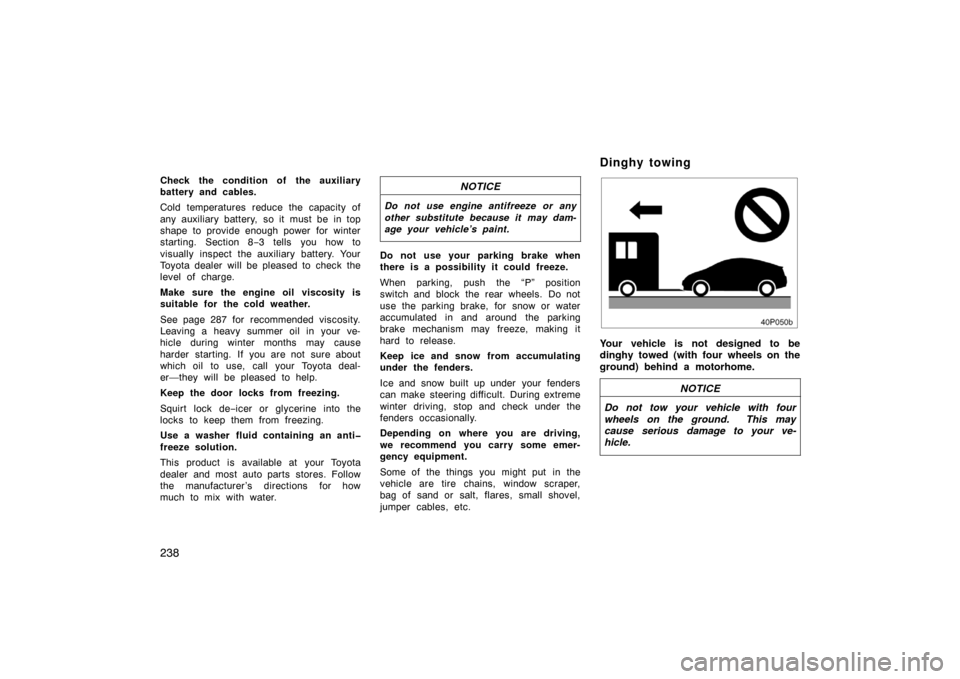
Your vehicle is not designed to be
dinghy towed (with four wheels on the
ground) behind a motorhome.
NOTICE
Do not tow your vehicle with four
wheels on the ground. This may
cause serious damage to your ve-
hicle.
Dinghy towing
Page 291 of 336
291
NOTICE
If you spill the fluid, be sure to wipe
it off to prevent it from damaging the
parts or painting.
82p105
Keep your tire inflation pressures
at the proper level.
The recommended cold tire inflation
pressures, tire sizes and the com-
bined weight of occupants and cargo
(vehicle capacity weight) are de-
scribed on pages 312 and 315. They
are also described on the tire and
loading information label as shown.
You should check the tire inflation
pressure every two weeks, or at least
once a month. And do not forget the
spare!
The following instructions for
checking tire inflation pressure
should be observed:
� The pressure s hould be
checked only when the tires are
cold. If your vehicle has been
parked for at least 3 hours and has
not been driven for more than 1.5
km or 1 mile since, you will get
an accurate cold tire inflation pres-
sure reading.
Checking tire inflation
pressure
Page 296 of 336
296 When rotating tires, check for uneven
wear and damage. Abnormal wear is
usually caused by incorrect tire infla-
tion pressure, improper wheel align-
ment, out−of −balance wheels, or se-
vere braking.
CAUTION
Do not include a compact spare
tire when rotating the tires. It is
designed for temporary use only.
WHEN TO USE SNOW TIRES OR
CHAINS
Snow tires or chains are recommended
when driving on snow or ice.
On wet or dry roads, conventional tires
provide better traction than snow tires.
SNOW TIRE SELECTION
If you need snow tires, select tires of
the same size, construction and load
capacity as the originally installed tires.
Do not use tires other than those men-
tioned above. Do not install studded tires
without first checking local regulations for
possible restrictions.
CAUTION
Do not use snow tires other than the
manufacturer ’s recommended size, as
this may cause dangerous handling
characteristics resulting in loss of
control. Otherwise, an accident may
occur resulting in death or serious
injuries.
SNOW TIRE INSTALLATION
Snow tires should be installed on all
wheels.
Installing snow tires on the front wheels
only can lead to an excessive difference
in road grip capability between the front
and rear tires which could cause loss of
vehicle control.
When storing removed tires, you should
store them in a cool dry place.
Mark the direction of rotation and be sure
to install them in the same direction when
replacing.
CAUTION
�Do not drive with the snow tires
incorrectly inflated.
�Never drive over 120 km/h (75 mph)
with any type of snow tires.
Installing snow tires and
chains
Page 312 of 336
312
Overall length mm (in.) 4445 (175.0)
Overall width mm (in.) 1725 (67.9)
Overall height mm (in.) 1500 (59.1)*
Wheelbase mm (in.) 2700 (106.3)
Front tread mm (in.) 1505 (59.3)
Rear tread mm (in.) 1480 (58.3)
Vehicle capacity weight
(occupants + luggage)kg (lb.) 385 (845)
*: Unladen vehicle
Electric motor
Type: Permanent magnet synchronous motor (water cooling)
Maximum output: 50/1200 − 1540 kW/rpm
Maximum torque: 400/0 − 1200 N·m/rpm Model: 1NZ
−FXE
Type: 4 −cylinder in line, 4 cycle, gasoline
Bore and stroke, mm (in.): 75.0 x 84.7 (2.95 x 3.33)
Displacement, cm
3 (cu. in.):
1497 (91.4)
Dimensions and weight Engine