Page 250 of 324
’05 MATRIX_U (L/O 0409)
240
2005 MATRIX from Sep. ’04 Prod. (OM12892U)
Buckle
2. Put the flat tire on the rear luggage storage box lid with the outer side
of the wheel facing up. Hook the
belt clips closest to the buckle to
the rear upper tie −down hooks.
3. Pass the belts through the center
hole of the wheel as shown above.4. Attach the other clips of the beltsto the lower rear tie −down hooks.
Page 251 of 324

’05 MATRIX_U (L/O 0409)
241
2005 MATRIX from Sep. ’04 Prod. (OM12892U)
5. Position the tire edge against therear center end of the rear luggage
storage box lid. Then pull the ends
of the belts to se cure the tire se-
curely.
After stowing the flat tire, check that
the tire and belts are secured.
To loosen the tire tie −down belts, see
“Tie −down hooks and tire tie −down
belts” on page 178 in Section 1 −10. 11. Check the air pressure of the re-
placed tire.
Adjust the air pressu re to the specifi-
cation designated on page 306 in
Section 8. If the pressure is lower,
drive slowly to the nearest service
station and fill to the correct pressure.
Do not forget to reinstall the tire infla-
tion valve cap as dirt and moisture
could get into th e valve core and
possibly cause air leakage. If the cap
is missing, have a new one put on as
soon as possible.
As soon after changing wheels as
possible, tighten the wheel nuts to the
torque specified on page 306 in Sec-
tion 8 with a torque wrench. Have a
technician repair the flat tire.
—After changing wheels
Page 252 of 324
’05 MATRIX_U (L/O 0409)
242
2005 MATRIX from Sep. ’04 Prod. (OM12892U)
Steel wheels
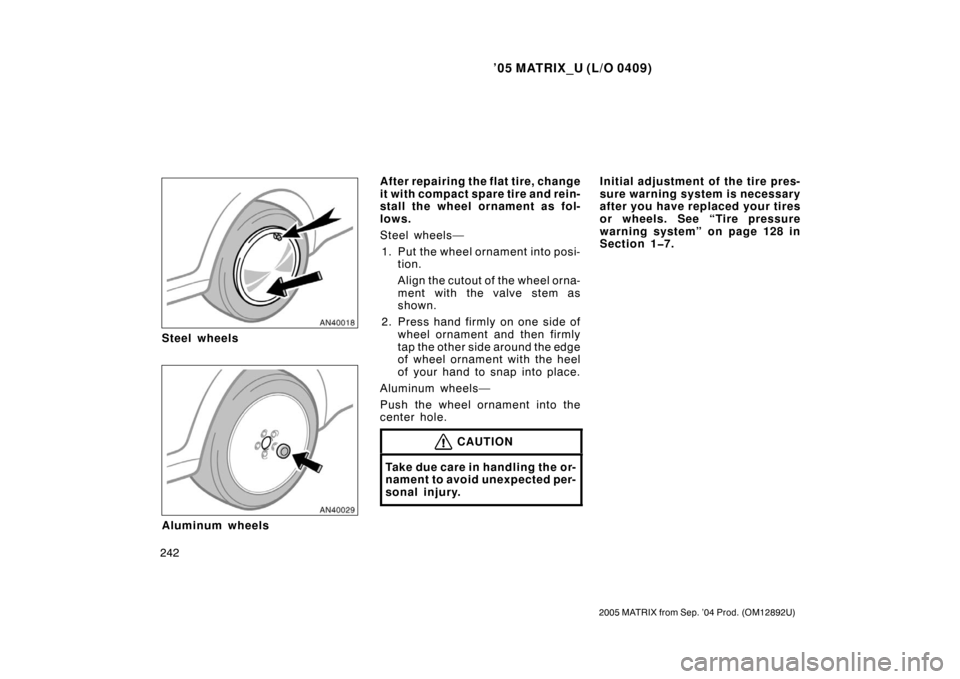
Aluminum wheelsAfter repairing the flat tire, change
it with compact spare tire and rein-
stall the wheel ornament as fol-
lows.
Steel wheels—
1. Put the wheel ornament into posi- tion.
Align the cutout of the wheel orna-
ment with the valve stem as
shown.
2. Press hand firmly on one side of wheel ornament and then firmly
tap the other side around the edge
of wheel ornament with the heel
of your hand to snap into place.
Aluminum wheels—
Push the wheel ornament into the
center hole.
CAUTION
Take due care in handling the or-
nament to avoid unexpected per-
sonal injury.
Initial adjustment of the tire pres-
sure warning system is necessary
after you have replaced your tires
or wheels. See “Tire pressure
warning system” on page 128 in
Section 17.
Page 253 of 324

’05 MATRIX_U (L/O 0409)
243
2005 MATRIX from Sep. ’04 Prod. (OM12892U)
If your vehicle becomes stuck in snow,
mud, sand, etc., then you may attempt
to rock the vehicle free by moving it
forward and backward.
Vehicles with traction control system—
Turn off the traction control system to
become unstuck to allow the tires to
spin enough to remove the vehicle from
the obstruction. (For details, see “Trac-
tion control system” on page 124 in
Section 17.)
CAUTION
Do not attempt to rock the vehicle
free by moving it forward and back-
ward if people or objects are any-
where near the vehicle. During the
rocking operation the vehicle may
suddenly move forward or backward
as it becomes unstuck, causing injury
or damage to nearby people or ob-
jects.
NOTICE
If you rock your vehicle, observe the
following precautions to prevent dam-
age to the transmission and other
parts.
�Do not depress the accelerator ped-
al while shifting the selector lever
or before the transmission is com-
pletely shifted to forward or reverse
gear.
� Do not race the engine and avoid
spinning the wheels.
� If your vehicle remains stuck after
rocking the vehicle several times,
consider other ways such as tow-
ing.
(a) Towing with wheel lift type truck—
(b) Using flat bed truck—From rear —From front
Twowheel drive models
If your vehicle becomes stuck If your vehicle needs to be
towed—
Page 271 of 324

’05 MATRIX_U (L/O 0409)
261
2005 MATRIX from Sep. ’04 Prod. (OM12892U)
Doors and engine hood
Check that all doors and back door includ-
ing glass hatch operate smoothly and all
latches lock securely. Make sure the en-
gine hood secondary latch secures the
hood from opening when the primary latch
is released.
Tire inflation pressure
Check the pressure with a gauge ev-
ery two weeks, or at least once a
month. See page 278 in Section 7−2
for additional information.
Tire surface and wheel nuts
Check the tires carefully for cuts,
damage or excessive wear. See page
280 in Section 7− 2 for additional in-
formation. When checking the tires,
make sure no nuts are missing, and
check the nuts for looseness. Tighten
them if necessary.
Tire rotation
Rotate the tires according to the
maintenance schedule. (For sched-
uled maintenance information, please
refer to the “Scheduled Maintenance
Guide” or “Owner ’s Manual Supple-
ment”.) See page 283 in Section 7 −2
for additional information.
Be on the alert for changes in perfor-
mance, sounds, and visual tip −offs that
indicate service is needed. Some impor-
tant clues are as follows:
�Engine missing, stumbling, or pinging
�Appreciable loss of power
�Strange engine noises
�A leak under the vehicle (however, wa-
ter dripping from the air conditioning
after use is normal.)
�Change in exhaust sound (This may
indicate a dangerous carbon monoxide
leak. Drive with the windows open and
have the exhaust system checked im-
mediately.)
�Flat −looking tire; excessive tire squeal
when cornering; uneven tire wear
�Vehicle pulls to one side when driving
straight on a level road
�Strange noises related to suspension
movement
�Loss of brake effectiveness; spongy
feeling brake or clutch pedal; pedal al-
most touches floor; vehicle pulls to one
side when braking
�Engine coolant temperature continually
higher than normal If you notice any of these clues, take your
vehicle to your Toyota dealer as soon as
possible. It probably needs adjustment or
repair.
CAUTION
Do not continue driving with the ve-
hicle unchecked. It could result in se-
rious vehicle damage and possibly
personal injury.
Does your vehicle need
repairing?
Page 281 of 324

’05 MATRIX_U (L/O 0409)
271
2005 MATRIX from Sep. ’04 Prod. (OM12892U)
DOITYOURSELF MAINTENANCE
Engine and Chassis
Checking the engine oil level272
. . . . . . . . . . . . . . . . . . . . . . . . . . . . . . . . .
Checking the engine coolant level 274
. . . . . . . . . . . . . . . . . . . . . . . . . . . .
Checking the radiator and condenser 275
. . . . . . . . . . . . . . . . . . . . . . . . .
Checking brake fluid 276
. . . . . . . . . . . . . . . . . . . . . . . . . . . . . . . . . . . . \
. . . .
Checking power steering fluid 276
. . . . . . . . . . . . . . . . . . . . . . . . . . . . . . . .
Precautions for tires of four −wheel drive models 277
. . . . . . . . . . . . . . .
Checking tire inflation pressure 278
. . . . . . . . . . . . . . . . . . . . . . . . . . . . . .
Checking and replacing tires 280
. . . . . . . . . . . . . . . . . . . . . . . . . . . . . . . . .
Rotating tires 283
. . . . . . . . . . . . . . . . . . . . . . . . . . . . . . . . . . . . \
. . . . . . . . . . .
Installing snow tires and chains 284
. . . . . . . . . . . . . . . . . . . . . . . . . . . . . .
Replacing wheels 285
. . . . . . . . . . . . . . . . . . . . . . . . . . . . . . . . . . . . \
. . . . . . .
Aluminum wheel precautions 286
. . . . . . . . . . . . . . . . . . . . . . . . . . . . . . . .
SECTION 7 2
Page 287 of 324

’05 MATRIX_U (L/O 0409)
277
2005 MATRIX from Sep. ’04 Prod. (OM12892U)
Clean all dirt from the outside of the res-
ervoir tank and look at the fluid level. If
the fluid is cold, the level should be in the
“COLD” range. Similarly, if it is hot, the
fluid level should be in the “HOT” range.
If the level is at the low side of either
range, add automatic transmission fluid
DEXRON�II or III to bring the level within
the range.
To remove the reservoir cap, turn it coun-
terclockwise and lift up. To reinstall it,
turn it clockwise. After replacing the reser-
voir cap, visually check the steering box
case, vane pump and hose connections
for leaks or damage.
CAUTION
The reservoir tank may be hot so be
careful not to burn yourself.
NOTICE
Avoid overfilling, or the power steer-
ing could be damaged.
CAUTION
Observe the following instruc-
tions. Otherwise, an accident
may occur resulting in death or
serious injuries.
� Keep your tire pressure at the
proper level. (See “Checking
tire inflation pressure” on page
278 in this Section.)
� Do not use tires (including
snow tires) of different brands,
sizes, construction or tread
patterns. (See “Checking and
replacing tires” on page 280
and “Installing snow tires and
chains” on page 284 in this
Section.)
� Do not use tires with different
t read wear. To eq u al i z e th e ti re
wear, rotate tires at the ap-
propriate interval. (See “Rotat-
ing tires” on page 283 in this
Section.)
�Use the manufacturer’s recom-
mended wheels. Do not use
wheels of different sizes and
types. (See “Replacing wheels”
on page 285 in this Section.)
Precautions for tires of
fourwheel drive models
Page 288 of 324
’05 MATRIX_U (L/O 0409)
278
2005 MATRIX from Sep. ’04 Prod. (OM12892U)
Keep your tire inflation pressures
at the proper level.
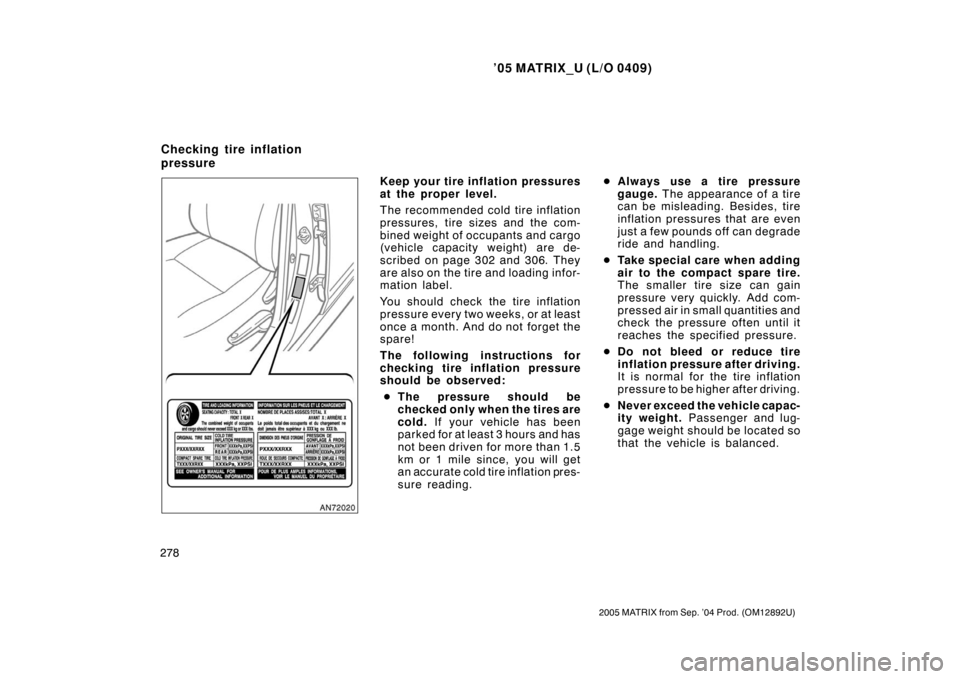
The recommended cold tire inflation
pressures, tire sizes and the com-
bined weight of occupants and cargo
(vehicle capacity weight) are de-
scribed on page 302 and 306. They
are also on the tire and loading infor-
mation label.
You should check the tire inflation
pressure every two weeks, or at least
once a month. And do not forget the
spare!
The following instructions for
checking tire inflation pressure
should be observed:
� The pressure s hould be
checked only when the tires are
cold. If your vehicle has been
parked for at least 3 hours and has
not been driven for more than 1.5
km or 1 mile since, you will get
an accurate cold tire inflation pres-
sure reading. �
Always use a tire pressure
gauge. The appearance of a tire
can be misleading. Besides, tire
inflation pressures that are even
just a few pounds off can degrade
ride and handling.
� Take special care when adding
air to the compact spare tire.
The smaller tire size can gain
pressure very qu ickly. Add com-
pressed air in small quantities and
check the pressure often until it
reaches the specified pressure.
� Do not bleed or reduce tire
inflation pressure after driving.
It is normal for the tire inflation
pressure to be higher after driving.
� Never exceed the vehicle capac-
ity weight. Passenger and lug-
gage weight should be located so
that the vehicle is balanced.
Checking tire inflation
pressure