Page 139 of 268
1312005 ECHO from Aug. ’04 Prod. (OM52636U)
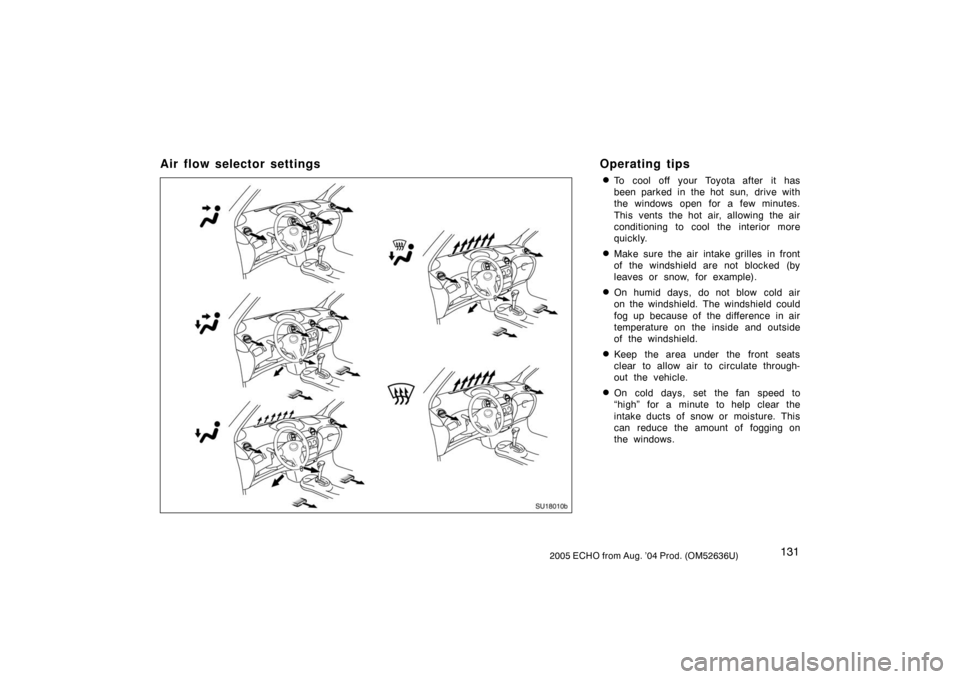
Air flow selector settingsOperating tips
�To cool off your Toyota after it has
been parked in the hot sun, drive with
the windows open for a few minutes.
This vents the hot air, allowing the air
conditioning to cool the interior more
quickly.
�Make sure the air intake grilles in front
of the windshield are not blocked (by
leaves or snow, for example).
�On humid days, do not blow cold air
on the windshield. The windshield could
fog up because of the difference in air
temperature on the inside and outside
of the windshield.
�Keep the area under the front seats
clear to allow air to circulate through-
out the vehicle.
�On cold days, set the fan speed to
“high” for a minute to help clear the
intake ducts of snow or moisture. This
can reduce the amount of fogging on
the windows.
SU18010b
Page 140 of 268

1322005 ECHO from Aug. ’04 Prod. (OM52636U)
�When driving on dusty roads, close all
windows. If dust thrown up by the ve-
hicle is still drawn into the vehicle after
closing the windows, it is recommended
that the air intake selector be set to
FRESH and the fan speed selector to
any setting except “OFF”.
�If following another vehicle on a dusty
road, or driving in windy and dusty
conditions, it is recommended that the
air intake selector be temporarily set to
RECIRCULATED, which will close off
the outside passage and prevent out-
side air and dust from entering the
vehicle interior.
�When turning the temperature selector
fully to the left–“Max.cool” position,
cold air comes out from the center
vents in spite of the position of the air
flow selector.Heating
For best results, set controls to:
Fan speed— Any setting except “OFF”
Temperature— Towards red zone
Air intake—FRESH (outside air)
Air flow—FLOOR
Air conditioning—OFF
�For quick heating, select recirculated
air for a few minutes. To keep the
windows from fogging, select fresh af-
ter the vehicle interior has been
warmed.
�Press the “A/C” button on for dehumidi-
fied heating.
�Choose floor/windshield air flow to heat
the vehicle interior while defrosting or
defogging the windshield. Air conditioning
For best results, set controls to:
Fan speed— Any setting except “OFF”
Temperature— Towards blue zone
Air intake—FRESH (outside air)
Air flow—PANEL
Air conditioning—ON
�For quick cooling, move the air intake
selector to recirculate for a few min-
utes.
Ventilation
For best results, set controls to:
Fan speed— Any setting except “OFF”
Temperature— Towards blue zone
Air intake—FRESH (outside air)
Air flow—PANEL
Air conditioning—OFF
Page 141 of 268

1332005 ECHO from Aug. ’04 Prod. (OM52636U)
Defogging
The inside of the windshield
For best results, set controls to:Fan speed— Any setting except “OFF”
Temperature— Towards red zone to heat;
blue zone to cool
Air intake—FRESH (outside air)
Air flow—WINDSHIELD
Turning the air flow control knob to wind-
shield position turns on the defroster −
linked air conditioning. This is to clean up
the front view more quickly.
When the “A/C” button is not pressed in,
turning the air flow control knob to a posi-
tion other than windshield or floor/wind-
shield turns off the air conditioning.
�On humid days, do not blow cold air
on the windshield—the difference be-
tween the outside and inside tempera-
tures could make the fogging worse. Defrosting
The outside of the windshield
For best results, set controls to:
Fan speed— Any setting except “OFF”
Temperature— Towards red zone
Air intake—FRESH (outside air)
Air flow—WINDSHIELD
Turning the air flow control knob to wind-
shield position turns on the defroster −
linked air conditioning. This is to clean up
the front view more quickly.
When the “A/C” button is not pressed in,
turning the air flow control knob to a posi-
tion other than windshield or floor/wind-
shield turns off the air conditioning.
�To heat the vehicle interior while de-
frosting the windshield, choose
floor/windshield air flow.
Instrument panel vents
SU18008
—Center vents —Side vents
Close Close
Open Open
If air flow control is not satisfactory, check
the instrument panel vents. The instrument
panel vents may be opened or closed as
shown.
Page 142 of 268

1342005 ECHO from Aug. ’04 Prod. (OM52636U)
SZ72005
The air conditioning filter information
label is placed inside the glove box as
shown and indicates that a filter has
been installed.
The air conditioning filter prevents dust
from entering the vehicle through the air
conditioning vent.
SZ72004
The air conditioning filter is behind the
glove box.The air conditioning filters may clog
after long use. The filters may need to
be replaced if the air flow of the air
conditioning and heater experiences ex-
treme reductions in operating efficiency,
or if the windows become to fog up
easily in FRESH mode.
To maintain the air conditioning efficiency,
replace the air conditioning filters accord-
ing to the maintenance schedule. In dusty
areas or areas with heavy traffic flow,
such as inner city or desert areas, early
replacement may be required. (For sched-
uled maintenance information, please refer
to the “Scheduled Maintenance Guide” or
“Owner ’s Manual Supplement”.)
Air conditioning filter—
(on some models: particle
filter)
—Checking and replacing the
air conditioning filter
Page 143 of 268
1352005 ECHO from Aug. ’04 Prod. (OM52636U)
SY72002
1. Remove the glove box from the in-strument panel, while pushing to-
gether both sides of the glove box.
SG72001
2. Pull out the air conditioning filtercase as shown in the illustration.
L18075
3. Remove the filter from the filtercase.
4. Inspect the filter on the surface.
If it is dirty, it should be replaced.
INFORMATION:
The air filter should be installed proper-
ly in position. The use of air condition-
ing with the air filter removed may
cause deteriorated dustproof perfor-
mance and then affect air conditioning
performance.
Page 144 of 268

1362005 ECHO from Aug. ’04 Prod. (OM52636U)
SN72006
The air conditioning filter information
label is placed inside the glove box as
shown and indicates that a filter has
been installed.
The air conditioning filter prevents dust
from entering the vehicle through the air
conditioning vent.
SN72003a
The air conditioning filter is behind the
glove box.The air conditioning filters may clog
after long use. The filters may need to
be replaced if the air flow of the air
conditioning and heater experiences ex-
treme reductions in operating efficiency,
or if the windows become to fog up
easily in FRESH mode.
To maintain the air conditioning efficiency,
clean the air conditioning filters according
to the maintenance schedule. In dusty
areas or areas with heavy traffic flow,
such as inner city or desert areas, early
replacement may be required. (For sched-
uled maintenance information, please refer
to the “Scheduled Maintenance Guide” or
“Owner ’s Manual Supplement”.)
Air conditioning filter—
(on some models: mesh filter)
—Checking and cleaning the
air conditioning filter
Page 145 of 268
1372005 ECHO from Aug. ’04 Prod. (OM52636U)
SY72002
1. Remove the glove box from the in-strument panel, while pushing to-
gether both sides of the glove box.
SN72002a
2. Pull out the air conditioning filtercase as shown in the illustration.
SN72005
3. Clean the filter.
When cleaning the air conditioning filter,
blow the dust out of the filter with com-
pressed air from the backside of the filter.
INFORMATION:
�Frequency of the cleaning varies de-
pending on road conditions (dusty
road, etc). Earlier cleaning is recom-
mended.
�The air filter should be installed
properly in position. The use of air
conditioning with the air filter re-
moved may cause deteriorated dust-
proof performance and then affect
air conditioning performance.
Page 172 of 268

1642005 ECHO from Aug. ’04 Prod. (OM52636U)
—Glossary of tire terminology
Ti r e relat ed ter mMeaning
Cold tire inflation pressure
tire inflation pressure when the vehicle has been parked for at leas t 3 hour s
or more, or it has not been driven more than 1.5 km or 1 mile under that
condition
Maximum inflation pressurethe maximum cold inflation pressure to which a tire may be inflated and it is
shown on the sidewall of the tire
Recommended inflation pressurecold tire inflation pressure recommended by a manufacturer
Accessory weight
the combined weight (in excess of those standard items which may be replaced)
of automatic transmission, power steering, power brakes, power windows, pow-
er seats, radio, and heater, to the extent that these items are available as
factory −installed equipment (whether installed or not)
Curb weight
the weight of a motor vehicle with standard equipment including the maximum
capacity of fuel, oil, and coolant, and, if so equipped, air conditioning and addi-
tional weight optional engine
Maximum loaded vehicle weight
t he sum of —
(a) curb weight;
(b) accessory weight;
(c) vehicle capacity weight; and
(d) production options weight
Normal occupant weight68 kg (150 lb.) times the number of occupants specified in the second column
of Table 1 that follows