Page 387 of 426
’05 4Runner_U (L/O 0504)
377
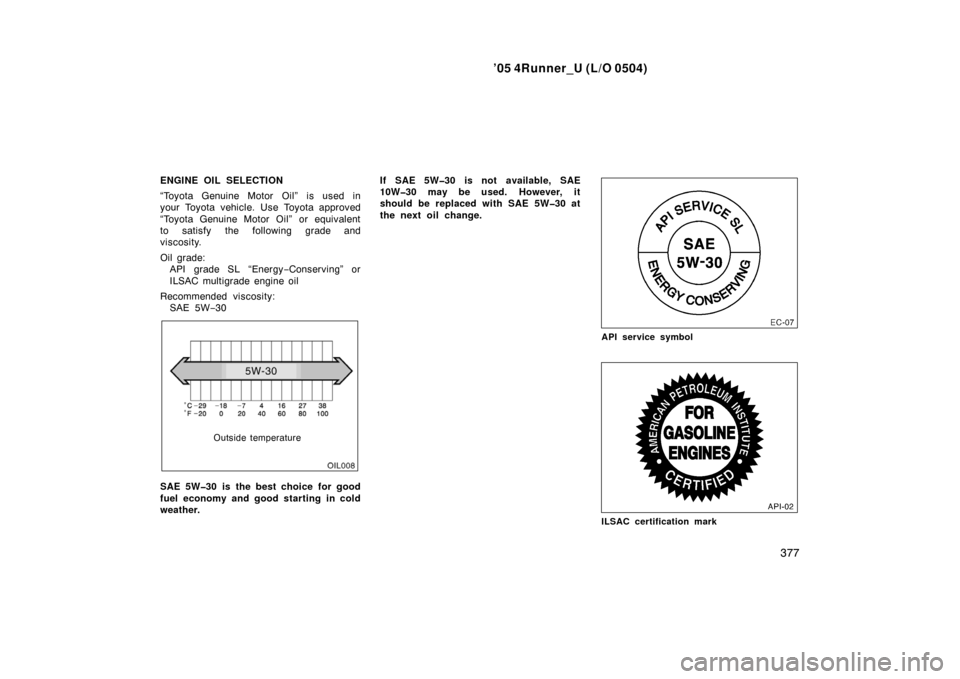
ENGINE OIL SELECTION
“Toyota Genuine Motor Oil” is used in
your Toyota vehicle. Use Toyota approved
“Toyota Genuine Motor Oil” or equivalent
to satisfy the following grade and
viscosity.
Oil grade:
API grade SL “Energy −Conserving” or
ILSAC multigrade engine oil
Recommended viscosity: SAE 5W −30
Outside temperature
SAE 5W30 is the best choice for good
fuel economy and good starting in cold
weather. If SAE 5W30 is not available, SAE
10W30 may be used. However, it
should be replaced with SAE 5W30 at
the next oil change.
API service symbol
ILSAC certification mark
Page 388 of 426

’05 4Runner_U (L/O 0504)
378
Oil identification marks
Either or both API registered marks are
added to some oil containers to help
you select the oil you should use.
The API Service Symbol is located any-
where on the outside of the container.
The top portion of the label shows the oil
quality by API (American Petroleum Insti-
tute) designations such as SL. The center
portion of the label shows the SAE viscos-
ity grade such as SAE 5W −30. “Energy −
Conserving” shown in the lower portion,
indicates that the oil has fuel −saving ca-
pabilities.
The ILSAC (International Lubricant Stan-
dardization and Approval Committee) Certi-
fication Mark is displayed on the front of
the container.
To ensure excellent lubrication perfor-
mance for your engine, “Toyota Genuine
Motor Oil” is available, which has been
specifically tested and approved for all
Toyota engines.
Please contact your Toyota dealer for fur-
ther details about “Toyota Genuine Motor
Oil”. Look at the seethrough coolant reser-
voir when the engine is cold. The cool-
ant level is satisfactory if it is between
the “F” and “L” lines on the reservoir.
If the level is low, add the coolant. (For
the coolant type, see “Coolant type
selection” described below.)
The coolant level in the reservoir will vary
with engine temperature. However, if the
level is on or below the “L” line, add
coolant. Bring the level up to the “F” line.
If the coolant level drops within a short
time after replenishing, there may be a
leak in the system. Visually check the
radiator, hoses, radiator cap and drain
cock and water pump.
If you can find no leak, have your Toyota
dealer test the cap pressure and check
for leaks in the cooling system.
CAUTION
To prevent burning yourself, do not
remove the radiator cap when the en-
gine is hot.
Checking the engine coolant
level
Page 389 of 426

’05 4Runner_U (L/O 0504)
379
Coolant type selection
Use of improper coolants may damage
your engine cooling system.
Only use “Toyota Super Long Life Coolant”
or similar high quality ethylene glycol
based non−silicate, non −amine, non− nitrite,
and non− borate coolant with long −life
hybrid organic acid technology. (Coolant
with long −life hybrid organic acid
technology is a combination of low
phosphates and organic acids.)
For the U.S.A.—“Toyota Super Long Life
Coolant” is a mixture of 50% coolant and
50% deionized water. This coolant pro-
vides protection down to about −35 �C
( − 31 �F).
For Canada—“Toyota Super Long Life
Coolant” is a mixture of 55% coolant and
45% deionized water. This coolant pro-
vides protection down to about −42 �C
( − 44 �F).
NOTICE
Do not use plain water alone.
Toyota recommends “Toyota Super Long
Life Coolant”, which has been tested to
ensure that it will not cause corrosion nor
result in malfunction of your engine
coolant system with proper usage. “Toyota
Super Long Life Coolant” is formulated
with long −life hybrid organic acid
technology and has been specifically
designed to avoid engine cooling system
malfunction on Toyota vehicles.
Please contact your Toyota dealer for
further details. If any of the above parts are extremely
dirty or you are not sure of their condi-
tion, take your vehicle to a Toyota dealer.
CAUTION
To prevent burning yourself, be care-
ful not to touch the radiator or con-
denser when the engine is hot.
NOTICE
To prevent damage to the radiator
and condenser, do not perform the
work by yourself.
Checking the radiator and
condenser
Page 391 of 426

’05 4Runner_U (L/O 0504)
381
If cold O.K.
If hot O.K.
If cold
add If hot
add
Close
Open
Check the fluid level through the reser-
voir. If necessary, add automatic trans-
mission fluid DEXRON �II or III.
If the vehicle has been driven around 80
km/h (50 mph) for 20 minutes (a little
more in frigid temperatures), the fluid is
hot (60 �C—80 �C or 140 �F—175 �F). You
may also check the level when the fluid
is cold (about room temperature,
10 �C—30 �C or 50 �F—85 �F) if the engine
has not been run for about five hours. Clean all dirt from the outside of the res-
ervoir tank and look at the fluid level. If
the fluid is cold, the level should be in the
“COLD” range. Similarly, if it is hot, the
fluid level should be in the “HOT” range.
If the level is at the low side of either
range, add automatic transmission fluid
DEXRON
�II or III to bring the level within
the range.
To remove the reservoir cap, turn it coun-
terclockwise and lift up. To reinstall it,
turn it clockwise. After replacing the reser-
voir cap, visually check the steering box
case, vane pump and hose connections
for leaks or damage.
CAUTION
The reservoir tank may be hot so be
careful not to burn yourself.
NOTICE
Avoid overfilling, or the power steer-
ing could be damaged.
Checking power steering fluid Checking tire inflation
pressure
Page 401 of 426

’05 4Runner_U (L/O 0504)
391
NOTICE
�Be sure the engine and all accesso-
ries are off before performing main-
tenance.
� When checking the battery, remove
the ground cable from the negative
terminal (“” mark) first and rein-
stall it last.
� Be careful not to cause a short cir-
cuit with tools.
� Take care no solution gets into the
battery when washing it.
If the battery is disconnected or run
down, the power window, power back win-
dow and moon roof may not operate auto-
matically and the jam protection function
will not function correctly, and does not
open the back door after you reconnect,
replace or recharge the battery. In any of
these cases, you should normalize the
power window, power back window, back
door and moon roof. To normalize them,
see “Power windows” on page 27, “Power
back window” on page 30, “Back door” on
page 32 and “Electric moon roof” on page
38 in Section 1 −2.
Ty p e A
Ty p e B Green Dark
Clear or light
yellow
Blue White Red
CHECKING BY INDICATOR
Check the battery condition by the indi-
cator color. Indicator color
ConditionTy p e ATy p e B
GreenBlueGood
DarkWhite
Charging necessary.
Have battery
checked by your
Toyota dealer.
Clear orlight
yellow
Red
Have battery
checked by your
Toyota dealer.
During recharging, the battery is pro-
ducing hydrogen gas.
Therefore, before recharging:
1. If recharging with the battery installed on the vehicle, be sure to disconnect
the ground cable.
2. Be sure the power switch on the re- charger is off when connecting the
charger cables to the battery and when
disconnecting them.
CAUTION
�Always charge the battery in an un-
confined area. Do not charge the
battery in a garage or closed room
where there is not sufficient ventila-
tion.
�Only do a slow charge (5 A or
less). Charging at a quicker rate is
dangerous. The battery may ex-
plode, causing personal injuries.
NOTICE
Never recharge the battery while the
engine is running. Also, be sure all
accessories are turned off.
—Checking battery c ondition Battery recharging pr ecautions
Page 403 of 426

’05 4Runner_U (L/O 0504)
393
If the new fuse immediately blows out,
there is a problem with the electrical sys-
tem. Have your Toyota dealer correct it as
soon as possible.
CAUTION
Never use a fuse with a higher am-
perage rating, or any other object, in
place of a fuse. This may cause ex-
tensive damage and possibly a fire.
If any washer does not work, the wash-
er tank may be empty. Check the wash-
er fluid level on the level gauge. If the
washer fluid level is below “LOW” or
only slightly above the “LOW” level,
add washer fluid.
For vehicles sold in Canada—
If any washer does not work or low
windshield washer fluid level warning
light comes on, the washer tank may be
empty. Add washer fluid. You may use plain water as washer fluid.
However, in cold areas where tempera-
tures range below the freezing point, use
washer fluid containing antifreeze. This
product is available at your Toyota dealer
and most auto parts stores. Follow the
manufacturer ’s directions for how much to
mix with water.
NOTICE
Do not use engine antifreeze or any
other substitute because it may dam-
age your vehicle’s paint.
Adding washer fluid
Page 411 of 426
’05 4Runner_U (L/O 0504)
401
SPECIFICATIONS
Dimensions and weights 402
. . . . . . . . . . . . . . . . . . . . . . . . . . . . . . . . . . . .
Engine 403
. . . . . . . . . . . . . . . . . . . . . . . . . . . . . . . . . . . . \
. . . . . . . . . . . . . . . .
Fuel 403
. . . . . . . . . . . . . . . . . . . . . . . . . . . . . . . . . . . . \
. . . . . . . . . . . . . . . . . . .
Service specifications 403
. . . . . . . . . . . . . . . . . . . . . . . . . . . . . . . . . . . . \
. . .
Tires 406
. . . . . . . . . . . . . . . . . . . . . . . . . . . . . . . . . . . . \
. . . . . . . . . . . . . . . . . .
Fuses 406
. . . . . . . . . . . . . . . . . . . . . . . . . . . . . . . . . . . . \
. . . . . . . . . . . . . . . . .
SECTION 8
Page 412 of 426

’05 4Runner_U (L/O 0504)
402
Towing capacity (trailer weight + cargo
weight), kg (lb.):
For weight carrying hitch 2268 (5000)
Also for weight distributing hitch
1GR −FE engine
Tw o −wheel drive models
3042 (6700)
Four −wheel drive models
2906 (6400)
2UZ− FE engine
Tw o −wheel drive models
3311 (7300)
Four −wheel drive models
3175 (7000)
Dimensions and weights
Overall width mm (in.)
2790 (109.8)
Overall height
∗
1mm (in.)
1575 (62.0)
Wheelbase mm (in.)
Front tread mm (in.) 1575 (62.0)
Rear tread mm (in.)
431 (950)
∗7
476 (1050)∗8
∗1: Unladen vehicle∗2: With two −wheel drive models∗
3: With four −wheel drive models∗
4: With roof rails∗5: With rear spoiler∗6: With rear height control air suspension∗7: With 5 occupants∗8: With 7 occupantsOverall length mm (in.)
Vehicle capacity weight (occupants + luggage)
kg (lb.)4800 (189.0)
1875 (73.8)
1820 (71.7)
∗
2or3,4
1800 (70.9)∗2, 3, 5
1755 (69.1)∗2, 3
1805 (71.1)∗2 or 3,4,6
1785 (70.3)∗2 or 3,5,6
1740 (68.5)∗2or3,6
91 (200)∗7
0(0)∗8Luggage compartment load capacity kg (lb.)