2005 SUBARU LEGACY recommended
[x] Cancel search: recommendedPage 71 of 627
1-40
Seat, seatbelt and SRS airbags
!
Where to place a child restraint system
The following are SUBARU’s recommendations on
where to place a child restraint system in your vehicle.
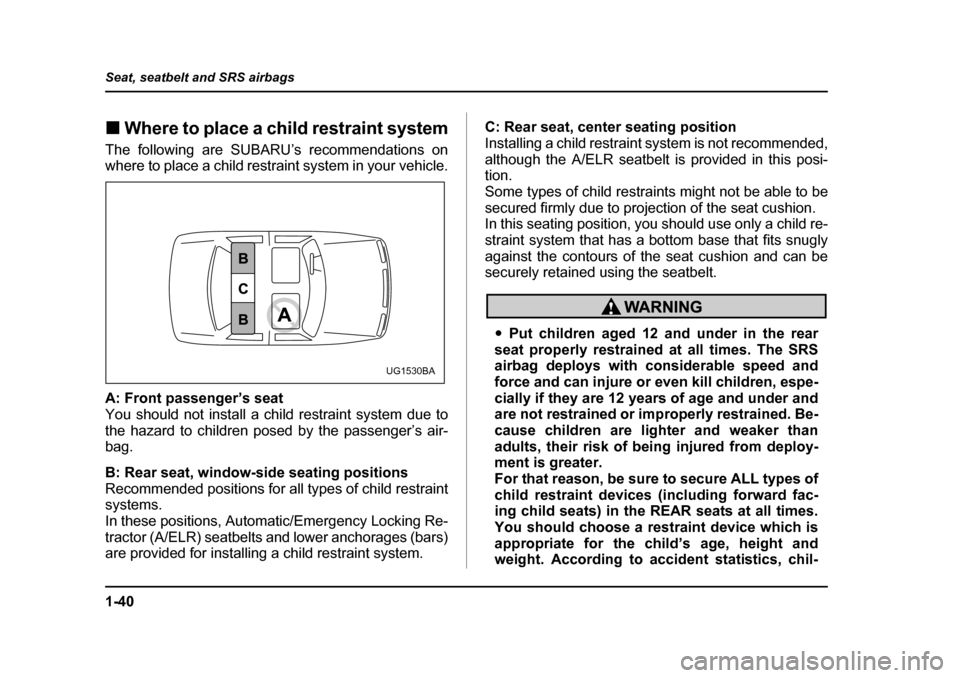
A: Front passenger’s seat
You should not install a child restraint system due to
the hazard to children posed by the passenger’s air-
bag.
B: Rear seat, window-side seating positions
Recommended positions for all types of child restraint
systems.
In these positions, Automatic/Emergency Locking Re-
tractor (A/ELR) seatbelts and lower anchorages (bars)
are provided for installing a child restraint system. C: Rear seat, center seating position
Installing a child restraint system is not recommended,
although the A/ELR seatbelt is provided in this posi- tion.
Some types of child restraints might not be able to be
secured firmly due to projection of the seat cushion.
In this seating position, you should use only a child re-
straint system that has a bottom base that fits snugly
against the contours of the seat cushion and can be
securely retained using the seatbelt.
"
Put children aged 12 and under in the rear
seat properly restrained at all times. The SRS
airbag deploys with considerable speed and
force and can injure or even kill children, espe-
cially if they are 12 years of age and under and
are not restrained or improperly restrained. Be-
cause children are lighter and weaker than
adults, their risk of being injured from deploy-
ment is greater.
For that reason, be sure to secure ALL types of
child restraint devices (including forward fac-
ing child seats) in the REAR seats at all times.
You should choose a restraint device which is
appropriate for the child’s age, height and
weight. According to accident statistics, chil-
UG1530BA
Page 102 of 627

1-71
Seat, seatbelt and SRS airbags
– CONTINUED –
ing the system check, both indicators extinguish for 2
seconds. After this, one of the indicators illuminates
depending on the status of the front passenger’s SRS
frontal airbag reached by the Subaru advanced frontal airbag system monitoring.
If the front passenger’s SRS frontal airbag is activated,
the passenger’s frontal airbag ON indicator will illumi-
nate while the OFF indicator will remain extinguished.
If the front passenger’s SRS frontal airbag is deacti-
vated, the passenger’s frontal airbag ON indicator will
remain extinguished while the OFF indicator will illumi-
nate.
If both the ON and OFF indicators remain lit or extin-
guished simultaneously, the system is faulty. Contact
your SUBARU dealer immediately for an inspection. !Conditions in which front passenger’s SRS
frontal airbag is not activated
The front passenger’s SRS frontal airbag will not be
activated when any of the following conditions are met
regarding the front passenger’s seat: " The seat is empty.
" The seat is equipped with a rearward facing child re-
straint system and an infant is restrained with it." The seat is equipped with a forward facing child re-
straint system and a small child is restrained with it. " The seat is equipped with a booster seat and a small
child is in the booster seat. "
The seat is relieved of the occupant load for a time
exceeding the predetermined period. " The seat is occupied by a child who has outgrown a
child restraint system or a small adult." The front passenger’s occupant detection system is
faulty.
NEVER INSTALL A REARWARD FACING CHILD
SEAT IN THE FRONT PASSENGER’S SEAT
EVEN IF THE FRONT PASSENGER’S SRS
FRONTAL AIRBAG IS DEACTIVATED. Be sure
to install it in the REAR seat in a correct man-
ner. Also, it is strongly recommended that any
forward facing child seat or booster seat be in-
stalled in the REAR seat, and that even children
who have outgrown a child restraint system be
also seated in the REAR seat. This is because
children sitting in the front passenger’s seat
may be killed or severely injured should the
front passenger’s SRS frontal airbag deploy.
REAR seats are the safest place for children.
When the front passenger’s seat is occupied by a
child, observe the following precautions. Failure to do
so may increase the load on the front passenger’s
Page 104 of 627

1-73
Seat, seatbelt and SRS airbags
– CONTINUED –
take the following actions. "Ensure that no article is placed on the seat other
than the occupant. " Ensure that there is no article left in the seat-
back pocket.
If the ON indicator still illuminates while the OFF
indicator extinguishes despite the fact that the ac-
tions noted above have been taken, seat the child/
small adult in the rear seat and immediately con-
tact your SUBARU dealer for an inspection. Even
if the system has passed the dealer inspection, it
is recommended that on subsequent trips the
child/small adult always take the rear seat.
Children who have outgrown a child restraint system
should always wear the seatbelt irrespective of wheth-
er the airbag is deactivated or activated. ! Conditions in which front passenger’s SRS
frontal airbag is activated
The front passenger’s SRS frontal airbag will be acti-
vated for deployment upon impact when any of the fol-
lowing conditions is met regarding the front passen-ger’s seat. " When the seat is occupied by an adult.
" When a heavy article is placed on the seat.
When the front passenger’s seat is occupied by an adult, observe the following precautions. Failure to do
so may lessen the load on the front passenger’s seat,
deactivating the front passenger’s SRS frontal airbag
despite the fact that the seat is occupied by an adult. "
Do not allow the rear seat occupant to lift the front
passenger’s seat cushion using his/her feet. " Do not place any article under the front passenger’s
seat, or squeeze any article from behind and under the
seat. This may lift the seat cushion. " Do not squeeze any article between the front pas-
senger’s seat and side trim/pillar, door or center con-
sole box. This may lift the seat cushion. " If the passenger’s frontal airbag OFF indicator
illuminates and the ON indicator extinguishes
even when the front passenger’s seat is occu-
pied by an adult
This can be caused by the adult incorrectly sitting in
the front passenger’s seat. Turn the ignition switch to
the “OFF” position. Ask the front passenger to set the
seatback to the upright position, sit up straight in the
center of the seat cushion, correctly fasten the seat-
belt, position his/her legs out forward, and adjust the
seat to the rearmost position. If the OFF indicator re-
mains illuminated while the ON indicator remains ex-
tinguished, take the following actions. " Ensure that there is no article, book, shoe, etc.
trapped under the seat, at the rear of the seat, or on
Page 143 of 627

2-18
Keys and doors
transmitters (up to four can be programmed), you
should re-program all of your transmitters for security
reasons. It is recommended that you have your dealer
program all of your transmitters into your system. !
Programming the transmitters
The keyless entry system is equipped with a special
code learning feature that allows you to program new
transmitter codes into the system or to delete old
ones. The system can learn up to four unique transmit-
ter codes. The four transmitter codes may be the same or different.
Programming transmitter codes into system:
Bag containing transmitter Transmitter circuit board
To register a new transmitter with the keyless entry system, it is necessary to program the transmitter’s
code (identification number) into the system. A label
showing the code is affixed to the bag containing the
transmitter, and another is affixed to the circuit board
inside the transmitter. If there is no bag, open the
transmitter case and make a note of the eight-digit
number. Program the number into the system in ac-
cordance with the following procedure:
1. Firmly close the doors and the rear gate or trunk lid.
2. Open the driver’s door, sit on the driver’s seat, and
close the door.
UB2223BA
UB2224BA
Page 168 of 627

2-43
Keys and doors
– CONTINUED –
To stop the moonroof at a selected mid-way position
while opening or closing it, momentarily push the
switch to the “OPEN” or “CLOSE” side.
After washing the vehicle or after it rains, wipe away
water on the roof prior to opening the moonroof to pre-
vent water drops from falling into the passenger com-
partment. !Anti-entrapment function
When the moonroof senses an object trapped be-
tween its glass and the vehicle’s roof during closure, it
automatically moves back to either of the following po-
sitions according to the point at which it senses the ob-ject: " When the moonroof senses the object at a point be-
tween the halfway stop position and fully closed posi-
tion, it moves back to the halfway stop position and
stops there. " When the moonroof senses the object at a point be-
tween the halfway stop position and fully open posi-
tion, it moves back to the fully open position and stops there.
The anti-entrapment function may also be activated by
a strong shock on the moonroof even when there is
nothing trapped.NOTE " For the sake of safety, it is recommended that
you avoid driving with the moonroof fully opened. " One-touch operation does not take place when
the moonroof is tilted up and down. Push the
switch continuously to tilt the moonroof up and
down. " If the moonroof cannot be closed through the
switch operation because of system failure, it can
be closed manually using a hex-head wrench. For
the procedure, refer to “Moonroof – if the moon-
roof cannot be closed” in Chapter 9. ! Sun shades
UB2532BA
Page 170 of 627

2-45
Keys and doors
– CONTINUED –
approximately 6.7 in (17 cm) from its fully closed posi- tion.
After confirming safety, pull the switch to the “OPEN”
side again and quickly release it. The rear moonroof
will open to its fully open position. To stop the rear
moonroof at some selected mid-way point while it is
moving toward its fully open position, momentarily
push the switch to the “CLOSE” or “OPEN” side.
To fully close the rear moonroof, push the switch to the
“CLOSE” side then quickly release it.
The rear moonroof will stop at a position approximate-
ly 5.9 in (15 cm) before its fully closed position. After
confirming safety, pull the switch to the “CLOSE” side
again and quickly release it. The rear moonroof will ful-
ly close. The front moonroof can then be fully closed. !Anti-entrapment function
When the moonroof senses an object trapped be-
tween its glass and during closure, it automatically
moves back by 5.9 in (15 cm) from that point and then
stops. The anti-entrapment function may also be acti-
vated by a strong shock on the moonroof even when
there is nothing trapped.
NOTE " For the sake of safety, it is recommended that
you avoid driving with the moonroof fully opened. " Driving with the moonroof fully open can cause an annoying sound to generate at high speeds. If
such a condition has been encountered, use the
moonroof at the initial stop position of 6.7 in (17 cm). "
If the moonroof cannot be closed through
switch operation because of system failure, it can
be closed manually using a hex-head wrench. For
the procedure, refer to “Moonroof – if the moon-
roof cannot be closed” in Chapter 9. ! Sun shades
The sun shade can be slid forward or backward by
hand while the moonroof is closed.
If the moonroof is opened, the sun shade also movesUB2509BA
Page 315 of 627

5-60
Audio
MP3 audio !
What is MP3?
MP3 (the name is an abbreviation of ‘MPEG Audio
Layer 3’) is a compression format for digital audio. It
was developed by the Motion Picture Experts Group.
It permits audio data to be shrunk by a factor of about
10 with no loss of sound quality, meaning that the au-
dio on 10 conventional CDs can be fitted onto a single
CD-R or CD-RW (assuming a bit rate of 128 kbps and
a sampling frequency of 44.1 kHz).
NOTE " MP3 encoding and writing software is not sup-
plied with the audio system. " CD writing software is not supplied with the au-
dio system. ! Creating MP3 files
" To create a high-quality MP3 file, it is advisable to a
high bit rate (128 kbps or higher) and a high sampling
frequency." If a file is created with a variable bit rate (VBR), the
elapsed time during playback may not be displayed
correctly and the sound may skip." The sound quality during playback depends upon
the encoder and bit rate. Detailed information can be found in the user’s manuals for encoder software and
writing software."
A fixed bit rate of 128 kbps or higher is recommend-
ed. ! Saving MP3 files on a disc
" Do not save any non-MP3 file on a disc. Also, do not
save any unnecessary folder on a disc. " If many folders and/or non-MP3 files are saved on a
disc, a delay will be caused before playback begins." If a disc contains both Compact Disc-Digital Audio
(CD-DA) files and MP3 files, the system will play only
the CD-DA files. " Add the extension ‘.MP3’ to the name of every MP3
file. The system will not play any file that has either no
extension or an extension other than ‘.MP3’. " Do not add the extension ‘.MP3’ to the name of any
non-MP3 file. Doing so could lead to speaker damage. " The system supports multi-session recording, so
disc-at-once recording is recommended. " The system does not support packet writing soft-
ware." The system does not have a playlist function.
" The system may not be able to display and play cer-
tain MP3 files depending on the writing software andCD recorder." Recording must be performed using a file system
Page 350 of 627

6-33
Interior equipment
– CONTINUED –
hand-held transmitters for further programming or
device testing in the event of a problem."It is recommended to insert a new battery in the
hand-held transmitter of a device to ensure cor-
rect programming. ! Garage door opener programming in the U.S.A.
NOTE
When programming the HomeLink® Wireless
Control System for a garage door opener, it is sug-
gested that you park the vehicle outside the ga-
rage.
1. Unplug the motor of the garage door opener from
the outlet. 2. Press and hold the two outside HomeLink® buttons
until the indicator light begins to flash (after 20 sec-
onds). Release both buttons.
NOTE
If any of the HomeLink® buttons are already pro-
grammed for other devices, skip step 2 because it
clears the memory of all the three buttons.
3. Hold the end of the garage door opener’s hand-
held transmitter between 1 and 3 inches (25 and 76
mm) away from the HomeLink® buttons on the driver’s
sun visor, keeping the indicator light in view.
UB6220BA