2005 SUBARU FORESTER transmission
[x] Cancel search: transmissionPage 274 of 477
7-17
Starting and operating
– CONTINUED –
A shift interlock function is employed in the automatic
transmission system to ensure safe starting of the ve-
hicle.
To shift the selector lever from the “P” to the any other
position, you have to depress the brake pedal fully
when the ignition switch is in the “ON” position. This
prevents the vehicle from lurching when it is started.
If the shift lever does not move from the “P” position
with the brake pedal depressed, refer to the “Shift lock
release” section in this chapter. TR (Reverse)
This position is for backing the vehicle.
To shift from the “N” to “R” position, first stop the vehi-
cle completely then move the lever to the “R” position. T N (Neutral)
This position is for restarting a stalled engine.
In this position the wheels and transmission are not
locked. In this position, the transmission is neutral; the
vehicle will roll freely, even on the slightest incline un-
less the parking brake or foot brake is on.
NOTE
If you stop the engine with the selector lever in the
“N” position, move the selector lever to the “P”
position immediately. Otherwise, you may find that the selector lever soon cannot be moved to
the “P” position. If you find that the selector lever
cannot be moved from the “N” position to the “P”
position, turn the ignition switch to the “ON” posi-
tion and try again.
Do not drive the vehicle with the selector lever
in the “N” (neutral) position. Engine braking
has no effect in this condition and the risk of an
accident is consequently increased.
T D (Drive)
This position is for normal driving.
The transmission automatically shifts into a suitable
gear from 1st to 4th according to the vehicle speed
and the acceleration you require.
When more acceleration is required in this position,
press the accelerator pedal fully to the floor and hold
that position. The transmission will automatically
downshift to 3rd, 2nd or 1st gear. When you release
the pedal, the transmission will return to the original
gear position.
Page 275 of 477

7-18
Starting and operating
V
While climbing a grade
When driving up hill, undesired upshift to 4th gear is
prevented from taking place when the accelerator
pedal is released. This minimizes the chances of sub-
sequent downshifting to a lower gear when accelerat-
ing again. This prevents repeated upshifting and
downshifting resulting in a smoother operation of the
vehicle.
NOTE
The transmission may downshift to 2nd or 1st
gear, depending on the way the accelerator pedal
is pressed to accelerate the vehicle again. V While going down a hill
When descending a steep hill, depressing the brake
pedal will cause the transmission to downshift to 3rd
gear, thus applying engine braking. Reacceleration for
a short time will cause the transmission to upshift nor-
mally.
NOTE
In some cases, depressing the brake pedal on a
downhill grade does not result in an automatic
downshift to 3rd gear. This can happen when the
automatic transmission fluid temperature is very
low, for example, during driving shortly after the
vehicle has been parked for an extended period of time. When the ATF temperature has risen to a cer-
tain level, automatic downshift normally takes
place. In the meantime, downshift manually for en-
gine braking as required.
Also, downshifting when braking downhill will not
occur at speeds above approximately 48 mph (78
km/h). T
3 (Third)
This position is for using engine braking when going
down a hill or for climbing a grade.
The transmission automatically shifts into a suitable
gear from 1st to 3rd according to the vehicle speed
and the acceleration you require.
When more acceleration is required in this position,
press the accelerator pedal fully to the floor and hold
that position. The transmission will automatically
downshift to 2nd or 1st gear. When you release the
pedal, the transmission will return to the original gearposition. T 2 (Second)
This position is for using engine braking when going
down a hill or for climbing a steep grade.
In this position, the transmission holds in the 2nd gear.
Use this position when starting off from a standstill on
slippery road surfaces such as mud or snow. It will en-
Page 276 of 477
7-19
Starting and operating
– CONTINUED –
sure greater traction. T1 (First)
This position is for driving up or down very steep
grades, or driving through mud or sand, or on slippery
surfaces. In this position, the transmission holds in the
1st gear. T Maximum speeds
The following tables show the maximum speeds that
are possible with each different gear.
When shifting down a gear, it is important to confirm
that the current vehicle speed is not in excess of the
Maximum Allowable Speed of the gear which is about
to be selected.
mph (km/h)
NOTE
In order to prevent over-revving during decelera- tion of the vehicle, the transmission will remain in
the current gear if the speed of the vehicle is in ex-
cess of the Maximum Allowable Speed for the gear
to which the selector lever has been moved.
When shifting down a gear, ensure that the ve-
hicle is not travelling at a speed exceeding the
Maximum Allowable Speed for the gear which
is about to be selected. Failure to observe this
precaution can lead to engine over-revving and
this in turn can result in engine damage.
In addition, sudden application of engine
brakes when the vehicle is travelling on a slip-
pery surface can lead to wheel locking; as a
consequence, control of the vehicle may be lost
and the risk of an accident increased.
T Driving tips
y Always apply the foot or parking brake when the ve-
hicle is stopped in the “D”, “3”, “2”, “1” or “R” position. y Always set the parking brake when parking your ve-
hicle. Do not hold the vehicle with only the transmis- sion. y Do not keep the vehicle in a stationary position on
an uphill grade by using the “D”, “3”, “2”, or “1” position.
Non-turbo
models Turbo
models
1st 28 (45) 29 (47)
2nd 61 (97) 60 (96) 3rd 96 (153) 103 (164)
Page 291 of 477
7-34
Starting and operating
Parking your vehicle „
Parking brake
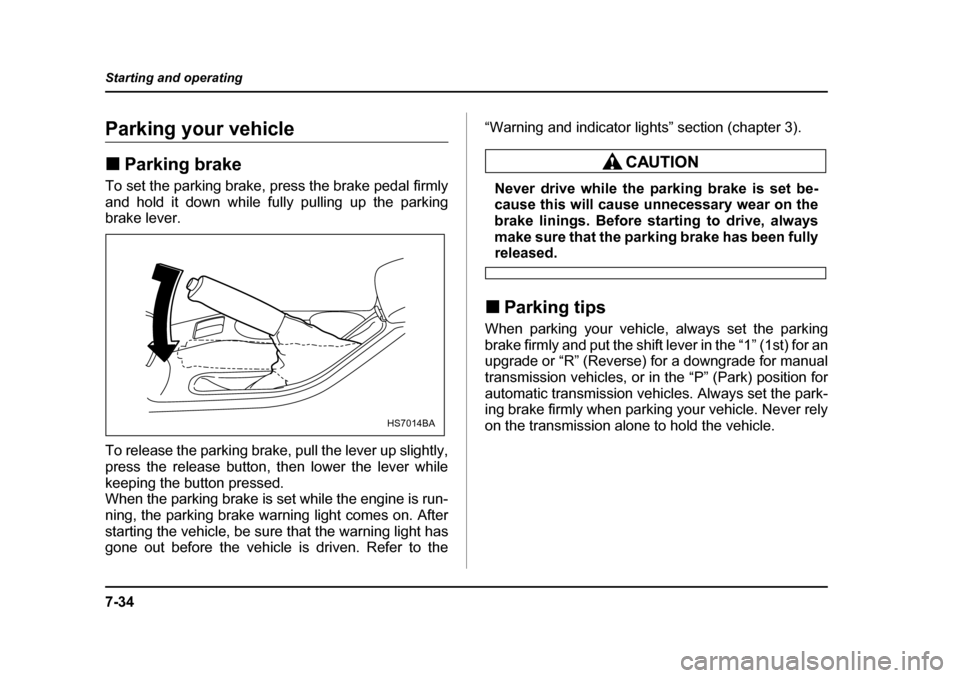
To set the parking brake, press the brake pedal firmly
and hold it down while fully pulling up the parking
brake lever.
To release the parking brake, pull the lever up slightly,
press the release button, then lower the lever while
keeping the button pressed.
When the parking brake is set while the engine is run-
ning, the parking brake warning light comes on. After
starting the vehicle, be sure that the warning light has
gone out before the vehicle is driven. Refer to the “Warning and indicator lights” section (chapter 3).
Never drive while the parking brake is set be-
cause this will cause unnecessary wear on the
brake linings. Before starting to drive, always
make sure that the parking brake has been fully
released.
„ Parking tips
When parking your vehicle, always set the parking brake firmly and put the shift lever in the “1” (1st) for an
upgrade or “R” (Reverse) for a downgrade for manual
transmission vehicles, or in the “P” (Park) position for
automatic transmission vehicles. Always set the park-
ing brake firmly when parking your vehicle. Never rely
on the transmission alone to hold the vehicle.
HS7014BA
Page 293 of 477
7-36
Starting and operating
they may burn easily if they come near hot en-
gine or exhaust system parts.y
Be sure to stop the engine if you take a nap in
the vehicle. If engine exhaust gas enters the
passenger compartment, occupants in the ve-
hicle could die from carbon monoxide (CO)
contained in the exhaust gas. Hill holder (for manual transmission –
if equipped)
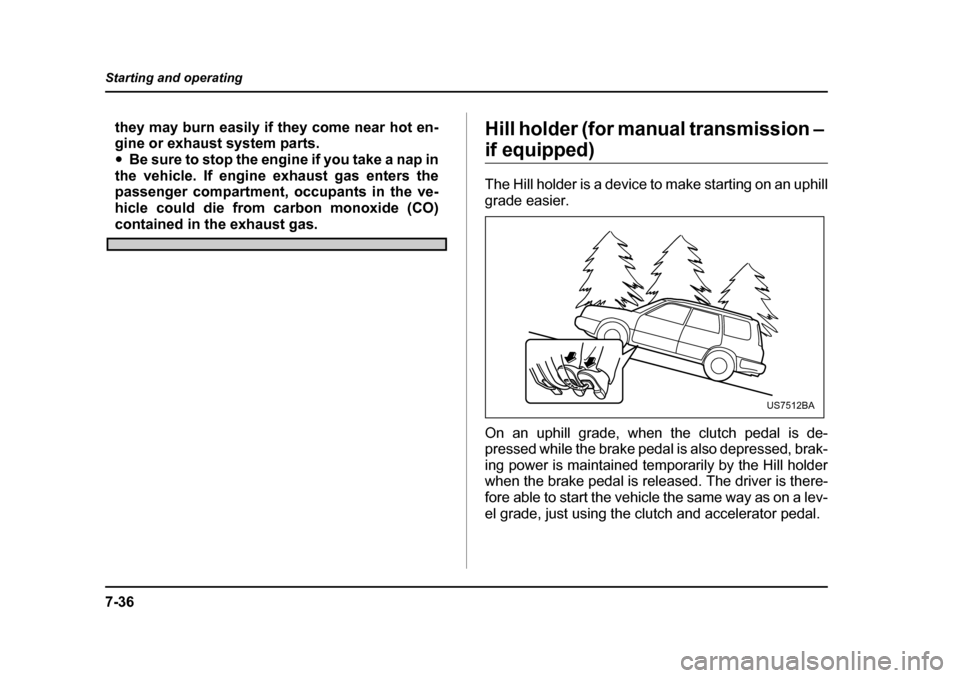
The Hill holder is a device to make starting on an uphill
grade easier.
On an uphill grade, when the clutch pedal is de-
pressed while the brake pedal is also depressed, brak-
ing power is maintained temporarily by the Hill holder
when the brake pedal is released. The driver is there-
fore able to start the vehicle the same way as on a lev-
el grade, just using the clutch and accelerator pedal.
US7512BA
Page 297 of 477
7-40
Starting and operating
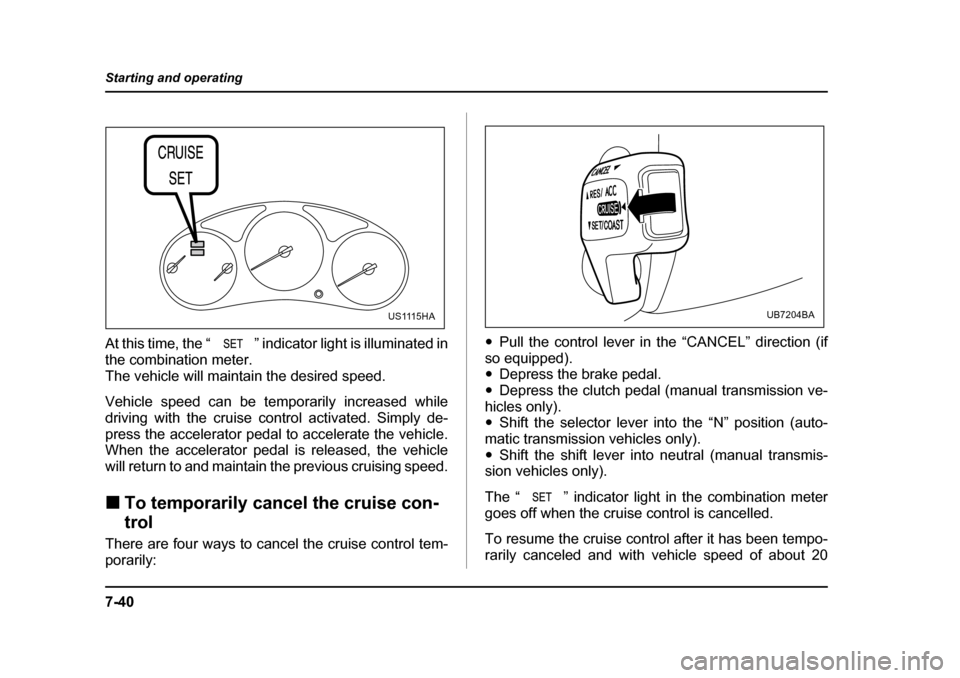
At this time, the “ ” indicator light is illuminated in
the combination meter.
The vehicle will maintain the desired speed.
Vehicle speed can be temporarily increased while
driving with the cruise control activated. Simply de-
press the accelerator pedal to accelerate the vehicle.
When the accelerator pedal is released, the vehicle
will return to and maintain the previous cruising speed. „
To temporarily cancel the cruise con- trol
There are four ways to cancel the cruise control tem-
porarily: y
Pull the control lever in the “CANCEL” direction (if
so equipped). y Depress the brake pedal.
y Depress the clutch pedal (manual transmission ve-
hicles only).y Shift the selector lever into the “N” position (auto-
matic transmission vehicles only). y Shift the shift lever into neutral (manual transmis-
sion vehicles only).
The “ ” indicator light in the combination meter
goes off when the cruise control is cancelled.
To resume the cruise control after it has been tempo-
rarily canceled and with vehicle speed of about 20
US1115HAUB7204BA
Page 310 of 477

8-9
Driving tips
– CONTINUED –
could create a fire hazard. yAfter driving through tall grass, mud, rocks, sand,
rivers, etc., check that there is no grass, bush, paper,
rags, stones, sand, etc. adhering to or trapped on the
underbody. Clear off any such matter from the under-
body. If the vehicle is used with these materials
trapped or adhering to the underbody, a mechanical
breakdown or fire could occur.y Secure all cargo carried inside the vehicle and make
certain that it is not piled higher than the seatbacks.
During sudden stops or jolts, unsecured cargo could
be thrown around in the vehicle and cause injury. Do
not pile heavy loads on the roof. Those loads raise the
vehicle’s center of gravity and make it more prone to
tip over. y If you must rock the vehicle to free it from sand or
mud, depress the accelerator pedal slightly and move
the selector lever back and forth between “D” and “R”
repeatedly. Do not race the engine. For the best pos-
sible traction, avoid spinning the wheels when trying to
free the vehicle.
When the road surface is extremely slippery, you can
obtain better traction by starting the vehicle with the
transmission in 2nd than 1st (both for MT and AT). y Never equip your vehicle with tires larger than those
specified in this manual. y Frequent driving of an AWD vehicle under hard-driv- ing conditions such as rough roads or off roads will ne-
cessitate more frequent replacement of engine oil,
brake fluid and transmission oil than that specified in
the maintenance schedule described in the “Warranty
and Maintenance Booklet”.
Remember that damage done to your SUBARU while
operating it off-road and not using common sense pre-
cautions such as those listed above is not eligible forwarranty coverage. y
Wash the vehicle’s underbody after off-road driving.
Suspension components are particularly prone to dirt
buildup, so they need to be washed thoroughly.
y Always maintain a safe driving speed accord-
ing to the road and weather conditions in order
to avoid having an accident on a sharp turn,
during sudden braking or under other similar
conditions.y Always use the utmost care in driving – over-
confidence because you are driving an All-
Wheel Drive vehicle could easily lead to a seri-
ous accident.
Page 312 of 477

8-11
Driving tips
– CONTINUED –
TParking in cold weather
Do not use the parking brake when parking for long
periods in cold weather since it could freeze in that po-
sition. Instead, observe the following:
1. Place the shift lever in “1” or “R” for manual trans-
mission vehicles, and in “P” for automatic transmissionvehicles.
2. Use tire stops under the tires to prevent the vehicle
from moving.
When the vehicle is parked in snow or when it snows,
raise the wiper blades off the glass to prevent damage to them.
When the vehicle has been left parked after use on
roads heavily covered with snow, or has been left
parked during a snowstorm, icing may develop on the
brake system, which could cause poor braking action.
Check for snow or ice buildup on the suspension, disc
brakes and brake hoses underneath the vehicle.
If there is caked snow or ice, remove it, being careful
not to damage the disc brakes and brake hoses and ABS harness.
Snow can trap dangerous exhaust gases under
your vehicle. Keep snow clear of the exhaust pipe and from around your vehicle if you park
the vehicle in snow with the engine running.
T Refueling in cold weather
To help prevent moisture from forming in the fuel sys-
tem and the risk of its freezing, use of an antifreeze ad-
ditive in the fuel tank is recommended during cold
weather.
Use only additives that are specifically designed for
this purpose. When an antifreeze additive is used, its
effect lasts longer if the tank is refilled whenever the
fuel level reaches half empty.
If your SUBARU is not going to be used for an extend-
ed period, it is best to have the fuel tank filled to capac- ity. „ Driving on snowy and icy roads
To prevent skidding and slipping, avoid sudden brak-
ing, abrupt acceleration, high-speed driving, and
sharp turning when driving on snowy or icy roads.
Always maintain ample distance between your vehicle
and the vehicle ahead of you to avoid the need for sud-
den braking.
To supplement the foot brake, use the engine brake
effectively to control the vehicle speed. (Shift into a