Page 56 of 469
1-31
Seat, seatbelt and SRS airbags
– CONTINUED –
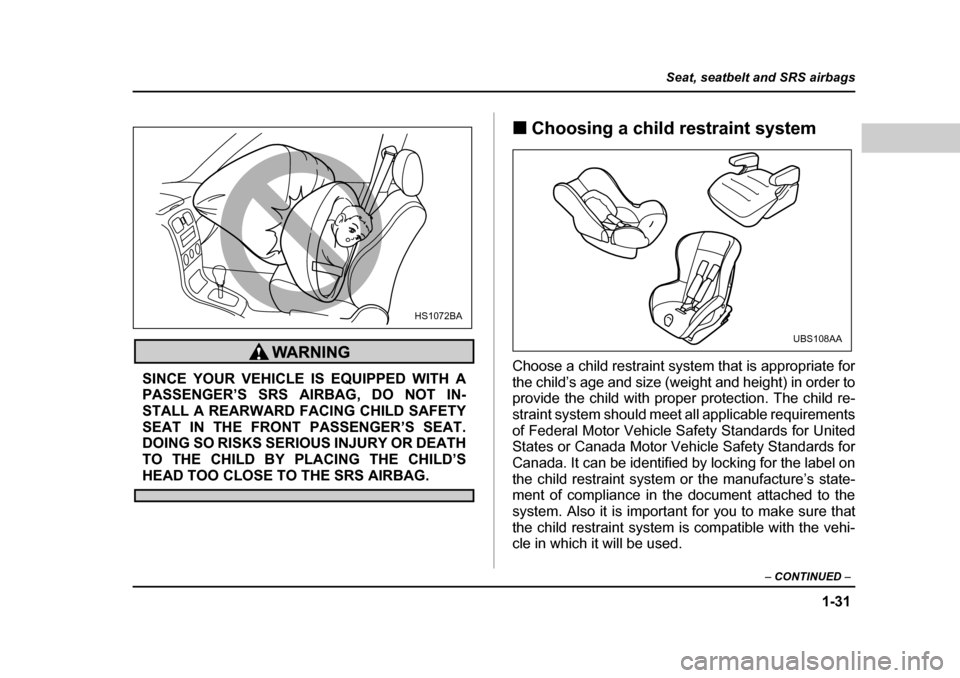
SINCE YOUR VEHICLE IS EQUIPPED WITH A
PASSENGER’S SRS AIRBAG, DO NOT IN-
STALL A REARWARD FACING CHILD SAFETY
SEAT IN THE FRONT PASSENGER’S SEAT.
DOING SO RISKS SERIOUS INJURY OR DEATH
TO THE CHILD BY PLACING THE CHILD’S
HEAD TOO CLOSE TO THE SRS AIRBAG. „
Choosing a child restraint system
Choose a child restraint system that is appropriate for
the child’s age and size (weight and height) in order to
provide the child with proper protection. The child re-
straint system should meet all applicable requirements
of Federal Motor Vehicle Safety Standards for United
States or Canada Motor Vehicle Safety Standards for
Canada. It can be identified by locking for the label on
the child restraint system or the manufacture’s state-
ment of compliance in the document attached to the
system. Also it is important for you to make sure that
the child restraint system is compatible with the vehi-
cle in which it will be used.
HS1072BA
UBS108AA
Page 74 of 469
1-49
Seat, seatbelt and SRS airbags
– CONTINUED –
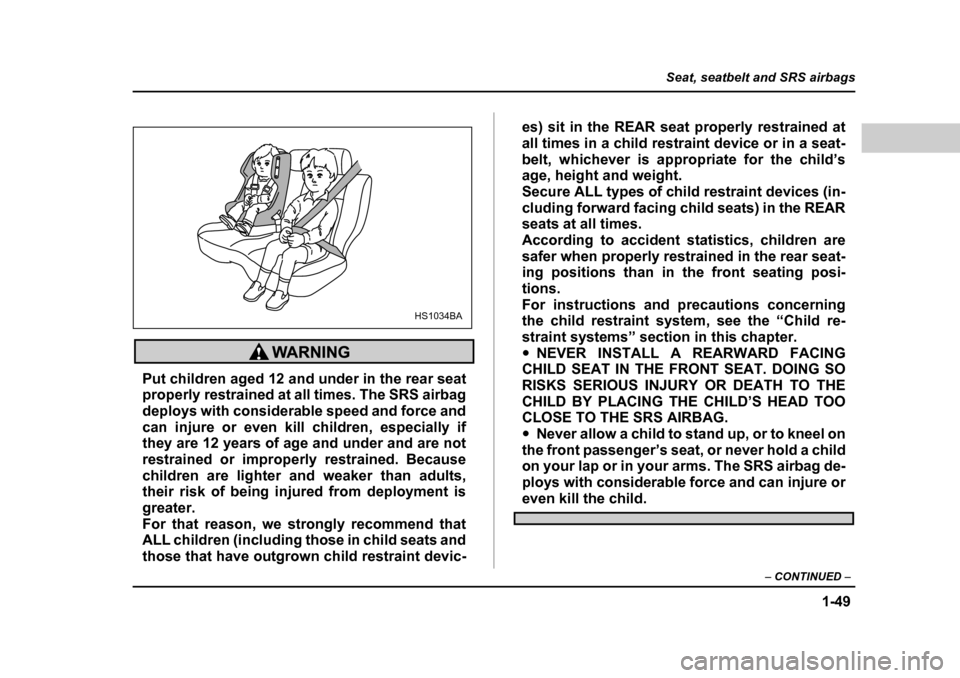
Put children aged 12 and under in the rear seat
properly restrained at all times. The SRS airbag
deploys with considerable speed and force and
can injure or even kill children, especially if
they are 12 years of age and under and are not
restrained or improperly restrained. Because
children are lighter and weaker than adults,
their risk of being injured from deployment is
greater.
For that reason, we strongly recommend that
ALL children (including those in child seats and
those that have outgrown child restraint devic- es) sit in the REAR seat properly restrained at
all times in a child restraint device or in a seat-
belt, whichever is appropriate for the child’s
age, height and weight.
Secure ALL types of child restraint devices (in-
cluding forward facing child seats) in the REAR
seats at all times.
According to accident statistics, children are
safer when properly restrained in the rear seat-
ing positions than in the front seating posi- tions.
For instructions and precautions concerning
the child restraint system, see the “Child re-
straint systems” section in this chapter.y
NEVER INSTALL A REARWARD FACING
CHILD SEAT IN THE FRONT SEAT. DOING SO
RISKS SERIOUS INJURY OR DEATH TO THE
CHILD BY PLACING THE CHILD’S HEAD TOO
CLOSE TO THE SRS AIRBAG. y Never allow a child to stand up, or to kneel on
the front passenger’s seat, or never hold a child
on your lap or in your arms. The SRS airbag de-
ploys with considerable force and can injure or
even kill the child.
HS1034BA
Page 306 of 469
8-29
Driving tips
– CONTINUED –
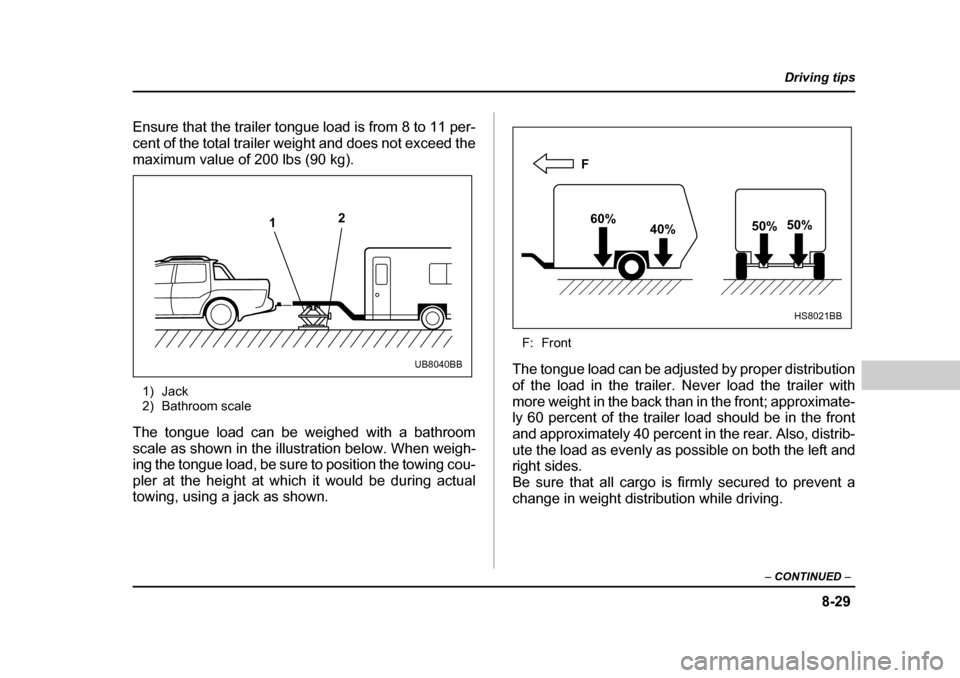
Ensure that the trailer tongue load is from 8 to 11 per-
cent of the total trailer weight and does not exceed the
maximum value of 200 lbs (90 kg).
1) Jack
2) Bathroom scale
The tongue load can be weighed with a bathroom
scale as shown in the illustration below. When weigh-
ing the tongue load, be sure to position the towing cou-
pler at the height at which it would be during actual
towing, using a jack as shown. F: Front
The tongue load can be adjusted by proper distribution
of the load in the trailer. Never load the trailer with
more weight in the back than in the front; approximate-
ly 60 percent of the trailer load should be in the front
and approximately 40 percent in the rear. Also, distrib-
ute the load as evenly as possible on both the left and
right sides.
Be sure that all cargo is firmly secured to prevent a
change in weight distribution while driving.
2
1
UB8040BB
F
60% 40% 50%
50%
HS8021BB
Page 392 of 469
11 -4 1
Maintenance and service
– CONTINUED –
Brake booster
If the brake booster does not operate as described be-
low, have it checked by your SUBARU dealer.
1. With the engine off, depress the brake pedal sever-
al times, applying the same pedal force each time. The
distance the pedal travels should not vary.
2. With the brake pedal depressed, start the engine.
The pedal should move slightly down to the floor.
3. With the brake pedal depressed, stop the engine
and keep the pedal depressed for 30 seconds. The
pedal height should not change.
4. Start the engine again and run for about one minute
then turn it off. Depress the brake pedal several times
to check the brake booster. Brake booster operates
properly if the pedal stroke decreases with each de-pression.Brake pedal
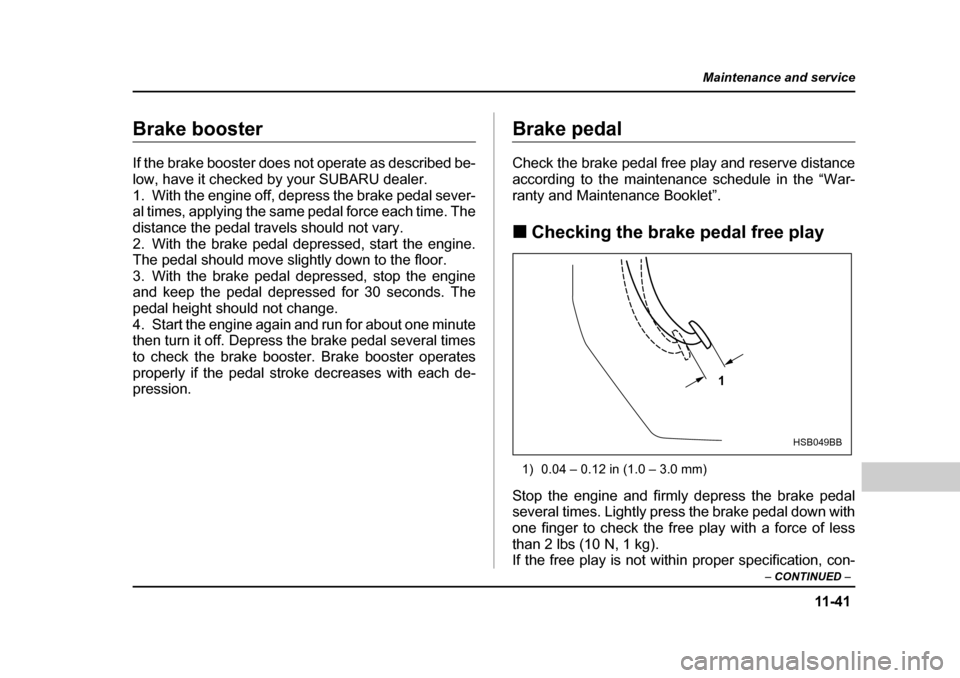
Check the brake pedal free play and reserve distance
according to the maintenance schedule in the “War-
ranty and Maintenance Booklet”. „Checking the brake pedal free play
1) 0.04 – 0.12 in (1.0 – 3.0 mm)
Stop the engine and firmly depress the brake pedal
several times. Lightly press the brake pedal down with
one finger to check the free play with a force of less
than 2 lbs (10 N, 1 kg).
If the free play is not within proper specification, con-
1
HSB049BB
Page 433 of 469
12-2
Specifications
SpecificationsSpecifications
These specifications are subject to change without notice. „
Dimensions
in (mm)
„ Engine
ModelBAJA, BAJA-SportBAJA-Turbo
Overall length199.3 (4,910)
Overall width70.1 (1,780)
Overall height62.1 (1,760)62.6 (1,775)
Wheelbase104.3 (2,650)
TreadFront57.7 (1,465)
Rear57.7 (1,465)
Ground clearance8.4 (213)
ItemNon-turboTurbo
Engine modelEJ251EJ255
Engine typeHorizontally opposed, liquid cooled 4 cylinder, 4 stroke gasoline engine
Displacement cc (cu-in)2,457 (150)
Bore × Stroke in (mm)3.92 × 3.11 (99.5 × 79.0)
Compression ratio10.0 : 18.2 : 1
Firing order1 - 3 - 2 - 4
Page 443 of 469
13-2
Consumer information and Reporting safety defects
Consumer information and Reporting safety defectsFor U.S.A.
The following information has been compiled accord-
ing to Code of Federal Regulations “Title 49, Part
575”.
Tire information „
Tire labeling
Many markings (e.g. Tire size, Tire Identification
Number or TIN) are placed on the sidewall of a
tire by tire manufacturers. These marking can
provide you with useful information on the tire. T Tire size
Your vehicle comes equipped with P-Metric tire
size. It is important to understand the sizing sys-
tem in selecting the proper tire for your vehicles.
Here is a brief review of the tire sizing system
with a breakdown of its individual elements. V P Metric
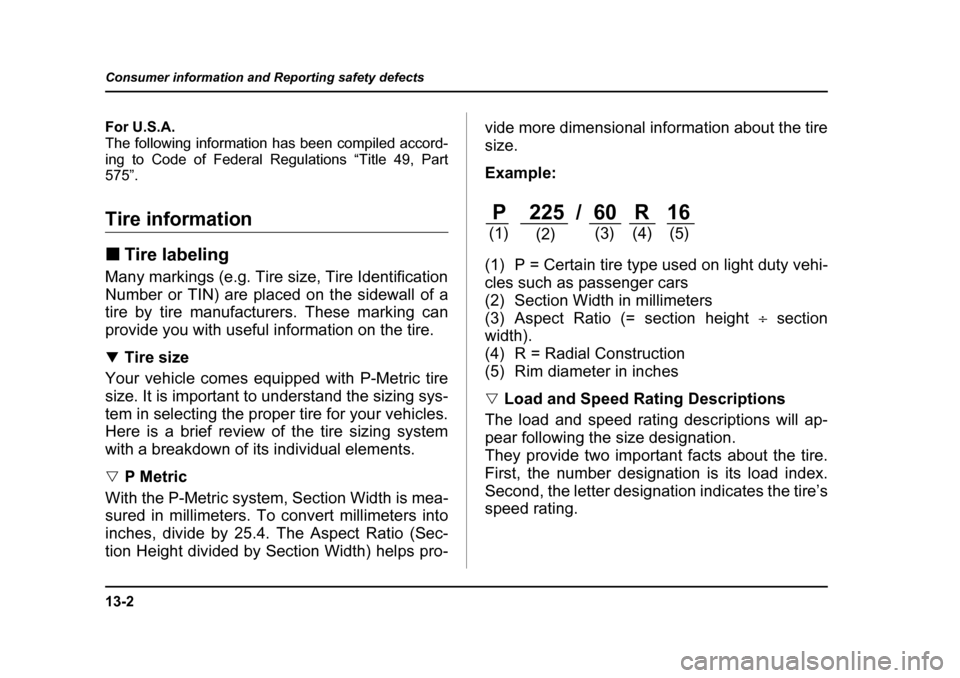
With the P-Metric system, Section Width is mea-
sured in millimeters. To convert millimeters into
inches, divide by 25.4. The Aspect Ratio (Sec-
tion Height divided by Section Width) helps pro- vide more dimensional information about the tire
size. Example:
(1) P = Certain tire type used on light duty vehi-
cles such as passenger cars
(2) Section Width in millimeters
(3) Aspect Ratio (= section height
÷ section
width).
(4) R = Radial Construction
(5) Rim diameter in inches V Load and Speed Rating Descriptions
The load and speed rating descriptions will ap-
pear following the size designation.
They provide two important facts about the tire.
First, the number designation is its load index.
Second, the letter designation indicates the tire’s
speed rating.P 225 / 60 R 16
(1) (2) (3) (4) (5)