2005 SKODA SUPERB leak
[x] Cancel search: leakPage 110 of 281

Heating and air conditioning system 109
Using the systemSafetyDriving TipsGeneral MaintenanceBreakdown assistanceTechnical Data
Heating and air conditioning system
The air conditioning system
Description
The air conditioning system is a combined cooling and
heating system. It makes it possible to optimally control
the air temperature at any season of the year.
Description of the air conditioning system
It is important for your safety and for your driving comfort that the air condi-
tioning system is operating properly.
The air conditioning system operates when switch ⇒page 110,
fig. 107 is pressed and the following conditions are met:
•engine running,
•outside temperature above +5 °C,
•blower switch switched on (positions 1 to 4).
If the cooling system is switched on, the temperature and air humidity
drops in the vehicle. The wellbeing of the occupants of the car is enhanced
as a result of this particularly at high outside temperatures and a high air
humidity. The system prevents the windows misting up during the cold
season of the year.
The heating effect is dependent upon the coolant temperature, thus full
heat output only occurs when the engine has reached its operating
temperature.
It is possible to briefly activate recirculated air mode in order to enhance
the cooling effect ⇒. Air at a temperature of about 5°C may flow out of the vents under certain
circumstances when the cooling system is operating. Lengthy and uneven
distribution of the air flow out of the vents (in particular at the leg area) and
large differences in temperature, for example when getting out of the
vehicle, can result in chills in sensitive persons.
The air inlet in front of the windscreen must be free of ice, snow or leaves
in order to ensure that the heating and ventilation systems operate prop-
erly.
After switching on the cooling
Condensation from the evaporator of the
air conditioning may drip down and form a puddle below the vehicle. This
is quite normal and not an indication of a leak!
Aeration of the vehicle when ignition is switched off*
On models fitted with power sliding/tilting roof with sollar cells, the fresh
air blower is automatically switched over to “solar mode ” if the sun ray's
are sufficient after switching off the ignition. The solar cells on the
sliding/tilting roof deliver power for the fresh air blower. This supplies the
interior of the car with fresh air.
For an optimum ventilation, the air outlet vents 3 and 4 must be opened
⇒ page 113.
The ventilation functions only when the sliding/tilting roof is closed.
WARNING
•For your own safety and that of other road users, ensure that all
the windows are free of ice, snow and misting. Please familiarize
yourself about how to correctly operate the heating and ventilation
systems, how to demist and defrost the windows, as well as with
the cooling mode.
ACAE
s3ec.book Seite 109 Montag, 2. Mai 2005 3:42 15
Page 115 of 281

Heating and air conditioning system
114
The desired interior temperature can also be achieved without switching
in the cooling system just by switching to fresh air mode.
For the sake of the environment
When you economize on fuel, you also reduce pollutant emissions.
Operational problems
If the cooling system does not operate at outside temperatures higher
than +5 °C, there is a problem in the system. The reasons for this may be:
•The fuse of the air conditioning system is defective ⇒page 260.
Check the fuse, replace it if necessary.
•The cooling system has switched off automatically for a short time
because the coolant temperature of the engine is too hot.
If you are not able to rectify the operational problem yourself, or if the
cooling capacity decreases, switch the cooling system off. Contact a
specialist garage.
Climatronic* (automatic air conditioning)
Description
The Climatronic system is a combination of an automatic heating, fresh air
and cooling system which provides optimal comfort for the occupants of
the car.
The Climatronic maintains a constant temperature fully automatically,
once it has been set. This is achieved by automatically varying the temperature of the outflowing air, the blower stages and the air distribu-
tion. It is not necessary to manually alter the settings. The
automatic
mode ⇒ page 116 ensures maximum wellbeing of the occupants at all
times of the year.
Description of Climatronic system
The Climatronic can only operate if the following conditions are met:
•engine running,
•outside temperature above +5 °C,
•the button is not pressed.
If the Climatronic system is switched on, the temperature and air humidity
drops in the vehicle. The wellbeing of the occupants of the car is enhanced
as a result of this particularly at high outside temperatures and a high air
humidity. The system prevents the windows misting up during the cold
season of the year.
It is possible to briefly activate recirculated air mode in order to enhance
the cooling effect ⇒.
The heating effect is dependent upon the coolant temperature, thus full
heat output only occurs when the engine has reached its operating
temperature.
Puddle of water below car
After switching on the cooling Condensation from the evaporator of the
air conditioning may drip down and form a puddle below the vehicle. This
is quite normal and not an indication of a leak!
Switching over between degrees Celsius and degrees Fahrenheit
First of all press and hold the button ⇒p a g e 11 5 , f i g . 11 0 and then
press the button . The temperature measuring unit appears in the
display.ECON
ECONAUTO
s3ec.book Seite 114 Montag, 2. Mai 2005 3:42 15
Page 192 of 281

Intelligent Technology191
Using the systemSafetyDriving TipsGeneral MaintenanceBreakdown assistanceTechnical Data
Power steering
Power steering assists the driver in steering the vehicle and reduces the
physical force needed for steering.
The steering characteristics can be changed by a specialist garage.
It is still possible to fully steer the vehicle if the power steering fails or if the
engine is not running (vehicle being towed in). The only difference is that
greater physical effort is required.
If the steering is turned to full lock when the car is stationary, you will
place great stresses on the power steering system. Turning the steering
to full lock in such a situation will be accompanied by noises. In addition,
the idling speed of the engine will drop briefly.
Caution
Do not leave the steering at full lock for more than 15 seconds when the
engine is running - risk of damaging the power steering!
Note
•Have the steering inspected as soon as possible by a specialist garage
if there is a leak or fault in the system.
•The power steering requires a special hydraulic oil. The oil reservoir is
located at the front left of the engine compartment ⇒page 220. The
correct hydraulic oil level is important for proper operation of the power
steering system.
s3ec.book Seite 191 Montag, 2. Mai 2005 3:42 15
Page 197 of 281

Driving and the Environment
196
Sensitive use of the accelerator will not only significantly reduce fuel
consumption but also positively influence environmental pollution and
wear of your vehicle.
You should avoid fully exploiting the top speed of your vehicle wherever
possible. Fuel consumption, pollutant emissions and vehicle noises
increase disproportionally at high speeds.
The ⇒page 195, fig. 163 shows the ratio of fuel consumption to the
speed of your vehicle. You will cut your fuel consumption by half if you only
make use three-quarters of the possible top speed of your vehicle.
Reducing idling
Idling also costs fuel.
It is worthwhile switching off the engine in a traffic jam or when waiting at
a level crossing or at traffic lights with a lengthy red phase. Even after just
30 - 40 seconds you will have saved more fuel than that is needed when
you start the engine up again.
If an engine is only idling it takes much longer for it to reach its normal
operating temperature. Wear-and-tear and pollutant emissions, though,
are particularly high in the warming-up phase. This is why you should
drive off right after starting the engine. Do avoid high engine revolutions
at this time, however.
Regular servicing
A poorly tuned engine consumes an unnecessarily high
amount of fuel.
Having your vehicle serviced regularly at a specialist garge enables you
to satisfy one of the requirements for economical motoring even before
you set off on your journey. Keeping your vehicle properly serviced not
only has a positive effect on the safety of your vehicle and maintaining its
value, but also saves on fuel.
A poorly tuned engine can result in a fuel consumption which is 10%
higher than normal.
The foreseen maintenance work should be undertaken exactly according
to the Service schedule by a specialist garage.
Also check the oil level after refueling. Oil consumption is dependent to
a considerable extent on the load and speed of the engine. Oil consump-
tion could be as high as 0.5 litres/1 000 km depending on your style of
driving.
It is quite normal that a new engine has a higher oil consumption at first,
and reaches its lowest level only after a certain running in time. It is there-
fore not possible to correctly assess the oil consumption of a new vehicle
until after you have driven about 5 000 km.
For the sake of the environment
•You can achieve additional improvements in your fuel economy by
using high-lubricity oils.
•Check the ground below your car at regular intervals to detect any
leakages in good time. Please have your vehicle inspected by a specialist
garge if you find any stains caused by oil or other fluids on the floor.
s3ec.book Seite 196 Montag, 2. Mai 2005 3:42 15
Page 199 of 281

Driving and the Environment
198
your vehicle causes it to use about 1 l more fuel than normal at a speed
of 100 - 120 km/h, even when you are not carrying a load on the roof.
Saving electricity
Generating electricity costs fuel.
– Switch off electrical components as soon as you no longer
need them.
When the engine is running, the alternator generates and supplies elec-
trical power. The greater the load on the alternator as a result of having a
large number of electrical components switched on, the more fuel will be
consumed for operating the alternator.
Keeping a log of your fuel consumption
If you really wish to keep a close check on your fuel consumption, it is
best to enter the figures in a logbook. This does not take much time but is
a very worthwhile exercise. It enables you to detect any change (positive
and negative) at an early stage and to take any appropriate action.
If you find that your fuel consumption is too high, you should reflect on
how, where and in what conditions you have driven the vehicle since you
last refuelled.
Environmental compatibility
Environmental protection has played a major role in the design, selection
of materials and manufacture of your new Škoda. Particular emphasis has
been paid to a number of aspects, including:
Design measures
•Joints designed to be easily detached
•Simplified disassembly due to the modular structure system
•Improved purity of different classes of materials
•Identification of all plastic parts in accordance with VDA Recommen-
dation 260
•Reduced fuel consumption and exhaust emission CO2
•Minimum fuel leakage during accidents
•Reduced noise
Choice of materials
•Extensive use of recyclable material
•Air conditioning filled with CFC-free refrigerant
•No cadmium
•No asbestos
•Reduction in the “vaporisation” of plastics
Manufacture
•Solvent-free cavity protectionolvent-free protection of the vehicle for
transportation from the production plant to the customer
•The use of solvent-free adhesives
•No CFCs used in the production process
•without use of mercury
•Use of water-soluble paints
s3ec.book Seite 198 Montag, 2. Mai 2005 3:42 15
Page 210 of 281

Taking care of your vehicle and cleaning the vehicle 209
Using the systemSafetyDriving TipsGeneral MaintenanceBreakdown assistanceTechnical Data
Caution
Never remove snow or ice from the glass parts with warm or hot water -
risk of formation of cracks in the glass!
The headlight lenses
Please do not use any aggressive cleaning or chemical solvent products
- risk of damage to the plastic lenses Please use soap and clean warm
water.
Caution
Never wipe the headlights dry and do not use any sharp objects for
cleaning the plastic lenses, this may result in damage to the protective
paintwork and consequently in formation of cracks on the headlight
lenses, e.g through effect of chemical products.
Door and window seals
The rubber seals on the doors, boot lid, bonnet, sliding roof and windows
remain supple and last longer if you treat them from time to time with a
rubber care product (e.g. silicone spray). You also avoid premature wear
of the seals and prevent leakages in this way. It is also easier to open the
doors. Rubber seals which are well cared for also do not stick together in
cold winter weather.
Locks
We recommend that you use the spray from Škoda original accessories
with regreasing and anticorrosive effect for de-icing locks.
Note
When washing your vehicle, ensure that as little water as possible gets
into the locks.
Wheels
Steel wheels
You should also thoroughly wash the wheels and wheel trims when giving
your vehicle its regular wash. This prevents any brake dust, dirt and road
salt from sticking to the wheel hubs. You can remove stubborn brake abra-
sion adhering to the wheels with an industrial cleaner. Touch up any
damage to the paintwork on the wheels before rust is able to form.
Light alloy wheels
Regular care of light alloy wheels is necessary in order to retain their
decorative appearance over long periods. It is particularly important to
remove any road salt and brake abrasion from light alloy wheels every two
weeks, otherwise the surface will suffer. Wash thoroughly and then treat
the wheels with a protective product for light alloy wheels which does not
contain any acidic components. You should provide the wheel hubs with
a hard wax layer every three months. You must not use any products
which cause abrasion when treating the wheel hubs. Any damage to the
paint layer on the wheel hubs must be touched up immediately.
We recommend using a preservative from Škoda genuine accessories
offered by your Škoda dealer.
s3ec.book Seite 209 Montag, 2. Mai 2005 3:42 15
Page 218 of 281
Fuel217
Using the systemSafetyDriving TipsGeneral MaintenanceBreakdown assistanceTechnical Data
– Press the fuel tank flap closed.
The correct grade of fuel for your vehicle as well as the tyre size and infla-
tion pressures are stated on a sticker affixed to the inside of the fuel filler
flap. Further information on fuel ⇒page 214, “Fuel”.
The fuel tank has a capacity of about 62 litres.
WARNING
Pay attention to any legal requirements if you do carry a spare
canister in the vehicle. We do not recommend carrying any fuel
canisters in your vehicle for safety reasons. The canister can be
damaged in the event of an accident and fuel may leak out.
Caution
•Remove any fuel which has spilled onto the paintwork of your vehicle
immediately. This particularly applies to biodiesel - risk of paint damage!
•Vehicles fitted with catalytic converter should never be allowed to let
the fuel tank to run completely empty. An irregular supply of fuel to the
engine can result in misfiring and unburnt fuel may get into the exhaust
system, which may result in overheating and damage to the catalytic
converter.
For the sake of the environment
The fuel tank is full just as soon as the pump nozzle switches off for the
first time, provided the nozzle has been operated properly. You should not
continue refuelling - otherwise the expansion chamber in the fuel tank will
also be filled with fuel. Fuel might flow out of the tank when it heats up.
Emergency release of fuel filler flap
If the electric lock is faulty, you can also unlock the fuel filler flap
manually.
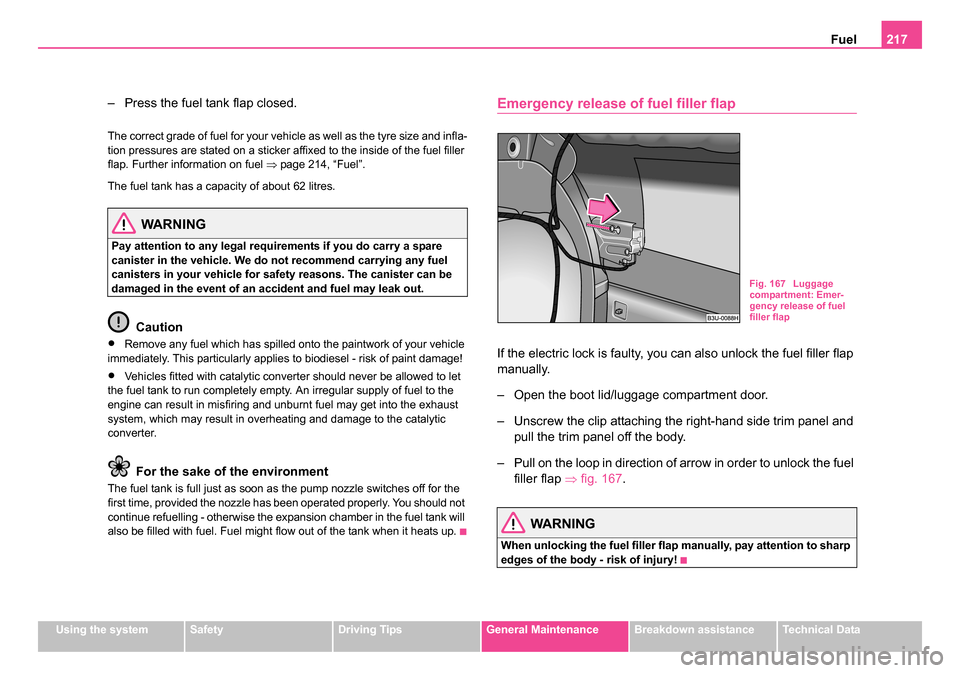
– Open the boot lid/luggage compartment door.
– Unscrew the clip attaching the right-hand side trim panel and
pull the trim panel off the body.
– Pull on the loop in direction of arrow in order to unlock the fuel filler flap ⇒fig. 167 .
WARNING
When unlocking the fuel filler flap manually, pay attention to sharp
edges of the body - risk of injury!
Fig. 167 Luggage
compartment: Emer-
gency release of fuel
filler flap
s3ec.book Seite 217 Montag, 2. Mai 2005 3:42 15
Page 226 of 281

Inspecting and Replenishing225
Using the systemSafetyDriving TipsGeneral MaintenanceBreakdown assistanceTechnical Data
Your Škoda dealer can also supply you with the correct coolant additives.
Caution
•Other coolant additives may cause operational problems which,
in particular, involves significantly reducing the anticorrosion effect.
•Any faults or problems resulting from corrosion may cause a loss
of coolant and, as a consequence of this, result in major engine
damage.
Inspecting the coolant level
The coolant expansion bottle is located in the engine compart-
ment on the left.
– Switch the engine off. – Open the bonnet
⇒ in “Working in the engine compart-
ment” on page 219.
– Check the level of coolant in the coolant expansion bottle ⇒fig. 172. The coolant level when the engine is cold must lie
between the “MIN” and “MAX” markings. The level may also
rise slightly above the “MAX” marking when the engine is
warm.
If the coolant level in the reservoir is too low, this is indicated by the
warning light in the instrument cluster ⇒ page 28. We nevertheless
recommend inspecting the coolant level directly at the reservoir from time
to time.
Loss of coolant
A loss of coolant is first and foremost an indication of a leak in the
system. You should not merely top up the coolant in the reservoir. It is also
important to have the cooling system inspected without delay by a
specialist garage.
Losses can only occur through the pressure relief in the cap of the coolant
expansion bottle which is completely free of leaks if the coolant boils as a
result of overheating and is forced out of the cooling system.
WARNING
Read and observe the warning notes ⇒page 219, “Working in the
engine compartment” before working in the engine compartment.
Caution
One should contact a specialist garage as soon as possible if the source
of overheating itself cannot be determined and removed, since there may
be grave damage to the engine.
Fig. 172 Engine
compartment: Coolant
expansion bottle
s3ec.book Seite 225 Montag, 2. Mai 2005 3:42 15