2005 SKODA SUPERB length
[x] Cancel search: lengthPage 196 of 281

Driving and the Environment195
Using the systemSafetyDriving TipsGeneral MaintenanceBreakdown assistanceTechnical Data
Shifting gears and saving energy
Shifting up early saves on fuel.
Manual gearbox
– Drive no more than about one length of your vehicle in first
gear. Always shift up into the next higher gear at approx. 2 000
to 2 500 revs.
Automatic gearbox
– Depress the accelerator pedal slowly. Do not depress it
beyond the kickdown position, however.
An effective way of achieving good fuel economy is to shift up early. You
will consume more fuel if you drive at unnecessarily high revolutions in
any given gear. The
⇒fig. 162 shows the ratio of fuel consumption to the speed of your
vehicle for the individual gears. Fuel consumption in 1st gear is the
highest, while that in 5th or the 6th gear is the lowest.
Only depress the accelerator pedal slowly if your vehicle is fitted with an
automatic gearbox in order to automatically select an economic driving
programme. You will achieve good fuel economy by shifting up early and
shifting down late. This applies in particular if you make use of the manual
mode (Tiptronic) for shifting gears.
Note
Also use the information supplied by the multi-functional indicator
⇒ page 18.
Avoiding full throttle
Driving more slowly means saving fuel.
Fig. 162 Fuel
consumption in
litres/100 km. and
speed in km/h.
Fig. 163 Fuel
consumption in
litres/100 km. and
speed in km/h.
s3ec.book Seite 195 Montag, 2. Mai 2005 3:42 15
Page 197 of 281

Driving and the Environment
196
Sensitive use of the accelerator will not only significantly reduce fuel
consumption but also positively influence environmental pollution and
wear of your vehicle.
You should avoid fully exploiting the top speed of your vehicle wherever
possible. Fuel consumption, pollutant emissions and vehicle noises
increase disproportionally at high speeds.
The ⇒page 195, fig. 163 shows the ratio of fuel consumption to the
speed of your vehicle. You will cut your fuel consumption by half if you only
make use three-quarters of the possible top speed of your vehicle.
Reducing idling
Idling also costs fuel.
It is worthwhile switching off the engine in a traffic jam or when waiting at
a level crossing or at traffic lights with a lengthy red phase. Even after just
30 - 40 seconds you will have saved more fuel than that is needed when
you start the engine up again.
If an engine is only idling it takes much longer for it to reach its normal
operating temperature. Wear-and-tear and pollutant emissions, though,
are particularly high in the warming-up phase. This is why you should
drive off right after starting the engine. Do avoid high engine revolutions
at this time, however.
Regular servicing
A poorly tuned engine consumes an unnecessarily high
amount of fuel.
Having your vehicle serviced regularly at a specialist garge enables you
to satisfy one of the requirements for economical motoring even before
you set off on your journey. Keeping your vehicle properly serviced not
only has a positive effect on the safety of your vehicle and maintaining its
value, but also saves on fuel.
A poorly tuned engine can result in a fuel consumption which is 10%
higher than normal.
The foreseen maintenance work should be undertaken exactly according
to the Service schedule by a specialist garage.
Also check the oil level after refueling. Oil consumption is dependent to
a considerable extent on the load and speed of the engine. Oil consump-
tion could be as high as 0.5 litres/1 000 km depending on your style of
driving.
It is quite normal that a new engine has a higher oil consumption at first,
and reaches its lowest level only after a certain running in time. It is there-
fore not possible to correctly assess the oil consumption of a new vehicle
until after you have driven about 5 000 km.
For the sake of the environment
•You can achieve additional improvements in your fuel economy by
using high-lubricity oils.
•Check the ground below your car at regular intervals to detect any
leakages in good time. Please have your vehicle inspected by a specialist
garge if you find any stains caused by oil or other fluids on the floor.
s3ec.book Seite 196 Montag, 2. Mai 2005 3:42 15
Page 203 of 281
Towing a trailer
202
time before negotiating a downhill section to allow the engine to also act
as a brake.
Engine overheating
Please keep a check on the coolant temperature gauge if you have to
negotiate a lengthy slope in a low gear at a high engine speed when the
outside temperature is very high ⇒page 14.
If the needle of the coolant temperature gauge moves into the right-hand
area or even the red area of the scale, reduce your speed immediately.
Stop and switch off the engine if the warning light
in the instrument
cluster begins flashing. Wait a few minutes and check the level of coolant
in the coolant expansion bottle ⇒page 225, “Inspecting the coolant level”.
Please refer to the following guidelines ⇒page 32, “Coolant temperature,
Coolant quantity ”.
The coolant temperature can be reduced by switching on the heating.
Any increase in the cooling effect of the coolant fan through shifting down
a gear and increasing the engine speed is not possible since the fan
speed is independent of the engine speed. One should also not drop a
gear for this reason when towing a trailer as long as the engine can
manage the slope without any drop in speed.
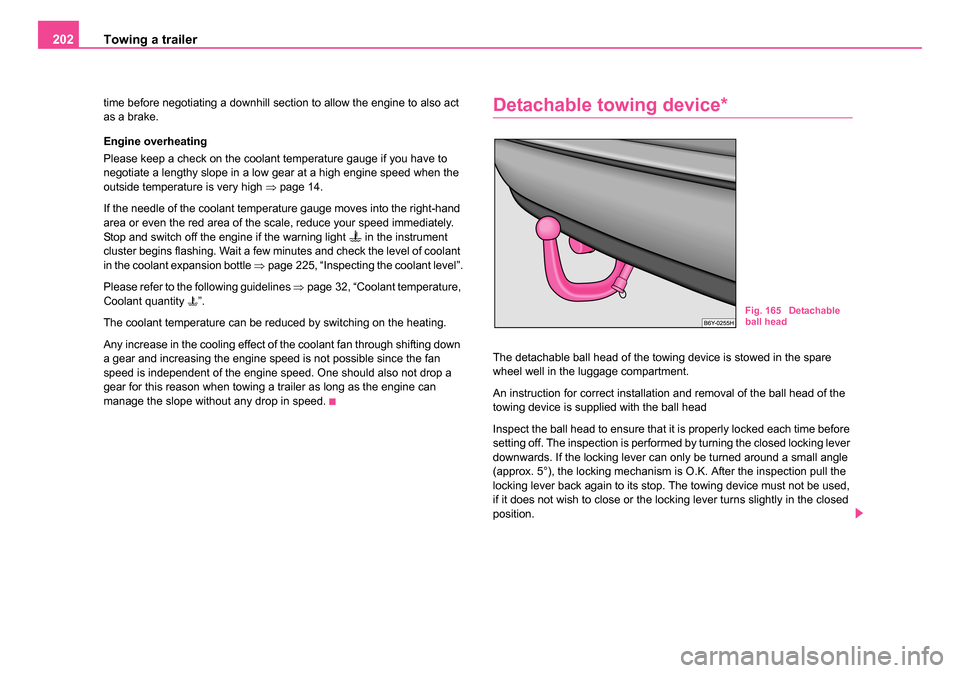
Detachable towing device*
The detachable ball head of the towing device is stowed in the spare
wheel well in the luggage compartment.
An instruction for correct installation and removal of the ball head of the
towing device is supplied with the ball head
Inspect the ball head to ensure that it is properly locked each time before
setting off. The inspection is performed by turning the closed locking lever
downwards. If the locking lever can only be turned around a small angle
(approx. 5°), the locking mechanism is O.K. After the inspection pull the
locking lever back again to its stop. The towing device must not be used,
if it does not wish to close or the locking lever turns slightly in the closed
position.
Fig. 165 Detachable
ball head
s3ec.book Seite 202 Montag, 2. Mai 2005 3:42 15
Page 213 of 281

Taking care of your vehicle and cleaning the vehicle
212
– Remove fresh stains on a fat base (e.g. butter, mayonnaise,
chocolate etc.) with an absorbent cloth or household cleaning
paper or with the cleaner from the care set if the stain has not
yet penetrated into the surface.
– Use a grease dissolver for grease stains which have dried
in .
–Eliminate special stains (e.g. ball-point pens, felt pen, nail
varnish, dispersion paint, shoe cream etc.) with a special stain
remover suitable for leather.
Leather care
– Treat the leather every six months with the leather care product available from Škoda dealers.
– Apply only a small amount of the care product.
– Dry the leather off with a soft cloth
It is best to consult your Škoda dealer if you have any questions regarding
cleaning and care of the leather interior.
Caution
•You must on no account treat the leather with solvents (e.g. gasoline,
turpentine), floor wax, shoe cream or such like.
•Avoid leaving your vehicle for lengthy periods in bright sunlight in order
to avoid bleaching the leather. If you leave your vehicle parked in the open
for lengthy periods, protect the leather from the direct rays of the sun by
covering it over.
•Sharp-edged objects on items of clothing such as zip fasteners, rivets,
sharp-edged belts may leave permanent scratches or signs of rubbing on
the surface.
Note
•Use a care cream with light blocker and impregnation effect regularly
and each time after cleaning the leather. The cream nourishes the leather,
allows it to breathe and keeps it supple and also provides moisture. It also
creates surface protection.
•Clean the leather every 2 to 3 months, remove fresh soiling each time
this occurs.
•Remove fresh stains such as those from ball-point pens, ink, lipstick,
shoe cream etc., as quickly as possible.
•Care also for the leather dye. Refreshen areas which have lost their
colour with a special coloured leather cream as required.
Alcantara upholstery
Do not use any leather care products for cleaning Alcantara upholsteries.
Eliminating dust and dirt
Wipe the Alcantara upholstery with a slightly moistened, soft cloth or clean
the covers with a suitable shampoo.
Removing stains
Moisten a soft cloth with lukewarm water or diluted methylated spirits and
dab the stain from the edges toward the middle.
Caution
•Do not use any leather care product on the Alcantara upholsteries.
•Avoid leaving your vehicle for lengthy periods in bright sunlight in order
to avoid bleaching the Alcantara upholsteries. If you leave your vehicle
parked in the open for lengthy periods, protect the Alcantara upholstery
from the direct rays of the sun by covering it over.
s3ec.book Seite 212 Montag, 2. Mai 2005 3:42 15
Page 223 of 281

Inspecting and Replenishing
222
Note
•Before a long drive we recommend that you purchase and carry with
you engine oil which complies with the specification for your vehicle.
Consequently, you will always have the correct engine oil for refilling.
•We recommend using a preservative from the Škoda original accesso-
ries offered by your Škoda dealer.
•For further information - see Service shedule.
Inspecting the engine oil level
The dipstick indicates the level of oil in the engine.
Checking the oil level
– Park the vehicle on a horizontal surface.
– Switch the engine off. – Open the bonnet
⇒ in “Working in the engine compart-
ment” on page 219.
– Wait a few minutes and pull out the oil dipstick.
– Wipe off the dipstick with a clean cloth and insert it again fully.
– After this, once again withdraw the dipstick and read off the oil level ⇒fig. 171 .
Oil level within range
– You must not top up the oil.
Oil level within range
–You may top up the oil. It is possible that the oil level may then
be within range after doing this.
Oil level within range
–You must top up the oil ⇒page 223. It is sufficient, once this
is done, to keep the oil level is within range .
It is normal for the engine to consume oil. The oil consumption may be as
much as 0.5 l/1 000 km depending on your style of driving and the condi-
tions under which you operate your vehicle. The oil consumption may be
slightly higher than this during the first 5 000 kilometres.
One should therefore check the oil level at regular intervals, preferably
every time after the fuel tank is filled or after driving for long stretches.
We recommend maintaining the oil level within the range if the engine
has been operating at high loads, for example during a lengthy motorway
trip during the summer months, towing a trailer or negotiating a high
mountain pass, but not above this .
Fig. 171 Dipstick
Aa
Ab
Aa
Ac
Ab
Aa
s3ec.book Seite 222 Montag, 2. Mai 2005 3:42 15
Page 241 of 281

Wheels and Tyres
240
Wheel bolts
Wheels and wheel bolts are matched to each other in terms of design.
Each time you fit other wheels - e.g. light alloy wheels or wheels with
winter tyres - you must therefore also use the matching wheel bolts of the
correct length and shape of spherical cap. This is essential to ensure that
the wheels are tightly fitted and that the brake system operates properly.
If you retrofit wheel trims (or have this done), please also ensure that an
adequate flow of air remains assured for cooling the brake system.
Škoda dealers are instructed in the technical possibilities which exist
regarding converting or retrofitting wheels, tyres and wheel trim.
WARNING
•In case of incorrect treatment of the wheel bolts, the wheel can
loosen when the car is moving - risk of accident!
•The wheel bolts must be clean and must turn easily. However,
they must never be treated with grease or oil.
•If the wheel bolts are tightened to a too low tightening torque,
the rim can lossen when the car is moving - risk of accident! A tight-
ening torque which is too high can damage the bolts and threads
and this can result in perman ent deformation of the contact
surfaces on the rims.
Caution
The prescribed tightening torque of the wheel bolts for steel and light alloy
wheels is 120 Nm.
Winter tyres
The handling of your vehicle will be significantly improved when driving on
wintry roads and at temperatures below 7 °C if you fit winter tyres.
Summer tyres do not offer the same grip on ice and snow at a temperature
below 7 °C because of their construction (width, rubber blend, tread
pattern). This applies in particular to vehicles which are equipped with
low-profile tyres or high-speed tyres (code index V, W or Y on wall of
tyre).
Winter tyres must be mounted on all four wheels to obtain the best
handling characteristics.
You must only fit those types of winter tyre which are approved for your
vehicle. The permissible sizes of winter tyres are stated in your vehicle
documents. Approvals may differ because of national legislation.
Please remember that the tyres should be inflated to 20 kPa (0.2 bar)
more than is the case for summer tyres ⇒page 236.
Winter tyres no longer offer the same winter performance once the tyre
tread has worn down to a depth of about 4 mm.
Ageing also causes winter tyres to lose most of their winter performance
properties - even in cases where the remaining tread depth is still clearly
more than 4 mm.
Speed restrictions apply to winter tyres as well as to summer tyres
⇒ page 238, ⇒ .
You can fit winter tyres of a lower speed category to your vehicle provided
that you also do not drive faster than the permissible maximum speed for
such tyres, even if the possible maximum speed of your vehicle is higher.
The corresponding tyre category can damage the tyres when exceeding
the permissible maximum speed.
Please pay attention to the notes if you decide to fit winter tyres
⇒ page 235.
s3ec.book Seite 240 Montag, 2. Mai 2005 3:42 15