2005 SKODA OCTAVIA lock
[x] Cancel search: lockPage 270 of 315

Wheels and Tyres269
Using the systemSafetyDriving TipsGeneral MaintenanceBreakdown assistanceTechnical Data
important on wet roads. Please refer to the notes
⇒page 275, “Spare
wheel”.
You should have the defective tyre replaced as soon as possible and
restore the correct direction of rotation on all tyres
Snow chains
Snow chains must only be mounted on the front wheels.
When driving on wintry roads, snow chains improve not only traction, but
also the braking performance.
For technical reasons, it is only permissible to fit snow chains with the
following wheel/tyre combinations:
Only use fine-link snow chains . They must not project more than 15 mm
- including the chain lock.
Remove the full wheel trims if you wish to fit snow chains to the wheels.
Observe the national legal requirements relating to the maximum vehicle
speed with snow chains.
WARNING
Please pay attention to the information in the supplied fitting
instructions of the snow chain manufacturer.
Caution
You must take the chains off as soon as you drive on roads which are free
of snow. They adversely affect the handling of your vehicle, damage the
tyres and are rapidly destroyed.
Note
We recommend that you use snow chains from the Škoda genuine
accessories.
Wheel sizeDepth (D)Tyre size
6J x 1547 mm195/65
6.5J x 1550 mm195/65
6J x 1650 mm205/55
s24s.book Page 269 Thursday, November 24, 2005 12:27 PM
Page 275 of 315

Breakdown assistance
274
compartment. You can open the compartment by turning the locks in the
direction of arrow ⇒fig. 203 .
If you wish to equip your vehicle additionally with a warning triangle,
please contact a specialist garage.
Note
Pay attention to the use-by-date of the contents of the first-aid box.
Fire extinguisher*
The fire extinguisher is attached with straps in a holder under the driver
seat.
Please read carefully the instructions which are attached to the fire
extinguisher.
The fire extinguisher must be checked by an authorised person or
company annually (please observe the differing legal equirements).
WARNING
If the fire extinguisher is not correctly attached, in case of sudden
manoeuvres or an accident it can be “thrown” through the interior
compartment and cause injuries.
Note
•The fire extinguisher must comply with the relevant and valid legal
requirements.
•Pay attention to the expiration date of the fire extinguisher. If the fire
extinguisher is used after the expiration date, its proper function is no
longer assured.
•The fire extinguisher is only supplied in certain countries within the
scope of delivery.
Vehicle tool kit
The vehicle tool kit and the lifting jack are stored in a locable box in the
spare wheel ⇒fig. 204 . There is also space here for the removable ball for
the trailer towing device*. The box is attached with a strap on the spare
wheel.
The vehicle tool kit contains the following parts (depending on equipment
fitted):
•Hook for pulling off a full wheel trim,
•Plastic clip for a wheel bolt cover,
•Wheel wrench,
•Towing eye,
Fig. 204 Luggage
compartment: Storage
compartment for
vehicle too kit
s24s.book Page 274 Thursday, November 24, 2005 12:27 PM
Page 276 of 315
Breakdown assistance275
Using the systemSafetyDriving TipsGeneral MaintenanceBreakdown assistanceTechnical Data
•Adapter for the wheel bolts lock,
After using the lifting jack, screw in the arm of the lifting jack fully before
placing it back in its stowage area.
WARNING
•The factory-supplied lifting jack is only intended for your model
of vehicle. On no account attempt to lift a heavier vehicle or other
loads - risk of injury!
•Ensure that the vehicle tool kit is safely attached in the luggage
compartment.
Note
Ensure that the box is always secured with the strap.
Tyre repair kit*
The tyre repair kit is intended for the repair of minor tyre defects. The tyre
repair kit contains a compressor, inflation bottle, operating instructions
and accessories.
The repair with the tyre repair kit is not at all intended to replace a
permanent repair on the tyre, this repair only serves to reach the next
specialist garage. The repair can be undertaken on the vehicle immedi-
ately. Please read the attached instructions carefully before the
repair.
The tyre repair kit is located in a well under the floor covering in the
luggage compartment.
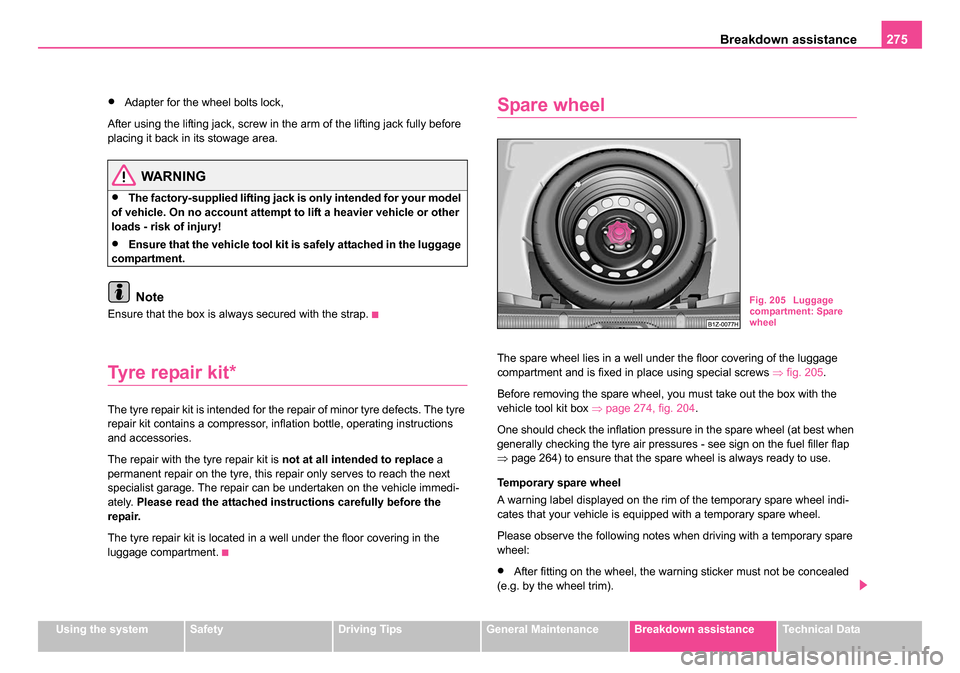
Spare wheel
The spare wheel lies in a well under the floor covering of the luggage
compartment and is fixed in place using special screws ⇒fig. 205 .
Before removing the spare wheel, you must take out the box with the
vehicle tool kit box ⇒page 274, fig. 204 .
One should check the inflation pressure in the spare wheel (at best when
generally checking the tyre air pressures - see sign on the fuel filler flap
⇒ page 264) to ensure that the spare wheel is always ready to use.
Temporary spare wheel
A warning label displayed on the rim of the temporary spare wheel indi-
cates that your vehicle is equipped with a temporary spare wheel.
Please observe the following notes when driving with a temporary spare
wheel:
•After fitting on the wheel, the warning sticker must not be concealed
(e.g. by the wheel trim).
Fig. 205 Luggage
compartment: Spare
wheel
s24s.book Page 275 Thursday, November 24, 2005 12:27 PM
Page 277 of 315

Breakdown assistance
276
•Do not drive with this spare wheel at more than 80 km/h - risk of acci-
dent. Avoid accelerating at full throttle, sharp braking and fast cornering.
•The inflation pressure for this spare wheel is identical to the inflation
pressure of the standard tyres. The temporary spare wheel R 18 must
have an inflation pressure of 420 kPa (4.2 bar)!
•Use this spare wheel only to reach the nearest specialist garage as it
is not intended for continuous use.
•No other summer or winter tyres must be mounted on the rim of the
spare wheel R 18.
Changing a wheel
Preliminary work
The following steps should be carried out before actually
changing the wheel.
– If it is necessary to change a wheel, park the vehicle as far away as possible from the traffic flow. The place you choose
should be level.
–Have all the occupants get out. While changing a wheel, the
occupants of the vehicle should not stand on the road (it is
better behind a crash barrier).
– Apply the handbrake firmly.
– Engage 1st gear or if your vehicle is fitted with an automatic
gearbox, position the selector lever into position P .
– If a trailer is coupled, uncouple it. – Take the
vehicle tool kit ⇒ page 274 and the spare wheel
⇒ page 275 out of the luggage compartment.
WARNING
•If you find yourself in flowing traffic switch on the hazard
warning lights system and place the warning triangle on the side of
the road at the prescribed distance from your vehicle while
observing all national legal provisions. In this way you are
protecting not only yourself but also other road users.
•Never start the engine with the vehicle sitting on the raised jack
- danger of suffering injury!
Caution
If you have to change a wheel on a slope first block the opposite wheel
with a stone or similar object in order to secure the vehicle from unexpect-
edly rolling away.
Note
Comply with the national legal regulations.
Changing a wheel
Always change a wheel on a level surface as far as possible.
– Take off the full wheel trim* ⇒page 278 or the caps
⇒ page 278.
– In the case of light alloy wheels remove the wheel trim cap ⇒page 279.
s24s.book Page 276 Thursday, November 24, 2005 12:27 PM
Page 279 of 315

Breakdown assistance
278
Full wheel trim*
Removing
– Hook the clamp found in the vehicle tool kit into the reinforced
edge of the full wheel trim.
– Push the wheel key through the clamp, support the wheel key on the tyre and pull off the wheel trim ⇒fig. 206.
Installing
– First press the full wheel trim onto the wheel at the valve opening provided. Then press the full wheel trim into the
wheel in such a way that its entire circumference locks
correctly in place. Caution
•Use the pressure of your hand, do not knock on the full wheel trim!
Heavy knocks mainly on the points where the full wheel trim has not been
inserted into the wheel, can result in damage to the guide and centering
elements of the full wheel trim.
•First check for yourself that the theft-deterrent wheel bolt is located
⇒ page 281, “Securing wheels against being stolen*” in the hole in the
area of the valve before fitting the full wheel trim onto a steel wheel which
is attached with a theft-deterrent wheel bolt.
Wheel bolts with caps*
Removing
– Push the plastic clip sufficiently far onto the cap until the inner catches of the clip are positioned at the collar of the cap and
detach the cap.
Fig. 206 Removing the
full wheel trim
Fig. 207 Removing the
cap.
s24s.book Page 278 Thursday, November 24, 2005 12:27 PM
Page 281 of 315

Breakdown assistance
280
WARNING
Slacken the wheel bolts only a little (about one turn) as long as the
vehicle has not yet been jacked up - risk of an accident!.
Note
apply pressure carefully with your foot to the end of the wheel wrench if it
proves difficult to slacken the wheel bolts. Hold tight on the vehicle when
doing this and ensure that you have a steady position.
Raise vehicle
You have to raise the vehicle with a lifting jack in order to
be able to take off the wheel.
Position the lifting jack by selecting the jacking point which is
closest to the wheel to be removed ⇒fig. 210 . The jacking point is located directly below the engraving in the lower sill. The
engraving is only visible after opening the door.
– Position the lifting jack below the jacking point and move it up
until its claw is positioned directly below the vertical web of the
lower sill.
– Align the car jack so that its claw grasps the web of the lower sill and the base plate is resting flat on the floor.
– Turn the lifting jack up further until the wheel is just clear of the ground.
Ground below the lifting jack which is soft and slippery can cause the
vehicle to slip off the jack. It is therefore always necessary to place the
lifting jack on a solid surface or use a wide and stable base. Use a non-
slip base (e.g. a rubber foot mat) if the surface is smooth, such as
cobbled stones, a tiled floor,etc.
WARNING
•Always raise the vehicle with the doors closed - risk of injury!
•Take suitable measures to prevent the base of the lifting jack
from slipping off - risk of injury!
•Not positioning the lifting jack at the specified points can result
in damage to the vehicle. The jack can also slip off if it does not
have sufficient grip - risk of injury!
•It is important to support the ve hicle with suitable supporting
blocks if you wish to work under the lifted vehicle - risk of injury!Fig. 210 Changing a
wheel: Points for posi-
tioning car jack
AAAB
s24s.book Page 280 Thursday, November 24, 2005 12:27 PM
Page 283 of 315

Breakdown assistance
282
Both batteries must have a rated voltage of 12 V. The capacity (Ah) of the
battery supplying the power must not be significantly less than the
capacity of the discharged battery in your vehicle.
Jump-start cables
Only use jump-start cables which have an adequately large cross-section
and insulated terminal clamps. Please pay attention to the manufacturer's
instructions.
Positive cable - colour coding in the majority of cases red.
Negative cable - colour coding in the majority of cases black.
WARNING
•A discharged battery may already freeze at temperatures just
below 0°C. In case of frozen battery carry out no jump-starting - risk
of explosion!
•Please pay attention to the warning instructions relating to
working in the engine compartment ⇒page 248.
Note
•There must not be any contact between the two vehicles otherwise
current may flow as soon as the negative terminals are connected.
•The discharged battery must be properly connected to the system of
the vehicle.
•Switch off any mobile phone, pay attention to the instructions for use
of the mobile phone in such a situation.
•We recommend purchasing jump-start cables from a Škoda dealer as
a Škoda original accessory or from retailers who sell branded batteries.
Starting engine
It is important to connect the jump-start cables in the correct
order:
Connecting positive terminals
– Attach one end to the positive terminal ⇒fig. 212 of the
discharged battery .
– Attach the other end to the positive terminal of the battery supplying the power .
Connecting negative terminal and engine block
– Attach one end to the negative terminal of the battery supplying the power .
Fig. 212 Jump-starting
using the battery from
another vehicle: A - flat
vehicle battery, B -
battery providing
current
A1
AA
A2
AB
A3
AB
s24s.book Page 282 Thursday, November 24, 2005 12:27 PM
Page 284 of 315

Breakdown assistance283
Using the systemSafetyDriving TipsGeneral MaintenanceBreakdown assistanceTechnical Data
– Attach the other end to a solid metal part which is
connected firmly to the engine block, or to the engine block
itself.
Starting engine
– Start the engine of the vehicle providing current and run the engine at idling speed.
– Now start the engine of the vehicle with the discharged battery.
– Interrupt the attempt at starting an engine after 10 seconds if it does not start right away and wait for about 30 seconds
before repeating the attempt.
– Disconnect the cables on the engine in exactly the reverse
order they were connected up.
WARNING
•The non-insulated parts of the terminal clamps must never
make contact with each other. Furthermore, the cable connected to
the positive terminal of the battery must not come into contact with
electrically conducting parts of the vehicle - risk of a short circuit!
•Do not affix the jump starting cables to the negative terminal of
the discharged battery. There is the risk of detonating gas seeping
out the battery being ignited by the strong spark which results from
the engine being started.
•Run the jump-start cables so that they cannot be caught by any
rotating parts in the engine compartment.
•Do not bend over the batteries - risk of caustic burns!
•The vent screws of the battery cells must be tightened firmly.
•Keep any sources of ignition (naked flame, smouldering ciga-
rettes etc.) away from the battery - risk of an explosion!
Tow-starting and towing vehicle
General
Please pay attention to the following instructions if you are going
to use a tow rope:
Driver of the towing vehicle
– Do not drive off until the tow rope is taught.
– Release the clutch particularly gently when starting off or depress the accelerator particularly gently if your vehicle is
fitted with an automatic gearbox.
Driver of the towed vehicle
– Switch the ignition on so that the steering wheel is not blocked and you can also operate the turn signal lights, the headlight
flasher, the windscreen wipers and windscreen washer
system.
– Take the vehicle out of gear or move the selector lever into position N if your vehicle is fitted with an automatic gearbox.
A4WARNING (continued)
s24s.book Page 283 Thursday, November 24, 2005 12:27 PM