2005 SKODA FABIA low beam
[x] Cancel search: low beamPage 104 of 260

Starting-off and Driving103
Using the systemSafetyDriving TipsGeneral MaintenanceBreakdown assist-
anceTechnical DataFabia Praktik
the steering wheel firmly in the 12 o'clock position or in another
way (e.g. in the middle of the steering wheel or at the inner steering
wheel edge). In such cases, injuries to the arms, the hands and the
head can occur when the driver airbag is deployed.
Ignition lock
Petrol engines
- ignition switched off, engine off
- ignition switched on
- start engine
Diesel engines - fuel supply interrupted, ignition switched off, engine off - heating glow plugs on, ignition switched on
•You should not switch on any major electrical components during the
heating period otherwise the vehicle battery will be drained unnecessarily.
- start engine
Applies to all models:
Position
To lock the steering , with the ignition key withdrawn, turn the steering
wheel until the steering locking pin is heard to engage. You should always
lock the steering as a general rule if you leave your vehicle. This acts as
a deterrent against possible theft of your vehicle ⇒.
Position
Move the steering wheel back and forward a little if the ignition key cannot,
or cannot easily be turned into this position, in order to release the
steering lock.
Position
The engine is started in this position. At the same time switched on low
beam or main beam or other electrical components with major power
consumption are briefly switched off. The ignition key moves back into
position when one releases the key.
The ignition key must be turned back into position each time before
starting the engine again. The starter repeat lock in the ignition lock
prevents the starter being engaged when the engine is running and thus
getting damaged.
Ignition key withdrawal lock (automatic gearbox)
You can only withdraw the ignition key after switching off the ignition if the
selector lever is in position P.WARNING (continued)
Fig. 91 Ignition lock
positions
A1
A2
A3
A1
A2
A3
A1
A2
A3
A2
A1
sqc.1.book Seite 103 Mittwoch, 13. April 2005 1:09 13
Page 172 of 260

Driving and the Environment171
Using the systemSafetyDriving TipsGeneral MaintenanceBreakdown assist-
anceTechnical DataFabia Praktik
Motoring abroad
General
Other circumstances may exist abroad.
It is also possible, in certain countries, that the Škoda dealership network
is limited or has not been established yet. This is the reason why obtaining
certain spare parts may be somewhat complicated and specialist garage
personnel may only be able to make limited repairs. Škoda Auto in the
Czech Republic and relevant importers are happy to provide information
about technical aspects of the vehicle, required maintenance work and
possibilities for getting repairs done.
Unleaded petrol
A vehicle fitted with a petrol engine must always be refuelled with
unleaded petrol ⇒page 165. The automobile associations can provide
you with information regarding the locations of filling stations which offer
unleaded petrol.
Headlights
The low beam of your headlights is set asymmetrically. It illuminates the
side of the road on which you are driving to a greater extent. If you drive
abroad on the other side of the road, you will dazzle oncoming traffic.
It is necessary in order to avoid dazzling oncoming traffic to stick a sticker
over a certain part of the headlights.
Windscreen wiper stickers are available at Škoda dealers. Headlights with Xenon lamps are designed for driving in countries with
traffic on the right or on the left. Have this done always at a Škoda dealer.
Note
You can obtain further information regarding masking over or converting
the headlights from your Škoda dealer.
Avoiding damage to your vehicle
When driving on poor roads and lanes or when driving over kerbstones,
steep ramps etc., you must pay particular attention to ensuring that any
low-slung parts of the vehicle, such as spoiler and exhaust, do not touch
the ground and get damaged.
This particularly applies to models with a lowered suspension (sport
suspension) and also when your vehicle is fully laden.
sqc.1.book Seite 171 Mittwoch, 13. April 2005 1:09 13
Page 174 of 260

Towing a trailer173
Using the systemSafetyDriving TipsGeneral MaintenanceBreakdown assist-
anceTechnical DataFabia Praktik
Distribution of the load
Distribute the load in the trailer in such a way that any heavy items are
located as close as possible to the axle. Secure the items to prevent them
slipping.
Tyre pressure
Correct the tyre inflation pressure on your vehicle for that of “fully laden”,
⇒
page 209. The inflation pressure of the tyres fitted to the trailer adjust
in accordance with the manufacturer's recommendation.
Exterior mirrors
You have to have additional exterior mirrors fitted if you are not able to see
the traffic behind the trailer with the standard rear-view mirrors. Both exte-
rior mirrors should be attached to folding arms. Adjust the mirrors so that
they provide you with an adequate field of view to the rear.
Headlights
Before starting off with a hitched trailer, also check the setting of the head-
lights. Alter the setting as necessary with the aid of the headlight beam
adjuster ⇒page 57.
Detachable ball head
The ball rod is detachable on vehicles which feature a factory-fitted towing
device. It is stowed together with separate fitting instructions in the spare
wheel well in the luggage compartment of the vehicle.
Further information on the towing device ⇒page 174.
Note
•We recommend that you also have your vehicle inspected between
service intervals if you tow a trailer frequently.
•The handbrake on the towing vehicle must be put on when coupling
and decoupling the trailer.
Driving Tips
Particular caution is required when towing a trailer.
– Do not, as far as possible, drive with your vehicle unladen and the trailer laden.
– Do not make full use of the legal maximum speeds. This applies in particular to downhill sections.
– Apply the brakes in good time.
– Keep a check on the coolant temperature gauge if the outside temperature is high.
Distribution of weight
The distribution of the weight is very poor if your vehicle is unladen and
the trailer is laden. Maintain a particularly low speed if you cannot avoid
driving with this combination.
Driving speed
Do not drive faster than 80 km/hour for safety reasons. This also applies
for countries in which higher speeds are allowed.
The fact that the driving stability of the vehicle + trailer combination
reduces with increasing speed means that the legally allowed speed
should not be used when there are unfavourable road, weather or wind
conditions, particularly near accident black spots.
You must always reduce your speed immediately as soon as you detect
even just the slightest swaying of the trailer. On no account attempt to
stop the trailer from “swaying” by accelerating.
Apply the brakes in good time! If the trailer is fitted with a trailer brake,
apply the brakes gently at first, then brake firmly. This will avoid brake jolts
resulting from the trailer wheels locking. Shift down gears in good time
sqc.1.book Seite 173 Mittwoch, 13. April 2005 1:09 13
Page 235 of 260

Fuses and light bulbs
234
10S-contact a)5
11Electrically adjustable rear mirror b)5
12Ventilation system, air-conditioning system, Xenon
headlight5
13Reversing light10
14Diesel engine control unit10
15Headlight cleaning system, window wiper10
16Instrument cluster5
17Petrol engine - control unit c)5
18Phone5
19Automatic gearbox10
20Control unit for lamp failure5
21Heated windscreen washer nozzles5
22Not assigned
23Right main beam10
24Engine electronics10
25Control unit for ABS, TCS
control unit for ESP5
10
26Not assigned
27Not assigned
28Cruise control, switch for the brake and clutch pedal5
29Not assigned
30Main beam on the left and indicator light10
31Central locking system - door lock for the boot lid10
No.Power consumerAmperes
32Rear window wiper10
33Parking light on the right5
34Parking light on the left5
35Injector - petrol engine10
36Licence plate light5
37Rear fog light and indicator light5
38Heating of the external mirror5
39Rear window heater20
40Horn20
41Front window wiper20
42Cigarette lighter, power socket15
43Central control unit, selector lever lock for the auto-
matic gearbox20
44Turn signals15
45Radio, navigation system20
46Electrical power window (at the front on the right)25
47Not assigned
48Diesel engine - control unit, injector30
49Central locking system15
50Low beam on the right15
51Power socket in the luggage compartment15
52Ignition15
53Electrical power window (at the rear on the right)25
54Low beam on the left15
No.Power consumerAmperes
sqc.1.book Seite 234 Mittwoch, 13. April 2005 1:09 13
Page 239 of 260

Fuses and light bulbs
238
Do not take hold of the glass bulb with naked fingers (even the smallest
amount of dirt reduces the working life of the light bulb). Use a clean cloth,
serviette or something similar.
Defect light bulbs should only be replaced with light bulbs of the same
type. The designation is located on the light socket or the glass bulb.
Changing certain bulbs is not something which you can do yourself, but
requires to be done by a specialist. Other parts of the vehcle must be
removed in order to change the light bulbs. This applies, in particular, to
bulbs which can only be reached from the engine compartment.
We therefore recommend that you have any bulbs changed by a Škoda
dealer or, in exceptional cases, by calling on other professional assist-
ance.
Please note that the engine compartment is a hazardous area
⇒ page 191, “Working in the engine compartment”.
We recommend that you carry the set of light bulbs with you which was
delivered in your vehicle. Replacement light bulbs
7) are available at
Škoda dealers.
The set of light bulbs can be stowed in the spare wheel well.
Fitted with a xenon headlight
Change of light bulbs on Xenon lights (low beam lights, parking lights and
main beam lights) should be undertaken by a Škoda dealer.
Overview of bulbs
7)Replacement light bulbs are, on the other hand, part of the basic equipping of the
vehicle in some countries.
Front headlightHalogen headlightXenon headlight
Low beamH7D2S
Main beamH3H7
Parking lightsW5W
Turn signalsPY21W
Fog lightsHB4
Rear light unitBulb
Reversing lightP21W
Turn signalsPY21W
Brake lightsP21W
Parking light and rear fog lightP21/4W
OthersBulb
Side turn signal lightsWY5W
Licence plate lightC5W
3. Brake lightLED
Interior lightC10W
Reading lightsW5W
Luggage compartment lightW5W
Door warning lightW5W
Storage compartment light - front pas-
senger sideC3W
sqc.1.book Seite 238 Mittwoch, 13. April 2005 1:09 13
Page 240 of 260
Fuses and light bulbs239
Using the systemSafetyDriving TipsGeneral MaintenanceBreakdown assist-
anceTechnical DataFabia Praktik
WARNING
•Bulbs H7 and H3 are pressurised and may burst when changing
the bulb - risk of injury!
•It is recommended to wear gloves and eye protection when
changing a light bulb.
•Gas discharge bulbs* (xenon bulbs) operate with a high voltage,
professional knowledge is required - danger to life!
Note
This Owner's Manual only describes the replacement of bulbs where it is
assumed that no major complications will arise. Other light bulbs should
be changed by your specialist garage.
Front headlight
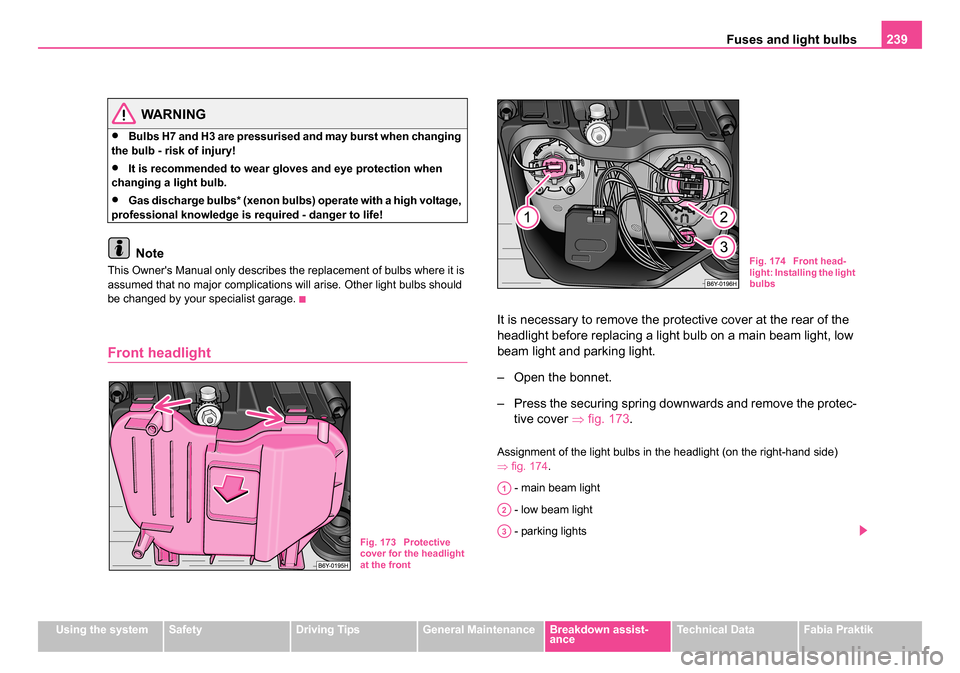
It is necessary to remove the protective cover at the rear of the
headlight before replacing a light bulb on a main beam light, low
beam light and parking light.
– Open the bonnet.
– Press the securing spring downwards and remove the protec- tive cover ⇒fig. 173 .
Assignment of the light bulbs in the headlight (on the right-hand side)
⇒fig. 174 .
- main beam light
- low beam light
- parking lights
Fig. 173 Protective
cover for the headlight
at the front
Fig. 174 Front head-
light: Installing the light
bulbs
A1
A2
A3
sqc.1.book Seite 239 Mittwoch, 13. April 2005 1:09 13
Page 241 of 260
Fuses and light bulbs
240
Note
For vehicles with a 2.0 litre/85 kW engine, we recommend that you have
the light bulbs for the main beam lights, low beam lights and parking lights
changed by a Skoda dealer.
Main beam
– Open the bonnet.
– Remove the protective cover at the rear of the headlight ⇒page 239, fig. 173 .
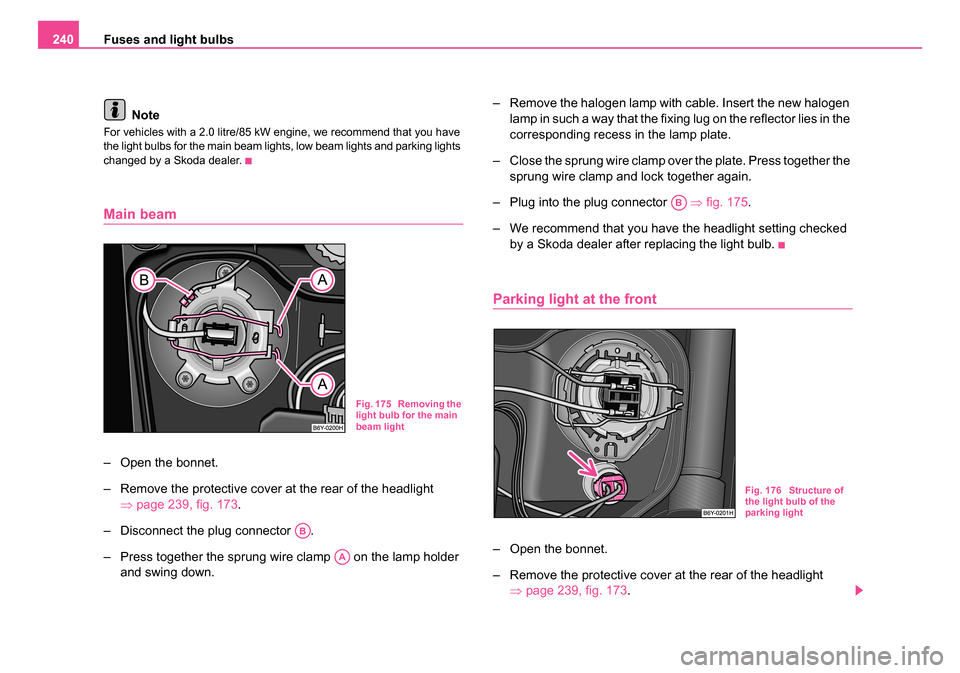
– Disconnect the plug connector .
– Press together the sprung wire clamp on the lamp holder and swing down. – Remove the halogen lamp with cable. Insert the new halogen
lamp in such a way that the fixing lug on the reflector lies in the
corresponding recess in the lamp plate.
– Close the sprung wire clamp over the plate. Press together the sprung wire clamp and lock together again.
– Plug into the plug connector ⇒fig. 175 .
– We recommend that you have the headlight setting checked by a Skoda dealer after replacing the light bulb.
Parking light at the front
– Open the bonnet.
– Remove the protective cover at the rear of the headlight ⇒page 239, fig. 173 .
Fig. 175 Removing the
light bulb for the main
beam light
AB
AA
AB
Fig. 176 Structure of
the light bulb of the
parking light
sqc.1.book Seite 240 Mittwoch, 13. April 2005 1:09 13
Page 242 of 260
Fuses and light bulbs241
Using the systemSafetyDriving TipsGeneral MaintenanceBreakdown assist-
anceTechnical DataFabia Praktik
– Pull the lamp holder with light bulb for the parking light out of
the headlight ⇒page 240, fig. 176.
– Pull the defect light bulb out of the lamp holder.
– Insert the new light bulb.
– Insert the lamp holder with new light bulb into of the headlight.
Low beam
– Open the bonnet.
– Remove the protective cover at the rear of the headlight ⇒page 239, fig. 173 .
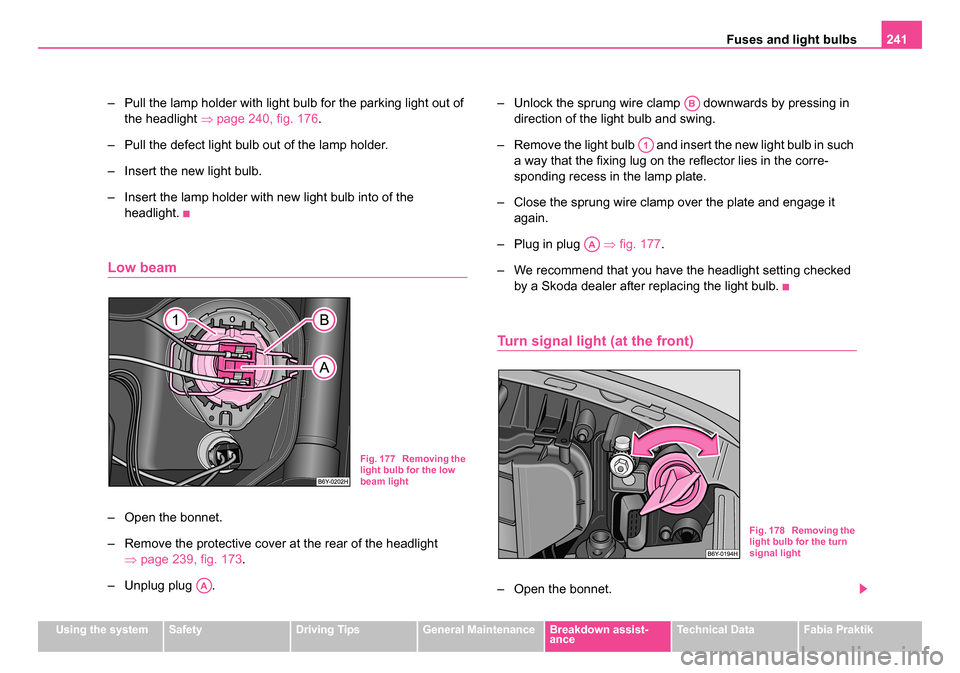
– Unplug plug . – Unlock the sprung wire clamp downwards by pressing in
direction of the light bulb and swing.
– Remove the light bulb and insert the new light bulb in such a way that the fixing lug on the reflector lies in the corre-
sponding recess in the lamp plate.
– Close the sprung wire clamp over the plate and engage it again.
– Plug in plug ⇒fig. 177.
– We recommend that you have the headlight setting checked by a Skoda dealer after replacing the light bulb.
Turn signal light (at the front)
– Open the bonnet.
Fig. 177 Removing the
light bulb for the low
beam light
AA
AB
A1
AA
Fig. 178 Removing the
light bulb for the turn
signal light
sqc.1.book Seite 241 Mittwoch, 13. April 2005 1:09 13