2005 SKODA FABIA lock
[x] Cancel search: lockPage 223 of 260

Breakdown assistance
222
– Stow and attach the replaced wheel in the spare wheel well.
– Stow the vehicle tool kit in the space provided.
–Check the tyre pressure on the spare wheel just mounted as
soon as possible.
– Have the tightening torque of the wheel bolts checked with
a torque wrench as soon as possible. The tightening torque for
steel and light alloy wheels must be 120 Nm.
– Have the defective tyre repaired as soon as possible.
WARNING
It is necessary to observe the guidelines given on ⇒page 211,
“New tyres and wheels” if the vehicle is subsequently fitted with
tyres which are different to those it was fitted with at the works.
Note
•If you find, when changing the wheel, that the wheel bolts are corroded
and difficult to turn, the bolts must be replaced before checking the tight-
ening torque.
•Drive cautiously and only at a moderate speed to a workshop where
the tightening torque can be checked.
Full wheel trim*
Removing
– Hook the clamp found in the vehicle tool kit into the reinforced edge of the full wheel trim.
– Push the wheel key through the clamp, support the wheel key on the tyre and pull off the wheel trim ⇒fig. 157 .
Installing
– First press the full wheel trim onto the wheel at the valve opening provided. Then press the full wheel trim into the
wheel in such a way that its entire circumference locks
correctly in place.
Fig. 157 Removing the
full wheel trim
sqc.1.book Seite 222 Mittwoch, 13. April 2005 1:09 13
Page 226 of 260

Breakdown assistance225
Using the systemSafetyDriving TipsGeneral MaintenanceBreakdown assist-
anceTechnical DataFabia Praktik
– Position the lifting jack by selecting the jacking point - lower sill
- which is closest to the wheel to be removed ⇒page 224,
fig. 161.
– Position the lifting jack below the jacking point and move it up until its claw is positioned directly below the vertical web of the
lower sill.
– Align the lifting jack so that its claw grasps the web of the lower sill and the moving base plate of the jack is resting flat
against firm ground.
– Turn the lifting jack up further until the wheel is just clear of the ground.
Ground below the lifting jack which is soft and slippery can cause the
vehicle to slip off the jack. It is therefore always necessary to place the
lifting jack on a solid surface or use a wide and stable base. Use a non-
slip base (e.g. a rubber foot mat) if the surface is smooth, such as
cobbled stones, a tiled floor,etc.
WARNING
•Always raise the vehicle with th e doors closed - risk of injury.
•Take suitable measures to prevent the base of the lifting jack
from slipping off - risk of injury!
•Place the lifting jack only on a solid and even surface.
•Not positioning the lifting jack at the specified points can result
in damage to the vehicle. The jack can also slip off if it does not
have sufficient grip - risk of injury!
•Never start the engine if the vehicle is lifted - risk of accident.
•Never lie under the vehicle if the vehicle is only lifted with the
vehicle lifting jack.
•It is important to support the vehicle with suitable supporting
blocks if you wish to work under the lifted vehicle - risk of injury!
Securing wheels against being stolen*
You need a special adapter for slackening the safety
wheel bolts.
– Pull off the full wheel trim/cap from the wheel hub or cap from the safety wheel bolt.
– Insert the adapter with its toothed side fully into the inner toothing of the safety wheel bolt right down in such a way
that only the outer hexagon is jutting out ⇒ fig. 162.
– Insert the wheel wrench fully onto the adapter .
AAAB
WARNING (continued)
Fig. 162 Safety wheel
bolt with adapter
AB
AA
AB
sqc.1.book Seite 225 Mittwoch, 13. April 2005 1:09 13
Page 228 of 260

Breakdown assistance227
Using the systemSafetyDriving TipsGeneral MaintenanceBreakdown assist-
anceTechnical DataFabia Praktik
•The discharged battery must be properly connected to the system of
the vehicle.
•Switch off any installed telephone and also pay attention to the instruc-
tions for use of the telephone in such a situation.
•We recommend purchasing jump-start cables from a Škoda dealer as
a Škoda original accessory or from retailers who sell branded batteries.
Starting engine
It is important to connect the jump-start cables in the correct
order.
Connecting positive terminals
– Attach one end to the positive terminal ⇒fig. 163 of the
discharged battery . – Attach the other end to the positive terminal of the battery
supplying the power .
Connecting negative terminal and engine block
– Attach one end to the negative terminal of the battery supplying the power .
– Attach the other end to a solid metal part which is connected firmly to the engine block, or to the engine block
itself ⇒ .
Starting engine
– Start the engine of the vehicle providing current and run the engine at idling speed.
– Now start the engine of the vehicle with the discharged battery.
– Interrupt the attempt at starting an engine after 10 seconds if it does not start right away and wait for about 30 seconds
before repeating the attempt.
– Disconnect the cables on the engine in exactly the reverse
order they were connected up.WARNING
•The non-insulated parts of the terminal clamps must never make
contact with each other. Furthermore, the cable connected to the
positive terminal of the battery must not come into contact with
electrically conducting parts of the vehicle - risk of a short circuit!
•Do not affix the jump starting cables to the negative terminal of
the discharged battery. There is the risk of detonating gas seeping
Fig. 163 Jump-starting
using the battery from
another vehicle: A - flat
vehicle battery, B -
battery providing
current
A1
AA
A2
AB
A3
AB
A4
sqc.1.book Seite 227 Mittwoch, 13. April 2005 1:09 13
Page 229 of 260

Breakdown assistance
228
out the battery being ignited by the strong spark which results from
the engine being started.
•Do not affix the cable end to parts of the fuel and brake
system.
•Run the jump-start cables so that they cannot be caught by any
rotating parts in the engine compartment.
•Do not bend over the batteries - risk of caustic burns!
•The vent screws of the battery cells must be tightened firmly.
•Keep any sources of ignition (naked flame, smouldering ciga-
rettes etc.) away from the battery - risk of an explosion!
Tow-starting and towing vehicle
General
Please pay attention to the following instructions if you are going
to use a tow rope:
Driver of the towing vehicle
– Do not drive off until the tow rope is taught.
– Release the clutch particularly gently when starting off or depress the accelerator particularly gently if your vehicle is
fitted with an automatic gearbox. Driver of the towed vehicle
– Switch the ignition on so that the steering wheel is not blocked
and you can also operate the turn signal lights, the headlight
flasher, the windscreen wipers and windscreen washer
system.
– Take the vehicle out of gear or move the selector lever into position N if your vehicle is fitted with an automatic gearbox.
– Note that the brake servo unit and power steering only operate if the engine is running. You will require significantly greater
physical force to depress the brake pedal and to steer the
vehicle if the engine is not running.
– Ensure that the tow rope is always kept taught.
Tow rope or tow bar
A tow bar is safest way of towing a vehicle and also minimizes any
shocks. You can use a tow rope only if a suitable tow bar is not available.
The tow rope must be elastic to protect the vehicle. Thus one should only
use plastic fibre rope or a rope made out of a similarly elastic material.
Attach the tow rope or the tow bar only to the towing eyes provided for
this purpose ⇒page 229, “Front towing eye” and ⇒ page 230, “Rear
towing eye”.
Driving style
Towing another vehicle requires a certain amount of practice. Both drivers
should be familiar with the particular points about towing a vehicle.
Unskilled drivers should not attempt to tow in another vehicle or to be
towed in.
One should be constantly vigilant not to allow impermissibly high towing
forces or jerky loadings. There is always a risk of excessive stresses and
WARNING (continued)
A4
sqc.1.book Seite 228 Mittwoch, 13. April 2005 1:09 13
Page 233 of 260

Fuses and light bulbs
232
Fuses and light bulbs
Electric fuses
Replacing fuses in the dash panel
Defect fuses must be replaced.
Individual electrical circuits are protected by fuses. The fuses are
located on the left side of the dash panel behind the safety cover.
– Switch the ignition off and also the electrical component
affected.
– Set the screwdriver under the safety cover (on the recess in the safety cover), lever it up carefully in the direction of the
arrow and take it out in the direction of the arrow
⇒fig. 167. – Find out which fuse belongs to the component which is not
operating ⇒page 233, “Fuse assignment in the dash panel”.
– Take the plastic clip out of its fixture in the fuse cover, insert it onto the respective fuse and pull out this fuse.
– Defect fuses can be detected by their melted metal strips. Replace the defect fuse by a new fuse of the same ampere
number.
– First shift the safety cover into the dash panel in the direction of arrow then press the safety cover in the direction of the
arrow in such a way that the guide lug locks into the
opening of the dash panel.
We recommend that you carry the box of replacement fuses with you
which was delivered in your vehicle. Replacement fuses 6) are available
at Škoda dealers.
Colour coding of fuses
Fig. 167 Left side of
the dash panel: fuse
cover
AAAB6)Replacement fuses are, on the other hand, part of the basic equipping of the ve-
hicle in some countries.
ColourMaximum amperage
light brown5
brown7,5
red10
blue15
AB
AA
sqc.1.book Seite 232 Mittwoch, 13. April 2005 1:09 13
Page 235 of 260

Fuses and light bulbs
234
10S-contact a)5
11Electrically adjustable rear mirror b)5
12Ventilation system, air-conditioning system, Xenon
headlight5
13Reversing light10
14Diesel engine control unit10
15Headlight cleaning system, window wiper10
16Instrument cluster5
17Petrol engine - control unit c)5
18Phone5
19Automatic gearbox10
20Control unit for lamp failure5
21Heated windscreen washer nozzles5
22Not assigned
23Right main beam10
24Engine electronics10
25Control unit for ABS, TCS
control unit for ESP5
10
26Not assigned
27Not assigned
28Cruise control, switch for the brake and clutch pedal5
29Not assigned
30Main beam on the left and indicator light10
31Central locking system - door lock for the boot lid10
No.Power consumerAmperes
32Rear window wiper10
33Parking light on the right5
34Parking light on the left5
35Injector - petrol engine10
36Licence plate light5
37Rear fog light and indicator light5
38Heating of the external mirror5
39Rear window heater20
40Horn20
41Front window wiper20
42Cigarette lighter, power socket15
43Central control unit, selector lever lock for the auto-
matic gearbox20
44Turn signals15
45Radio, navigation system20
46Electrical power window (at the front on the right)25
47Not assigned
48Diesel engine - control unit, injector30
49Central locking system15
50Low beam on the right15
51Power socket in the luggage compartment15
52Ignition15
53Electrical power window (at the rear on the right)25
54Low beam on the left15
No.Power consumerAmperes
sqc.1.book Seite 234 Mittwoch, 13. April 2005 1:09 13
Page 237 of 260

Fuses and light bulbs
236
– Press the interlocks of the fuse covers ⇒page 235,
fig. 170 and open the covers.
– Press simultaneouly the interlocks of the fuse cover and push out the cover in the direction of the arrow.
– Find out which fuse belongs to the relevant component ⇒page 236, “Fuse assignment at battery - version 1”, if
necessary ⇒page 237.
– Defect fuses can be detected by their melted metal strips. Replace the defect fuse by a new fuse of the same ampere
number.
Caution
•Never attempt to “repair” fuses and also do not replace them with a
fuse of a higher amperage - risk of fire! This may also cause damage at
another part of the electrical system.
•Have the electrical system checked as quickly as possible by a
specialist garage if a newly inserted fuse blows again after a short time.
Note
•We recommend that you have these fuses replaced by a specialist
garage.
•Some vehicles are only fitted with the cover ⇒page 235,
fig. 170 .
Fuse assignment at battery - version 1
Certain electrical components are only standard on certain vehicle model
versions or only suppliable as optional equipment for certain models.
AA
AB
AB
No.Power consumerAmperes
1Dynamo175
2Interior11 0
3The radiator fan40
4ABS or TCS or ESP40
5Power steering50
6Glow plugsa)50
7ABS or TCS or ESP25
8The radiator fan30
9The air conditioning system5
Fig. 171 Schematic
representation of fuse
assignment at battery
sqc.1.book Seite 236 Mittwoch, 13. April 2005 1:09 13
Page 241 of 260
Fuses and light bulbs
240
Note
For vehicles with a 2.0 litre/85 kW engine, we recommend that you have
the light bulbs for the main beam lights, low beam lights and parking lights
changed by a Skoda dealer.
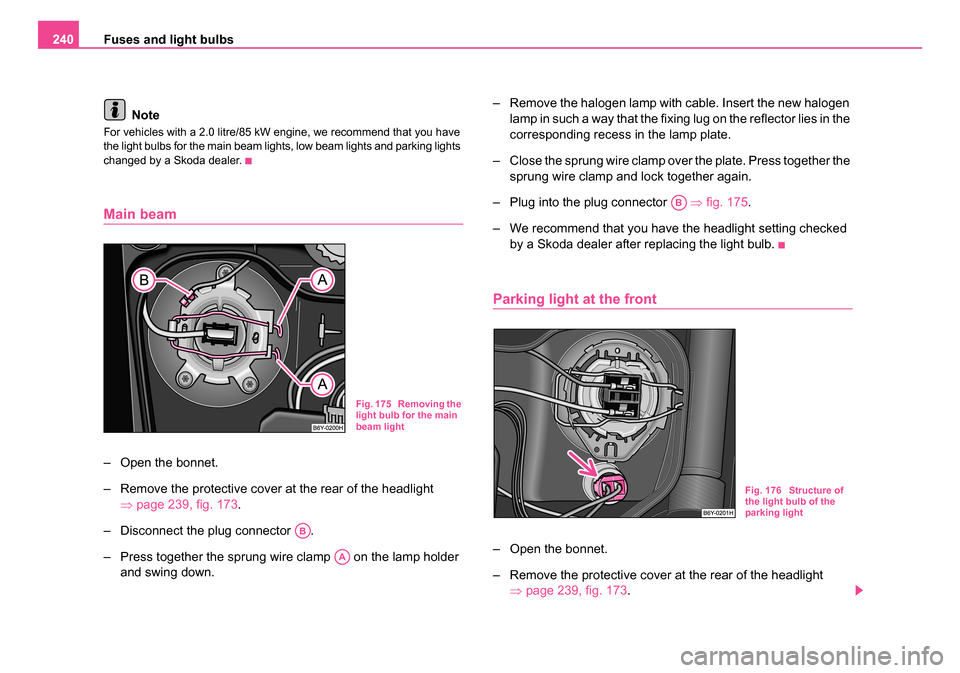
Main beam
– Open the bonnet.
– Remove the protective cover at the rear of the headlight ⇒page 239, fig. 173 .
– Disconnect the plug connector .
– Press together the sprung wire clamp on the lamp holder and swing down. – Remove the halogen lamp with cable. Insert the new halogen
lamp in such a way that the fixing lug on the reflector lies in the
corresponding recess in the lamp plate.
– Close the sprung wire clamp over the plate. Press together the sprung wire clamp and lock together again.
– Plug into the plug connector ⇒fig. 175 .
– We recommend that you have the headlight setting checked by a Skoda dealer after replacing the light bulb.
Parking light at the front
– Open the bonnet.
– Remove the protective cover at the rear of the headlight ⇒page 239, fig. 173 .
Fig. 175 Removing the
light bulb for the main
beam light
AB
AA
AB
Fig. 176 Structure of
the light bulb of the
parking light
sqc.1.book Seite 240 Mittwoch, 13. April 2005 1:09 13