2005 Seat Leon 5D engine oil
[x] Cancel search: engine oilPage 201 of 280

Checking and refilling levels199
Safety First
Operating instructions
Tips and Maintenance
Te c h n i c a l D a t a
– Pull the dipstick out again and check the oil level ⇒ page 198,
fig. 136.
– Replace the dipstick, pushing it in as far as it will go.The position of the dipstick is shown in the corresponding engine compart-
ment diagram ⇒page 252.
If the oil level is in area ⇒page 198, fig. 136 , do not top up with oil.
If the oil level is in area , you may top up with oil (approx. 0.5 l).
If the oil level is in area , you mu st top up with oil (approx. 1.0 l).
It is normal for the engine to consume a certain amount of oil. Consumption
can be up to 1.0 litres per 1,000 km. For this reason the engine oil level must
be checked at regular intervals, prefer ably when filling the tank and before a
journey.
When the engine is working hard, for instance during sustained high-speed
motorway cruising in summer, when towi ng a trailer or climbing on mountain
passes, the oil level should preferably be kept within area and not above
this.
WARNING
Any work carried out in the engine compartment or on the engine must be
carried out cautiously.•
When working in the engine compartment, always observe the safety
warnings ⇒ page 193.Caution
If the oil level is above the area do not start the engine. This could result
in damage to the engine and catalytic converter. Contact an Authorised
Service Centre.
Topping up engine oil
Top up gradually with small quantities of oil.Before opening the bonnet, read and observe the warnings ⇒ in
“Safety instructions on working in the engine compartment” on
page 193 .
– Unscrew cap from oil filler opening ⇒fig. 137.
– Top-up oil in small amounts, using the correct oil.
– To avoid over-filling with engine oil, you should top-up using small quantities, wait a while and check the oil level before
adding any more oil.
– As soon as the oil level is in area , carefully close the cap.The position of the oil filler openi ng is shown in the corresponding engine
compartment diagram ⇒page 252.
AA
ABAC
AA
AA
Fig. 137 In the engine
compartment: Engine oil
filler cap
AB
leon_ingles Seite 199 Donnerstag, 20. Oktober 2005 12:14 12
Page 202 of 280

Checking and refilling levels
200Engine oil specification ⇒page 196.
WARNING
Oil is highly inflammable! Ensure tha t no oil comes into contact with hot
engine components when topping up.
Caution
If the oil level is above the area do not start the engine. This could result
in damage to the engine and catalytic converter. Contact a qualified work-
shop.
For the sake of the environment
The oil level must never be above area . Otherwise oil can be drawn in
through the crankcase breather and escape into the atmosphere via the
exhaust system.Changing engine oil
The engine oil must be changed at the intervals given in the
service schedule.We recommend that you have the engine oil changed by an Authorised
Service Centre.
The two different oil change intervals are shown in the ⇒Booklet “Service
schedule”.
WARNING
Only change the oil yourself if you have the specialist knowledge required!
•
Before opening the bonnet, read and observe the warnings
⇒ page 193, “Safety instructions on wo rking in the engine
compartment”
.
•
Wait for the engine to cool down. Hot oil may cause burn injuries.
•
Wear eye protection to avoid injuries caused by splashes of oil.
•
When removing the oil drain plug with your fingers, keep your arm hori-
zontal to help prevent oil from running down your arm.
•
Wash your skin thoroughly if it comes into contact with engine oil.
•
Engine oil is poisonous! Used oil must be stored in a safe place out of
the reach of children until it is disposed of.Caution
No additives should be used with engine oil. This could result in engine
damage. Any damage caused by the use of such additives would not be
covered by the factory warranty.
For the sake of the environment
•
Because of the disposal problems, the necessary special tools and
specialist knowledge required, we recommend that you have the engine oil
and filter changed by an Authorised Service Centre.
•
Never pour oil down drains or into the ground.
•
Use a suitable container when draining the used oil. It has to be large
enough to hold all the engine oil
AA
AA
WARNING (continued)
leon_ingles Seite 200 Donnerstag, 20. Oktober 2005 12:14 12
Page 203 of 280

Checking and refilling levels201
Safety First
Operating instructions
Tips and Maintenance
Te c h n i c a l D a t a
CoolantCoolant specifications
Coolant is a mixture of water and at least 40% coolant addi-
tive.The cooling system must be filled with a mixture of water and at least 40 % of
our coolant additive G 12+ or an additive with the specification TT-VW 774 F
(it is dyed purple). This mixture gives the necessary frost protection down to
-25
°C and protects the alloy parts of the cooling system against corrosion. It
also prevents scaling and raises the boiling point of the coolant.
The concentration of coolant must always be at least 40% - even if frost
protection is not required.
If greater frost protection is required in very cold climates, the proportion of
the antifreeze additive G 12+ can be increased. However, the percentage of
coolant additives should not exceed 60%, as this would reduce the frost
protection. It would also reduce the cooling effect. A mixture with 60%
coolant additive will give frost protection to approx. -40
°C.
WARNING
•
The coolant additive is toxic. This represents a toxic danger. Always
keep the coolant additive in the original container which should be stored
out of the reach of children. The same applies to coolant which you have
drained off.
•
The coolant additive G 12+ must be added in sufficient quantities to
provide anti-freeze protection at the coldest ambient temperatures that
can be expected. At extremely cold ambient temperatures, the coolant
could freeze, causing the vehicle to br eakdown. As the heater would also
not work in this situation, there is a risk of suffering exposure!
Caution
•
Other additives may give considerably inferior corrosion protection. The
resulting corrosion in the cooling system can lead to a loss of coolant,
causing serious damage to the engine.
•
The coolant additive G 12+ (purple) can be mixed with the additive G 12
(red) or G 11. Never mix G 12 (red colour) with G 11.
Checking the coolant level and topping up
The correct coolant level is important for fault-free func-
tioning of the engine cooling system.Before opening the bonnet, read and observe the warnings ⇒ in
“Safety instructions on working in the engine compartment” on
page 193 .
Fig. 138 In the engine
compartment: Coolant
expansion tank cap
leon_ingles Seite 201 Donnerstag, 20. Oktober 2005 12:14 12
Page 208 of 280
Checking and refilling levels
206Brake fluidChecking the brake fluid level
The brake fluid is checked at the intervals given in the service
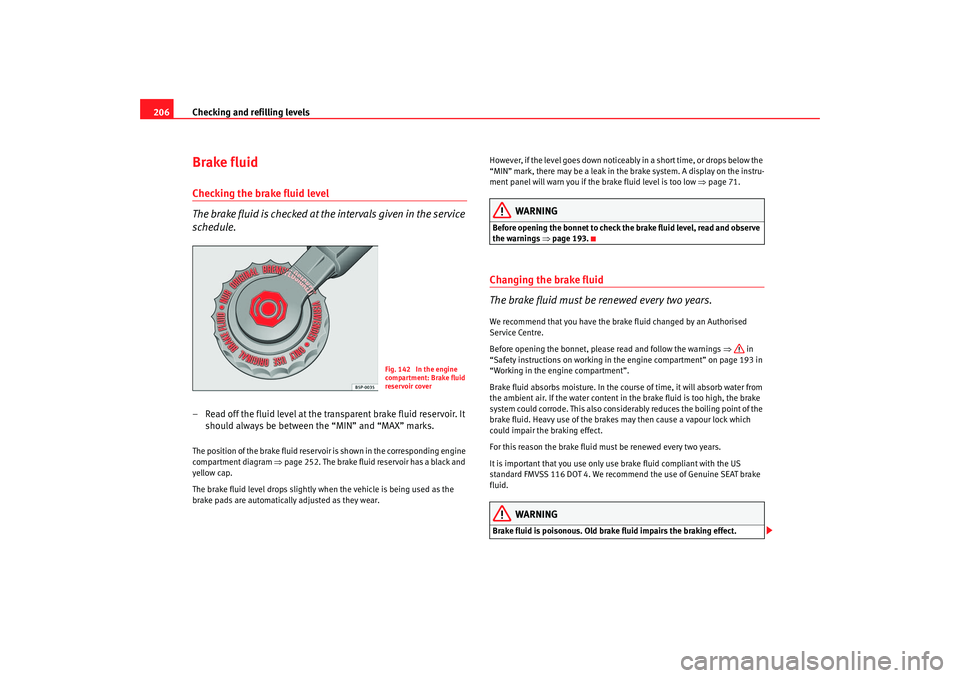
schedule.– Read off the fluid level at the transparent brake fluid reservoir. It
should always be between the “MIN” and “MAX” marks.The position of the brake fluid reservoir is shown in the corresponding engine
compartment diagram ⇒ page 252. The brake fluid reservoir has a black and
yellow cap.
The brake fluid level drops slightly when the vehicle is being used as the
brake pads are automatically adjusted as they wear. However, if the level goes down noticeab
ly in a short time, or drops below the
“MIN” mark, there may be a leak in the brake system. A display on the instru-
ment panel will warn you if the brake fluid level is too low ⇒page 71.
WARNING
Before opening the bonnet to check the brake fluid level, read and observe
the warnings ⇒page 193.Changing the brake fluid
The brake fluid must be renewed every two years.We recommend that you have the brake fluid changed by an Authorised
Service Centre.
Before opening the bonnet, please read and follow the warnings ⇒ in
“Safety instructions on working in the engine compartment” on page 193 in
“Working in the engine compartment”.
Brake fluid absorbs moisture. In the cour se of time, it will absorb water from
the ambient air. If the water content in the brake fluid is too high, the brake
system could corrode. This also consider ably reduces the boiling point of the
brake fluid. Heavy use of the brakes may then cause a vapour lock which
could impair the braking effect.
For this reason the brake fluid must be renewed every two years.
It is important that you use only use brake fluid compliant with the US
standard FMVSS 116 DOT 4. We recommend the use of Genuine SEAT brake
fluid.
WARNING
Brake fluid is poisonous. Old brake fluid impairs the braking effect.
Fig. 142 In the engine
compartment: Brake fluid
reservoir cover
leon_ingles Seite 206 Donnerstag, 20. Oktober 2005 12:14 12
Page 231 of 280

If and when229
Safety First
Operating instructions
Tips and Maintenance
Te c h n i c a l D a t a
11
Vacant
12 Gateway 5
13 Petrol injection module supply
25
Diesel injection module supply 30
14 Coil 20
15 Engine T71 / 20 FSI
5
Pump relay 10
16 ADS pump 30
17 Horn 15
18 Vacant
19 Clean 30
20 Vacant
21 Lambda probe 15
22 Brake pedal, speed sensor 5
23 Engine 1.6, main relay (relay n° 100)
5
T 71 diesel EGR 10
2.0 D2L High-pressure fuel pump 15
24 ARF, change valve 10
25 Right lighting 40
26 Left lighting 40
1.6 SLP engine 40
1.9 TDI Glow plug relay 50
28 KL15 40
Number
Electrical equipment Amperes
leon_ingles Seite 229 Donnerstag, 20. Oktober 2005 12:14 12
Page 254 of 280

Technical Data
252Te c h n i c a l D a t aChecking fluid levelsFrom time to time, the different fluid levels in the vehicle must
be checked. Never fill with incorrect fluids, to do so may cause
serious damage to the engine.
Radiator expansion tank
Windscreen washer fluid reservoir
Engine oil filler cap
Engine oil dipstick
Brake fluid reservoir
Vehicle battery (underneath the cover)
The checking and replenishment of the service fluids are carried out on the
components mentioned above. These operations are described in the
⇒ page 193. Overview
Further explanations, instructions and restrictions on the technical data are
contained as of
⇒page 247.
Fig. 175 Diagram for the
location of the various
elements
A1A2A3A4A5A6
leon_ingles Seite 252 Donnerstag, 20. Oktober 2005 12:14 12
Page 256 of 280

Technical Data
254Weights
Trailer weights
Engine oil capacityPetrol engine 2.0l 110 kW (150 bhp)General engine data Gross vehicle weight
in kg 1783
Weight in working order (with driver) in kg 1280/ 1395
Gross axle weight, front in kg 936
Gross axle weight, rear in kg 890
Permitted roof load in kg 75
With no brakes, gradients up to 12% 640
With brakes, gradients up to 12% 1200
Engine oil capacity with oil filter change. 4.8 litres
Power output in kW (bhp) rpm 110 (150)/ 6000
Maximum torque in Nm at rpm 200/ 3500
No. of cylinders, capacity in cm
3
4/ 1984
Compression 11.5-0.5
Fuel Super Plus unleaded 98 RON or Premium unleaded 95 RON
a)
a)Slight power loss
leon_ingles Seite 254 Donnerstag, 20. Oktober 2005 12:14 12
Page 257 of 280

Technical Data255
Safety First
Operating instructions
Tips and Maintenance
Te c h n i c a l D a t a
Performance figures
Consumption (litres/100 km)/ CO
2 (g/km)
Weights
Trailer weights
Engine oil capacity Maximum speed
in km/h 210
Acceleration from 0-80 km/h in sec. 6.0
Acceleration from 0-100 km/h in sec. 8.8
Urban cycle 11.1/26611.3/271
Extra urban cycle 6.1/1466.4/151
Combined 7.9/1908.2/197
Gross vehicle weight in kg 1830
Weight in working order (with driver) in kg 1335 /1442
Gross axle weight, front in kg 989
Gross axle weight, rear in kg 883
Permitted roof load in kg 75
With no brakes, gradients up to 12% 660
With brakes, gradients up to 12% 1400
Engine oil capacity with oil filter change. 5.3 litres
leon_ingles Seite 255 Donnerstag, 20. Oktober 2005 12:14 12