2005 Seat Leon 5D brake fluid
[x] Cancel search: brake fluidPage 196 of 280

Checking and refilling levels
194
WARNING
All work on the engine or in the engine compartment, e.g. checking and
refilling fluids, involves the danger of injury and scalding as well as the risk
of accident or fire.•
Never open the bonnet if you see steam, smoke or coolant escaping
from the engine compartment. Otherwise, there is a risk of sustaining
burns. Wait until no more steam or coolant is emitted, then allow the
engine to cool before carefully opening the bonnet.
•
Switch off the engine and remove the key from the ignition.
•
Apply the handbrake and move the gea r stick to neutral or selector
lever to position P.
•
Keep children away from the vehicle.
•
Never touch hot engine parts. There is a risk of burns.
•
Never spill liquids on a hot engine or on a hot exhaust gas system. This
is a fire hazard.
•
Avoid causing short-circuits in the electrical system, particularly at the
points where the jump leads are attached ⇒page 241. The battery could
explode.
•
Never touch the radiator fan. It is temperature controlled and could
start automatically, even when the engine has been switched off and the
key removed from the ignition!
•
Do not unscrew the cap on the expansion tank when the engine is hot.
If the coolant is hot, the cooling system will be pressurised!
•
Protect face, hands and arms by covering the cap with a large, thick
cloth to protect against escaping coolant and steam.
•
Always make sure you have not left any objects, such as cleaning cloths
and tools, in the engine compartment.
•
If you have to work underneath the vehicle, you must use suitable
stands additionally to support the vehicl e, there is a risk of accident! A
hydraulic jack is insufficient for securing the vehicle and there is a risk of
injury.
•
If any work has to be performed when the engine is started or with the
engine running, there is an additional, potentially fatal, safety risk from the
rotating parts, such as the drive belt s, alternator, radiator fan, etc., and
from the high-voltage ignition system. You should also observe the
following points:
−Never touch the electrical wiring of the ignition system.
− Ensure that jewellery, loose clothing and long hair do not get
trapped in rotating engine parts. Danger of death. Before starting any
work remove jewellery, tie back and cover hair, and wear tight-fitting
clothes.
− Always think carefully about pressing the accelerator if a gear is
engaged in either an automatic or manual gearbox. The vehicle could
move, even if the handbrake is applied. Danger of death.
•
If work has to be carried out on the fuel system or on electrical compo-
nents, you must observe the following safety notes in addition to the above
warnings:
−Always disconnect the battery. The vehicle must be unlocked when
this is done, otherwise the alarm will be triggered.
− Do not smoke.
− Never work near naked flames.
− Always have a fire extinguisher on hand.Caution
When changing or topping up service fluids, make absolutely certain that you
fill the fluids into the correct reservoirs. Failure to observe this point will result
in serious malfunctions and engine damage!
WARNING (continued)
leon_ingles Seite 194 Donnerstag, 20. Oktober 2005 12:14 12
Page 208 of 280
Checking and refilling levels
206Brake fluidChecking the brake fluid level
The brake fluid is checked at the intervals given in the service
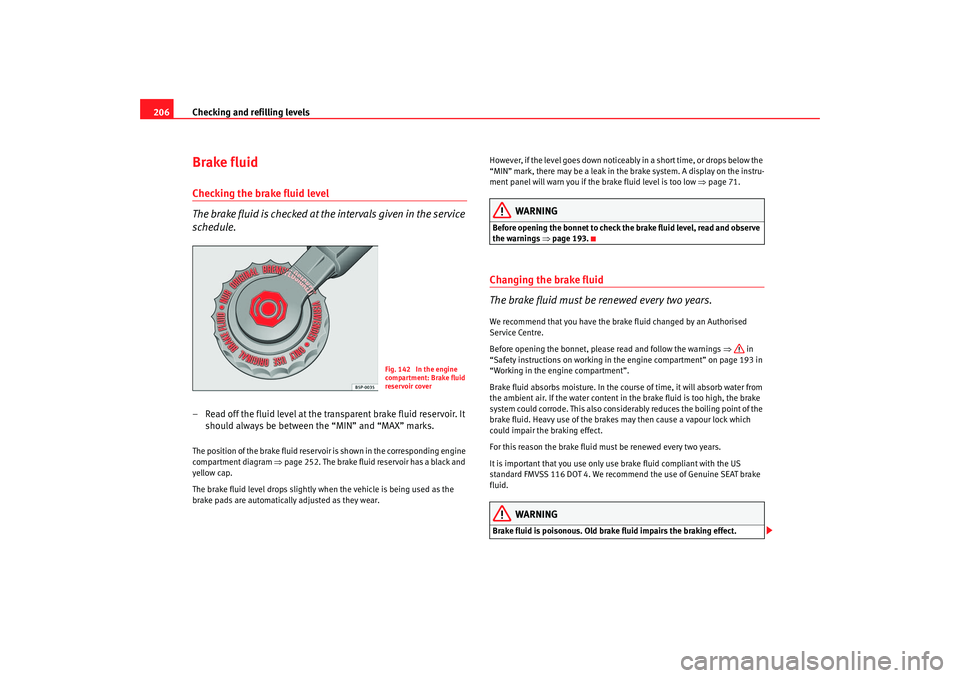
schedule.– Read off the fluid level at the transparent brake fluid reservoir. It
should always be between the “MIN” and “MAX” marks.The position of the brake fluid reservoir is shown in the corresponding engine
compartment diagram ⇒ page 252. The brake fluid reservoir has a black and
yellow cap.
The brake fluid level drops slightly when the vehicle is being used as the
brake pads are automatically adjusted as they wear. However, if the level goes down noticeab
ly in a short time, or drops below the
“MIN” mark, there may be a leak in the brake system. A display on the instru-
ment panel will warn you if the brake fluid level is too low ⇒page 71.
WARNING
Before opening the bonnet to check the brake fluid level, read and observe
the warnings ⇒page 193.Changing the brake fluid
The brake fluid must be renewed every two years.We recommend that you have the brake fluid changed by an Authorised
Service Centre.
Before opening the bonnet, please read and follow the warnings ⇒ in
“Safety instructions on working in the engine compartment” on page 193 in
“Working in the engine compartment”.
Brake fluid absorbs moisture. In the cour se of time, it will absorb water from
the ambient air. If the water content in the brake fluid is too high, the brake
system could corrode. This also consider ably reduces the boiling point of the
brake fluid. Heavy use of the brakes may then cause a vapour lock which
could impair the braking effect.
For this reason the brake fluid must be renewed every two years.
It is important that you use only use brake fluid compliant with the US
standard FMVSS 116 DOT 4. We recommend the use of Genuine SEAT brake
fluid.
WARNING
Brake fluid is poisonous. Old brake fluid impairs the braking effect.
Fig. 142 In the engine
compartment: Brake fluid
reservoir cover
leon_ingles Seite 206 Donnerstag, 20. Oktober 2005 12:14 12
Page 209 of 280

Checking and refilling levels207
Safety First
Operating instructions
Tips and Maintenance
Te c h n i c a l D a t a
•
Before opening the bonnet to check the brake fluid level, read and
observe the warnings ⇒page 193.
•
Brake fluid should be stored in the closed original container in a safe
place out of reach of children. This represents a toxic danger.
•
Have the brake fluid changed every two years at the latest. Heavy use
of the brakes may cause a vapour lock if the brake fluid is left in the system
for too long. This would seriously affect the efficiency of the brakes and the
safety of the vehicle. This may be an accident risk.Caution
Brake fluid could damage the paintwork. Wipe off any brake fluid from the
paintwork immediately.
For the sake of the environment
Brake fluid must be drained and disposed of in the proper manner observing
environmental regulations.
BatteryWarnings on handling the battery
WARNING
Always be aware of the danger of injury and chemical burns as well as the
risk of accident or fire when working on the battery and the electrical
system:•
Wear eye protection. Protect your eyes , skin and clothing from acid and
particles containing lead.
•
Battery acid is very corrosive and caustic. Wear protective gloves and
eye protection. Do not tilt the batter ies. This could spill acid through the
vents. Rinse battery acid from eyes immediately for several minutes with
clear water. Then seek medical care immediately. Neutralize any acid
splashes on the skin or clothing with a soapy solution, and rinse off with
plenty of water. If acid is swallowed by mistake, consult a doctor immedi-
ately.
•
Fires, sparks, naked lights and smoki ng are prohibited. When handling
cables and electrical equipment, avoid causing sparks and electrostatic
WARNING (continued)
Wear eye protection
Battery acid is very corrosive and caustic. Wear protec-
tive gloves and eye protection!
Fires, sparks, naked lights and smoking are prohibited!
A highly explosive mixture of gases is released when the
battery is under charge.
Keep children away from acid and batteries!
leon_ingles Seite 207 Donnerstag, 20. Oktober 2005 12:14 12
Page 214 of 280

Checking and refilling levels
212
WARNING
There is a serious danger of accidents if a tyre bursts during driving!•
The tyres must be replaced at the latest when the tread is worn down to
the tread wear indicators. Failure to do so could result in an accident. Worn
tyres do not grip well at high speeds on wet roads. There is also a greater
risk of “aquaplaning”.
•
At continuously high speeds, a tyre with insufficient pressure flexes
more. This causes it to overheat. This can cause tread separation and tyre
blow-out. Risk of accident. Always observe the recommended tyre pres-
sures.
•
If tyres show excessive wear, you should have the running gear checked
by an Authorised Service Centre.
•
Keep chemicals such as oil, fuel and brake fluid away from tyres.
•
Damaged wheels and tyres must be replaced immediately!For the sake of the environment
Under-inflated tyres will increase fuel consumption.New tyres and wheels
New tyres and wheels have to be run-in.The tyres and wheel rims are an essenti al part of the vehicle's design. The
tyres and rims approved by SEAT are specially matched to the characteristics
of the vehicle and make a major contribution to good road holding and safe
handling ⇒.
Tyres should be replaced at least in pairs and not individually (i.e. both front
tyres or both rear tyres together). A kn owledge of tyre designations makes it easier to choose the correct tyres. Radial tyres have the tyre designations
marked on the sidewall, for example:
195/65 R15 91T
This contains the following information:
195 Tyre width in mm
65 Height/width ratio in %
R Tyre construction: Radial
15 Rim diameter in inches
91 Load rating code
T Speed rating
The tyres could also have the following information:
•
A direction of rotation symbol
•
“Reinforced” denotes heavy-duty tyres.
The manufacturing date is also indicate d on the tyre sidewall (possibly only
on the inner side of the wheel).
“DOT ... 1103 ...” means, for example, that the tyre was produced in the 11th
week of 2003.
We recommend that work on tyres and wheels is carried out by an Authorised
Service Centre. They are familiar with the procedure and have the necessary
special tools and spare parts as well as the proper facilities for disposing of
the old tyres.
Any Authorised Service Centre has full information on the technical require-
ments when installing or changing tyres, wheels or wheel trims.
WARNING
•
We recommend that you use only wheels and tyres which have been
approved by SEAT for your model. Failure to do so could impair vehicle
handling. Risk of accident.
leon_ingles Seite 212 Donnerstag, 20. Oktober 2005 12:14 12
Page 254 of 280

Technical Data
252Te c h n i c a l D a t aChecking fluid levelsFrom time to time, the different fluid levels in the vehicle must
be checked. Never fill with incorrect fluids, to do so may cause
serious damage to the engine.
Radiator expansion tank
Windscreen washer fluid reservoir
Engine oil filler cap
Engine oil dipstick
Brake fluid reservoir
Vehicle battery (underneath the cover)
The checking and replenishment of the service fluids are carried out on the
components mentioned above. These operations are described in the
⇒ page 193. Overview
Further explanations, instructions and restrictions on the technical data are
contained as of
⇒page 247.
Fig. 175 Diagram for the
location of the various
elements
A1A2A3A4A5A6
leon_ingles Seite 252 Donnerstag, 20. Oktober 2005 12:14 12
Page 271 of 280

Index269
Index
AABS . . . . . . . . . . . . . . . . . . . . . . . . . . . . . . . . . . . 166
Warning lamp . . . . . . . . . . . . . . . . . . . . . . . . . 77
Accessories . . . . . . . . . . . . . . . . . . . . . . . . . . . . 186
Acoustic signal . . . . . . . . . . . . . . . . . . . . . . . . . . 20
Acoustic warning . . . . . . . . . . . . . . . . . . . . . . . . 148
Adjusting headlights driving on the left . . . . . . . . . . . . . . . . . . . . 172
driving on the right . . . . . . . . . . . . . . . . . . . 172
Adjusting the seat belt height . . . . . . . . . . . . . . 27
Air conditioner* 2C-Climatronic* . . . . . . . . . . . . . . . . . . . . . . 141
Air conditioning system General notes . . . . . . . . . . . . . . . . . . . . . . . . 145
Air conditioning* . . . . . . . . . . . . . . . . . . . . . . . . 138
Air recirculation mode 2C-Climatronic . . . . . . . . . . . . . . . . . . . . . . . 144
Manual air conditioner . . . . . . . . . . . . . . . . 140
Airbag covers . . . . . . . . . . . . . . . . . . . . . . . . . . . . 36
Airbag system . . . . . . . . . . . . . . . . . . . . . . . . . . . 30 Curtain airbags . . . . . . . . . . . . . . . . . . . . . . . 42
front airbags . . . . . . . . . . . . . . . . . . . . . . . . . . 34
Side airbags . . . . . . . . . . . . . . . . . . . . . . . . . . 38
Warning lamp . . . . . . . . . . . . . . . . . . . . . . . . . 31 Airbags
Care . . . . . . . . . . . . . . . . . . . . . . . . . . . . . . . . 32
Disposal . . . . . . . . . . . . . . . . . . . . . . . . . . . . . 32
Safety notes . . . . . . . . . . . . . . . . . . . . . . . . . . 32
Alarm system Switching off . . . . . . . . . . . . . . . . . . . . . . . . 100
Alterations to the vehicle . . . . . . . . . . . . . . . . . 186
Alternator Warning lamp . . . . . . . . . . . . . . . . . . . . . . . . . 78
Ambient temperature display . . . . . . . . . . . . . . . 63
Anti-freeze . . . . . . . . . . . . . . . . . . . . . . . . . . . . . 201
Anti-lock brake system . . . . . . . . . . . . . . . . . . . 166 Warning lamp . . . . . . . . . . . . . . . . . . . . . . . . . 77
Anti-theft alarm system . . . . . . . . . . . . . . . . . . . 100 Switching off . . . . . . . . . . . . . . . . . . . . . . . . 100
Anti-theft wheel bolts . . . . . . . . . . . . . . . . . . . . 219
Aquaplaning . . . . . . . . . . . . . . . . . . . . . . . . . . . 212
Ashtray* . . . . . . . . . . . . . . . . . . . . . . . . . . . . . . . 130
Aspects to take into account before starting the vehicle . . . . . . . . . . . . . . . . . . . . . . . . . . . . . . 8
Automatic anti-dazzle interior mirror* Activating the anti-dazzle function . . . . . . 121
Deactivating anti-dazzle function . . . . . . . . 121
Automatic car washes . . . . . . . . . . . . . . . . . . . . 178
Automatic gearbox / DS G automatic gearbox . 153
Automatic lighting . . . . . . . . . . . . . . . . . . . . . . . 110
Automatic mode 2C-Climatronic . . . . . . . . . . . . . . . . . . . . . . . 142 Automatic wiper/wash function for the rear window
119
BBall coupling . . . . . . . . . . . . . . . . . . . . . . . . . . . 174
BAS . . . . . . . . . . . . . . . . . . . . . . . . . . . . . . . . . . . 165
Battery
Changing . . . . . . . . . . . . . . . . . . . . . . . . . . . 209
Charging . . . . . . . . . . . . . . . . . . . . . . . . . . . . 209
Winter conditions . . . . . . . . . . . . . . . . . . . . 207
Before starting the vehicle . . . . . . . . . . . . . . . . . . 8
Belt tension device Disposal . . . . . . . . . . . . . . . . . . . . . . . . . . . . . 28
Warning lamp . . . . . . . . . . . . . . . . . . . . . . . . 31
Belt tension devices . . . . . . . . . . . . . . . . . . . . . . 28
Biodiesel . . . . . . . . . . . . . . . . . . . . . . . . . . . . . . 192
Bonnet . . . . . . . . . . . . . . . . . . . . . . . . . . . . . . . . 195
Brake assist system . . . . . . . . . . . . . . . . . . . . . 165
Brake fluid . . . . . . . . . . . . . . . . . . . . . . . . . . . . . 206 Brake fluid . . . . . . . . . . . . . . . . . . . . . . . . . . . 64
Changing . . . . . . . . . . . . . . . . . . . . . . . . . . . 206
Brake pad wear indicator* Indicator . . . . . . . . . . . . . . . . . . . . . . . . . . . . . 81
Brake pads . . . . . . . . . . . . . . . . . . . . . . . . . . . . . 169
Brake servo . . . . . . . . . . . . . . . . . . . . . . . 165, 169
Brake system . . . . . . . . . . . . . . . . . . . . . . . . . . . 206 Warning lamp . . . . . . . . . . . . . . . . . . . . . . . . 76
leon_ingles Seite 269 Donnerstag, 20. Oktober 2005 12:14 12