2005 Seat Leon 5D air condition
[x] Cancel search: air conditionPage 141 of 280
Heating, ventilation and air conditioning139
Safety First
Operating instructions
Tips and Maintenance
Te c h n i c a l D a t a
Note
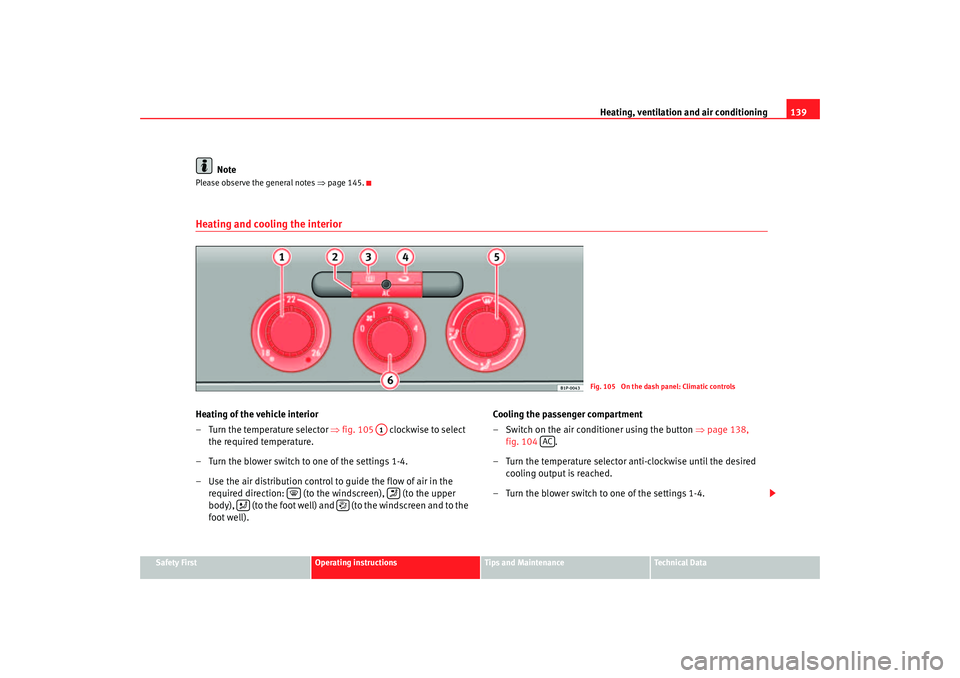
Please observe the general notes ⇒page 145.Heating and cooling the interiorHeating of the vehicle interior
– Turn the temperature selector ⇒fig. 105 clockwise to select
the required temperature.
– Turn the blower switch to one of the settings 1-4.
– Use the air distribution control to guide the flow of air in the required direction: (to the windscreen), (to the upper
body), (to the foot well) and (to the windscreen and to the
foot well). Cooling the passenger compartment
– Switch on the air conditioner using the button
⇒page 138,
fig. 104 .
– Turn the temperature selector anti-clockwise until the desired cooling output is reached.
– Turn the blower switch to one of the settings 1-4.
Fig. 105 On the dash panel: Climatic controls
A1
AC
leon_ingles Seite 139 Donnerstag, 20. Oktober 2005 12:14 12
Page 142 of 280

Heating, ventilation and air conditioning
140
– Use the air distribution control to guide the flow of air in the required direction: (to the windscreen), (to the upper
body), (to the foot well) and (to the windscreen and to the
foot well).Heating system
Maximum heat output, which is needed to defrost the windows quickly, is
only available when the engine has reached its operating temperature.
Air conditioner
When the air conditioning system is switched on, not only the temperature,
but also the air humidity in the vehicle interior is reduced. This improves comfort for the vehicle occupants and prevents misting of the windows when
the ambient air humidity is high.
If the air conditioning system cannot be switched on this may be caused by
the following reasons:
•
The engine may not be running.
•
The blower is switched off.
•
The ambient air temperature is lower than +3° C.
•
The air conditioning system compressor has been temporarily switched
off because the engine coolant temperature is too high.
•
The air conditioner fuse is faulty.
•
Another fault in the vehicle. Have the air conditioner checked by a quali-
fied workshop.
Air recirculation mode
Air recirculation mode prevents fumes or unpleasant smells from entering the vehicle.
Fig. 106 On the dash panel: Climatic controls
leon_ingles Seite 140 Donnerstag, 20. Oktober 2005 12:14 12
Page 143 of 280

Heating, ventilation and air conditioning141
Safety First
Operating instructions
Tips and Maintenance
Te c h n i c a l D a t a
Air recirculation mode
⇒page 140, fig. 106 prevents strong odours in
the outside air from entering the vehicle interior, for example when passing
through a tunnel or in queuing traffic.
With low ambient temperatures, the air recirculation increases the effective-
ness of the heating system by heating the air inside the passenger compart-
ment rather than the ambient air.
With high ambient temperatures, the air recirculation increases the effective-
ness of the air cooling system by cooling the air inside the passenger
compartment rather than the ambient air. For reasons of safety, air recirculation is
not possible when the control for air
distribution is set to the windscreen setting .
WARNING
In air recirculation mode, no ambient air enters the vehicle interior. If the
air conditioning system is switched off, the windows can quickly mist over.
Therefore, you should never leave the air recirculation mode switched on
for longer periods, as this increases the risk of an accident.
2C-Climatronic*Control switches
The controls allow separate adjustment of air conditioning settings for the left and right.
Fig. 107 On the dash panel: 2C Climatronic controls
leon_ingles Seite 141 Donnerstag, 20. Oktober 2005 12:14 12
Page 144 of 280

Heating, ventilation and air conditioning
142
The air conditioning system only works when the engine is running
and the blower is switched on.
– Press the temperature control buttons ⇒page 141, fig. 107
or in order to adjust the temperature on the left hand side or
the right hand side respectively.
– The functions will be switched on when the buttons are pressed. When these functions are activate d, they are indicated in the
display. Also, the de-icing and re ar heated window functions will
turn on along with their corresponding yellow symbol. Press the
button again to switch off the function.The temperature can be adjusted separately for the left and right sides of the
vehicle interior.
Display of the selected interior temperature for the left side.
Button – Manual air recirculation mode
Button – Central air distribution
Button – Downward air distribution
Button – Upward air distribution
Display of the selected interior temperature for the right side.
Button – defrost function for the windscreen. The air drawn in from
outside the vehicle is directed at the windscreen. The air recirculation
mode, if switched on, will be switched off as soon as the defrost function
is switched on. At temperatures over 3° C, the air conditioning system
will be switched on automatically and the blower speed will be increased
by one level in order to dry the air. The button lights up yellow and the
symbol appears in the display.
Button – Rear window heating. The heating will be switched off auto-
matically approximately 20 minutes after switching on. However, it may
be turned off by pushing the button. Th e button lights up yellow and the
symbol appears in the display.
Temperature selector for the left side ⇒page 142 Blower control
⇒page 143
Button – Switches the 2C-Climatronic on and off ⇒page 143
Button – Automatic temperature, ventilation and air distribution
control ⇒page 142
Button – Switches air conditioning system off
Temperature selector for the right side ⇒page 142
WARNING
For road safety all windows must be clear of ice, snow, and condensation.
This is essential to ensure good visibility. Please familiarise yourself with
the correct operation of the heating and ventilation system, including the
anti-fog/defrost functions for the windows.
Note
Please observe the general notes ⇒page 145.Automatic mode
In automatic mode air temperatur e, air flow and distribution
are automatically regulated so that a specified temperature is
attained as quickly as possible and then maintained.The temperature can be adjusted separately for the left and right
sides of the vehicle interior.
Switching on automatic mode
– Press the button ⇒page 141, fig. 107 . “AUTO” is shown
on the display.
A9
A14
A1A2
A3
A4
A5
A6A7
A8
A9
A10A11
OFF
A12
AUTO
A13
ECON
A14
AUTO
leon_ingles Seite 142 Donnerstag, 20. Oktober 2005 12:14 12
Page 145 of 280

Heating, ventilation and air conditioning143
Safety First
Operating instructions
Tips and Maintenance
Te c h n i c a l D a t a
– Press temperature selectors to set the desired temperatures for
the left and right sides of the interior. We recommend 22°C
(72°F).A comfortable interior climate is quickly reached when a temperature of
+22° C (72° F) is set in automatic mode. It can be changed as necessary to
suit individual preferences or particular circumstances. It is possible to select
interior temperatures from +16° C (6 1° F) to +29.5° C (86° F). These are
approximate temperatures and the actual temperature may be slightly higher
or lower depending on the ambient conditions. Climatronic maintains a constant temperature level fully automatically. The
temperature of the air supplied to the interior, the blower speed and the air
distribution are regulated automatically. The system also allows for the effect
of strong sunlight, so there is no n
eed for manual adjustment. Therefore,
automatic mode provides the best comfort for the vehicle occupants in virtu-
ally all conditions throughout the year.
Automatic mode is switched off whenever an adjustment is made using the
buttons for the air distribution, air flow or . The temperature will
continue to be regulated within the parameters manually selected by the
user.Manual mode
In manual mode you can adjust the air temperat ure, air flow and distribution as required.Switching on manual mode
– To enter manual mode, press one of the buttons ⇒fig. 108 to , or press the air flow control . The symbol will
disappear from the display.
ECON
Fig. 108 On the dash panel: 2C Climatronic controls
A3
A5
ECON
A10
AUTO
leon_ingles Seite 143 Donnerstag, 20. Oktober 2005 12:14 12
Page 146 of 280

Heating, ventilation and air conditioning
144Temperature
There are separate temperature selectors for the left and right sides of the
vehicle interior. The selected temperatur e is displayed above the selector. It
is possible to select interior temper atures from +16° C (61° F) to +29.5° C
(86° F). These are approximate temperat ures and the actual temperature may
be slightly higher or lower depending on the ambient conditions.
If a temperature below 16° C (61° F) is selected, the display switches to LO. In
this setting the system runs at maximum cooling output and the temperature
is not regulated.
If a temperature above 29.5 °C (86 °F) is selected the display switches to HI.
In this setting the system runs at maximum heating output and the tempera-
ture is not regulated.
Blower
The air flow may be adjusted freely using the control . Always have the
blower running at a low setting to ensure a constant flow of fresh air into the
vehicle. Pushing the button
to the minimum -1, turns the Climatronic off.
Air distribution
The air distribution is adjusted using the buttons , and . It is also
possible to open and close some of the air vents separately.
Switching the air conditioning system on and off
Pressing the button switches off th e air conditioning system to save
fuel. The temperature continues to be regulated. The set temperature can
then only be reached if it is higher than the ambient temperature.
Air recirculation mode
Air recirculation mode prevents fumes or unpleasant smells
from entering the vehicle.– Press the button ⇒page 143, fig. 108 to switch air recir-
culation mode on or off. It is sw itched on if the following symbol
appears in the display
.
Air recirculation mode pr events strong odours in the ambient air from
entering the vehicle interior, for example when passing through a tunnel or in
queuing traffic.
With low ambient temperatures, the air recirculation increases the effective-
ness of the heating system by heating the air inside the passenger compart-
ment rather than the ambient air.
With high ambient temperatures, the ai r recirculation increases the effective-
ness of the air conditioning system by cooling the air inside the passenger
compartment rather than the ambient air.
For reasons of safety, air recirculation is not possible when the control for air
distribution is set to the windscreen setting
.
WARNING
In air recirculation mode, no ambient air enters the vehicle interior. If the
air conditioning system is switched off, the windows can quickly mist over.
Therefore, you should never leave the air recirculation mode switched on
for longer periods, as this increases the risk of an accident.
A10
ECON
A2
leon_ingles Seite 144 Donnerstag, 20. Oktober 2005 12:14 12
Page 147 of 280

Heating, ventilation and air conditioning145
Safety First
Operating instructions
Tips and Maintenance
Te c h n i c a l D a t a
General notesThe pollen filter
The pollen filter (a combined particle filter and active carbon filter) serves
as a barrier against impurities in the ambient air, including dust and pollen.
For the air conditioning system to work with maximum efficiency, the pollen
filter must be replaced at the intervals specified in the Service Schedule.
If the filter loses efficiency prematurely due to use in areas with very high
levels of air pollution, the pollen filter must be changed more frequently than
stated in the Service Schedule.
Caution
•
If you suspect that the air conditioner is damaged, switch off the air condi-
tioner with button to prevent further damage and have it checked by a
qualified workshop.
•
Repairs to the air conditioning system require specialist knowledge and
special tools. Therefore, we recommend that you take the vehicle to a quali-
fied workshop should problems occur.Note
•
If the humidity and temperature outside the vehicle are high, condensa-
tion can drip off the evaporator in the cooling system and form a pool under-
neath the vehicle, this is completely normal and there is no need to suspect
a leak.
•
Keep the air intake slots in front of the windscreen free of snow, ice and
leaves to ensure heating and cooling is not impaired, and to prevent the
windows misting over.
•
The air from the vents flows through the passenger compartment and is
extracted by slots designed for this purpose. Do not cover these slots with
articles of clothing or other objects.
•
The air conditioning system operates most effectively with the windows
and the sliding/tilting roof* closed. However, if the sun has heated up the
vehicle, the air inside can be cooled more quickly by opening the windows for
a short period.
•
Do not smoke while air recirculation mode is on, as smoke drawn into the
air conditioning system leaves a residue on the evaporator, producing a
permanent unpleasant odour.
ECON
leon_ingles Seite 145 Donnerstag, 20. Oktober 2005 12:14 12
Page 161 of 280

Driving159
Safety First
Operating instructions
Tips and Maintenance
Te c h n i c a l D a t a
•
Depending on weather conditions, it may become extremely hot or cold
inside the vehicle. This can be fatal.
Acoustic parking aid system*Rear parking aid
The parking aid system will use an acoustic signal to warn of
the approach of any object towards the rear of the vehicle.Description
The acoustic parking aid system will measure the distance between the rear
of the vehicle and any possible obstacle using four ultrasonic sensors located
on the rear bumper. The measuring range of the sensors starts at approxi-
mately and depending on the nature of the obstacle at a distance of:•
side of the rear bumper: 0.8 m
•
centre of the rear bumper: 1.3 m
Activation
The system is activated by engagement of the reverse gear. A brief acoustic
signal confirms the activation and correct function of the system.
Reversing
The distance warning will begin as soon as an obstacle is detected by the
system. The frequency of the bleeps emitted by the system will increase
rapidly as the vehicle approaches the obstacle.
Within a short distance of about 25 cm, a continuous signal sounds (stop
signal). The driver should not reverse any further. Trailer towing
For vehicles fitted with a tow bar by the manufacturer, the parking aid system
will not be activated by the engagement of the reverse gear when pulling a
trailer, as the trailer's electric conne
cter will be plugged into the vehicle.
To avoid system malfunctions, when not driving with a trailer, remove the
trailer hitch.
Possible faults
If a continuous bleep sounds for some seconds when the reverse gear is
engaged, this indicates that there is a fault in the parking aid system.
If the fault continues until the ignition is turned off, the acoustic signal
warning of the fault will not be emitted every time the system is reactivated
(by engaging the reverse gear). Thus, the system ready indication will not
sound either. Have the fault repaired by an Authorised Service Centre as soon
as possible.
If there is no ready signal or no acoustic warning signal then the parking aid
loudspeaker is faulty and may not warn of obstacles.
To ensure that the system works properly, the sensors must be kept clean and
free of ice and snow.
WARNING
•
The sensors have blind spots in which obstacles may not be detected.
•
Always look out for small children and animals because the system will
not always detect them. Always pay attention when reversing to avoid acci-
dents.
•
The parking aid is not a replacement for driver awareness. The driver
must take full responsibility for parking and other manoeuvres.
WARNING (continued)
leon_ingles Seite 159 Donnerstag, 20. Oktober 2005 12:14 12